The cost of a GLP tox study is the number every nonclinical budget is built around, and it is also the number with no independent public source: prices for a 13-week repeat-dose study in two species come from the laboratories that sell them, and a seller's price list is a quote, not a benchmark. What can be costed, from figures FDA publishes about its own regulations, is the part that comes after the study — preparing and reading the report. That is the smaller line, and it is where the recoverable risk lives, because an error found before the study director signs costs a comment and an error found afterwards costs an amendment. Botminds' Toxicology Report Review exists for that line: six agents read each draft as it arrives, check the summary against the tables and recompute the exposure margins, and a named toxicologist decides each issue and signs.
Every public figure below is linked to the document it comes from. Figures described as sample data are from a fictional programme, and figures described as targets are design goals, not measured savings.
Four public numbers behind the cost of reporting a nonclinical study
18,075
annual responses FDA estimates under the nonclinical reporting rule — 300 respondents at 60.25 reports each
27.65h
average burden per response for reporting a nonclinical laboratory study
$105.60
FDA's own loaded hourly rate for sponsor, quality assurance and management with executive responsibility
517,849h
total annual reporting burden across the industry, including the quality assurance statement
How much does a GLP tox study cost, and what drives it?
No regulator, journal or standards body publishes a price for a good laboratory practice toxicology study, and the numbers that circulate come from laboratories' own pages. What can be said precisely is what moves the number, because the drivers are the study design itself.
Species and duration dominate: a non-rodent study usually costs more than a rodent study of the same length, animal husbandry runs for the whole in-life phase, and a study must be at least as long as the clinical dosing it supports. Group sizes multiply everything downstream, since each additional animal adds clinical pathology, organ weights, tissue collection and slides. The endpoints bolted on — toxicokinetic sampling, safety pharmacology measurements built into the general study, recovery groups — each add their own stream of work. And the pathology is the long pole: slide preparation, the study pathologist's reading, and peer review where it applies.
One structural feature is worth naming because it shapes the whole business case: almost all of the spend is committed before anybody can act on the result. The animals are ordered, the dosing runs for weeks, the tissues are collected and the slides are read, and only then does a document appear. There is no stage at which a sponsor can spend a little more to make the study better; there is only a stage at which it can read carefully or read quickly.
The report sits at the end of that chain and is usually the cheapest part of it. This is precisely why it is the wrong place to economise. The study has already been paid for by the time anybody reads the draft, and everything that study is worth to a programme passes through a document that one person has a few days to check.
How much does it cost to review a CRO draft report?
This is the number nobody publishes, and it is the one a business case needs. It has three inputs and every one of them is available inside your own building.
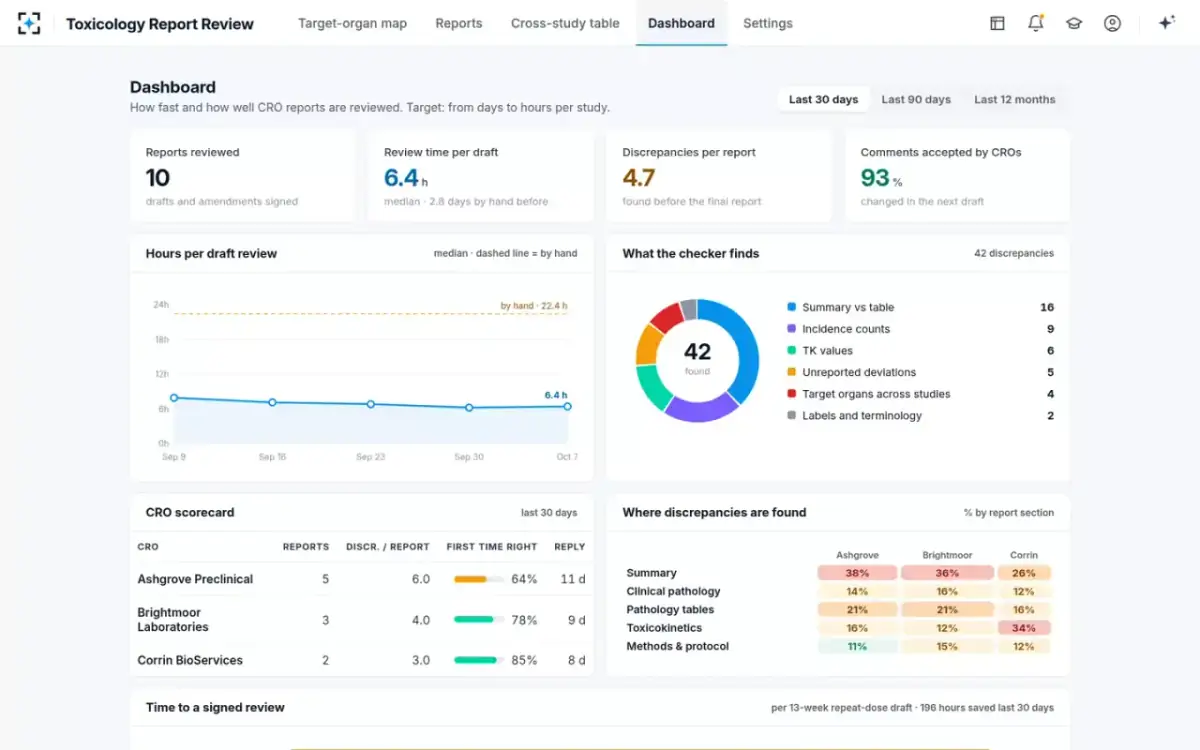
The first is hours per draft. By hand, reviewing one 13-week repeat-dose draft of 300 to 500 pages takes two to four days — our estimate of common practice, not a published figure. On the sample programme used throughout this series the baseline is 22.4 hours a draft, against a design target of 6.4 hours.
The second is the number of drafts. Not studies: drafts. A study produces a draft report, usually a revised draft, sometimes an amendment, and a final — and each version has to be checked against the comments raised on the last one. A programme with eight studies does not generate eight reviews.
The third is the hourly rate, and here a sponsor can borrow a defensible one rather than argue about it, because FDA has published its own.
One warning about measuring the first input. Asking reviewers how long a draft takes produces the time they remember spending on it, which is the deciding time — the part that feels like work. The hours that vanish from memory are the ones spent finding a table, flipping to an appendix and re-reading a sentence to check it against a number three hundred pages away. Those are the hours a system can take, and they are also the hours that get left out of a baseline, which makes the baseline flattering and the eventual comparison meaningless. Measure from calendar time between opening a draft and sending its comments, with interruptions excluded, rather than from recollection.
Hours on one draft report: by hand, FDA's estimate, and Toxicology Report Review's target
How many nonclinical study reports are produced each year?
FDA publishes an estimate, in the notice that renews the Good Laboratory Practice information collection. For the reporting requirement the agency estimates 300 respondents making 60.25 responses each: 18,075 annual responses, at an average of 27.65 hours per response, for 499,774 hours. A further 18,075 hours cover the quality assurance statement, giving 517,849 hours in total (Federal Register, 30 April 2026, Table 1).
Two details decide how much weight that figure can carry. The notice describes the respondents as sponsors of nonclinical laboratory studies supporting applications for research or marketing permits, so the count is of reports in the regulated system rather than of studies run anywhere. And the hours are the burden of the reporting requirement itself — what the regulation makes somebody do to produce a compliant final report — not a sponsor's separate review of a contract laboratory's draft. The notice is specific about what that report must contain:
The GLP regulations require that, for each nonclinical laboratory study, a final report be prepared that documents the results of quality assurance unit inspections, test and control article characterization, testing of mixtures of test and control articles with carriers, and an overall interpretation of nonclinical laboratory studies.
FDA, Federal Register, 30 April 2026
Some eighteen thousand responses a year, each estimated at about twenty-eight hours, is a useful order of magnitude for a business case. It says the document at the end of a study is not a formality: it is most of a working week of somebody's time, and on the sample baseline the sponsor who receives a draft spends a comparable 22 hours reading it.
What an hour of this work is worth, on FDA's wage basis
FDA's economists had to value the same hours when they costed the proposed revision of the good laboratory practice rule, and their method is reusable. They took median wages from the Bureau of Labor Statistics for the relevant manufacturing sectors, and then doubled them: "before calculating the estimated labor cost we multiply the reported wage rate by 2 — a commonly used multiplier — to adjust the median hourly wage rate for benefits and overhead" (FDA Economics Staff, August 2016).
The resulting rates are stated plainly: "hourly median wage rate for sponsor, QAU, and management with executive responsibility is $105.60, $79.80 for contributing scientists or principal investigators, and $28.84 for clerical assistants". The $105.60 is twice a $52.80 management wage drawn from 2014 data, so a sponsor using it in 2026 should uprate it rather than quote it as current; what is durable is the method, not the figure.
Using an agency's own rate has a quiet advantage in an internal business case: it moves the argument off whose assumption is right. If finance disputes the number, the dispute is with FDA's wage basis and its doubling convention, both of which are published.
Two lines a business case needs, with every input named
Hours on one draft
H
Measured on your last ten drafts by the people who actually review them — not estimated in a meeting.
you measure this
Loaded hourly rate
R = 2 × median wage
FDA's own convention: double the median wage for benefits and overhead. Its figure for sponsor, quality assurance and management is $105.60 on a 2014 wage base.
FDA, 2016
Cost of one draft review
H × R
At the sample baseline of 22.4 hours and $105.60 an hour, about $2,365 a draft; at the 6.4-hour target, about $676. Our arithmetic on a sample figure and a target.
the auditable line
Cost of one amendment
(Hs + Hq + Hr) × R + delay
Study director, quality assurance and sponsor hours to correct a signed report, plus whatever the programme waits for while it happens.
the line nobody tracks
What does an error in a study report cost?
It depends entirely on when it is found, and the step change is the study director's signature. Before it, an error is a numbered comment in a letter and a correction in the next draft version — a few hours of somebody's attention on both sides. After it, the report is a signed document and correcting it is a formal act.
There is a third possibility that budgets never carry, and it is the expensive one: the error that is not found at all, and that propagates. A figure quoted from the wrong sampling day travels from the summary into the sponsor's cross-study table, from there into the investigator's brochure, and from there into a dose-escalation argument. Each hop makes it more expensive to unpick, and the last hop puts it in front of people whose decisions are about dosing humans.
The inspection system is explicit that a report's reliability is what is at stake. Among the reasons FDA inspects nonclinical laboratories is "verifying the results from third party audits or sponsor audits submitted to FDA for consideration in determining whether to accept or reject questionable or suspect studies" (FDA Compliance Program 7348.808). A study can be rejected. That is the ceiling on what an error in a report can cost, and it is a long way above an amendment.
Toxicology Report Review's dashboard: hours per draft against the by-hand baseline, and what the checker finds
What does a GLP report amendment involve?
It is a defined act with a defined author. Under the reporting rule, corrections or additions to a final report take the form of an amendment by the study director, which must identify the part of the report being corrected and the reasons for it, and be signed and dated by the person responsible (21 CFR 58.185). Nothing about that is casual: it is a change to a document already in the regulatory system, and it announces itself.
The work around it is what costs. The laboratory re-opens the report and re-issues it; its quality assurance unit revisits what it inspected; the sponsor re-checks everything downstream that used the old value — the cross-study table, the brochure section, any submission text already drafted. Where the correction touches pathology the chain is longer still, because changed histopathology diagnoses after signature are themselves a reason for the study director to amend the report.
There is a quieter cost in the same place, and it is the one sponsors feel most. An amendment arrives weeks after the programme has moved on. Whoever has to absorb it is in the middle of something else, the people who knew the study have been reassigned, and the value being corrected has already been quoted in two other documents. The hours are not the problem; the re-entry is.
An amendment is also visible. A reviewer at an agency sees that a study was corrected, and a correction that moves a no-adverse-effect level or a target organ invites a closer look at everything else in the package. That is not a penalty; it is simply the cost of having published a number twice.
The cost model, with the row a finance partner will ask about first
| Row | Where the number comes from | What this series can show |
|---|---|---|
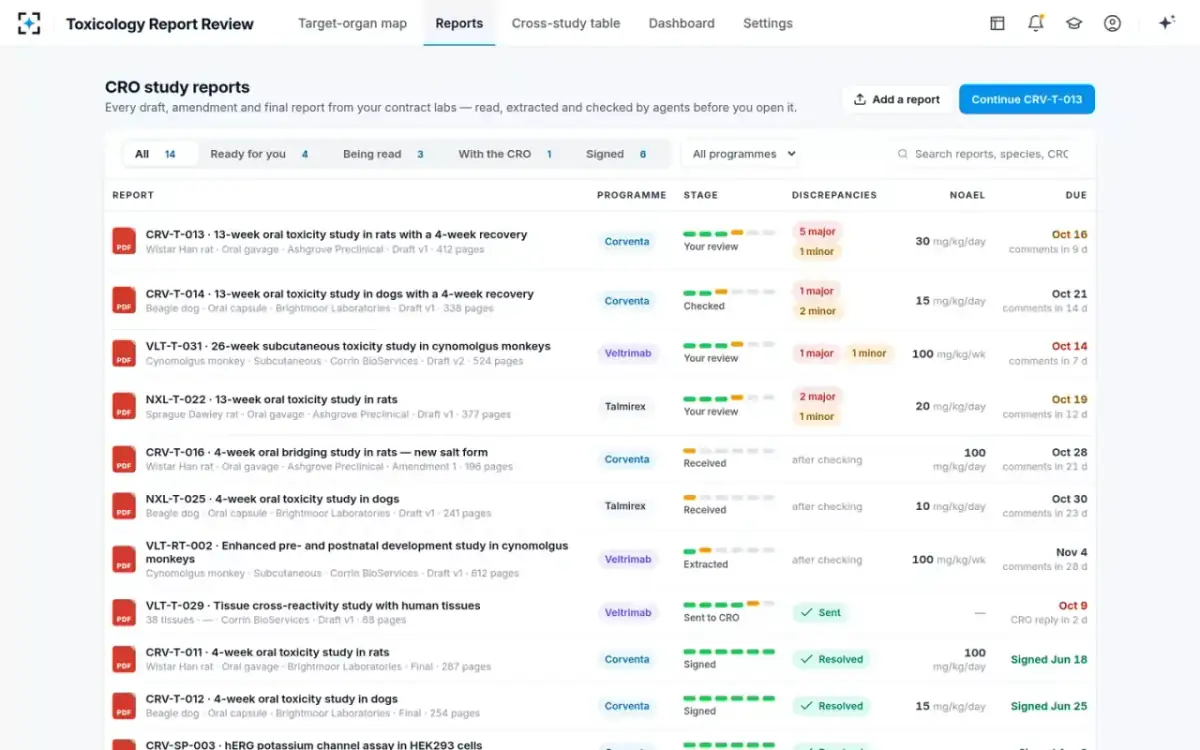
| Draft, amendment and final reports reviewed in a year | Your own report list, counting versions and not studies. | Fourteen reports across three programmes, in the sample data. |
| Hours per draft review | Measured on the last ten drafts, by the reviewers. | 22.4 hours by hand on the sample baseline; 6.4 hours is the design target. |
| Loaded hourly rate | Twice the median wage, FDA's own convention. | $105.60 for sponsor, quality assurance and management, on a 2014 wage base — uprate it. |
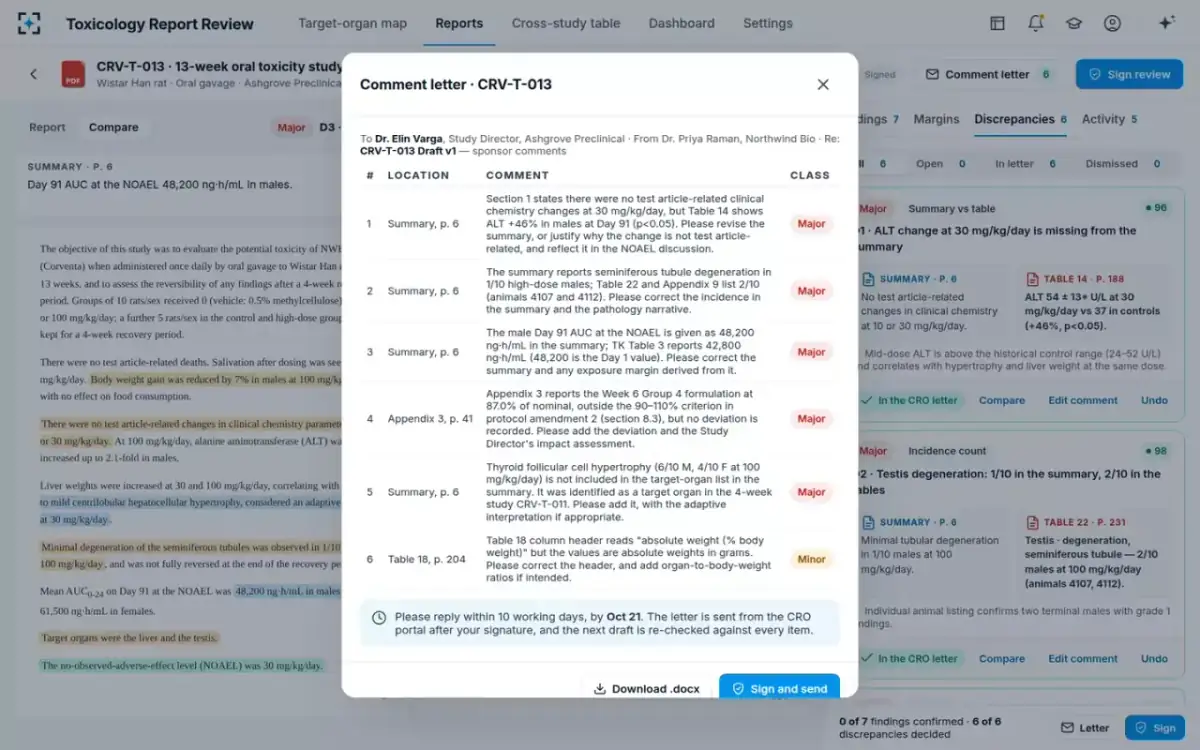
| Issues found before the report is final | Count them. This is the recoverable part of the spend. | 4.7 per report on the sample dashboard, which is sample data; six discrepancies, five of them major, in one 412-page sample draft. |
| Comments accepted in the next draft version | Count them when the next version arrives. | 93%, a design target, not a measured result. |
| Amendments avoided | Errors that would have been found after signature. | Nothing. Only your own history can fill this row, which is why a pilot should be run on past reports whose errors you already know. |
| Industry scale, for context | FDA's own estimate under the reporting rule. | 18,075 responses a year at 27.65 hours each, 499,774 hours. |
The cost of the question you cannot answer today
There is a cost that no model of review hours catches, and on an active programme it is usually the biggest one. A clinical team asks what dose it may go to. Answering means taking every study's no-adverse-effect level, finding the right exposure for each one, dividing by the human exposure at the proposed dose, and doing it for every organ. By hand that is a spreadsheet rebuilt for each dose, and the honest answer to "can we have it by Thursday" is often no.
So the question gets answered at the next meeting instead, or answered conservatively because nobody has time to check the aggressive version. A month of dosing at a lower dose than the data supports is not in anybody's budget line, and neither is a month of waiting. On the sample programme the same question is a dose change on one screen: switching the clinical dose from 200 mg to 400 mg recalculates every organ's margin, turns the rows that fall below the floor red with the value they held before, and reads out the highest dose that keeps every adverse target organ above the floor — about 205 mg in that programme.
That is the part of the business case that does not reduce to hours. It is worth stating separately, and worth measuring separately: how long between the programme team asking for a margin at a new dose and getting an answer somebody will put their name to. Which study row sets the margin works through the arithmetic underneath it.
The model, with your own drafts, hours and rate in it
A defensible case is built in one afternoon with four of your own numbers and one borrowed one. Count the report versions reviewed last year. Measure hours on the last ten drafts, honestly, including the time spent finding things rather than deciding them. Take a loaded rate — FDA's method and your own wages. Count the issues found in those ten drafts, and separately count the ones found after a report was final, because that second count is the whole argument.
These proposals are intended to build quality into planning, conducting, and reporting a nonclinical laboratory study and to help ensure data quality and integrity.
FDA, proposed rule on Good Laboratory Practice, 24 August 2016
That sentence is the regulator's framing of the same case, and it is a better one than a savings number. Quality built into reporting is cheaper than quality inspected into it afterwards — which is why the issues found before a report is final are the line to optimise, and why a review that reliably finishes inside the laboratory's comment window is worth more than a review that is thorough but late.
Every draft, amendment and final, with its comment deadline
What to measure after six months
Six numbers that tell you whether the case held
- Hours per draft review, as a median
Not a mean — one monstrous draft should not flatter or ruin the series. Compare with the baseline you measured before.
- Issues found per report before the final version
The recoverable part. If it falls, ask whether the drafts got better or the review got shallower.
- Issues found after a report was final
The number the whole case rests on. It should trend to zero, and it is the only honest measure of an avoided amendment.
- Share of comments the laboratory accepts in the next version
A proxy for comment quality. Comments that are specific, located and sourced get accepted; vague ones get argued.
- Reviews finished inside the comment window
A thorough review delivered after the deadline buys nothing. Ten, fifteen or twenty days is a per-laboratory setting; measure against the right one.
- Time from a dose question to a signed answer
The margin-at-a-new-dose question. This is the number programme leadership actually feels.
Six issues, one numbered letter to the study director
To put your own drafts, hours and rate into the model, start from Toxicology Report Review, or read how to pilot it on your own reports for the measurement design.
Questions people ask
How much does a GLP toxicology study cost?
No regulator, journal or professional body publishes a figure, and the prices in circulation come from the laboratories selling the studies, which makes them quotes rather than benchmarks. What is public is what drives the number — species, dosing duration, group sizes, added endpoints such as toxicokinetics and recovery groups, and the pathology workload — and what the reporting at the end of it costs, which FDA does estimate.
How long does it take to review a CRO draft report?
By hand, two to four days for a 300-to-500-page repeat-dose draft is common practice in our experience, not a published figure. The sample programme in this series uses a baseline of 22.4 hours a draft, against a design target of 6.4 hours. Measure your own on the last ten drafts before you believe anybody's number, including ours.
How many nonclinical study reports are produced each year?
FDA estimates 18,075 annual responses under the nonclinical reporting requirement — 300 respondents at 60.25 responses each — at an average of 27.65 hours per response, totalling 499,774 hours, plus 18,075 hours for the quality assurance statement. That is the burden of preparing and reporting studies in the regulated system, not of a sponsor's review of a contract laboratory draft.
What hourly rate should a nonclinical business case use?
FDA's method is a defensible one to borrow: take the median wage for the relevant occupation and double it for benefits and overhead. Its own published rates are $105.60 an hour for sponsor, quality assurance and management with executive responsibility, $79.80 for contributing scientists or principal investigators, and $28.84 for clerical assistants — on a 2014 wage base, so uprate before quoting.
What does amending a final GLP report involve?
The reporting rule requires corrections or additions to take the form of an amendment by the study director, identifying the part being corrected, giving the reasons, and signed and dated by the person responsible. Around that sit the re-issue, the quality assurance unit's revisit, and the sponsor's re-check of everything downstream that used the old value.
How do you build a business case for study report review software?
With five numbers: report versions reviewed a year, measured hours per draft, a loaded hourly rate, issues found before a report is final, and issues found after one was final. The last is the case. Treat any vendor figure labelled as a target — including the 6.4-hour and 93% figures in this series — as a design goal, not a saving you have been promised.