To determine the NOAEL — the no-observed-adverse-effect level — in a repeat-dose study, you take the dose groups the study actually used, decide for each finding at each dose whether it is an adverse effect or a tolerable biological response, and name the highest dose at which nothing adverse was seen. There is no instrument that reads it out. It is a judgement, made by the study pathologist and the study director, about findings whose incidence counts, severity grades, organ weights, clinical chemistry and recovery data sit in tables hundreds of pages apart — and FDA's own guidance sets out how to settle it when pathologists disagree. That is why the only defensible NOAEL is one where every finding, every count and every page is in view at the same time, which is what Botminds' Toxicology Report Review puts in front of the sponsor's toxicologist.
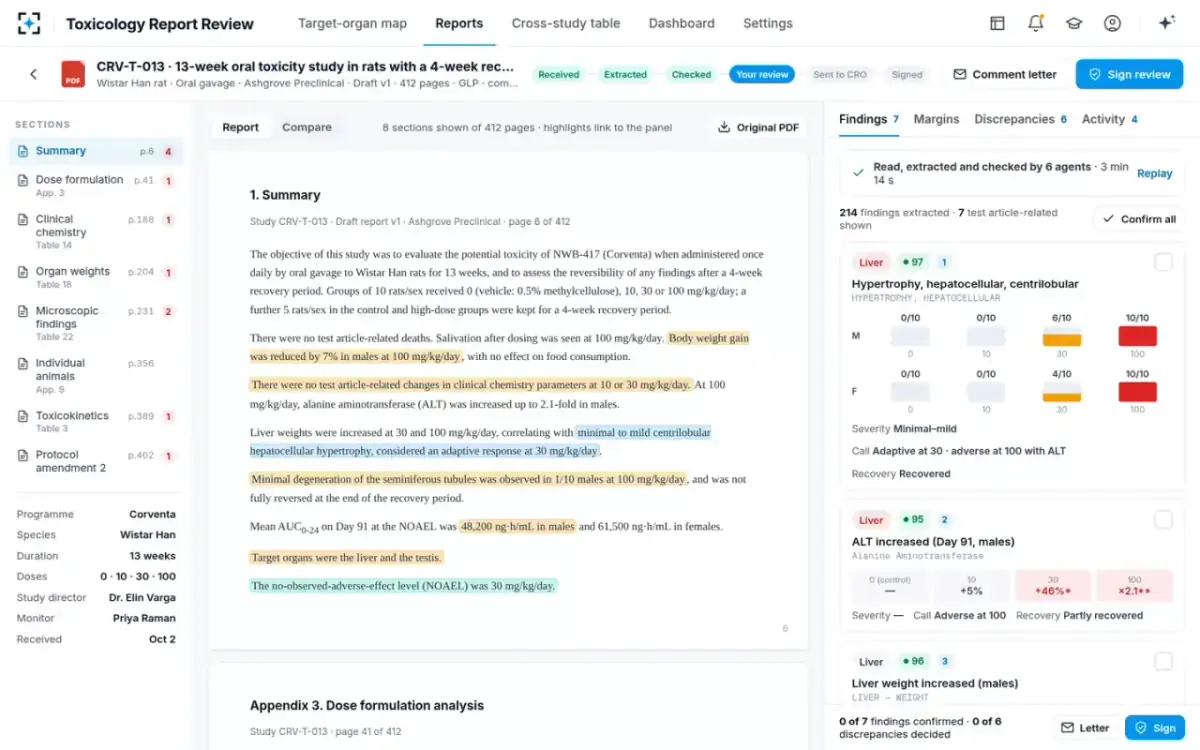
One fictional sample draft runs through this page: a 13-week oral toxicity study in rats at 0, 10, 30 and 100 mg/kg/day, with a four-week recovery period, reporting a NOAEL of 30 mg/kg/day. The drug, the laboratory, the people and the findings are invented sample data from the solution, not a customer's study. The rules and the published findings are linked where they appear.
Four numbers from one draft, and why the stated NOAEL is a question
30mg/kg/day
the no-observed-adverse-effect level the draft report states
6/10
males with centrilobular hepatocellular hypertrophy at that same dose
+46%
alanine aminotransferase in males at that dose on Day 91, above the laboratory historical range of 24 to 52 U/L
2/10
top-dose males with seminiferous tubule degeneration, where the summary says 1 of 10
How do you determine the NOAEL?
The method has four steps, and only the third is hard. First, list every finding the study produced, by organ, with its incidence in each dose group and each sex, its severity grade and what happened to it in the recovery animals. Second, separate the findings that are related to the test article from background pathology and chance — incidental lesions, a single animal, a finding as common in the controls. Third, decide for each test-article-related finding, at each dose, whether it is adverse. Fourth, read off the highest dose at which no adverse finding occurred. That dose is the NOAEL.
The fourth step is arithmetic on the third. If the liver change at 30 mg/kg/day is adaptive, and the enzyme rise at that dose is within normal variation, the NOAEL is 30. If either is judged adverse, the NOAEL falls to 10, because 10 is the next dose down that the study used. There is no 20 to retreat to. The number can only ever be one of the doses in the protocol, which is the first thing that makes it less of a measurement than it looks.
ICH M3(R2) sets out what the whole exercise is for: the goals of the nonclinical safety evaluation "generally include a characterisation of toxic effects with respect to target organs, dose dependence, relationship to exposure, and, when appropriate, potential reversibility" (ICH M3(R2), Step 4, 2009). Those four — target organ, dose dependence, exposure relationship, reversibility — are also the questions an adversity judgement turns on, which is not a coincidence.
NOAEL, NOEL and LOAEL: three terms, and the one that reaches the IND
Three levels are read off the same dose groups and they mean different things. The NOEL, the no-observed-effect level, is the highest dose at which no effect of any kind was seen. The NOAEL is the highest dose at which no adverse effect was seen, which can be higher, because a pharmacological effect the drug is supposed to have is an effect but not necessarily a harm. The LOAEL, the lowest-observed-adverse-effect level, is the first dose at which something adverse appeared — in a well-dosed study, the dose immediately above the NOAEL.
FDA's starting-dose guidance is blunt about the distinction and about why it matters: the NOAEL "is not the same as the no observed effect level (NOEL)", and the definition of the NOAEL "reflects the view that some effects observed in the animal may be acceptable pharmacodynamic actions of the therapeutic and may not raise a safety concern." The same document warns against confusing the NOAEL with the LOAEL or the maximum tolerated dose, neither of which is used to set a safe starting dose in healthy volunteers.
Only one of the three normally leaves the report with consequences attached. The NOAEL is the number that becomes a human equivalent dose, an exposure margin and a line in the investigator's brochure; the rest are context. That is why a report that quietly gives a NOEL where the reader expects a NOAEL, or a discussion that calls the top dose a LOAEL where the tables show the mid dose was already affected, is worth a comment. What the number becomes next is set out in NOAEL to human equivalent dose.
The three kinds of finding a NOAEL can rest on
FDA groups the evidence into three kinds, and a reviewer who sorts a study's findings into them sees quickly whether the stated NOAEL rests on one leg or three.
FDA's starting-dose guidance names the three: overt toxicity, such as clinical signs and gross or microscopic lesions; surrogate markers of toxicity, such as serum liver enzymes; and exaggerated pharmacodynamic effects (FDA, Estimating the Maximum Safe Starting Dose, July 2005).
The sample draft has all three, and they do not agree with each other. Overt toxicity: seminiferous tubule degeneration at the top dose, microscopic, graded minimal, incomplete recovery. A surrogate marker: the alanine aminotransferase rise, 46% at the mid dose and 2.1-fold at the top dose. An exaggerated pharmacodynamic effect: nothing clearly in this study, but salivation after dosing at the top dose and a 7% fall in body weight gain in top-dose males are the kind of general signs that sit at the edge of the category.
The mid dose is where the three disagree. There is a microscopic liver change there and a surrogate marker moving at the same dose, and the report calls neither adverse. That is a defensible position — hepatocellular hypertrophy with a modest enzyme rise and no necrosis is often read as adaptive — but it is a position, and it is the position the whole NOAEL rests on.
Every test-article-related finding in one 13-week draft, by dose
| Finding | 10 mg/kg/day | 30 mg/kg/day | 100 mg/kg/day | Recovery | The report's own call |
|---|---|---|---|---|---|
| Centrilobular hepatocellular hypertrophy | None | 6/10 M · 4/10 F, minimal | 10/10 M · 10/10 F, minimal to mild | Recovered | Adaptive at 30 · adverse at 100 with the enzyme change |
| Alanine aminotransferase, males, Day 91 | No change | +46% (54 ± 13 U/L against 37) | 2.1-fold | Partly recovered | Adverse at 100 |
| Liver weight | No change | Increased | Increased | Recovered | Correlates with the hypertrophy |
| Thyroid follicular cell hypertrophy | None | None | 6/10 M · 4/10 F | Recovered | Adaptive — secondary to liver enzyme induction |
| Seminiferous tubule degeneration | None | None | 2/10 M, minimal (animals 4107, 4112) | One male still affected | Adverse at 100 |
| Body weight gain, males | No change | No change | Down 7%, food consumption unchanged | Not stated | Not called |
Adverse or adaptive: who actually decides
The call belongs to the study pathologist. FDA states the ownership without qualification: "The pathology report is the sole responsibility of the study pathologist, and the peer-review pathologist(s) should not sign the final pathology report" (FDA, Pathology Peer Review in Nonclinical Toxicology Studies, December 2021). A peer-review pathologist may review the slides and may disagree; a sponsor may argue in writing; a reviewing toxicologist at an agency may reach another view years later. None of them re-writes the diagnosis.
What a sponsor can do is check that the call was made on the whole picture and is stated consistently wherever the report mentions it. The six questions below are the ones a reviewer runs over a borderline finding. Five can be answered from the tables by anyone who can read them. The sixth cannot.
Six questions behind one adversity call, and the one only a pathologist answers
Magnitude
How big is the change, against the concurrent control and against the laboratory's own historical range?
Alanine aminotransferase at 54 ± 13 U/L against 37 in controls — a 46% rise, and above a historical range of 24 to 52 U/L.
Dose response
Does it grow with dose, or appear once and stop?
Hypertrophy in 6 of 10 males at the mid dose and 10 of 10 at the top dose, with the enzyme change rising from 46% to 2.1-fold.
Correlating findings
Does anything else point the same way — organ weight, chemistry, microscopy?
Liver weight up at both doses, hypertrophy at both doses, the enzyme change only clearly at the top dose.
Reversibility
Is it gone at the end of the recovery period, and in every animal?
The liver change recovered. One recovery male still had the testis finding, so that one is not fully reversible.
Functional consequence
Does the animal show anything for it — clinical signs, body weight, food consumption?
No test-article-related deaths; salivation at the top dose; body weight gain down 7% in top-dose males with food consumption unchanged.
The pathologist's judgementPathologist only
Taking all of it together, is this an adaptive response or an adverse effect?
The study pathologist's call, and nobody else's. In the sample draft it reads: adaptive at the mid dose, adverse at the top dose with the enzyme change.
The fifth question is the one most often skipped, and it is where an adaptive reading usually stands or falls. A liver change with no functional consequence — no necrosis, no bilirubin, no weight loss, reversed in the recovery animals — is a liver doing its job under an enzyme-inducing drug. The same change with a 2.1-fold enzyme rise alongside it is a different argument, and the sample report draws its own line exactly there.
Every finding with its incidence, its severity and its page
Why the NOAEL is partly an artifact of the study design
Two studies of the same drug can produce different NOAELs without either being wrong, because the number depends on choices made before any animal was dosed. The published analysis is unusually direct about this.
Writing in Clinical and Translational Science, Chen, Lavezzi and McDougall conclude that "the NOAEL estimate is to some extent an artifact of the experimental design, instead of a true reflection of the inherent safety risk level of the drug" (Clinical and Translational Science, 2024). Their mechanism is simple arithmetic on detection: "The more densely the doses are placed in an experiment, and the larger the group size of the animals, the more likely toxicity will be observed in an animal at a lower dose."
Three consequences follow for a reviewer. A study with wide dose spacing will tend to report a higher NOAEL than a study with close spacing, because the first dose at which something appears is further up. A study with ten animals per sex per group will tend to report a higher NOAEL than one with twenty, because a 1-in-20 finding is more likely to show up in twenty. And a NOAEL equal to the top dose means only that the study did not reach an adverse effect — it is a floor on the answer, not the answer.
None of that makes the NOAEL useless; it makes it a number that has to travel with its design. A cross-study safety table that gives a NOAEL without the dose groups, the group sizes and the duration beside it is giving a reader a conclusion with its evidence removed.
Two NOAELs in one report: how the summary and the discussion drift apart
A long report states its NOAEL more than once — in the summary, in the discussion, sometimes in the conclusions and in the toxicokinetic section — and the versions can diverge. The usual cause is innocent: a value changed during drafting after peer review of the pathology, and one of the three places was not updated. The effect is not innocent, because the summary is what gets quoted into the investigator's brochure and the discussion is what gets read by anyone who goes looking for the reasoning.
The regulation is clear about what a final report owes on this point. Under 21 CFR 58.185(a)(11), a final report must describe the calculations performed on the data, summarise and analyse the data, and state the conclusions drawn from that analysis. A report that states two different NOAELs leaves its reader to guess which conclusion it actually drew.
The sponsor-side check is mechanical: find every sentence in the report that names a NOAEL, a no-observed-adverse-effect level or a no-effect level, put them side by side, and confirm they agree with each other and with the target-organ list. In the sample draft that check also caught a related inconsistency — thyroid follicular cell hypertrophy at the top dose, present in the microscopic findings table and absent from the summary's target-organ sentence, which names only the liver and the testis.
Does the NOAEL have to be the same in males and females?
No, and a report that gives one number for both should say why. Sex differences in exposure are ordinary — in the sample study females reach about 1.4-fold the male exposure at the same dose — and sex-specific findings are ordinary too; the testis finding here has no female counterpart by definition. Where the sexes diverge, a study may state a NOAEL per sex, or state the lower of the two and say so.
What a reviewer should not accept is a single NOAEL that quietly follows the less-affected sex. In the sample draft the liver change appears in 6 of 10 males and 4 of 10 females at the mid dose, so the direction is the same and one number is defensible. If the mid-dose enzyme rise had appeared only in males, a NOAEL of 30 mg/kg/day would have been true for females and not for males, and both the margin and the human dose derived from it would have been drawn from the wrong sex — a choice that also runs through which row of the toxicokinetic table sets the margin.
What moves a NOAEL after the draft: counts, listings and recovery animals
Between a draft and a signed final report, a NOAEL moves for three reasons, and all three are findable in the comment window.
The first is a count that does not survive the individual animal data. The sample draft's summary reports seminiferous tubule degeneration in 1 of 10 top-dose males; the pathology table reports 2 of 10, and the individual animal listing names both animals. One animal against two does not move this NOAEL, because the finding is at the top dose either way, but the same error one dose lower would.
One finding, three places in the same report
What the summary says: Minimal degeneration of the seminiferous tubules was observed in 1/10 males at 100 mg/kg/day.
What the tables and listings say: Table 22, page 231: 2/10 males at 100 mg/kg/day, seminiferous tubule degeneration, minimal.
What the summary says: Not named.
What the tables and listings say: Individual animal listing, Appendix 9: animal 4107 unilateral and animal 4112 bilateral, both grade 1.
What the summary says: "Was not fully reversed at the end of the recovery period."
What the tables and listings say: One recovery male still affected — consistent with the summary, and the reason the finding is not called reversible.
What the summary says: —
What the tables and listings say: Correct the incidence in the summary and in the pathology narrative; the two should match the table and the listing.
The second is the recovery animals. A finding that reverses and a finding that does not are different arguments about adversity, and recovery data arrives late in a draft's life. Here one recovery male still had the tubule finding, which is what keeps it out of the reversible column.
The third is the surrogate marker nobody put in the summary. The sample summary states that there were no test-article-related changes in clinical chemistry at 10 or 30 mg/kg/day; the clinical chemistry table on page 188 shows alanine aminotransferase at 54 ± 13 U/L against 37 in controls at 30 mg/kg/day, a 46% rise with p < 0.05, above the laboratory's historical control range of 24 to 52 U/L and correlating with hypertrophy and liver weight at the same dose. Either that change is not test-article related, in which case the summary is right and the discussion should say why, or it is — and the NOAEL is the question, not the sentence.
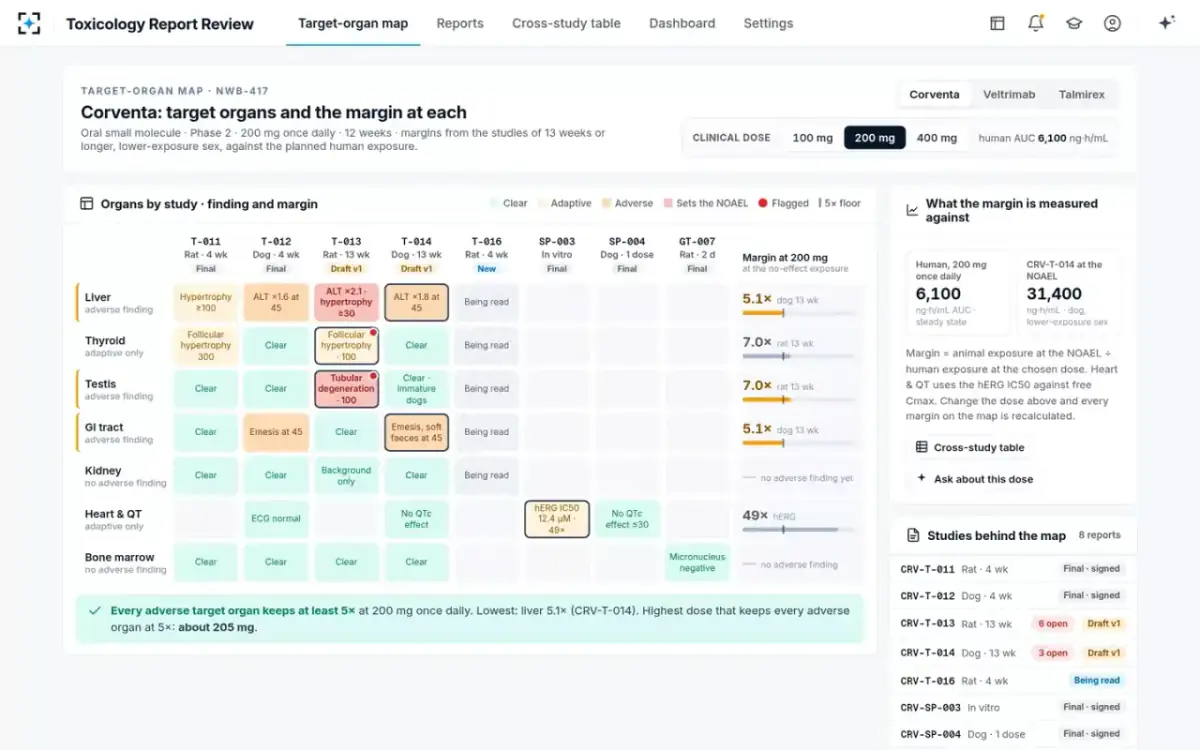
One programme's target organs, with the mid-dose question still open
Confirming a NOAEL you did not set
Most sponsor toxicologists never determine a NOAEL from raw data; they confirm one that a contract laboratory has already determined, inside a comment window, from a report. That is a different task with its own checklist, and it is finished when four things hold.
Every finding in the report is accounted for, by organ and dose, with its incidence matching the table behind it. Every statement of the NOAEL in the report agrees with every other. The target-organ list matches the findings that were actually called adverse. And the dose below the stated NOAEL is genuinely clean — because the whole number rests on nothing adverse having happened there, and the mid dose is where summaries are thinnest.
That last check is the one the sample draft fails, on a sentence rather than on the science. Whether the review then changes the NOAEL is the study director's call to make and the sponsor's to accept or contest, which is the split that runs through the whole of the study monitor's week. What the sponsor controls is whether the question was asked while the report was still a draft, and the order in which to ask it is laid out in a GLP audit checklist for a draft report. To see the findings, the counts and the pages together on one sample study, start from Toxicology Report Review.
Questions people ask
What is the difference between NOAEL, NOEL and LOAEL?
The NOEL is the highest dose with no observed effect of any kind. The NOAEL is the highest dose with no observed adverse effect, and can be higher than the NOEL, because an expected pharmacological action is an effect without necessarily being a harm. The LOAEL is the lowest dose at which an adverse effect was seen. FDA's starting-dose guidance uses the NOAEL and warns against substituting the NOEL, the LOAEL or the maximum tolerated dose for it.
Who decides whether a finding is adverse?
For histopathology, the study pathologist: FDA states that the pathology report is that person's sole responsibility, and that a peer-review pathologist should not sign it. The study director owns the report's overall interpretation and its stated NOAEL. A sponsor can comment, argue and record its own reading, and FDA expects divergences to be resolved through a documented, transparent process, but it does not get to re-call the finding.
Is an increase in liver enzymes adverse?
It depends on size, direction and company. An alanine aminotransferase rise within the laboratory's historical control range, with no microscopic correlate and no change in bilirubin or organ weight, is usually read as variation. A rise above the historical range that grows with dose and sits alongside hepatocellular change, as in the sample draft at 46% and then 2.1-fold, is at least a question about the NOAEL and should be addressed in the discussion rather than left out of the summary.
Is hepatocellular hypertrophy adverse or adaptive?
Centrilobular hypertrophy without degeneration, necrosis or functional change is commonly read as an adaptive response to enzyme induction, and it often reverses completely in recovery animals. It is read as adverse when it comes with evidence of injury — necrosis, a marked enzyme rise, raised bilirubin — or when it fails to reverse. In the sample draft the report calls it adaptive at the mid dose and adverse at the top dose, where the enzyme change is 2.1-fold.
Can a study report have two NOAELs?
It can state two, and that is a defect rather than a feature. A final report must contain a statement of the conclusions drawn from its analysis, and a summary saying one dose while the discussion says another is an inconsistency to raise in the comment window. A study can legitimately report a NOAEL per sex, or separate NOAELs for different endpoints such as general toxicity and reproductive organs, provided it says plainly which is which.
What happens if the sponsor disagrees with the CRO's NOAEL?
The sponsor comments in writing, with the evidence, and asks the study director to address it. If the study director does not change the report, the NOAEL in the signed report stands as the laboratory's conclusion, and the sponsor records its own reading in its own review and carries that position into the submission. Where the disagreement is a histopathology diagnosis, FDA's guidance points to a documented process — which can include consultation with further pathologists — rather than an informal redraft.