The NOAEL-to-HED calculation is one division: take the no-observed-adverse-effect level in milligrams per kilogram per day from an animal study, divide it by that species' body surface area conversion factor, and the result is the human equivalent dose in milligrams per kilogram, which multiplied by a 60 kg adult gives milligrams. A rat NOAEL of 30 mg/kg/day divided by 6.2 is 4.8 mg/kg, or 290 mg a day. FDA publishes the factors and the order of operations, and the whole algorithm is three divisions long. What trips a dose rationale up is rarely the arithmetic; it is which number was wanted: a human equivalent dose answers "what dose in a person corresponds to this animal dose?", and an exposure margin answers "how much more drug did the animal have than the patient will?" Botminds' Toxicology Report Review computes both from each contract laboratory report and states the basis of each one, because a number without its basis cannot be checked.
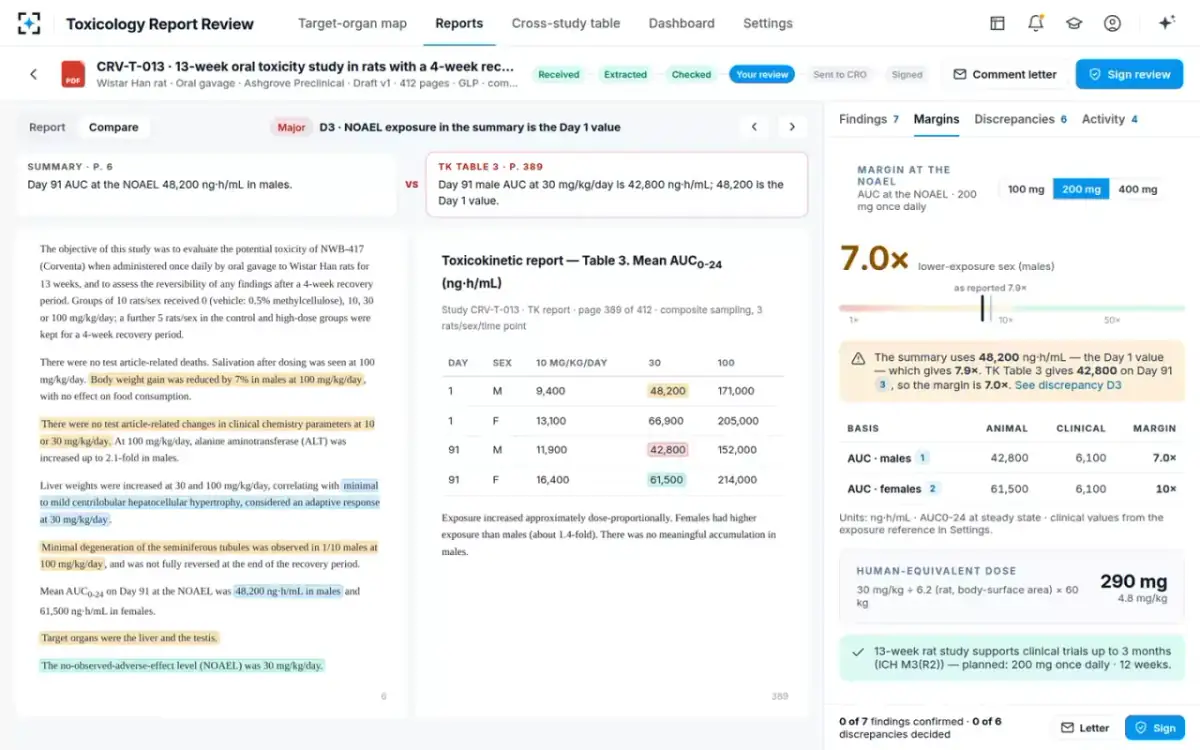
The study on this page is fictional sample data from the solution: a 13-week oral toxicity study in rats reporting a NOAEL of 30 mg/kg/day, in a programme whose planned clinical dose is 200 mg once daily. The conversion factors, the algorithm and the exposure conventions come from FDA and ICH, linked where they appear.
One NOAEL, converted: the chain in four numbers
30mg/kg/day
the rat NOAEL in the sample 13-week study
6.2
the body surface area conversion factor FDA publishes for the rat
290mg
the human equivalent dose for a 60 kg adult — 4.8 mg/kg
10×
the safety factor FDA says to consider at minimum when setting a first dose
How do you calculate a human equivalent dose from a NOAEL?
In one step, by division. FDA is specific that it should not be done in two: "The body surface area normalization and the extrapolation of the animal dose to human dose should be done in one step by dividing the NOAEL in each of the animal species studied by the appropriate body surface area conversion factor (BSA-CF)" (FDA, Estimating the Maximum Safe Starting Dose in Initial Clinical Trials for Therapeutics in Adult Healthy Volunteers). Converting to milligrams per square metre and back again invites a rounding error at each turn, and the published divisors already fold the whole conversion into one number.
The three formulas below are the complete set. Each answers a different question and only the first two are about a dose at all.
Three calculations from one NOAEL, and the question each one answers
Human equivalent dose
HED (mg/kg) = animal NOAEL (mg/kg) ÷ species factor
What dose in a person corresponds to the animal dose, normalised by body surface area. Multiply by 60 kg for milligrams a day.
FDA starting-dose algorithm, step 2
Maximum recommended starting dose
MRSD = HED ÷ safety factor
The highest first dose in healthy volunteers. The safety factor is at least 10 by default, and higher where the animal data give reason.
FDA starting-dose algorithm, step 4
Exposure margin
margin = animal AUC at the NOAEL ÷ human AUC at the clinical dose
How much more drug the animal had than the patient will, at a stated dose. Measured, not scaled — it needs toxicokinetic data on both sides.
ICH M3(R2) and its Q&A
The conversion in one step: divide by the species factor
The factors are a short table and worth knowing by eye, because a dose rationale with a transposed one is hard to spot and easy to carry forward. They come from the assumption that doses scale one-to-one between species when normalised to body surface area, which is why a rat — small, with a large surface area for its mass — divides by more than a dog.
FDA's body surface area conversion factors, and the arithmetic each way
| Species | Multiply mg/kg by this for mg/m² (km) | Divide the animal dose by this for the HED in mg/kg | Or multiply the animal dose by this |
|---|---|---|---|
| Human (60 kg) | 37 | — | — |
| Mouse | 3 | 12.3 | 0.08 |
| Rat | 6 | 6.2 | 0.16 |
| Rabbit | 12 | 3.1 | 0.32 |
| Dog | 20 | 1.8 | 0.54 |
| Monkey (cynomolgus, rhesus) | 12 | 3.1 | 0.32 |
| Minipig | 35 | 1.1 | 0.95 |
Two practical notes. The dog's divisor of 1.8 means a dog dose and a human dose are nearly the same number in milligrams per kilogram, which is why dog studies often look alarmingly close to the clinical dose until the arithmetic is done. And the divisor is for the dose, not for anything else: exposures, concentrations and in vitro potencies are never scaled this way.
Why body surface area, and when it is the wrong basis
Body surface area scaling is the default because, across species, many measures of systemic turnover track surface area better than body weight. It is a default, not a law, and FDA sets out when to depart from it. Scaling on milligrams per kilogram instead may be considered when "the available data should show that the NOAEL occurs at a similar mg/kg dose across species" — and the guidance notes that this is the less conservative choice, because "mg/kg scaling will give a twelve-, six-, and twofold higher HED than the default mg/m2 approach for mice, rats, and dogs, respectively."
There is also a category of drugs where surface area scaling is simply not the right model. FDA states that "scaling between species based on mg/m2 is not recommended" for therapeutics given by routes where the dose is limited by local toxicity — "topical, intranasal, subcutaneous, intramuscular" — which should be normalised to concentration or to the amount at the application site, and for drugs given into compartments with little distribution beyond them, such as intrathecal or intravesical administration. A guide that converts an intranasal NOAEL with a factor of 6.2 has produced a number, not an answer.
The honest version of the rule is that the basis belongs beside the number. "HED 290 mg, from the 13-week rat NOAEL of 30 mg/kg/day, by body surface area, 60 kg adult" is checkable in ten seconds. "HED 290 mg" is not.
From HED to a starting dose: the safety factor of at least 10
A human equivalent dose is not a dose anyone gives. FDA's algorithm puts a factor between them: "In general, one should consider using a safety factor of at least 10. The MRSD should be obtained by dividing the HED by the safety factor." The factor covers what the animal studies could not see — interspecies differences in sensitivity, the narrower variability of a laboratory animal population against a human one, and effects such as headache or nausea that no rat reports.
Ten is a floor, not a tariff. The guidance says plainly that "safety concerns or design shortcomings noted in animal studies may increase the safety factor, and thus reduce the MRSD further", while a well-characterised pharmacological class with extensive prior human experience can justify a smaller one. On the sample study the arithmetic runs 30 ÷ 6.2 = 4.8 mg/kg, × 60 kg = 290 mg, ÷ 10 = 29 mg as a maximum recommended starting dose — against a planned therapeutic dose of 200 mg once daily, which is why a first-in-human programme climbs.
Most sensitive species, or most appropriate species?
Where several species have been studied, the HED is computed for each and the lowest one normally wins. FDA names it: "The species that generates the lowest HED is called the most sensitive species." The default rule then follows, with its reasoning attached — "without any additional information to guide the choice of the most appropriate species for assessing human risk, the most sensitive species is designated the most appropriate, because using the lowest HED would generate the most conservative starting dose."
The qualifier matters. A species can be set aside as not the most appropriate on evidence — a metabolite profile that does not resemble the human one, a target that is not expressed, a toxicity that is species-specific — and that argument should be made in writing, not by quietly choosing the more convenient study.
The same programme, four repeat-dose studies, four human equivalent doses
A human equivalent dose is not an exposure margin
This is where most of the confusion lives, and the sample programme makes the point without any argument: the two calculations choose different species.
By human equivalent dose, the 13-week rat is the most sensitive study at 290 mg, and the dog studies are nearly twice as permissive at 500 mg. By exposure margin at the planned clinical dose, the order reverses — the dog sets the floor at 4.9× in the four-week study and 5.1× in the 13-week study, while the 13-week rat gives 7.0×. A dose scaled by body surface area and a ratio of measured exposures are answers to different questions, and the species that is most sensitive on one need not be most sensitive on the other.
One programme, both calculations, study by study
| Study | NOAEL | Exposure at the NOAEL | Margin at 200 mg once daily | Human equivalent dose |
|---|---|---|---|---|
| Rat, 4 weeks | 100 mg/kg/day | 118,000 ng·h/mL (AUC) | 19× | 968 mg |
| Dog, 4 weeks | 15 mg/kg/day | 29,800 ng·h/mL (AUC) | 4.9× — the lowest | 500 mg |
| Rat, 13 weeks | 30 mg/kg/day | 42,800 ng·h/mL (AUC) | 7.0× | 290 mg — the lowest |
| Dog, 13 weeks | 15 mg/kg/day | 31,400 ng·h/mL (AUC) | 5.1× | 500 mg |
| In vitro hERG assay | — | IC50 12.4 µM | 49× against free Cmax | — not applicable |
Reading the two columns together is the useful habit. The human equivalent dose is the number for a dose rationale in a first-in-human programme, where no human exposure exists yet. The exposure margin is the number for a programme already dosing patients, where it can be measured — and which row of the toxicokinetic table sets that margin is a choice with four parts to it. Quoting one where the reader expects the other is an easy way to get a dose rationale sent back.
Worked example: 30 mg/kg/day in the rat, for a 60 kg adult
The full chain on the sample study, with every intermediate value shown, is six lines. Each line is checkable against the report page or the published table it came from.
The conversion, line by line, on one 13-week rat study
- The NOAEL, from the report: 30 mg/kg/day
Stated in the summary and the discussion of the draft report, and consistent with the target-organ list. A reviewer confirms it appears once, not twice.
- The species factor, from FDA Table 1: rat, divide by 6.2
Not 6 — that is the km for converting to mg/m², a different column of the same table and an easy transposition.
- The HED in mg/kg: 30 ÷ 6.2 = 4.84
Keep it unrounded through the chain; round once, at the end.
- The HED in mg a day: 4.84 × 60 kg = 290 mg
The 60 kg adult is the guidance's standard assumption. State it, because a programme in a different population may not use it.
- The maximum recommended starting dose: 290 ÷ 10 = 29 mg
With the default safety factor of at least 10. A larger factor is justified by concerns or design shortcomings in the animal studies.
- The basis sentence that travels with the number
"HED 290 mg: 13-week rat NOAEL 30 mg/kg/day ÷ 6.2, body surface area, 60 kg adult." Anyone can check that in a minute; "HED 290 mg" they cannot.
Toxicology Report Review prints the conversion and the margin with their basis
The heart exception: a margin against free Cmax, not a dose
One endpoint does not use either calculation. Cardiac repolarisation risk is assessed against an in vitro potency, and the comparison is a concentration ratio, not a dose conversion. ICH's E14/S7B question-and-answer document sets out the method: "A drug's potency for hERG block, usually calculated as half-inhibitory concentration (IC50), can be normalized to the drug's estimated clinically relevant exposures in patients to calculate the safety margin" (ICH E14/S7B Implementation Working Group Q&As, Step 4, 2022).
Two details decide whether that number is defensible. The denominator is the free, unbound concentration, not total plasma concentration, because only free drug reaches the channel; and the same document sets a floor on how small that fraction may be assumed to be: "Because of uncertainties in the protein binding measurements, the unbound (free) fraction in plasma should be set to 1% if experimentally determined to be < 1%." A heart margin computed on total concentration, or on a measured free fraction of 0.3% taken at face value, is larger than the convention allows.
In the sample programme the hERG margin is 49× at 200 mg once daily — an in vitro potency of 12.4 µM against an estimated free peak concentration, with no body surface area factor anywhere in it. It sits in the same programme table as the dose-based numbers, with its basis written out, because a reader who assumes every column was computed the same way will draw the wrong conclusion from it.
What a reviewer checks in a dose conversion
Five things go wrong often enough to be worth a standing check, and all five are visible from the report and the published table without recomputing anything.
Five checks on a dose conversion, and the error each one catches
- The species, and the right column of the table
Dividing by the km instead of the divisor — 20 instead of 1.8 for a dog, 3 instead of 12.3 for a mouse — gives a number wrong by a factor of about four to eleven that can still look plausible. For a rat the two columns, 6 and 6.2, sit close enough to hide the slip.
- The human weight the conversion assumes
FDA's table assumes 60 kg. A rationale quoting mg a day without saying so cannot be reproduced, and a paediatric or a 70 kg assumption changes the answer.
- Whether body surface area is the right basis at all
Topical, intranasal, subcutaneous, intramuscular, intrathecal and intravesical routes where the dose is limited locally are explicitly outside the mg/m² model.
- Which study the NOAEL came from, and its duration
The most sensitive species is the one giving the lowest HED, and the longer study in a species usually gives the lower NOAEL. A conversion from the four-week study where a 13-week study exists is a choice that has to be defended.
- Whether the number wanted was a dose or a ratio
An HED answers a dose question; an exposure margin answers an exposure question. A dose rationale that labels one as the other needs correcting before anything else on this list.
Every study in one programme, with NOAEL, exposure, margin and HED side by side
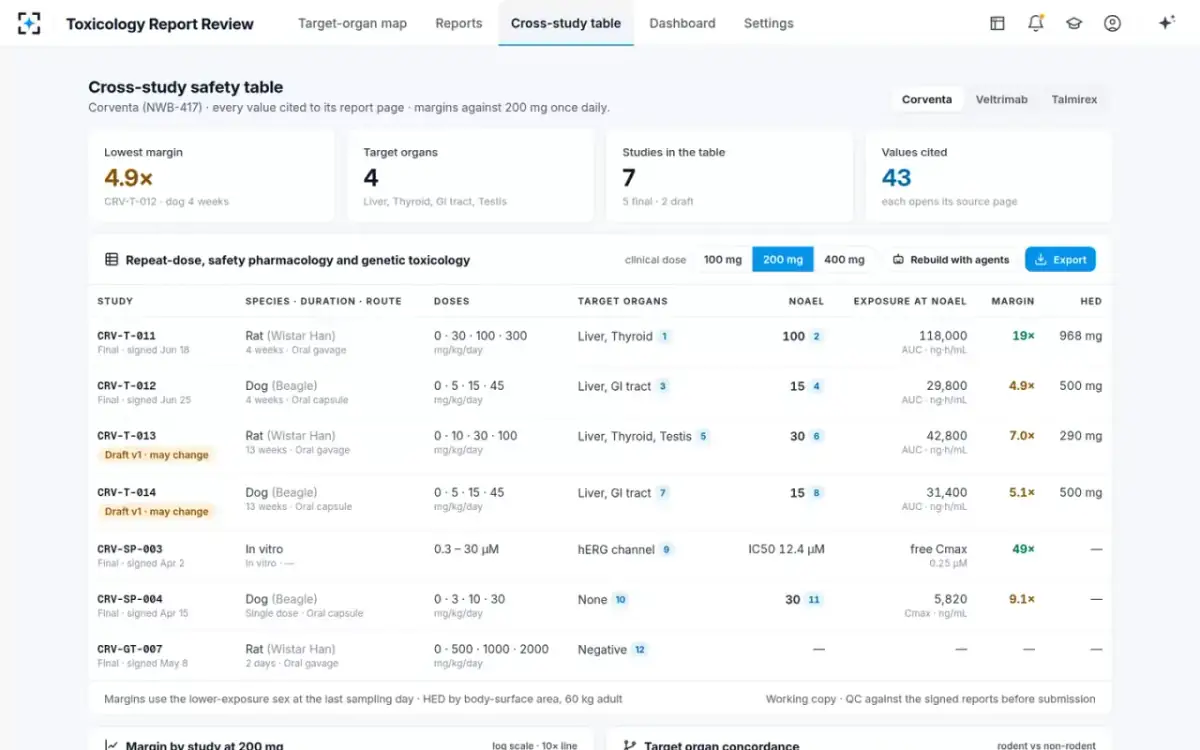
One last convention is worth stating because it sits underneath the margin column. ICH M3(R2) defines exposure, for the purpose of margins, as the group mean area under the curve, with peak concentration used instead in particular circumstances — so a margin is a ratio of two exposures measured the same way, not a ratio of a dose to an exposure. The sample programme computes it on the lower-exposure sex, which is a more conservative choice than the group mean and is a setting the sponsor makes, not a rule. How the NOAEL that feeds both calculations is arrived at in the first place is set out in how to determine the NOAEL in a repeat-dose study, and the sponsor-side review that confirms it in what a toxicology study monitor does, week by week. To see the conversion, the margin and the programme table together, start from Toxicology Report Review.
Questions people ask
What is the body surface area conversion factor for a rat?
6.2. FDA's starting-dose guidance gives two columns for every species: a km of 6 to convert a rat dose from mg/kg to mg/m², and a divisor of 6.2 to convert a rat dose in mg/kg straight to a human equivalent dose in mg/kg. Equivalently, multiply the rat dose by 0.16. Using 6 where 6.2 is meant changes the answer by only about 3%; the larger slips come from mixing the columns for other species, such as dividing a dog dose by its km of 20 instead of by 1.8.
What is the km factor in dose conversion?
The km is the factor that converts a dose in milligrams per kilogram to a dose in milligrams per square metre for a given species — 37 for a 60 kg human, 20 for a dog, 6 for a rat, 3 for a mouse. It is body weight divided by body surface area. FDA publishes it alongside the direct divisors but recommends the one-step division, so the km is mostly useful for reading older literature that reports doses in mg/m².
How do you convert a dog dose to a human dose?
Divide the dog dose in mg/kg by 1.8, or multiply by 0.54, then multiply by the human weight. A dog NOAEL of 15 mg/kg/day gives 8.3 mg/kg, or about 500 mg a day for a 60 kg adult. The dog's divisor is close to 1, so dog doses and human doses look similar in mg/kg — which is why the dog study in a programme often looks the most alarming before conversion and not after.
How do you calculate the maximum recommended starting dose?
Compute the HED for every animal species studied, take the lowest — the most sensitive species, unless there is evidence for choosing another as more appropriate — and divide it by a safety factor of at least 10. On the sample study, 290 mg ÷ 10 = 29 mg. The factor goes up where the animal studies raise concerns or have design shortcomings, and may come down for a well-characterised pharmacological class with extensive human experience.
Is the human equivalent dose the same as the exposure margin?
No. An HED is a dose, scaled from an animal dose by body surface area, and needs no measured human data. An exposure margin is a ratio of two measured exposures — the animal's area under the curve at the NOAEL divided by the human's at the clinical dose — and needs both. In the sample programme they point at different studies: the 13-week rat gives the lowest HED at 290 mg, while the dog studies give the lowest margins at 4.9× and 5.1×.
Which species should the human equivalent dose come from?
By default the one that produces the lowest HED, which FDA calls the most sensitive species, because it yields the most conservative starting dose. A different species may be designated the most appropriate where there is a reason — metabolite profile, target expression, a toxicity known to be species-specific — and that reason belongs in the dose rationale, not in the choice of which study to quote.