Preclinical study management software is a category label rather than a product description: it is attached to animal and study scheduling systems, to laboratory data capture, to dataset production for submission, and to tools that read and check the study reports a contract laboratory sends back. Those are four different purchases with four different buyers, and a shortlist that mixes them will compare things that do not compete. The way out is a narrow pilot — five of your own reports whose answers you already know, one question you can measure, and the electronic signature evidence settled first. Botminds' Toxicology Report Review sits squarely in the fourth job: six agents read each draft, extract every value with its page, check the summary against the tables and compute the exposure margins, and a named toxicologist decides each issue and signs.
What follows is a pilot design you can run with any vendor in that fourth category, including one that is not us. The regulatory requirements are quoted and linked; the screens are sample data on a fictional programme.
What does preclinical study management software actually do?
Depending on the vendor, one of four things — and assuming the answer is a costly mistake in an evaluation. A system built for study scheduling knows about rooms, animals, protocols and staff, and knows nothing about what a report says. A laboratory data capture system holds the observations as they are made. A dataset tool turns a finished study into standardised files for submission. A report review tool reads the finished document and tests it against itself.
Each of those has a legitimate claim on the phrase, and each solves a problem the others do not touch. A sponsor whose studies are all outsourced has no use for the first two and acute need of the fourth, because the only artefact it ever holds is a PDF. A sponsor with its own laboratory may need all four and should still buy them as four.
The four jobs to separate before you shortlist
Four jobs sold under one category name, and the question that separates them
| The job | Who owns it | The question that tells you which one you are looking at |
|---|---|---|
| Study and animal operations | The laboratory, or an in-house facility | "Does it schedule rooms, animals and staff?" If the answer is yes, it is an operations system and will not read your reports. |
| Capturing data as it is made | In-life and laboratory staff | "Does it record observations at the bench?" A sponsor whose studies are outsourced never touches this. |
| Producing and packaging datasets | Data management and regulatory operations | "Does it build the standardised datasets and the reviewer’s guide?" This is a submission tool, not a review tool. |
| Reading and checking the study report | The sponsor toxicologist and study monitor | "Can it tell me where the summary disagrees with the tables, and show me both pages?" This is the job a sponsor reviewing contract laboratory drafts is buying. |
There is a tell that costs nothing to use. Ask what the system does with a scanned appendix page and an incidence table whose header sits on the previous page. A tool built to read reports will have an answer with a page citation in it; a tool built for something else will describe an import format.
How to pilot it on your own CRO reports
A pilot of a review tool is not a trial period; it is an experiment with a result. The design that works is small and fixed in advance: five reports, chosen by you, whose findings and discrepancies you already know, run through the system without anyone telling it what to look for, and scored on three counts — what it found, what it missed, and what it invented.
Five is enough because the variance that matters is between report styles, not between reports. Pick them to vary deliberately: two laboratories at least, one rodent and one non-rodent study, one draft and one final, and at least one with a scanned or awkwardly laid out appendix. A pilot of five similar reports measures one report five times.
Fix the scoring before the first run, and write down who scores. The person who knows the answers should not be the person operating the system, and the scoring should be done against a list written before anything was uploaded. This is unglamorous and it is the difference between a measurement and an impression.
A six-week pilot that produces a decision, not an impression
- Context of use written down, five reports chosen, answer list sealedweek 0
- Known discrepancies listed per report, severity rules and margin floor set from your own procedureweek 1
- Reports processedweek 2
- Scored against the sealed list by someone who did not operate the systemweek 3
- Electronic signature manifestation, audit trail completeness, access and authority checksweek 4
- Results written upweek 5
- Decision, with the three counts and the signature evidence attachedweek 6
Seeding the test: five reports whose answers you already know
The reports to choose are the ones that already cost you something. A draft where a discrepancy was caught late. A report whose exposure value was quoted from the wrong sampling day. One where a finding in a table never made the summary. One where the target organ list did not match the rest of the programme. If you have a report that was amended after signature, that is the most valuable single file you own for this purpose, because you know exactly what should have been caught and when.
Write the answer list from the comment letters you actually sent, not from memory, and include the items you decided not to raise — because a system that surfaces those is behaving correctly even though they are not on the "found" list. Then seal it. The list is the ground truth and it must not grow during the pilot.
One deliberate addition is worth making: plant nothing. Resist the temptation to introduce an artificial error into a report to see whether the system catches it. Synthetic errors are easier than real ones in ways that are hard to control, and a pilot that passes on planted errors and fails on real ones has told you nothing you can act on.
What to measure: found, missed, invented
Three counts, and the third is the one that decides whether a system is usable. Found is how many of the sealed list's items the system raised. Missed is how many it did not. Invented is how many items it raised that, on inspection, are not differences at all — a misread number, a mis-paired table, a confident statement with nothing behind it.
A high invented count is worse than a high missed count, because it destroys the economics. Every spurious item costs a reviewer the time to open both sources and dismiss it, and a tool that produces more work than it saves will be abandoned whatever its recall. Score invented items separately and insist on seeing both sources for each one; an item that cannot show you two pages is not a finding.
Add two softer measures that will decide adoption. Time from upload to a reviewed, signed output, which is the number your reviewers will feel. And comment quality: take the drafted comment letter from the pilot and ask whether you would have sent it to that study director. The cost model turns these counts into the business case; the pilot's job is to produce the counts.
What to write in each column, for every one of the five reports
By hand, from your own history: The items you raised in the real comment letter, plus the ones you considered and dropped.
In the pilot, measured: How many of them the system raised, counted by someone who did not run it.
By hand, from your own history: Not applicable — you did not raise any.
In the pilot, measured: The invented count. Each one costs a reviewer two pages of checking to dismiss.
By hand, from your own history: Not applicable — a person wrote every one down from a page.
In the pilot, measured: Any extracted value with no page citation, or a citation that does not open the right page.
By hand, from your own history: From the file’s own dates: when the draft arrived and when the letter went.
In the pilot, measured: From upload to signature, with the review itself timed separately from the reading.
By hand, from your own history: The one you sent, and what the laboratory accepted.
In the pilot, measured: The drafted one. Would you have sent it, unedited, to that study director?
By hand, from your own history: Who made each one, and on what basis.
In the pilot, measured: The same person, unchanged. A pilot where this column differs is a pilot that failed.
What does 21 CFR Part 11 require of a system?
Part 11 governs electronic records and electronic signatures where a predicate regulation requires the record, and for a sponsor review of a good laboratory practice study it is the part of the evaluation that quality assurance will own. Two sections carry most of the weight.
The first is what a signature must show. "Signed electronic records shall contain information associated with the signing that clearly indicates all of the following: (1) The printed name of the signer; (2) The date and time when the signature was executed; and (3) The meaning (such as review, approval, responsibility, or authorship) associated with the signature" (21 CFR 11.50). Those three items must also be subject to the same controls as the record itself and appear in any human-readable form of it — so a signature visible on screen but absent from the printout fails.
The meaning is the item most often missing, and it matters here more than usual. A sponsor's study monitor signing a review is not approving the study; they are recording that they have reviewed it and that comments are going to the laboratory. A system that offers one undifferentiated "sign" button cannot express that, and the difference will be noticed the first time somebody asks what a particular signature meant.
What is being signed, and what the signature means
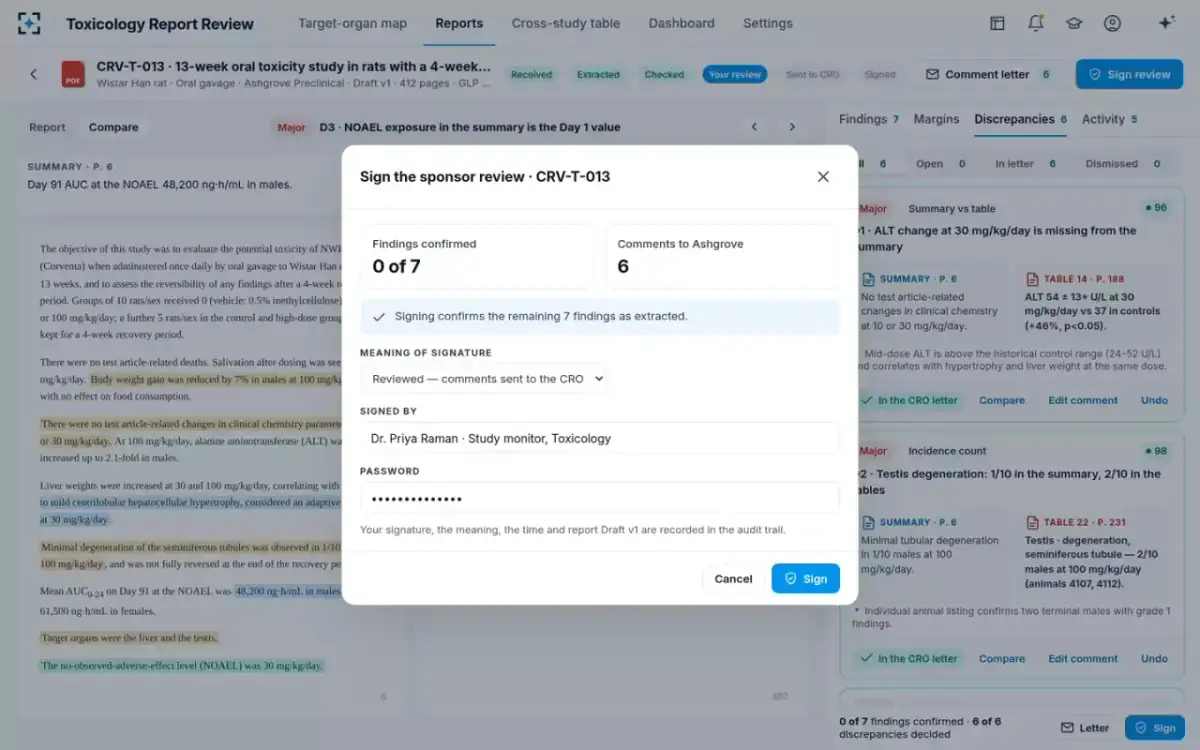
The audit trail an inspection will ask for
The requirement is short and exacting: "use of secure, computer-generated, time-stamped audit trails to independently record the date and time of operator entries and actions that create, modify, or delete electronic records", with the rider that a change to a record must leave the earlier information visible, and that the trail is retained at least as long as the records themselves and is available for agency review and copying (21 CFR 11.10(e)).
Three words in that sentence are worth testing in a pilot rather than accepting on a datasheet. Computer-generated: the trail cannot be something a user writes. Independently: it cannot be derived from the same fields a user can change. Not obscure: an edit must leave the earlier value readable, not replace it.
FDA's own inspection programme approaches it from the procedures side. An investigator is directed to "determine whether there are SOPs to ensure the quality and integrity of data, including input (data checking and verification), output (data control), and an audit trail covering all data changes" (FDA Compliance Program 7348.808). The same programme notes that Part 11 "describes the technical and procedural requirements that must be met if a firm chooses to maintain records electronically and/or use electronic signatures", and that it works alongside the predicate rules that establish what must be kept and signed in the first place.
Section 11.10 asks for more than the trail, and the rest is a usable checklist for an IT reviewer: validation of the system so that invalid or altered records can be discerned; the ability to generate accurate and complete copies in human-readable and electronic form for inspection; protection of records for ready retrieval through the retention period; access limited to authorised individuals; authority checks so that only authorised people can sign, alter a record or perform an operation; and written policies that hold individuals accountable for actions taken under their signatures.
The boundary Toxicology Report Review draws, and the one a pilot should test in any system
What it reads
- The study report, draft, amendment and final
- The toxicokinetic report
- The pathology report and the individual animal listings
- The protocol and its amendments
- Your clinical exposure reference
What it proposes
- Each finding with its incidence, severity and page
- Differences between the summary and the tables, with both sources shown
- Exposure margins and human-equivalent doses, with the basis of each stated
- A numbered comment letter to the study director
What only a person does
- Call a finding adverse or adaptive
- Accept or dismiss each difference, with a reason for a dismissal
- Confirm the target organ list
- Sign the sponsor review, and release the letter
What you bring: the SOP, the exposure reference, a sample of past reports
A pilot of a review tool is only as good as the rules it is given, and those rules are yours. Three inputs matter, and a vendor that does not ask for all three is going to show you its defaults rather than your work.
The review procedure comes first: what your reviewers check, in what order, and what makes something major rather than minor. Then the clinical exposure reference — the exposure at steady state for each planned clinical dose — because without it no margin can be computed and the most valuable output is unavailable. Then a sample of past reports, which is how the system learns what your laboratories' documents look like rather than what reports look like in general.
In Toxicology Report Review those inputs become settings you can see and change, each on the activity trail: the seven checks the reviewer runs, each switched on or off; whether a summary-versus-table mismatch is graded major or minor; the margin floor at three, five or ten times the level at which nothing adverse was seen; whether only studies as long as the clinical plan may set an organ's margin or all repeat-dose studies may; the exposure basis; the comment window agreed with each laboratory; the controlled terminology release; and the severity grading scale. The solution is built from your own procedure, exposure reference and sample of past reports, and goes live once every check has passed.
The settings a pilot sets in Toxicology Report Review, and which an inspection can read
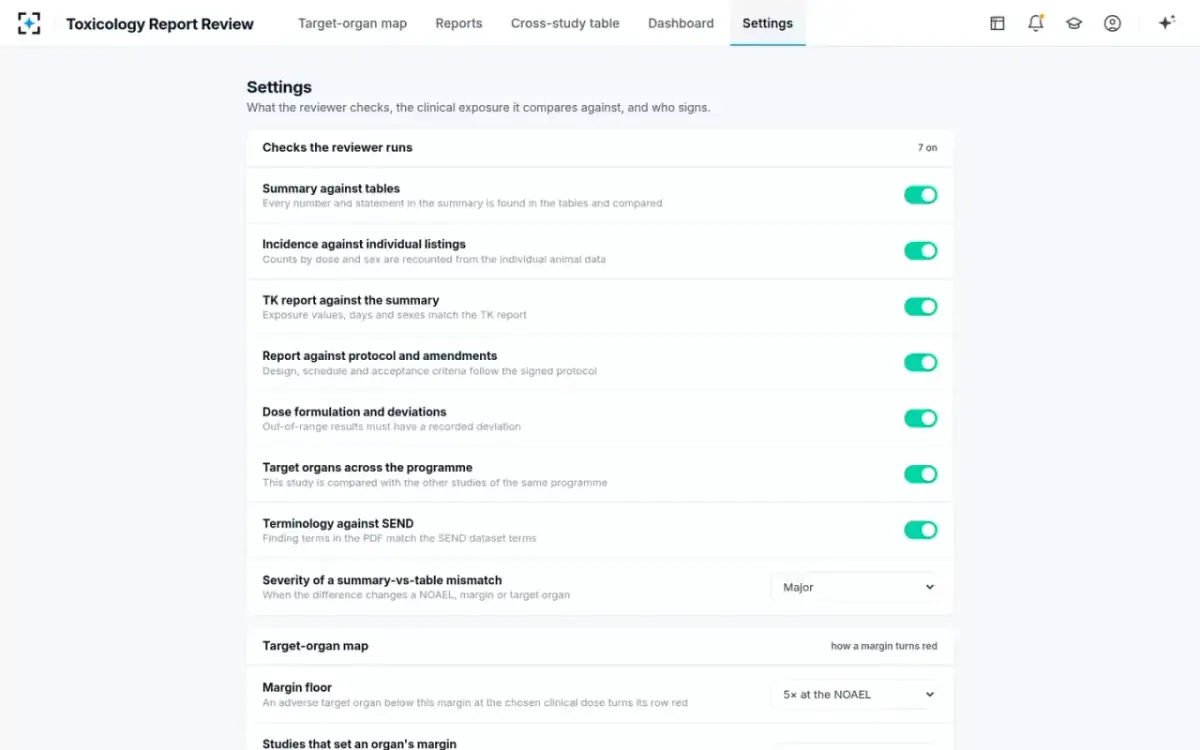
What to have ready before week 0
- Your review procedure
What is checked, in what order, and who signs. If it is not written down, the pilot will measure the vendor’s assumptions instead of yours.
- The severity rules
What makes a difference major rather than minor. These belong to your toxicology function and should never be a vendor default.
- The clinical exposure reference
Exposure at steady state for each planned clinical dose. Without it there are no margins and the pilot tests half the system.
- The margin floor
Three, five or ten times the level at which nothing adverse was seen — whichever your programme uses, stated before the first report is run.
- Five past reports and their comment letters
Chosen to vary by laboratory, species and report status, with at least one awkward appendix among them.
- The sealed answer list
Written from the letters you sent, including the items you considered and dropped, and not changed once the pilot starts.
- The context of use, in one sentence
What the system does, how its outputs are used, and who decides. It is the shortest useful risk assessment you will write.
A sequence that reaches go-live in weeks
After a successful pilot the remaining work is mostly yours rather than the vendor's, and it goes in a fixed order. Settings first, from the procedure rather than from the pilot's temporary values. Then the people: who is named for each programme, who may sign, and what meanings their signatures can carry. Then one programme, run in parallel with the existing process for its next two drafts, so that the first real comment letter has a hand-made comparison behind it. Then the rest.
Two things should be in place before the first letter leaves. The signed study report remains the official document, so the system must be read-only against source files and must label any value read from a draft as draft. And the signature must come before the letter, not after it — a sequence worth testing once deliberately, by trying to send without signing.
Plan the life-cycle work too, because it is cheap to set up now and awkward later. FDA's draft guidance on AI describes life cycle maintenance as "the management of changes to AI models whether incidentally or deliberately, to ensure the model remains fit for use over the drug product life cycle for its COU", a "set of planned activities to monitor and ensure the model's performance and its suitability throughout its life cycle" (FDA draft guidance, January 2025). In practice that means re-running your five sealed reports once or twice a year and comparing the three counts with the pilot's. It takes an afternoon and it is the only evidence that nothing has drifted.
Signed, with every step and its time
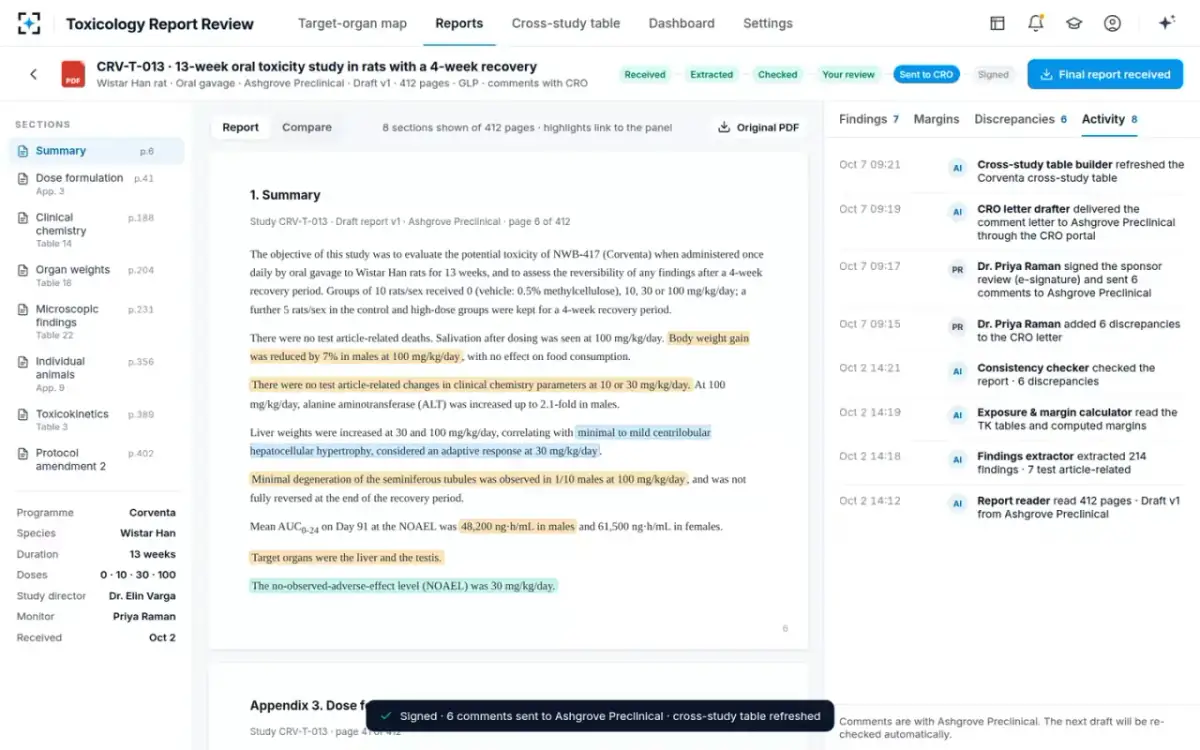
One requirement sits outside the system and should be stated once in any evaluation document. The contract laboratory's final report is signed and dated by its study director (21 CFR 58.185), and that document, not anything in your review system, is the official study record. A review tool produces comments, decisions and a signed sponsor review; it does not produce the study.
To run this design against a sample of your own past drafts, start from Toxicology Report Review, or read what a machine can and cannot be allowed to do with a study report before the pilot's scoping week.
Questions people ask
How long should a preclinical software pilot take?
Six weeks is a workable shape for five reports: a scoping week, a seeding week, two weeks of measured running and scoring, a week on electronic signature and audit trail evidence, and a decision. Shorter pilots usually drop the signature week, which is the one quality assurance will ask about later.
What does 21 CFR Part 11 require of an electronic signature?
That the signed record clearly shows the printed name of the signer, the date and time the signature was executed, and the meaning associated with it — review, approval, responsibility or authorship. Those items must carry the same controls as the record and appear in any human-readable form of it, so a signature that is visible on screen but missing from the printout does not satisfy the rule.
What does a Part 11 audit trail have to record?
Secure, computer-generated, time-stamped entries recording the date and time of operator entries and actions that create, modify or delete electronic records, independently of the records themselves. Changes must not obscure what was there before, and the trail must be retained at least as long as the records and be available for agency review and copying.
How do you measure whether the software found real errors?
Score three counts against a list sealed before the pilot started: found, missed, and invented. Have the scoring done by someone who did not operate the system. The invented count decides usability — every spurious item costs a reviewer the time to open both sources and dismiss it — so insist that every raised item shows two sources.
What do we have to bring to a pilot?
Your review procedure, your severity rules, the clinical exposure reference for each planned dose, the margin floor you use, five past reports with the comment letters you actually sent, and a sealed answer list written from those letters. A vendor that does not ask for the exposure reference cannot compute margins, which is half of what the pilot should be testing.
Who signs in the system, and what does the signature mean?
The sponsor's named toxicologist or study monitor signs the sponsor review, choosing the meaning — for example, reviewed with comments sent to the laboratory — with the signer, the meaning, the time and the report version all recorded. The contract laboratory's study director still signs the final study report, and that document remains the official study record.