The difference between mortgage servicing and subservicing is who owns the right to service. A mortgage subservicer is a company that services mortgage loans on behalf of the company that owns that right: it collects payments, runs escrow, answers borrowers, works delinquent loans through loss mitigation and, where needed, manages foreclosure, all under a subservicing agreement. Reg X defines it in one line: a subservicer is “a servicer that does not own the right to perform servicing, but that performs servicing on behalf of the master servicer”, and the master servicer is “the owner of the right to perform servicing” (12 CFR 1024.31). What does not move with the work is the owner’s responsibility to investors and regulators, its obligation to fund advances, and its duty to oversee the subservicer. Botminds’ Subservicer Oversight is built for that last duty: it grades each subservicer every month from its own reports, its loan tape and its loan files.
Where this page uses an example, it is a fictional owner, Meridale Home Lending, which holds the servicing rights on 81,740 loans and uses three subservicers; every company, person and loan in it is invented.
Ginnie Mae’s own split of the work: most tasks may go to a subservicer, the money and signatures stay
Responsibilities in both Ginnie Mae programs (10)
- May be done by the subservicer · 7 · 70%
- Issuer only · 3 · 30%
Added in the Ginnie Mae I program (10)
- Subservicer · 4 · 40%
- Issuer only · 6 · 60%
What is a subservicer in a mortgage?
In a mortgage, a subservicer is the company that actually handles the borrower’s loan day to day when the company holding the servicing rights has contracted the work out. Three separate parties can sit behind one loan: the investor that owns the loan, the owner of the servicing rights (the servicer of record, or master servicer in Reg X’s terms), and the subservicer that does the work.
Three roles behind one mortgage, and what each holds
| Role | What it owns | What it does | Example |
|---|---|---|---|
| Investor or guarantor | The loan, or the guarantee on the security backing it | Sets the servicing rules in its guide; receives payments through the servicer | Ginnie Mae-guaranteed pools; Fannie Mae and Freddie Mac; a bank holding loans |
| Owner of the servicing rights (master servicer) | The right to service and the fee that comes with it, carried as an asset | Answers to the investor; funds advances; oversees any subservicer | A bank or nonbank that kept or bought the rights |
| Subservicer | Nothing in the loan or the rights | Payments, escrow, statements, calls, collections, loss mitigation, foreclosure, investor reporting | A firm that services for many owners under contract |
The work itself is the ordinary content of mortgage servicing. FHFA’s Inspector General lists it as “sending borrowers monthly account statements and tax documents, responding to customer service inquiries, maintaining escrow accounts for property taxes and hazard insurance, and forwarding monthly mortgage payments to the loan owners”, and, when borrowers fall behind, actions “from offering a workout option to allow the borrower to stay in the home to initiating foreclosure proceedings” (FHFA OIG, AUD-2024-003). A subservicer can do every one of those tasks.
Subservicer vs servicer: who holds the rights, and who holds the cash
The difference between a servicer and a subservicer is ownership: the servicer owns the servicing rights and carries them on its balance sheet; the subservicer owns nothing and is paid a fee to do the work. FSOC sets out the difference in four lines, and the fourth is the one that matters most in a downturn.
Servicer and subservicer, as FSOC distinguishes them
Servicer (owner of the rights): Holds them.
Subservicer: Does not hold them.
Servicer (owner of the rights): Records the servicing asset.
Subservicer: Does not record a servicing asset.
Servicer (owner of the rights): Retains some, or most, functions.
Subservicer: Provides the functions the servicer does not perform.
Servicer (owner of the rights): Responsible for the advances the servicing contract requires.
Subservicer: Not responsible for those outlays.
That split explains who uses subservicers. FSOC describes originators without an in-house servicing platform that “still value the servicing income and will retain the servicing while contracting out the loan administration”, and passive investors, such as mortgage real-estate investment trusts, that hold servicing rights for yield and as a hedge and “are more likely to outsource loan administration duties to a subservicer” (FSOC, 2024). How large that market has become is its own story.
Master servicer vs subservicer: two meanings of “master”
In Reg X, the master servicer is simply the owner of the servicing right, who may service the loans itself “or do so through a subservicer” (1024.31). The subservicer services on its behalf. Reg X treats both as servicers: its transfer rules, for example, define a transferee or transferor servicer as “a servicer, including a master servicer or a subservicer” (1024.38(b)(4)(iii)).
In some securitization documents the term means something narrower: a party appointed by the trust to oversee several primary servicers, reconcile their remittances and step in if one fails. FHFA’s eligibility rules use “Master Servicer” in the Reg X sense, as the servicer whose owned loans count toward its capital and liquidity (FHFA FAQs), and Ginnie Mae’s subservicing approval form, HUD-11707, is itself titled a Master Servicing Agreement. When the word appears in a contract, read the definition section before assuming which role is meant.
What a subservicer does when a borrower falls behind
When a borrower falls behind, the subservicer runs the default clocks Reg X sets, and this is where most of the owner’s risk sits. It must make good-faith efforts to establish live contact “no later than the 36th day of a borrower’s delinquency” and send a written notice “no later than the 45th day” (12 CFR 1024.39), and assign personnel to the borrower by the same day 45 under the continuity-of-contact rule in 1024.40.
If the borrower applies for help, the subservicer must acknowledge the application within five days, excluding weekends and holidays, saying whether it is complete; decide a complete application within 30 days of receiving it, if it arrived more than 37 days before a sale; and keep the foreclosure from moving while the protections apply. No first foreclosure filing may be made until the loan is more than 120 days delinquent (12 CFR 1024.41). The official commentary also requires staff to tell the people handling foreclosure, often outside counsel, promptly when a complete application has arrived (comment 38(b)(3)(iii)-1).
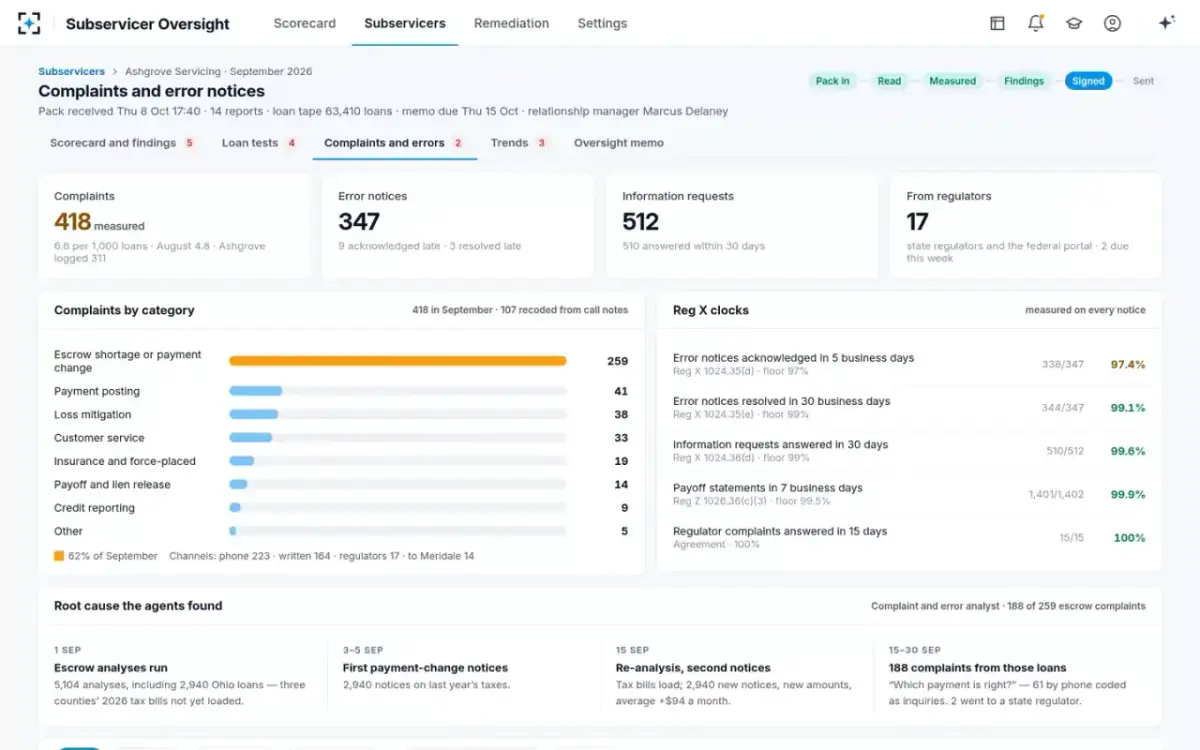
Each of those steps runs on the subservicer’s people and systems, and each failure lands on the owner. In the fictional sample month, the subservicer’s loss-mitigation team had shrunk from 46 underwriters to 33 over the year while complete applications rose from 281 to 362 a month; seventeen complete applications missed the 30-day decision, and two of those borrowers had a foreclosure sale set. The subservicer’s own foreclosure report showed no such loans.
What a subservicer reports to the owner each month
A subservicer reports its month to the owner as a pack of reports and, if the agreement requires it, a loan-level tape. The sample owner receives 14 reports, from the service-level scorecard and delinquency, loss-mitigation and foreclosure reports to complaints, notices of error, escrow, custodial accounts, investor reporting, payoffs, the call centre, the subservicer’s own quality control, early intervention and staffing, plus a tape of 63,410 loans with 412 fields and an invoice.
For investor-backed loans the subservicer may also prepare what the owner sends to the investor. Under Ginnie Mae’s rules a subservicer may prepare and transmit the issuer’s monthly report of pool and loan data, while the issuer remains liable for it. The owner’s oversight, in other words, is partly a check on reports that will go out under its own name.
Who is responsible if the subservicer makes a mistake?
Both can be. The owner stays responsible to investors and regulators for the servicing of its loans, and the subservicer is responsible for its own conduct under the law and its contract. Ginnie Mae keeps the issuer fully responsible for every servicing function it delegates (MBS Guide, chapter 4), and the CFPB’s service-provider bulletin warns that a provider which does not implement legal requirements carefully “can harm consumers and create potential liabilities for both the service provider and the entity with which it has a business relationship” (Bulletin 2016-02).
Regulators also act against subservicers directly. In 2021 the OCC issued a consent order against Cenlar FSB, which it called “the largest mortgage sub-servicer in the country”, for failing “to establish effective controls and risk management practices related to its mortgage servicing and subservicing activities”, and required its no supervisory objection “before adding new subservicing clients” (OCC NR 2021-111). Neither kind of action relieves the owner: its oversight is what is supposed to find the problem first.
What stays with the owner of the servicing rights when a subservicer does the work
- The investor relationship
Ginnie Mae, Fannie Mae and Freddie Mac deal with the owner; for Ginnie Mae the issuer is liable for what a subservicer reports in its name.
- The cash
Advances the servicing contract requires; FSOC places them with the servicer, and Ginnie Mae keeps custodial withdrawals with the issuer.
- Capital and liquidity
FHFA’s requirements apply to loans the owner holds as master servicer, not to loans it has others subservice.
- Certifications and signatures
Ginnie Mae reserves most certifications and signatures to the issuer.
- The oversight duty
Reg X 1024.38(b)(3): access to the subservicer’s records, periodic reviews able to audit compliance, and foreclosure status shared with counsel.
- The borrower outcome
If the subservicer misses a clock, the owner answers for it to the investor and, often, to the regulator.
Why a borrower’s statement shows a different company
Usually because the company that services the loan day to day is not the company that owns it, and sometimes not the one that owns the servicing rights either. The name on the statement is normally the servicer handling the account; that may be a subservicer working for the owner of the rights, which in turn services for the investor that owns the loan. The borrower’s payments, escrow and questions go to the company named on the statement.
For borrowers, the practical point is that the protections do not change with the arrangement. The subservicer must meet the same Reg X deadlines for acknowledging a notice of error, evaluating a complete loss-mitigation application or paying an escrow bill on time, and the owner must be able to check that it did. When it does not, the borrower’s complaint is where the problem often shows first.
Where borrowers’ problems surface first: complaints and error notices at the subservicer
Does a subservicer own the loan?
No. A subservicer owns neither the loan nor the right to service it. The loan belongs to an investor, or sits in a pool backing a security; the servicing right belongs to the master servicer; the subservicer is a contractor. That is why a subservicer can change without the loan changing hands, and why the owner of the rights, not the subservicer, is the party investors hold to account.
How an owner checks what its subservicer does
An owner checks a subservicer by testing its work, not only reading its reports. The subservicer measures itself, and its definitions can drift from the rules: in the sample owner’s September, the subservicer reported 24 of 24 service levels met, while the owner’s testing found 19 met, 3 on watch and 2 missed, one of them the 30-day loss-mitigation decision clock.
The subservicer’s claim, as received, before the owner tests anything
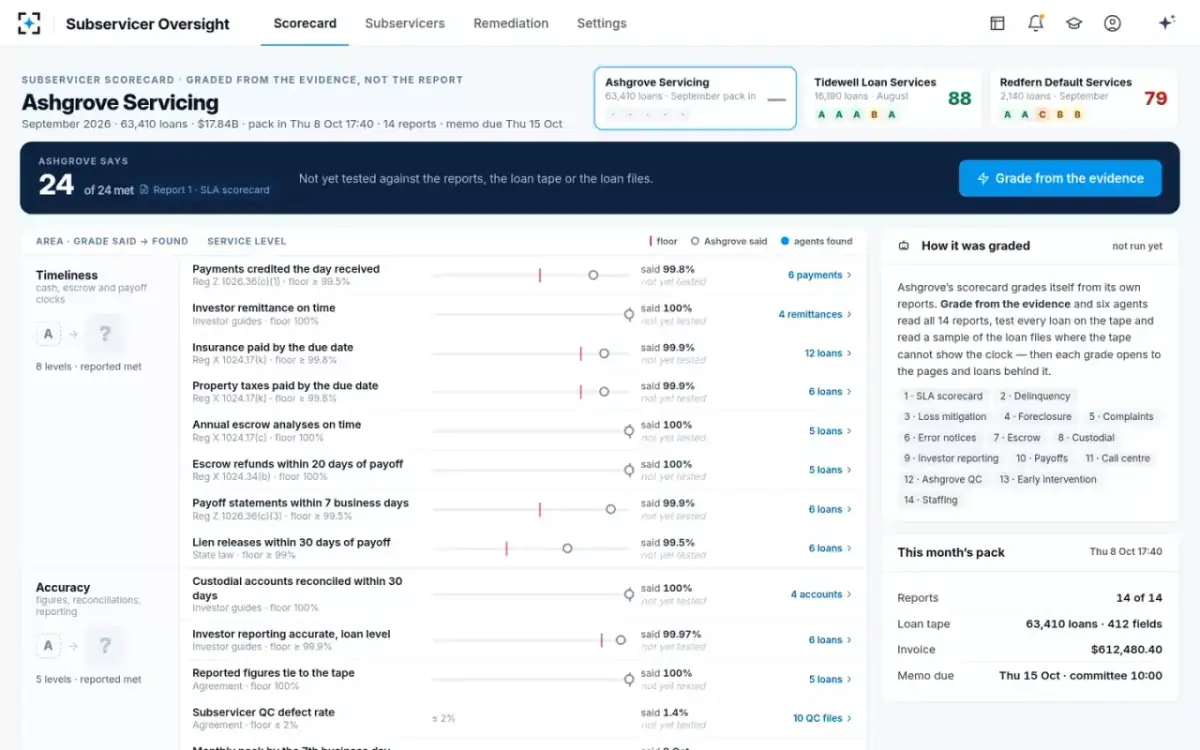
Botminds’ Subservicer Oversight does that testing every month for each subservicer, and leaves the owner’s oversight manager to decide and sign. For an issuer of Ginnie Mae securities, Ginnie Mae’s subservicer rules add approval, a one-subservicer-per-pool limit and liability for the subservicer’s reporting.
Questions people ask
What does subservicer mean?
A subservicer is a company that services loans for the owner of the servicing rights without owning those rights itself. Reg X defines it as “a servicer that does not own the right to perform servicing, but that performs servicing on behalf of the master servicer”.
Is a subservicer the same as a loan servicer?
A subservicer is a loan servicer in the sense that it does the servicing and must follow the servicing rules. What it lacks is ownership of the servicing rights, so it carries no servicing asset and does not fund the advances the servicing contract requires.
Why do companies use subservicers?
Mostly because they want the servicing income or the hedge the rights provide without building a servicing operation. FSOC names originators without an in-house platform and passive investors such as mortgage REITs as the typical users.
Does a subservicer have to follow the investor’s rules?
Yes. It services under the investor’s guide as well as the law, and Ginnie Mae makes any separate subservicing agreement subordinate to its guaranty agreement and MBS Guide. Reg X also requires servicing procedures that identify every loss-mitigation option the loan’s owner allows.
Do subservicers need to be approved?
Yes, by the investors. A Ginnie Mae subservicer must be an approved issuer with Ginnie Mae’s prior written approval of the arrangement, and a Fannie Mae or Freddie Mac subservicer must be an Enterprise-approved servicer. Nonbank subservicers also need state licences.