Loan servicing KPIs are the service levels a mortgage servicer reports each month, such as payments credited on the day received, escrow bills paid by the due date, complete loss-mitigation applications decided within 30 days and notices of error acknowledged within five days. When a subservicer does the work, those KPIs arrive in its own report pack, measured by its own systems, and an owner who reads them as given is grading the subservicer by the subservicer’s method. Two parties can measure the same service level on the same loans and get different answers, because one starts the clock at a different event, counts a different population or codes a call differently. Botminds’ Subservicer Oversight re-measures each KPI from the loan tape and the loan files and shows the owner, measure by measure, where its score and the subservicer’s agree.
The numbers below come from a fictional sample owner, Meridale Home Lending, reviewing its subservicer Ashgrove Servicing’s September pack in the solution: 14 reports and a tape of 63,410 loans. The companies, people and loans are invented.
Three loan servicing KPIs, measured twice on the same loans
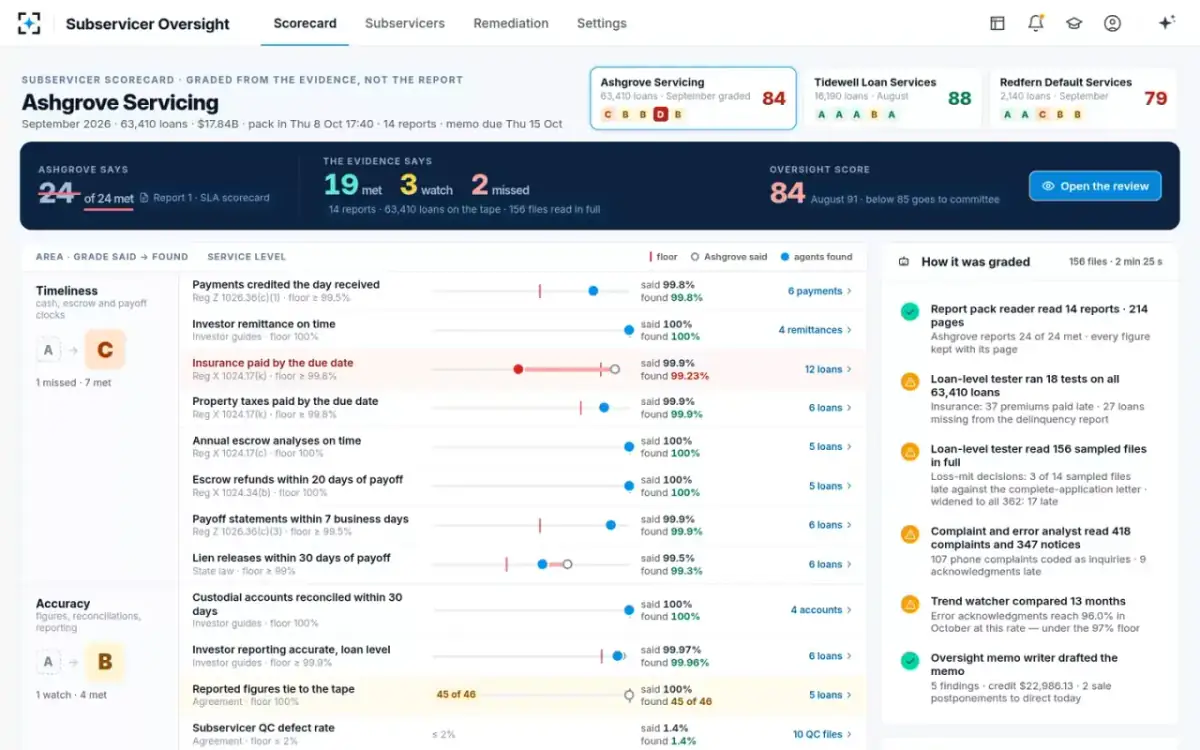
What the subservicer reported: 99.4%, met. Counted from the day underwriting received the file.
What the loan data and files show: 95.3%, missed. Counted from the day the application became complete, read from the letter in each file: 345 of 362 on time.
What the subservicer reported: 99.9%, met. Counted against the subservicer’s own scheduled payment date.
What the loan data and files show: 99.23%, missed against a 99.8% floor. Counted against each bill’s due date: 4,775 of 4,812, with 4 policies cancelled.
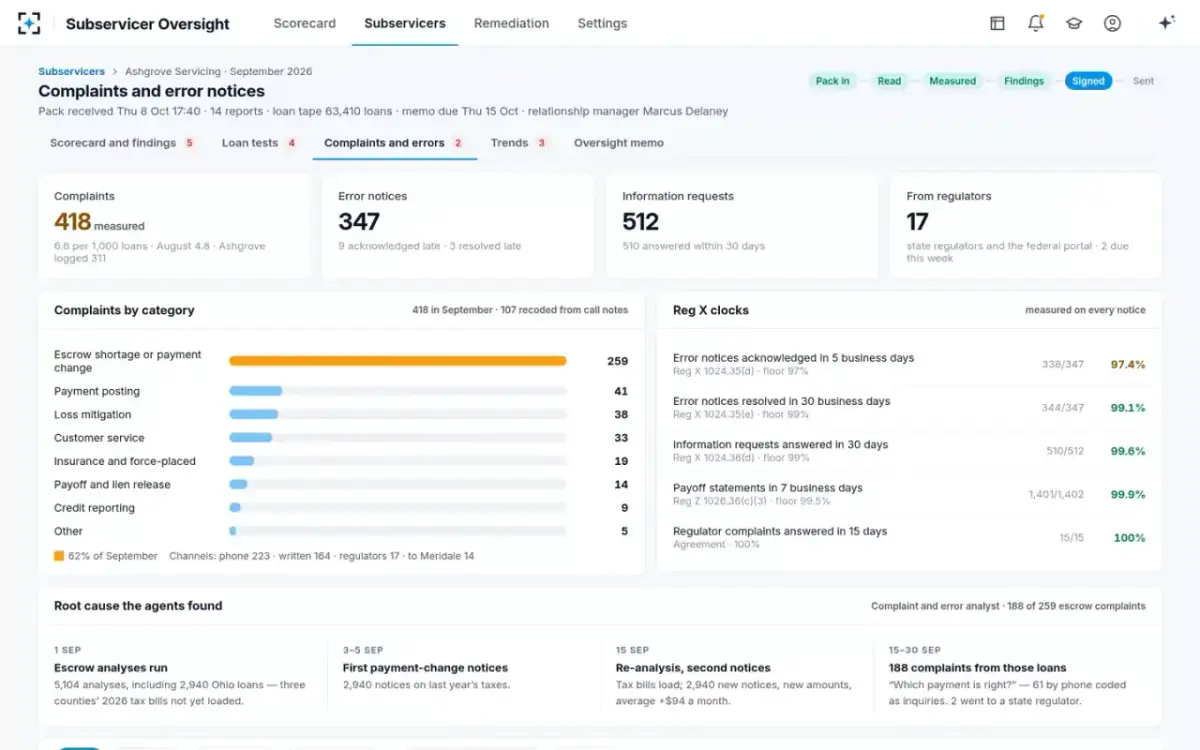
What the subservicer reported: 311 complaints, 4.9 per 1,000. Phone complaints logged as inquiries were not counted.
What the loan data and files show: 418 complaints, 6.6 per 1,000, against 4.8 in August. The subservicer’s own definition, applied to call notes, adds 107.
Why do subservicer metrics look green?
Subservicer metrics look green because the subservicer chooses, often without meaning to, the definitions that its systems can produce: the date its own team touched a file, its own payment schedule, its own coding of a call. Each choice is defensible inside the subservicer’s operation and each moves the number away from what the regulation or the contract measures. None of it requires bad faith.
Take the loss-mitigation measure. Ashgrove’s report, page 4 of Report 3, states that it counts “from the date the file was received by underwriting”. Reg X counts from receipt of a complete application: a servicer that “receives a complete loss mitigation application more than 37 days before a foreclosure sale” must decide it “within 30 days of receiving the complete loss mitigation application” (12 CFR 1024.41(c)(1)). Every day an application waits in an intake queue before underwriting sees it is a day the borrower’s clock runs and the subservicer’s does not.
The interagency guidance on third parties warns about exactly this kind of measure. It is important “to negotiate performance measures that do not incentivize imprudent performance or behavior, such as encouraging processing volume or speed without regard for accuracy, compliance requirements, or adverse effects on the banking organization or customers” (Interagency Guidance on Third-Party Relationships, 2023). A turnaround KPI that starts late rewards speed inside the subservicer’s process and hides delay in front of it.
Such measures can be used to monitor performance, penalize poor performance, or reward outstanding performance.
Interagency Guidance on Third-Party Relationships: Risk Management, 88 FR 37920 (2023)
That is the other reason definitions matter: the KPI is also the trigger for a service-level credit. In the sample agreement each missed service level credits 2.5% of the monthly base fee. A definition that turns a miss into a pass is worth money to the party that writes the report.
What is the right start date for the 30-day evaluation clock?
The 30-day evaluation clock starts on the day the servicer receives a complete loss-mitigation application, not the day an underwriter opens the file. Reg X also fixes the protections a borrower gets “as of the date a complete loss mitigation application is received” (1024.41(b)(3)), and treats an application as facially complete once the borrower sends the missing items named in the acknowledgment notice (1024.41(c)(2)(iv)).
Most loan tapes cannot show that date reliably, because the field labelled “complete date” is whatever event the subservicer’s system stamps. The evidence is in the file: the dated notice that told the borrower the application was complete, and the receipt dates of the last documents. That is why the sample owner’s agents read the letter in a risk-based sample of 14 files, found 3 late, and then read all 362. How the file sample widens when it fails covers the method.
The same logic applies to every clock. Notices of error must be acknowledged within five days, excluding weekends and legal public holidays, of the servicer “receiving a notice of error” (1024.35(d)), so the start is the day the letter arrived, not the day it was coded. Escrow disbursements must be paid “on or before the deadline to avoid a penalty” (1024.17(k)(1)), so the test is against the bill, not the payment run.
Report agreement by measure, not one green scorecard
The useful output of a re-measurement is not a second scorecard but an agreement table: for each service level, the reported value, the measured value, and whether the two put the measure on the same side of its floor. Most measures will agree. The ones that do not are where the owner’s attention belongs.
Reported against measured for a selection of the 24 service levels
| Service level | Floor | Reported | Measured | Agreement |
|---|---|---|---|---|
| Payments credited the day received | ≥ 99.5% | 99.8% | 99.8% | Agree, met |
| Payoff statements within 7 business days | ≥ 99.5% | 99.9% | 99.9% | Agree, met |
| Lien releases within 30 days of payoff | ≥ 99% | 99.5% | 99.3% | Same side, gap of 0.2 points |
| Investor reporting accurate, loan level | ≥ 99.9% | 99.97% | 99.96% | Same side |
| Reported figures tie to the tape | 100% | 100% | 45 of 46 | Disagree: the delinquency report |
| Error notices acknowledged in 5 days | ≥ 97% | 99.1% | 97.4% | Same side, but falling: watch |
| Insurance paid by the due date | ≥ 99.8% | 99.9% | 99.23% | Disagree: missed |
| Complete applications decided in 30 days | ≥ 99% | 99.4% | 95.3% | Disagree: missed, critical |
Read down the last column and the subservicer’s month is clearer than any single grade. Payment processing agrees to the decimal. Accuracy agrees except for one report that does not tie: the pack showed 1,184 loans 60 or more days delinquent, the tape 1,211. The disagreements cluster in the two places where the subservicer’s definition departed from the rule’s start event.
Every service level on one line: the floor, what was said and what was found
Why the denominator matters as much as the clock
A KPI’s denominator decides how much a single failure weighs, so the population behind each measure should be stated and recounted, not assumed. In the sample month the populations ranged from 362 complete loss-mitigation applications to 4,812 insurance premiums due and 63,410 loans on the tape. Seventeen late decisions out of 362 moves the loss-mitigation measure by almost five points; 37 late premiums out of 4,812 moves the insurance measure by less than one.
That asymmetry is why a single portfolio-wide score hides the measures that matter most. The loss-mitigation population is small and its failures are severe, because two of the seventeen late applications had a foreclosure sale set. A scorecard that averages it with payment processing on 63,410 loans will always look healthy. The same arithmetic runs the other way for rates: the 60-day delinquency figure on the tape, 1,211 loans or 1.91%, is the base from which the next quarter’s loss-mitigation volume will come, and a rising delinquency rate tells the owner which small populations are about to grow.
Recounting is the check. If the subservicer reports 362 complete applications and the owner’s count from the tape and files is different, the rate is wrong before anyone looks at the clock. The sample owner’s reconciliation tied 45 of the 46 figures in the pack to the tape; the one that did not, the delinquency count, was itself a finding.
Which loan servicing KPIs belong on the committee page?
The committee page should carry the agreement table, not a single score: each service level’s floor, the reported value, the measured value and whether they agree, with the misses and watch items at the top. Under it, three things the committee cannot get from the table: the trend of each slipping measure with its forecast, the cause the evidence points to, and the money, meaning any service-level credit and the remediation items opened.
The sample owner’s committee threshold is an oversight score of 85, and September’s 84, down from 91, put Ashgrove on the agenda. The score is a summary; the agreement table is the substance. A committee that sees only “84” will ask what changed. One that sees “loss-mitigation decisions, reported 99.4%, measured 95.3%, clock started at underwriting rather than at a complete application” can decide what to require of the subservicer in the same meeting.
What KPIs should a subservicer report?
A subservicer should report the service levels in the subservicing agreement, each with its definition, its population and its start event, plus the volumes and staffing that explain them. In the sample owner’s pack that is 14 reports: the SLA scorecard, delinquency, loss mitigation, foreclosure, complaints, error notices, escrow, custodial accounts, investor reporting, payoffs, the call centre, the subservicer’s own QC, early intervention and staffing.
The staffing report is the one owners most often skip, and it is the one that explains a slide. In the sample, loss-mitigation underwriters at the subservicer fell from 46 to 33 over the year while complete applications rose from 281 to 362 a month. No KPI in the pack mentioned the link; the trend made it visible.
What every reported KPI should carry before an owner accepts it
- The start event, in the rule’s words
Receipt of a complete application; receipt of a notice of error; the bill’s penalty date. Not an internal milestone.
- The population
Which loans or items are in the denominator, and which are excluded and why.
- The stop event
A decision letter sent, not a decision keyed; a disbursement made, not scheduled.
- The coding rule
For complaints, the definition applied to every channel, including calls.
- The loan list behind any exception
So the owner can re-test the misses, not just count them.
- The source system and page
So a figure in the pack can be tied back to the tape.
How to measure complaints per 1,000 loans
Complaints per 1,000 loans is the number of complaints received in the month, across every channel, divided by the loans serviced, times 1,000. The arithmetic is easy; the count is not. Written complaints arrive labelled. Phone complaints arrive as call notes, and whether a call becomes a complaint depends on someone applying a definition in the moment.
In the sample month Ashgrove logged 311 complaints, which on 63,410 loans is 4.9 per 1,000, comfortably under the 7.0 ceiling in the agreement. The agents applied Ashgrove’s own complaint definition to its call notes and found 107 phone complaints coded as inquiries. The measured figure is 418, or 6.6 per 1,000, against 4.8 in August: still under the ceiling, but a rise of more than a third in a month. The cause was escrow: analyses run on 1 September before three Ohio counties’ 2026 tax bills loaded, so 2,940 borrowers received two payment-change notices two weeks apart.
Complaints recounted from every channel, with the Reg X clocks measured on every notice
What is a service level floor, and what is a watch band?
A service level floor is the minimum performance the subservicing agreement requires for a measure, such as 99% of complete applications decided within 30 days; falling below it is a miss and usually triggers a credit. A watch band is the owner’s own early-warning rule: a measure that has not breached yet but is falling, or is forecast to cross its floor.
A measure can pass every month and still be heading for a breach
The sample owner’s watch band flags a measure that falls three months running or is forecast to breach within two months. Error-notice acknowledgments qualified on both counts while still passing. In a scorecard that only shows met or missed, this measure would have been green in September and red in October, with no warning in between.
How to verify a subservicer’s scorecard in a month
Verify a scorecard by re-measuring the service levels that carry borrower clocks from their start events, recounting the reported figures from the tape, and reading the files where the tape cannot show the date. In order: take the agreement’s definitions; check each against the rule; recompute what the tape can answer for every loan; sample the files for what it cannot, and widen when the sample fails; recode complaints from call notes; then compare.
Done by hand, that is weeks of work for one subservicer, which is why most owners verify a few measures and accept the rest. Botminds’ Subservicer Oversight does the re-measurement on every measure each month and keeps the reported figure beside the found one, so the gap is visible rather than averaged away. The definitions themselves belong in the contract: the subservicing agreement clause that decides when each clock starts shows how to write them.
Questions people ask
What mortgage servicing data does an owner need to re-measure KPIs?
The monthly loan tape with the fields behind each measure, the reports in the pack, access to loan files and letters for dates the tape cannot show, and the complaint and correspondence logs including call notes. In the sample, the tape had 412 fields for 63,410 loans.
Are the subservicer’s numbers wrong when the two scores differ?
Not necessarily. Most gaps come from a definition, such as a start date or a coding rule, that differs from the rule or the contract. The fix is to agree the definition, then measure both ways until the numbers converge.
Which loan servicing KPIs matter most to regulators?
The ones attached to borrower clocks in Reg X: early intervention by days 36 and 45, the loss-mitigation acknowledgment and 30-day evaluation, the foreclosure protections, and the notice-of-error and information-request deadlines. Escrow disbursement by the penalty date and prompt payment crediting matter too.
Should KPIs be reported monthly or quarterly?
Monthly, with thirteen months of history. Quarterly reporting averages away exactly the slide a watch band is meant to catch, and the costliest Reg X clocks run in days.
What is a good complaint rate for a mortgage servicer?
There is no published industry benchmark; the agreement sets a ceiling and the trend matters more than the level. A sudden rise, as from 4.8 to 6.6 per 1,000 in the sample, is worth a root-cause read even under the ceiling.