A subservicing agreement is the contract under which a subservicer services mortgage loans for the owner of the servicing rights, and its service-level schedule decides what the owner can measure, credit and enforce each month. The clause that matters most is rarely negotiated: when each clock starts. If the agreement measures the 30-day loss-mitigation decision from the day the subservicer’s underwriter receives the file, while Reg X counts from receipt of a complete application, the subservicer can report 99.4% on time while the true figure is 95.3%, and the owner can neither collect a credit nor show an examiner it noticed. Write the regulation’s own start event into each service level, require the evidence that proves it, and the scorecard and the law measure the same thing. Botminds’ Subservicer Oversight reads those definitions from the agreement as settings and re-measures every service level against them.
The examples come from a fictional owner, Meridale Home Lending, and its subservicer Ashgrove Servicing; their agreement, its Schedule B service levels and Schedule C credits are invented, as are every person and loan named.
Five service levels, as often written and as the rule starts them
Complete applications decided within 30 daysReg X 1024.41(b)(3), (c)(1), (c)(2)(iv)
As often writtenfrom the date the file is received by underwriting
Written to the rulefrom receipt of a complete loss-mitigation application, or the date it first became facially complete
Evidencethe complete-application notice and document receipt dates in the file
Insurance and taxes paid by the due dateReg X 1024.17(k)(1)
As often writtenby the scheduled disbursement date
Written to the ruleon or before the deadline to avoid a penalty, while the borrower is not more than 30 days overdue
Evidencethe bill’s due date and the disbursement date, per loan
Notices of error acknowledged within 5 daysReg X 1024.35(d)
As often writtenwithin 5 days of being logged as a notice of error
Written to the rulewithin five days, excluding legal public holidays, Saturdays and Sundays, of receiving the notice
Evidencethe date stamp on the letter at the designated address
Payments credited the day receivedReg Z 1026.36(c)(1)
As often writtencredited within one business day of posting
Written to the rulecredited as of the date of receipt
Evidencereceipt date and credit date on the payment history
Complaints per 1,000 loansContract definition
As often writtenwritten complaints logged in the complaint system
Written to the ruleevery complaint meeting the agreement’s definition, in every channel, including calls
Evidencecomplaint log and call notes, recoded against the definition
Why the start event decides the score
A service level is a ratio of items that met a deadline to items that should have, and the deadline is measured from a start event. Move the start event later and every item gains days; nothing about the servicing changes, but the percentage rises. Because the subservicer produces the report, the start event is usually whichever date its systems stamp, which tends to be the date its own team first touched the item.
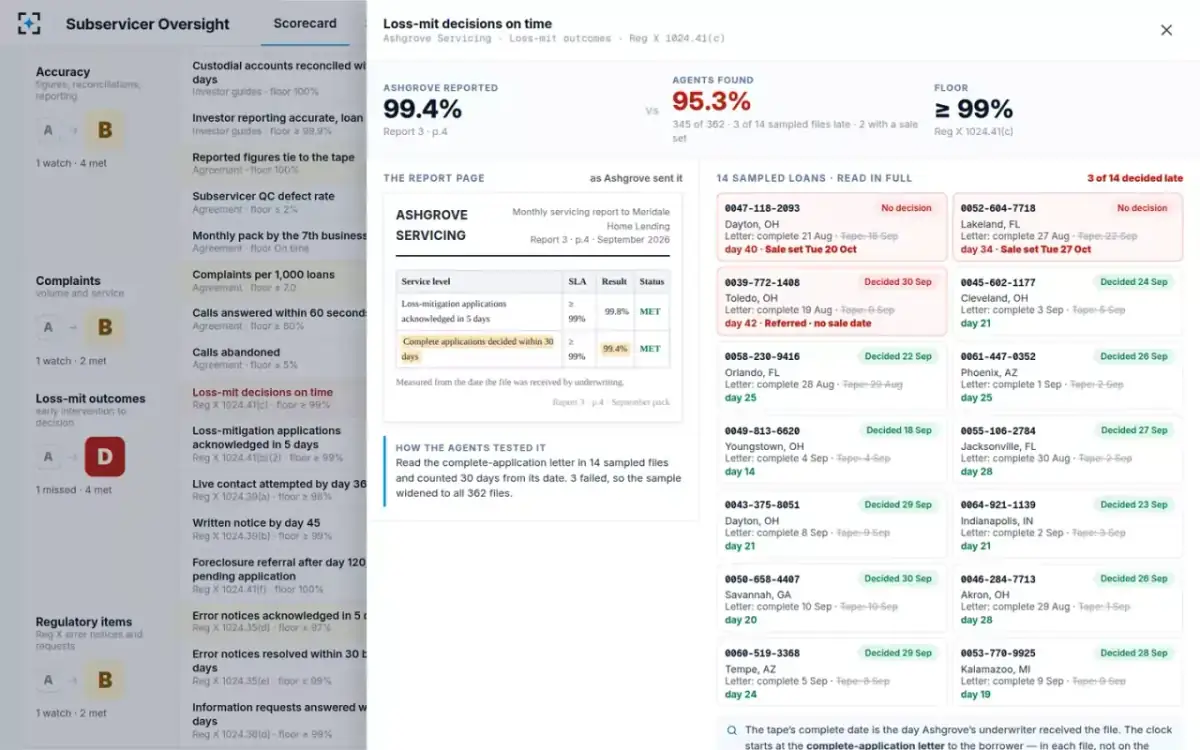
In the sample month the effect was large. Ashgrove’s report, page 4 of Report 3, stated that the loss-mitigation decision rate was measured from the date the file was received by underwriting, and showed 99.4% against a 99% floor. Reg X says a servicer that “receives a complete loss mitigation application more than 37 days before a foreclosure sale” must decide it “within 30 days of receiving the complete loss mitigation application” (12 CFR 1024.41(c)(1)), and fixes the borrower’s protections “as of the date a complete loss mitigation application is received” (1024.41(b)(3)). Measured that way, from the letters in the files, 345 of 362 applications were decided in time: 95.3%, a missed service level, with two of the late ones attached to scheduled foreclosure sales.
The insurance measure drifted the same way on a smaller scale. Ashgrove measured premiums against its own scheduled payment date and reported 99.9%. Reg X requires escrow disbursements “on or before the deadline to avoid a penalty” (1024.17(k)(1)). Against each bill’s due date, 4,775 of 4,812 premiums were paid on time, 99.23% against a 99.8% floor, and four policies were cancelled. How to re-measure each KPI works through the rest of the scorecard.
What service levels should a subservicing agreement include?
A subservicing agreement should include a service level for every borrower clock in Reg X and Reg Z that the subservicer runs, plus the investor reporting, custodial and accuracy measures the owner answers for, each with a floor, a credit and a definition. The sample agreement’s Schedule B has 24, grouped into five areas.
The five areas of a subservicing agreement’s service-level schedule
| Area | Examples of service levels | Rule or source |
|---|---|---|
| Timeliness | Payments credited the day received; insurance and taxes paid by the due date; escrow analyses on time; payoff statements within 7 business days; lien releases | Reg Z 1026.36(c); Reg X 1024.17, 1024.34; state law |
| Accuracy | Custodial accounts reconciled within 30 days; investor reporting accurate at loan level; reported figures tie to the tape; subservicer QC defect rate | Investor guides; the agreement |
| Complaints | Complaints per 1,000 loans; calls answered and abandoned | The agreement’s complaint definition |
| Loss-mitigation outcomes | Live contact by day 36; written notice by day 45; applications acknowledged in 5 days; complete applications decided in 30 days; no foreclosure referral or sale step barred by a pending application | Reg X 1024.39, 1024.41 |
| Regulatory items | Notices of error acknowledged in 5 days and resolved in 30; information requests answered in 30; regulator complaints answered on time | Reg X 1024.35, 1024.36; the agreement |
Two additions are worth writing in even though no regulation sets them. A reporting service level, such as the monthly pack delivered complete by the seventh business day, makes lateness and missing reports a measurable miss. A tie-out service level, every reported figure reconciling to the loan tape, makes the accuracy of the pack itself enforceable; in the sample month, 45 of 46 figures tied, and the one that did not was the delinquency count.
How to define clock start in an SLA
Define each clock by naming three things in the regulation’s words: the start event, the stop event and the population, then say what evidence settles a dispute. For loss mitigation that reads: “measured from the date the Subservicer receives a complete loss mitigation application, or the date it first becomes facially complete under 12 CFR 1024.41(c)(2)(iv), to the date the written decision notice is sent, for every complete application received more than 37 days before a scheduled sale”.
The stop event deserves the same care. A decision keyed into a system is not a decision sent; a disbursement scheduled is not a disbursement made. For notices of error, the start is the day the notice reaches the address the servicer designated, if it has designated one, because Reg X runs the clock from receipt (1024.35(d)). For payments, Reg Z requires crediting “as of the date of receipt” (1026.36(c)(1)), so the stop event is the effective date of the credit, not the posting run.
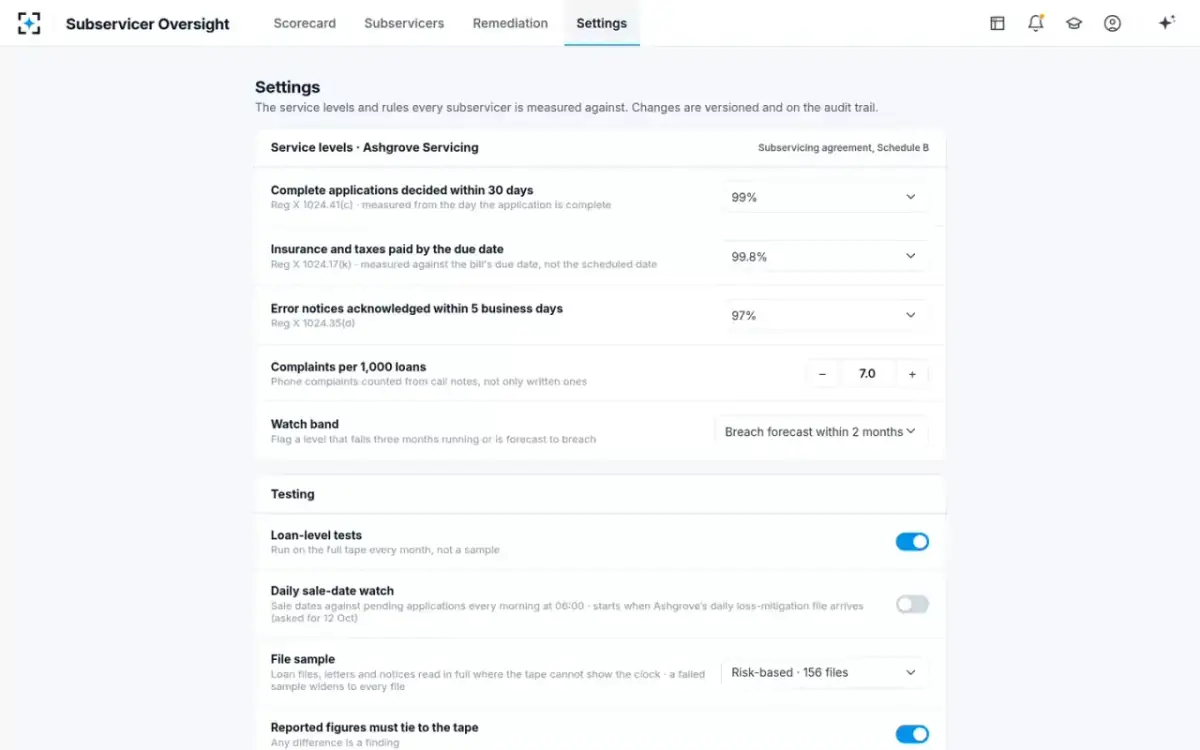
The agreement as the owner’s settings: each service level names its rule and its start event
Can the owner audit the subservicer under the contract?
Only if the contract says so, which is why the audit and information clauses matter as much as the service levels. Reg X requires the owner’s procedures to give its staff “documents and information necessary to audit compliance by service providers” (1024.38(b)(3)(ii)); a subservicing agreement that does not oblige the subservicer to provide them leaves the owner unable to meet its own rule.
The interagency guidance describes the provisions banks commonly use. A contract “often establishes the banking organization’s right to audit and provides for remediation when issues are identified”, and may “reserve the banking organization’s right to conduct its own audits of the third party’s activities or to engage an independent party to perform such audits” (Interagency guidance, 2023). Its information provisions add the owner’s access to the third party’s data and supporting documentation, “specification of the type and frequency of reports to be received”, and notice of “use of subcontractors, key personnel changes, or other business initiatives that could affect the activities involved”.
Clauses a subservicing agreement needs for oversight to work
- Service levels with the rule’s start and stop events
Each with a floor, a population and the evidence that settles disputes.
- The monthly pack, by a date
Named reports, delivered complete by a set business day, with late or missing reports a measurable miss.
- The loan-level tape
Every loan, every month, with the fields each test needs, defined in a schedule.
- File and letter access
Loan files, notices and call notes for the dates the tape cannot show, within a set number of days of request.
- The right to audit
The owner’s own audits and independent ones, of the subservicer and its relevant subcontractors.
- Service-level credits
A schedule that turns a measured miss into a credit, with a cap.
- Remediation and re-test
A plan by a date for each finding, closed only when the owner’s re-test passes.
- Escalation and urgent directions
A same-day path for anything that cannot wait, such as a sale date against a pending complete application.
- Notice of change
Staffing reductions, system changes and subcontractors, before they happen.
- Termination and transition
Defaults, cure periods, data return and an orderly transfer of the servicing.
What is a service-level credit?
A service-level credit is the amount the subservicer owes back, usually as a reduction of its monthly fee, when a measured service level falls below its floor. It gives the scorecard consequences, and the CFPB’s service-provider bulletin expects exactly that: a contract with “clear expectations about compliance, as well as appropriate and enforceable consequences for violating any compliance-related responsibilities” (CFPB Bulletin 2016-02).
A credit of 2.5% of the base fee per missed level, capped at 10%
The credit only works if the definitions do. With the subservicer’s start events, September showed no misses and no credit; with the rule’s, two misses and $22,986.13. A credit schedule attached to loose definitions rewards the measure rather than the servicing, which is the trap the interagency guidance warns of when it cautions against measures that reward speed at the expense of accuracy and compliance.
What should a subservicing agreement say about remediation?
It should say that a finding closes when the owner’s re-test shows it fixed, not when the subservicer reports a fix. The interagency guidance expects a contract to give the owner “the right to monitor and be informed about the third party’s compliance with applicable laws and regulations, and to require timely remediation if issues arise”; the agreement should add what “timely” means for each severity and what evidence closes an item.
What a finding looks like when the clock starts where the rule says
How to terminate a subservicing agreement
Terminate on the grounds and with the transition the agreement already sets out, which is why the termination clause should be written before it is needed. The interagency guidance recommends provisions for “termination and notification requirements with reasonable time frames to allow for the orderly transition of the activity”, for the return of data, and for assigning “all costs and obligations associated with transition and termination”. Bulletin 2016-02 lists “terminating the relationship where appropriate” among the steps a firm should be prepared to take.
For Ginnie Mae issuers, any separate subservicing agreement “will be subordinate to the applicable Guaranty Agreement and this Guide” (Ginnie Mae MBS Guide, chapter 4), and a new subservicer needs approval before it takes over. A transition is also when service levels are most at risk, so the oversight program should keep measuring the outgoing subservicer until the last loan has moved.
From the clause to the monthly measurement
A well-written clause is only as good as the measurement that enforces it. Botminds’ Subservicer Oversight reads the agreement’s service levels, floors, credits and definitions into its settings, tests every loan on the tape against the rule’s start event, reads files where the tape cannot show it, and drafts the credit and the remediation items into the memo for the oversight manager to sign. Where the contract and the rule differ, it can measure both, which is the evidence an owner needs to renegotiate. Setting up the program starts with this table.
Questions people ask
What is a mortgage subservicing agreement?
It is the contract between the owner of the servicing rights and the subservicer that services its loans, setting the work, fees, service levels, reporting, audit rights, remediation and termination. For Ginnie Mae loans it sits beside the approved form HUD-11707 and is subordinate to the guaranty agreement and the MBS Guide.
Should the agreement copy the regulation’s deadlines exactly?
It should copy the start and stop events exactly and may set floors tighter than the law, since a floor of 99% still allows some misses that are each a potential violation. Many owners also set an internal target above the floor for watching trends.
Who should draft the service-level definitions?
The owner’s oversight and compliance teams, with counsel, because they will measure and defend them. A schedule drafted from the subservicer’s standard reports tends to inherit its system’s dates.
Can the agreement require the subservicer to report subcontractors?
Yes, and the interagency guidance recommends notice of subcontractor use and key personnel changes. Staffing matters too: in the sample, loss-mitigation underwriters fell from 46 to 33 while applications rose, which explained the slide.
What if the subservicer disputes a measured miss?
The agreement should name the evidence that settles it, such as the complete-application notice in the file or the bill’s due date. A finding that opens to the report page, the method and the loans behind it leaves little to dispute.