Subservicer oversight requirements are the obligations an owner of mortgage servicing rights carries for the subservicer that does its servicing, and no single rule holds them all. Reg X 12 CFR 1024.38(b)(3) requires procedures that let the owner see what its service providers did and audit their compliance periodically; CFPB Bulletin 2016-02 says using a provider does not absolve the owner; Ginnie Mae requires prior approval and keeps the issuer fully responsible; FHFA requires a Fannie Mae or Freddie Mac subservicer to be an approved servicer itself; and the states that adopted the CSBS standards expect board-overseen risk management, with vendor oversight named as a core function. Botminds’ Subservicer Oversight was built to answer all five with one monthly method: grade every service level from the subservicer’s reports, its loan tape and its loan files, and leave a signed, evidenced record of what was found and fixed.
Where this guide shows the method at work, the example is a fictional sample owner, Meridale Home Lending, overseeing its subservicer Ashgrove Servicing; every company, person and loan in it is invented.
The reach of the rules on subservicing
12
states that have adopted the CSBS prudential standards for nonbank servicers
99%
of the nonbank mortgage market, by loan count, those states effectively cover
2,000
loans serviced or subserviced for others: the CSBS coverage threshold
1
subservicer permitted per Ginnie Mae pool or loan package
Subservicer oversight requirements, source by source
Each source asks a different question, and together they cover the life of the relationship: who may subservice, what the owner keeps, what it must be able to see, how it must monitor and who governs the oversight.
Five sources of subservicer oversight requirements, and what each asks of the owner
| Source | Who it binds | What it requires | Status, October 2026 |
|---|---|---|---|
| Reg X, 12 CFR 1024.38(b)(3) and commentary | Servicers subject to 1024.38, including the master servicer that owns the rights | Access to accurate, current information on providers’ actions; periodic reviews with what is needed to audit compliance; status shared with foreclosure counsel | In force; unchanged since 2016 |
| CFPB Bulletin 2016-02 and exam procedures | CFPB-supervised banks and nonbanks | Due diligence, contract terms with enforceable consequences, ongoing monitoring, prompt action including termination; examiners weigh risk per major provider | Bulletin not withdrawn in May 2025; exam procedures revised July 2026 |
| Ginnie Mae MBS Guide, chapter 4 | Ginnie Mae issuers | Subservicer must be an approved issuer; prior written approval on form HUD-11707; one subservicer per pool; issuer remains fully responsible | In force (sections effective 2018 and 2019) |
| FHFA servicer eligibility | Fannie Mae and Freddie Mac seller/servicers | A subservicer must itself be an Enterprise-approved servicer; capital and liquidity apply to loans the master servicer owns | In force (2022 requirements) |
| CSBS model prudential standards | Nonbank servicers in adopting states (≥ 2,000 loans, two or more states) | Board-overseen risk-management program; internal audit; vendor oversight named among servicer functions | Adopted by 12 states |
What does Reg X require for service provider oversight?
Reg X requires the owner’s policies and procedures to be reasonably designed so that it can do three things: give its staff “access to accurate and current documents and information reflecting actions performed by service providers”; “facilitate periodic reviews of service providers, including by providing appropriate servicer personnel with documents and information necessary to audit compliance by service providers with the servicer’s contractual obligations and applicable law”; and share loss-mitigation and foreclosure status with provider staff, “including service provider personnel responsible for handling foreclosure proceedings” (12 CFR 1024.38(b)(3)).
The official commentary adds two operational duties. Procedures must provide “for promptly obtaining information from service providers to facilitate achieving the objective of correcting errors resulting from actions of service providers, including obligations arising pursuant to § 1024.35” (comment 38(b)(1)(ii)-1), and staff must “promptly inform service provider personnel handling foreclosure proceedings that the servicer has received a complete loss mitigation application” (comment 38(b)(3)(iii)-1) (Supplement I to Part 1024). The commentary also defines “procedures” as “the actual practices followed by a servicer” (comment 38(a)-2): a written policy nobody follows does not count.
Small servicers, those servicing 5,000 or fewer loans that they or an affiliate own or originated, are exempt from 1024.38. An owner of purchased servicing rights that uses a subservicer is rarely small in that sense.
Do CFPB examiners review subservicer oversight?
Yes. The CFPB’s mortgage servicing exam procedures, revised in July 2026, include a service-provider oversight section in their general procedures, before the modules begin, and repeat the check in the foreclosure module, covering “both service providers performing foreclosure-related services and service providers performing other services” (CFPB Mortgage Servicing Examination Procedures, July 2026).
Depending on the facts and circumstances, mortgage servicers may be legally responsible for the activities of service providers. Examiners should ensure that such entities appropriately manage their relationships with service providers.
CFPB Mortgage Servicing Examination Procedures, July 2026
The procedures tell examiners to evaluate “policies, procedures, complaints, and copies of any agreements” with providers, and to use the CFPB’s service-provider bulletin as the framework. That bulletin, first issued as 2012-03 and reissued as 2016-02, says that a business relationship with a service provider “does not absolve the supervised bank or nonbank of responsibility for complying with Federal consumer financial law to avoid consumer harm” (CFPB Bulletin 2016-02). It was not among the guidance withdrawn in May 2025.
What does Ginnie Mae require for subservicers?
Ginnie Mae requires that a subservicer be a Ginnie Mae-approved issuer, that the arrangement have Ginnie Mae’s prior written approval on form HUD-11707, and that there be only one subservicer for each pool or loan package. The issuer stays fully responsible for delegated work and liable for what a subservicer reports in its name, and some functions, such as withdrawing funds from principal and interest custodial accounts and signing most certifications, can never be delegated (MBS Guide, chapter 4). Ginnie Mae’s subservicer rules are set out in full on their own page.
Fannie Mae subservicer oversight: what FHFA says, and what the guides add
For loans sold to Fannie Mae or Freddie Mac, FHFA’s eligibility rules say a subservicer “must be an Enterprise-approved servicer”, and that the capital and liquidity requirements “apply to loans where the Servicer serves as Master Servicer. Loans that are subserviced are not applied to either the capital or liquidity requirement” (FHFA Servicer Eligibility FAQs). All approved servicers, subservicers included, must meet the minimum net worth and tangible capital ratio.
The Enterprises’ own servicing guides add contractual oversight and quality-control requirements for servicers that use subservicers. Those guides are the binding text for Fannie Mae and Freddie Mac loans; this page does not quote them, and an owner should read the current versions directly.
FHFA’s position in the chain matters for what an owner can expect from it. FHFA “does not have express statutory authority to supervise nonbank seller/servicers”, whose financial and operational condition “are most closely monitored by the Enterprises to whom they deliver most of their business”, as its Inspector General put it in 2024 (FHFA OIG, AUD-2024-003). For an owner, that puts the Enterprises’ servicer requirements, and its own monitoring, in front of any federal review.
Do the CSBS prudential standards apply to subservicers?
Partly. The CSBS model standards cover nonbank servicers with “2,000 or more 1–4-unit residential mortgage loans serviced or subserviced for others” operating in two or more states, so subserviced loans count toward coverage. Their capital and liquidity requirements “have limited application to entities that only perform subservicing for others”, but the base capital and operating liquidity requirements and the corporate-governance requirements apply to subservicers (CSBS Final Model Standards, 2021).
For the owner, the governance half is the one that bites. Every covered servicer “must establish a risk management program under the oversight of the board of directors that identifies, measures, monitors, and controls risk”, and the standards list “vendor oversight” among the functions a servicer performs. Twelve states had adopted them by the end of 2025, effectively covering 99% of the nonbank market by loan count (FSOC 2025 Annual Report). State regulators, in CSBS’s words, are “the only comprehensive regulators for nonbank mortgage servicers”.
Which requirements reach a bank owner and which reach a nonbank owner
A bank that owns servicing rights: Applies, unless a small servicer.
A nonbank that owns servicing rights: Applies, unless a small servicer.
A bank that owns servicing rights: The 2023 interagency guidance from its prudential regulator: life cycle, ongoing monitoring, independent reviews, board reporting.
A nonbank that owns servicing rights: CFPB Bulletin 2016-02 if CFPB-supervised; no prudential regulator.
A bank that owns servicing rights: Generally not; banks are not state-licensed servicers.
A nonbank that owns servicing rights: CSBS standards in 12 adopting states: board-overseen risk management, internal audit.
A bank that owns servicing rights: Ginnie Mae chapter 4 as an issuer; the Enterprises’ guides and FHFA eligibility.
A nonbank that owns servicing rights: The same.
A bank that owns servicing rights: Its prudential regulator; the CFPB if large.
A nonbank that owns servicing rights: State regulators, often in multistate exams; the CFPB where it supervises.
How often must a servicer review its service providers?
Reg X says “periodic” and sets no interval; the interagency guidance says monitoring “may be conducted on a periodic or continuous basis” and should be more frequent for higher-risk and critical activities (2023 guidance). In practice the cadence is set by the subservicer’s reporting, which is monthly, and by the borrower clocks under test, which run in days. A monthly review with a daily watch on sale dates against pending loss-mitigation applications meets every source above without stretching any of them.
For banks, the same guidance adds that “the use of third parties does not diminish or remove banking organizations’ responsibilities to ensure that activities are performed in a safe and sound manner and in compliance with applicable laws and regulations, including but not limited to those designed to protect consumers”. Every source in this guide says the same thing in its own vocabulary: the work can be delegated, the responsibility cannot.
One method that satisfies all five sources
The requirements differ in wording and agree in substance, so one monthly method can satisfy them together. It needs access to the evidence, testing against the rules and the contract, action on what is found, and a signed record a reviewer can re-perform.
Seven controls that answer every source at once
- Approval and eligibility on file
Ginnie Mae’s HUD-11707 approval, the subservicer’s Enterprise approval, state licences. Re-check when the subservicer changes.
- An agreement that grants evidence
The monthly pack, the loan tape, file access and the right to audit, as Reg X’s access duty and the guidance on contracts both expect.
- Monthly testing against rule and contract
Every service level re-measured from the rule’s start event, on the full tape where possible.
- Errors traced to providers
Notices of error and complaints tied to the subservicer’s actions and root causes, per comment 38(b)(1)(ii)-1.
- Foreclosure handoffs watched
Sale and judgment dates checked against pending complete applications, per comment 38(b)(3)(iii)-1.
- Findings acted on
Directions, credits and remediation, with termination considered for repeated failures, as Bulletin 2016-02 sets out.
- Governance and records
A signed memo to a committee that reports to the board; escalation of critical findings; everything kept for independent review.
Botminds’ Subservicer Oversight runs the monthly part of that method. Its agents read the full pack, run 18 tests on every loan, read loan files where the tape cannot show a clock, recount complaints from call notes, tie reported figures to the tape and draft the memo; the oversight manager decides and signs. It does not hold approvals or licences, and it cannot test evidence an agreement does not grant.
Where the method starts each month: the subservicer’s own claim, before any testing
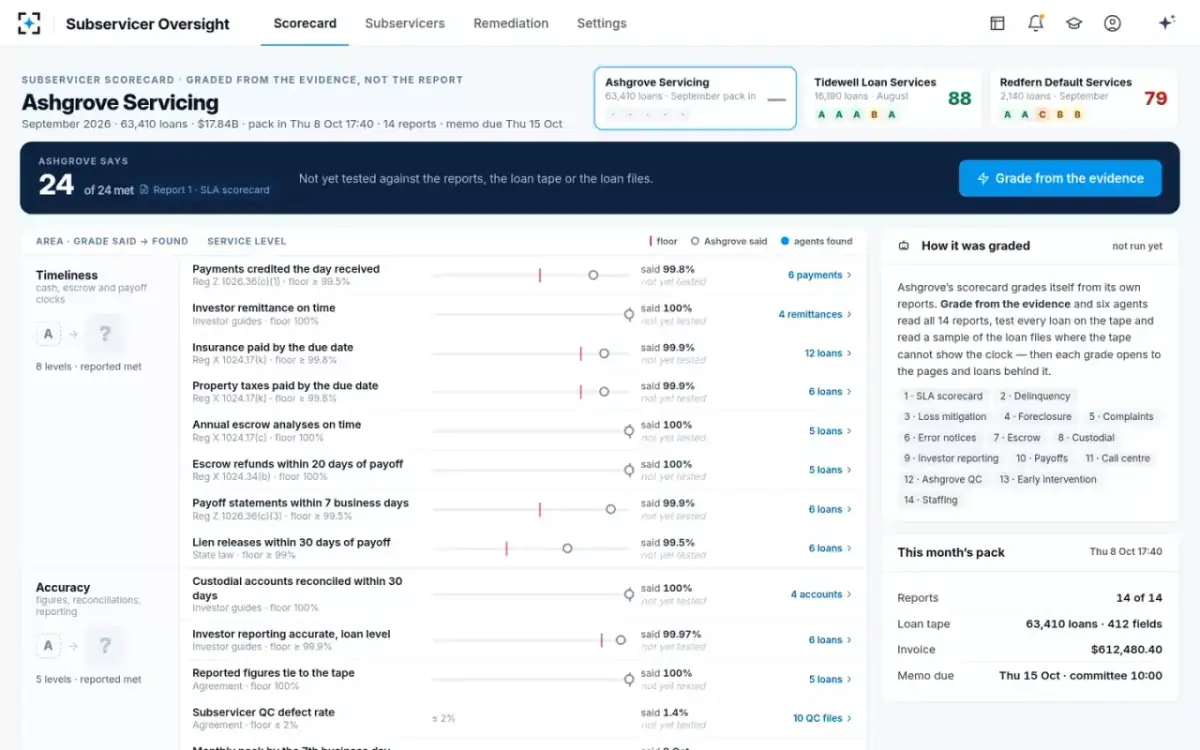
What the requirements do not settle is how to word the agreement so the evidence exists. That is the subject of the subservicing agreement clause that decides when each clock starts, and for a reader new to the arrangement, what a subservicer does and what stays with the owner.
Questions people ask
Does a subservicer need Fannie Mae approval?
Yes, for Fannie Mae or Freddie Mac loans. FHFA’s eligibility FAQ states that “a subservicer must be an Enterprise-approved servicer” and that all approved servicers must meet minimum net worth and tangible capital requirements, though subserviced loans do not count toward the subservicer’s capital and liquidity requirements.
Is a subservicer a service provider under Reg X?
Reg X defines a subservicer as a servicer that performs servicing for the master servicer without owning the right to do so, and defines a service provider as any party retained by a servicer that interacts with a borrower or provides a service for which a borrower may incur a fee. A subservicer fits both, and the CFPB’s exam procedures treat servicing providers under the service-provider oversight section.
Are subservicers directly supervised too?
Yes, in several ways. State regulators license and examine nonbank subservicers, the CFPB has authority over service providers to supervised firms, and a bank subservicer has a prudential regulator; the OCC’s 2021 order against Cenlar required its no supervisory objection before the bank added new subservicing clients.
Does the owner’s responsibility end if the subservicer is itself regulated?
No. Every source here keeps the owner responsible: Bulletin 2016-02 says the relationship does not absolve it, Ginnie Mae keeps the issuer fully responsible, and the interagency guidance says third parties do not diminish or remove the bank’s responsibilities.
What records should an owner keep of subservicer oversight?
The pack as received, the tests and their results, the findings with evidence, directions sent, credits applied, remediation and re-tests, and committee minutes. The interagency guidance lists similar items, and Reg X requires servicing records to be kept until one year after a loan is discharged or its servicing transferred.