A mortgage servicing audit of a subservicer, done monthly by the owner of the servicing rights, costs mainly people’s time: reading the report pack, testing loans, pulling files, reviewing complaints, tying reports to the tape and writing the memo. Priced at public wage rates, a hand-run review of a 60,000-loan subservicer is a few thousand dollars of salary a month, small beside the subservicing fee; the real cost is what that money cannot buy, which is coverage of the whole book, and the liability the owner keeps for everything the sample misses. Botminds’ Subservicer Oversight changes the cost structure rather than the headline: agents read the whole pack, test every loan and read files where the tape cannot show a clock, so the owner’s hours go to the decisions and the review covers every loan.
The method below is ours, and every input can be replaced with your own. The worked example uses a fictional sample owner, Meridale Home Lending, and its subservicer Ashgrove Servicing, which sent an invoice for $612,480.40 for September on a book of 63,410 loans. Companies, people and loans are invented; wages and industry figures are public and linked.
One month’s review by hand: the testing and file pulls cost the most
How much does a subservicer audit cost?
On our assumptions, about $5,400 of wages a month for one subservicer reviewed by hand, or roughly nine cents per loan per month on a 63,410-loan book; add benefits and overhead at your own rate. Set beside the sample invoice, which charges a base fee of $7.25 per loan, that is a little over 1% of the base fee and under 1% of the full invoice.
That ratio is the reason oversight budgets are rarely questioned and rarely enough. The number is small, so nobody argues about it; and because it buys 120 hours, the review covers what 120 hours can cover. In the sample owner’s case that was a read of a few of the fourteen reports, a file sample of a few dozen loans, and the subservicer’s scorecard for everything else.
A monthly oversight budget for one subservicer, by hand and with agents
| Line | By hand | With agents | How we priced it |
|---|---|---|---|
| Analyst and manager hours | 120 h | 16 h | Botminds’ estimate of days per task × 8 h; replace with a time study of your own review |
| Wages at $45.24 an hour | $5,429 | $724 | BLS OEWS May 2025, compliance officers in credit intermediation, mean |
| Loans tested | A sample, often a few dozen files | All 63,410 on 18 tests, plus 156 files read in full | Sample month in Subservicer Oversight |
| Reports read end to end | About 4 of 14 | 14 of 14, every figure with its page | Sample month; the manager’s own estimate of what she had time to read |
| Software | — | Your subscription | Ask for it per subservicer per month so it sits beside this table |
Is the MSR owner liable for subservicer errors?
Yes, in the ways that matter to a budget: investors hold the owner responsible, and the CFPB says liability can sit with both. Ginnie Mae’s rule is the plainest: “The Issuer remains fully responsible for the performance of any servicing functions that have been delegated to a subservicer”, and it “is liable to Ginnie Mae for any representations or omissions submitted on its behalf by a subservicer” (Ginnie Mae MBS Guide, chapter 4).
The CFPB’s Bulletin 2016-02 says that “depending on the circumstances, legal responsibility may lie with the supervised bank or nonbank as well as with the supervised service provider” (CFPB Bulletin 2016-02), and the CFPB’s current servicing exam procedures tell examiners to review the agreements between servicers and their providers for that reason (July 2026).
One honest limit: we found no public enforcement action in which an owner of servicing rights was penalised specifically for its subservicer’s failures. The closest case is a prime contractor and its subcontractor sanctioned together. In 2024 the CFPB ordered Sutherland, which as a subcontractor supplied “roughly half of the personnel” for a reverse-mortgage servicing contract with HUD, to pay $11.5 million in redress, jointly and severally, and a $5 million civil penalty (CFPB consent order 2024-CFPB-0005). The prime contractor was banned from reverse-mortgage servicing.
What a missed failure costs: remediation dwarfs the penalty
The cost of a servicing failure that reaches a regulator is mostly the redress to borrowers, and it is paid long after the month it happened. In the CFPB and states’ 2020 settlement with Nationstar Mortgage, the redress was “approximately $73 million” to more than 40,000 borrowers, against “a $1.5 million civil penalty” to the CFPB (CFPB, December 2020). Among the practices named were tax payments not disbursed from escrow on time, and the settlement required improvements in transferring information during servicing transfers.
What one month of oversight costs, beside what one missed failure can cost
The monthly review: Thousands of dollars of wages a month for one subservicer, on our model.
A failure the review did not catch: Redress measured in millions, owed to every affected borrower back to when the practice began.
The monthly review: The owner, as an operating cost.
A failure the review did not catch: Whoever the regulator or investor holds responsible; under Ginnie Mae’s rule, the issuer for anything reported in its name.
The monthly review: Every month, predictably.
A failure the review did not catch: Years later, after an examination, an investor review or a borrower lawsuit.
The monthly review: Coverage, if the hours buy testing rather than reading.
A failure the review did not catch: Nothing; remediation repairs harm that oversight existed to prevent.
Default is where the stakes concentrate. The MBA’s Servicing Operations Study puts the fully loaded cost of servicing a performing loan at $176 a year in 2024, and a non-performing loan at $1,573, nearly nine times as much (MBA, Chart of the Week, July 2025). The non-performing figure includes loss mitigation, bankruptcy and foreclosure, the same work where Reg X’s clocks are shortest and a missed one is hardest to reverse.
What does a missed service level cost the subservicer?
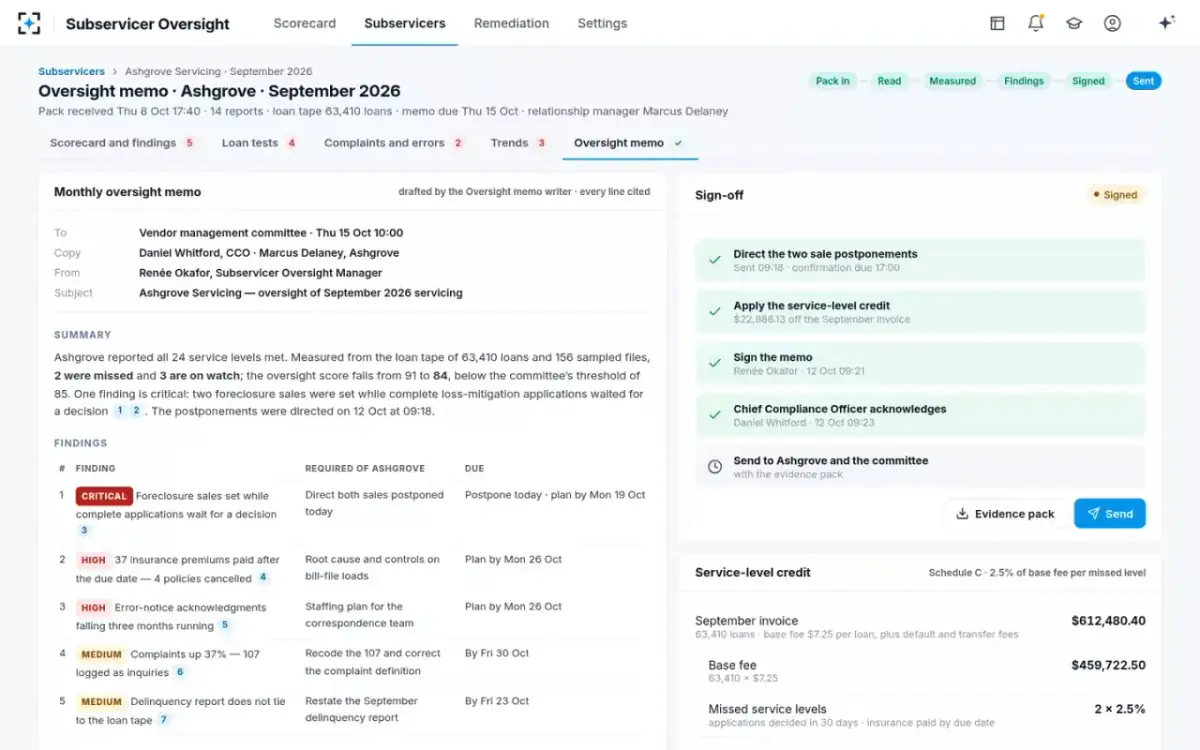
Whatever the subservicing agreement says, and nothing if the owner’s review does not find the miss. In the sample agreement, Schedule C credits 2.5% of the monthly base fee for each missed service level, capped at 10%. September had two misses once the evidence was measured, so the credit was 2 × 2.5% × $459,722.50 = $22,986.13, off an invoice of $612,480.40.
That single credit is about four times our estimate of the month’s oversight wages. It was found only because both misses were invisible in the subservicer’s own scorecard, which reported 24 of 24 met: one because the loss-mitigation clock started at underwriting rather than at a complete application, the other because insurance payments were measured against the subservicer’s schedule rather than the bill’s due date. An owner that reads the scorecard as given never collects the credit, and pays for a service level it did not receive. Subservicer oversight requirements sets out where the obligation to look comes from.
The credit, worked out and applied on the memo the oversight manager signs
Why a hand-run review buys less coverage as the book grows
Hours spent reading do not scale with loans, so a fixed oversight budget covers a shrinking share of a growing book. The sample owner’s three subservicers work 63,410, 16,190 and 2,140 of its 81,740 loans. A hand-run review of each takes broadly the same reading of a monthly pack, and a file sample of a few dozen loans is a reasonable share of the smallest book and a sliver of the largest. The largest subservicer, where most of the risk sits, gets the thinnest coverage per loan.
Delinquency moves the same lever. The loss-mitigation, bankruptcy and foreclosure populations are where Reg X’s clocks are shortest, and they grow when delinquency rises: the MBA’s survey put the national delinquency rate at 4.37% in the second quarter of 2026, up 44 basis points in a year, and FHA’s at 11.79% (MBA, August 2026). An owner with a large government book can see its default populations swell in a year while its oversight hours stay where they were.
That is the case for pricing oversight per subservicer by risk and coverage rather than per head. With testing on the full tape, the cost of covering a larger book is close to the cost of covering a smaller one, and the owner’s hours track the number of findings that need a decision. By hand, covering a larger or riskier book means hiring, and the budget conversation happens after the coverage has already slipped.
How to budget for vendor oversight of a subservicer
Budget oversight as a share of what is at risk, not as a share of the fee. The fee is what the subservicer charges for doing the work; the risk is what the owner answers for if the work is wrong, and it grows with the default share of the book and with each investor that holds the owner responsible. Bulletin 2016-02 makes the same point in regulatory language: “the depth and formality of the entity’s risk management program for service providers may vary depending upon the service being performed — its size, scope, complexity, importance and potential for consumer harm”.
The monthly return on an oversight review
Credits collected
missed service levels found × credit per level × base fee
Only misses the review actually finds count; in the sample month, $22,986.13.
Oversight manager
Harm prevented
failures caught before they reach borrowers × expected remediation per failure
A sale postponed while an application is decided is the clearest case; price it from your own remediation history.
Compliance
Staff time
review hours × loaded hourly cost
120 hours by hand on our model; about 16 with agents.
Oversight
Tools
software and file-access costs per subservicer per month
Finance
What does a mortgage servicing audit cover?
A monthly owner’s audit of a subservicer covers the service levels in the agreement, the borrower clocks in Reg X and Reg Z, escrow and custodial money, investor reporting, complaints and notices of error, and the accuracy of the pack itself. An annual or periodic independent audit, by internal audit or an outside mortgage servicing auditor, covers something different: whether the owner’s oversight process works. The CSBS model standards adopted by state regulators require the board of a covered nonbank servicer to “establish internal audit requirements that are appropriate for the size, complexity and risk profile of the servicer” (CSBS Model Prudential Standards, 2021).
The two kinds of audit cost different money and should not be confused in a budget. The monthly review is an operating cost that scales with books and subservicers. The independent audit is a periodic cost that scales with how hard the oversight file is to re-perform. An oversight file where every finding opens to its report page or loan is cheaper to audit than one built on screenshots and spreadsheets.
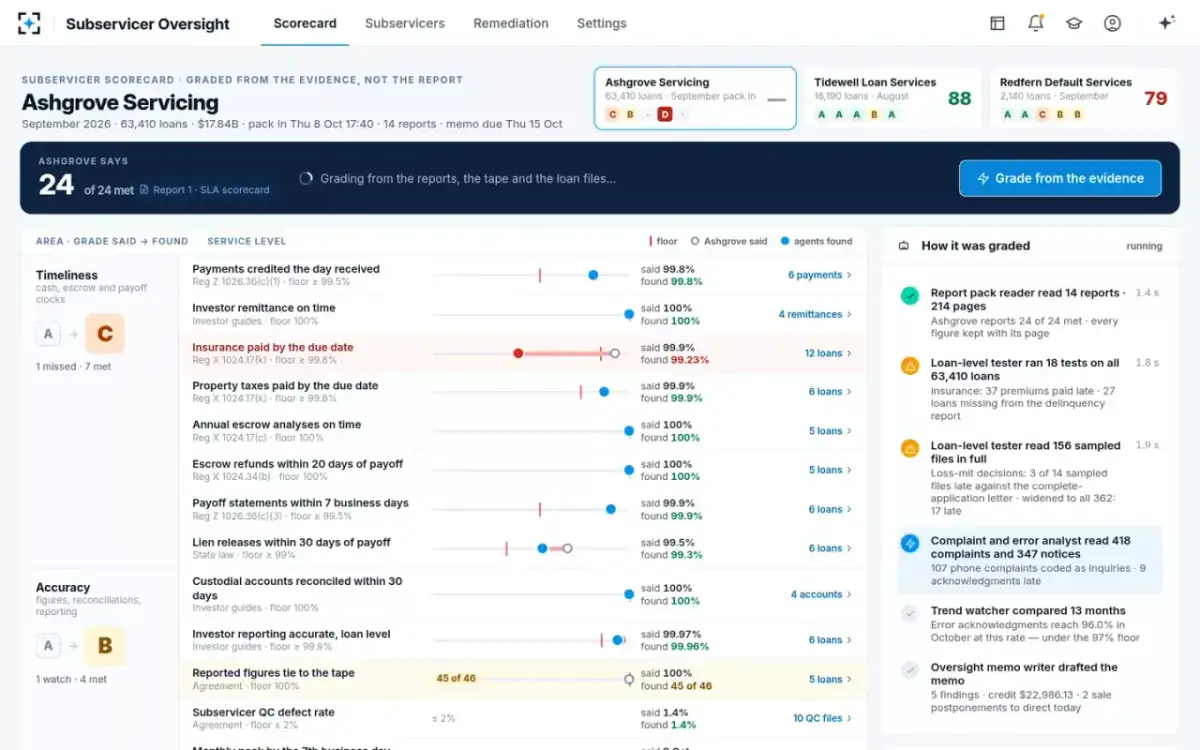
Coverage is the line that changes most: every report, every loan, the files where the tape is blind
Where the agents change the sum, and where they do not
Agents change the hours line and the coverage line; they do not remove the decisions, and they do not move the liability. On the sample month the run took 2 minutes 25 seconds, and the two-day target from pack to signed memo is a design target for the solution, not a customer measurement. What remains with the owner is the work that should: deciding findings, directing the subservicer, applying the credit and signing.
For the economics to hold, two inputs have to exist. The subservicing agreement must give the owner the loan tape and file access, and the service levels must be defined from the regulation’s start events, or re-measurement only produces disputes. If those are in place, Botminds’ Subservicer Oversight turns a monthly cost that buys a sample into one that covers the book. If they are not, the first spend is on the contract, and the oversight desk that will run it.
Questions people ask
What does a mortgage servicing auditor do?
An auditor tests whether servicing, or the oversight of it, complies with the contract, investor guides and the law, and documents the evidence. For an owner using a subservicer, an internal or external auditor usually tests the oversight program itself: whether reviews happened, whether findings were evidenced and whether remediation was proven.
How much does it cost to service a mortgage loan?
The MBA’s study put the fully loaded cost at $176 per performing loan and $1,573 per non-performing loan in 2024, from a sample of in-house servicers covering about 60% of the single-family market. Large servicers averaged $127 to $132 per performing loan; mid-size ones about $100 more.
Can an owner recover oversight costs from the subservicer?
Only through the agreement: service-level credits, audit-cost clauses or remediation obligations. The interagency guidance suggests contracts state which party pays legal, audit and examination fees associated with the activity.
Is a SOC report enough to oversee a subservicer?
No. A SOC report tests the subservicer’s controls over a period; it does not test whether this month’s loans met their clocks. The interagency guidance lists SOC reports among the audit reports a contract can require, alongside the owner’s right to conduct its own audits.
Should oversight cost scale with the number of loans?
With the risk in them more than the count. A book with a rising delinquency rate puts more loans under the short Reg X clocks, so the same loan count can need much more testing in a bad year.