A Ginnie Mae subservicer is a Ginnie Mae-approved issuer that services pooled loans on behalf of the issuer of record, under an arrangement Ginnie Mae has approved in writing on form HUD-11707. The rules in chapter 4 of the MBS Guide are short and strict: “There may be only one subservicer for each pool or loan package”; some duties, such as withdrawing funds from principal and interest custodial accounts and signing most certifications, can never be delegated; and the issuer “remains fully responsible for the performance of any servicing functions that have been delegated to a subservicer”, including what the subservicer reports in its name. Ginnie Mae may also limit how much of its portfolio one issuer has subserviced. For the issuer, those rules turn monthly oversight into a liability control, and Botminds’ Subservicer Oversight was built to supply it: every service level graded from the subservicer’s reports, the loan tape and the loan files, with the issuer’s oversight manager signing.
The examples use a fictional owner, Meridale Home Lending, whose subservicer Ashgrove Servicing works a book that includes Ginnie Mae-pooled FHA loans; every company, person and loan in them is invented.
Ten subservicers handled four-fifths of the subservicing market: concentration an issuer inherits
What does Ginnie Mae require for a subservicer?
Ginnie Mae requires three things before a subservicer touches a pool: the subservicer must be a Ginnie Mae-approved issuer that meets “all requirements for maintaining Ginnie Mae Issuer status”, the arrangement must have “Ginnie Mae’s prior written approval”, and there may be “only one subservicer for each pool or loan package” (MBS Guide 5500.3, chapter 4). Manufactured-housing pools are excluded: servicing of “all program types, except MH pools”, may be carried out by a subservicer.
The approval itself runs through a fixed form. The issuer submits “a cover letter and Master Servicing Agreement, form HUD-11707”, and “the form HUD-11707 may not be altered”. Ginnie Mae “may, in its sole discretion, approve or reject subservicing arrangements and limit the percentage of the overall Ginnie Mae portfolio that may be subserviced by a specific Issuer”, considering the subservicer’s share of outstanding Ginnie Mae MBS and HMBS as one factor.
What a Ginnie Mae issuer answers for
$2.8T
Ginnie Mae MBS outstanding, 30 September 2025
12.3M
active loans behind that portfolio
53.4%
of single-family balance with the five largest non-depository issuers
11.79%
FHA delinquency rate, Q2 2026, seasonally adjusted
Can a Ginnie Mae pool have two subservicers?
No. The MBS Guide allows “only one subservicer for each pool or loan package”, just as each pool has only one issuer of record. An issuer that wants to split its servicing between subservicers has to do it pool by pool, which also means a subservicer change moves whole pools, not selected loans.
The rule has a practical consequence for oversight. Every loan in a pool sits with one operation, so a failure in that operation, a mis-set escrow run or an understaffed loss-mitigation team, touches the whole pool at once. FSOC adds the matching constraint at the other end: when a failed servicer’s portfolio is sold, “Ginnie Mae pools must be transferred in their entirety” (FSOC, 2024).
Is the issuer liable for subservicer reporting?
Yes, explicitly. The issuer is liable to Ginnie Mae for anything a subservicer submits in its name, including the monthly pool and loan data and the monthly reporting certification.
The Issuer is liable to Ginnie Mae for any representations or omissions submitted on its behalf by a subservicer, including those representations or omissions reflected on the Issuer’s monthly report of pool and loan data to Ginnie Mae and on the Issuer’s Monthly Reporting Certification in RFS.
Ginnie Mae MBS Guide 5500.3, Rev. 1, chapter 4, part 2, section B
That sentence makes the accuracy of the subservicer’s reporting the issuer’s own exposure. The monthly report of pool and loan data and the monthly reporting certification may be prepared and completed by a subservicer, but only if the issuer does not list any of the subservicer’s employees on its HUD-11702 list of authorized signers; the Guide says issuers are “strictly prohibited” from doing so. An issuer overseeing a Ginnie Mae subservicer should therefore test loan-level reporting accuracy every month, and tie every reported figure to the tape, rather than read the subservicer’s summary.
What can a Ginnie Mae subservicer not do?
A subservicer may not do anything Ginnie Mae reserves to the issuer: chiefly withdrawing funds from principal and interest custodial accounts, withdrawing documents from the document custodian, and signing certifications other than the monthly reporting one. In the Ginnie Mae I program the reserved list adds signing checks and remittance advice to security holders, remitting guaranty fees and keeping the register of security holders.
Who may do what under a Ginnie Mae subservicing arrangement (both MBS programs)
| Responsibility | Must be done by the issuer | May be done by the subservicer |
|---|---|---|
| Collect principal, interest and escrow amounts | No | Yes |
| Deposit funds into P&I and escrow custodial accounts | No | Yes |
| Withdraw funds from the P&I custodial account | Yes | No |
| Withdraw funds from escrow custodial accounts | No | Yes |
| Supply funds for advances to security holders | No | Yes |
| Absorb foreclosure losses not covered by the insurer or guarantor | No | Yes |
| Prepare and transmit the monthly report of pool and loan data | No | Yes |
| Complete the monthly reporting certification | No | Yes, if no subservicer staff are on the issuer’s HUD-11702 |
| Access documents at the document custodian | Yes | No |
| Sign other certifications to Ginnie Mae | Yes | No |
The advances row deserves a note. A subservicer may supply its own funds to cover payments to security holders and uncovered foreclosure losses, but “upon demand by Ginnie Mae, subservicers advancing funds on behalf of an Issuer shall disclose the frequency, duration, amount, and purpose for such advances”. An issuer that lets a subservicer advance should track those advances itself.
Ginnie Mae approved subservicers, and the master subservicer question
Ginnie Mae does not publish a separate list of approved subservicers, because a subservicer must already be an approved issuer; the approval Ginnie Mae gives is for each arrangement, on form HUD-11707. Its 2025 annual report mentions subservicers in one program detail: “eight eSubservicers” active in its digital-note program (Ginnie Mae 2025 Annual Report).
Searches for a “Ginnie Mae master subservicer” usually mean one of two things. The HUD-11707 form is itself called a Master Servicing Agreement, the document that creates the subservicing arrangement. And Ginnie Mae, like the other agencies, contracts its own servicers to take over portfolios when an issuer fails; FSOC describes the agencies transferring servicing “to their contracted subservicers” and assuming “the advancing burden of a master servicer” in that case. What “master servicer” means in Reg X is a third sense again.
What happened in the OCC Cenlar order?
In October 2021 the OCC issued a consent order against Cenlar FSB, which it described as “the largest mortgage sub-servicer in the country”, for “the bank’s failure to establish effective controls and risk management practices related to its mortgage servicing and subservicing activities” (OCC NR 2021-111). The order required corrective action and controls appropriate to “the size of its mortgage subservicing operations”, and limited growth by requiring the OCC’s “no supervisory objection” before Cenlar added new subservicing clients or paid dividends while the order was in effect.
For issuers the lesson is in the shape of the remedy. A regulator that limits a subservicer’s new clients is treating its operational capacity as the risk, the same risk every owner relying on that subservicer carries on its own pools. This page describes the order as announced in 2021; check the OCC’s enforcement search for its current status.
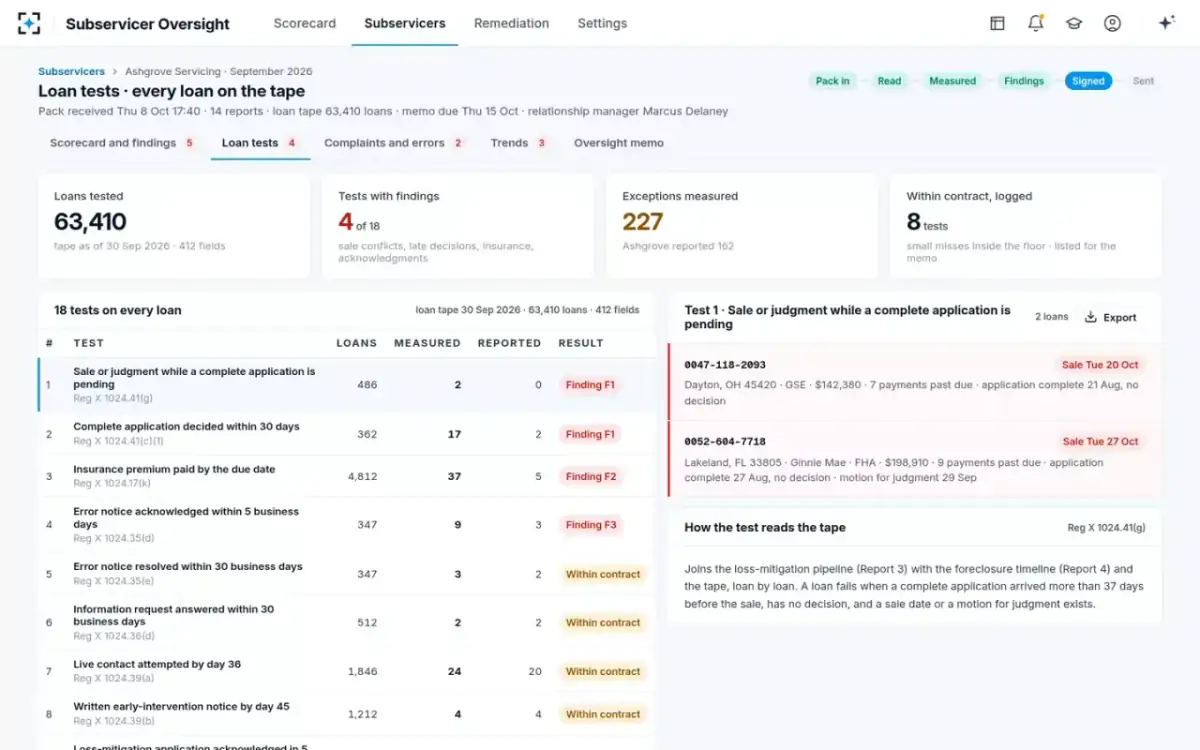
Loan-level tests across an owner’s book, including its Ginnie Mae-pooled FHA loans
What changes when an issuer moves pools to a new subservicer
Moving pools to a new subservicer is a servicing transfer in everything but ownership, and the one-subservicer rule means whole pools move at once. The issuer needs Ginnie Mae’s approval of the new arrangement on a fresh HUD-11707 before the new subservicer takes over, and the loans’ borrowers, clocks and pending applications move with the pools.
Reg X treats the change as a transfer for its information rules. Its transfer provisions define the transferor and transferee as “a servicer, including a master servicer or a subservicer” (12 CFR 1024.38(b)(4)(iii)), so the outgoing subservicer must transfer “all information and documents” in a form that keeps them accurate, and the incoming one must identify what did not arrive and obtain it from the outgoing one. The official commentary requires the transfer to include the current status of any loss-mitigation discussions and any agreements reached (comment 38(b)(4)(i)-2).
For the issuer’s oversight, a transfer is the month to test hardest. Loss-mitigation applications in progress, escrow bills about to fall due and foreclosure dates already set are where transferred loans fail, and the issuer remains responsible for all of them on both sides of the move. A practical rule: keep grading the outgoing subservicer until its last pool has moved, test the incoming one on the transferred loans from its first tape, and compare the two subservicers’ figures for the same loans in the transfer month. Differences in that month are rarely performance; they are data that did not survive the move.
Concentration makes the stakes larger. An issuer that has placed a large share of its Ginnie Mae book with one subservicer cannot move it quickly if that subservicer runs into trouble, which is part of why Ginnie Mae reserves the right to cap the share one issuer has subserviced and weighs the subservicer’s existing Ginnie Mae portfolio when it approves an arrangement.
How a Ginnie Mae issuer should oversee its subservicer
Oversee the reporting, the money and the borrower clocks every month, because those are the places Ginnie Mae’s rules leave the issuer exposed. Reg X adds the general duty: procedures that let the issuer’s staff audit a service provider’s compliance “with the servicer’s contractual obligations and applicable law” (12 CFR 1024.38(b)(3)).
A Ginnie Mae issuer’s monthly checks on its subservicer
- Approval in order
An approved HUD-11707 for each arrangement; one subservicer per pool; no subservicer staff on the issuer’s HUD-11702.
- Pool and loan data tied to the tape
Every figure the subservicer reports in the issuer’s name recomputed from the loan data.
- Custodial accounts
Reconciliations with no unexplained items older than 30 days; the issuer alone withdraws from P&I accounts.
- Advances
Frequency, duration, amount and purpose of any advances the subservicer funds.
- FHA and VA borrower clocks
Early intervention, loss-mitigation decisions and foreclosure protections tested on every loan, with files read where the tape cannot show the date.
- Escrow disbursements
Taxes and insurance paid by the bill’s penalty date, per loan.
- Concentration
How much of the issuer’s Ginnie Mae book sits with each subservicer, and that subservicer’s own condition and staffing.
Default is where the stakes are highest for a Ginnie Mae book, because FHA delinquency runs far above the market: 11.79% in the second quarter of 2026 by the MBA’s survey, with FHA serious delinquency up 227 basis points in a year (MBA, August 2026). In the fictional sample month, one of the two loans whose foreclosure sale was set while a complete application waited undecided was a Ginnie Mae-pooled FHA loan; the subservicer’s foreclosure report showed none.
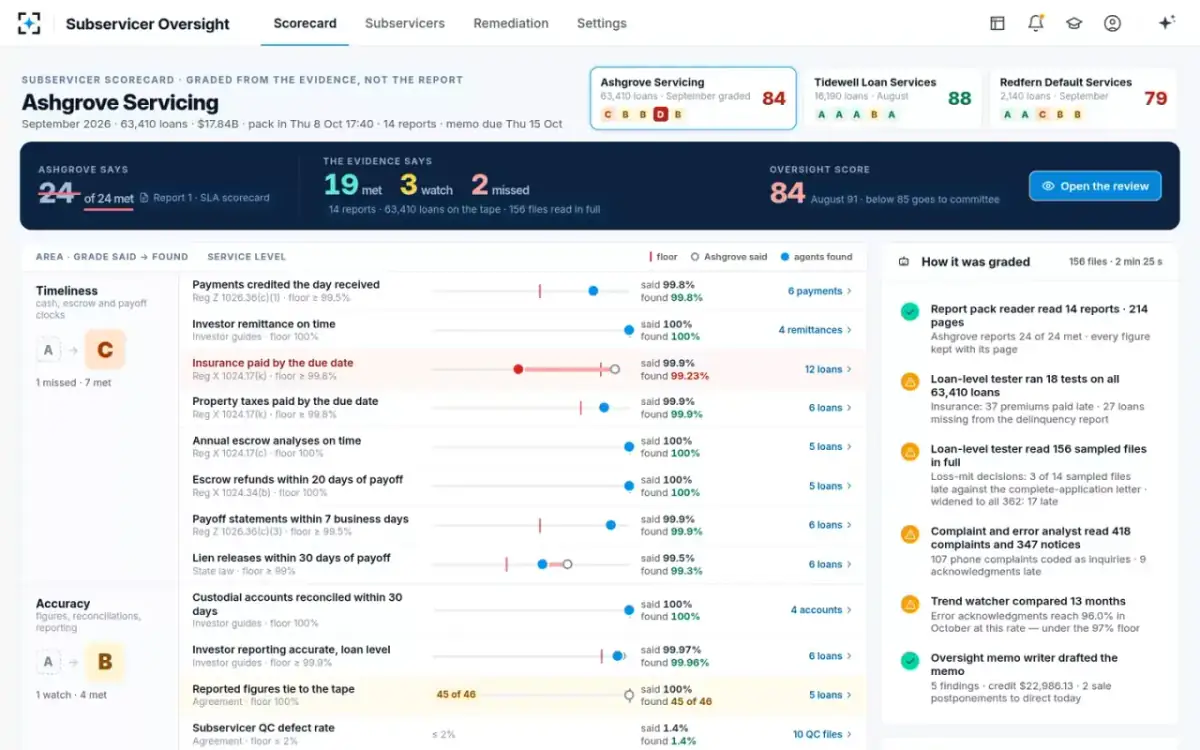
Botminds’ Subservicer Oversight runs those checks monthly for each subservicer: the full pack read, 18 tests on every loan, reported figures tied to the tape, and a memo the issuer’s oversight manager signs. Why concentration among subservicers worries regulators explains the wider picture.
Investor reporting and tie-out graded from the loan data, not the subservicer’s summary
Questions people ask
What is form HUD-11707?
It is the Master Servicing Agreement an issuer submits, with a cover letter, to ask Ginnie Mae to approve a subservicing arrangement. Ginnie Mae says the form may not be altered, and may approve or reject the arrangement in its sole discretion.
Does the subservicer have to be a Ginnie Mae issuer?
Yes. To perform servicing functions for another issuer, a subservicer must be a Ginnie Mae-approved issuer and meet all requirements for maintaining that status.
Can a separate subservicing agreement change Ginnie Mae’s rules?
No. The Guide allows the issuer and subservicer to set out their relationship more fully in a separate agreement, but any such agreement “will be subordinate to the applicable Guaranty Agreement and this Guide”.
Can a subservicer sign the issuer’s monthly reporting certification?
It may complete the monthly reporting certification if the issuer does not list any subservicer employee on its HUD-11702. All other certifications to Ginnie Mae must be signed by the issuer.
Can Ginnie Mae limit how much an issuer subservices?
Yes. Ginnie Mae may limit the percentage of its overall portfolio that a specific issuer has subserviced, and weighs the subservicer’s share of outstanding Ginnie Mae MBS and HMBS when it considers approvals.