Subservicing mortgage companies are the firms that service loans for other companies that own the servicing rights, and they now do about half of the servicing for which a nonbank holds the rights. FSOC found that at the end of 2023 a third-party subservicer handled the administration of approximately half of nonbank-owned balances, against about 25% in 2015, and estimated the subservicing market at $3.99 trillion. The growth follows the rise of nonbanks themselves, which serviced 59% of US mortgages by mid-2025, and of passive owners of servicing rights who never built a servicing operation. It concentrates risk in a few operators that many owners share, which is why FSOC calls them a contagion channel and why each owner’s monthly oversight, the work Botminds’ Subservicer Oversight was built to do, matters beyond its own book.
The figures on this page come from FSOC, the OCC, FHFA’s Inspector General, CSBS and the New York Fed, linked where they appear. A fictional sample owner, Meridale Home Lending, illustrates what oversight of three subservicers looks like; its companies and loans are invented.
The subservicing market in four numbers
~50%
of nonbank-owned servicing balances worked by a third-party subservicer, Q4 2023
~25%
the same share in 2015
$3.99T
estimated subservicing market, Q4 2023
59%
of US mortgages serviced by nonbanks, Q2 2025 (20% in 2013)
How big is the subservicing market?
About $4 trillion of unpaid principal: FSOC’s estimate of the subservicing market at the end of 2023 is $3,990 billion, including loans in agency pools, private-label securitizations and bank portfolios (FSOC, 2024). Set against the $13.1 trillion of mortgage debt outstanding in mid-2026 (New York Fed, August 2026), that is close to a third of the market by balance, though the two figures come from different dates and sources.
The market is concentrated. In FSOC’s table of the ten largest residential subservicers, the largest held 21.9% of the estimated total, and the four largest together more than half. Seven of the ten are nonbanks. FSOC notes that two subservicers each handled portfolios “exceeding $400 billion in unpaid principal balances”.
Thirteen years in which subservicing doubled and the rules caught up
- Nonbanks 20%2013
- Subserviced share of nonbank-owned balances ~25% → ~50%2015 → 2023
- $3.99T market2023
- 59%2025
- Reg X servicing rules2013
- CFPB Bulletin 2016-02 on service providers2016
- CSBS; OCC2021
- Banks2023
- FSOC; states2024–25
Why do MSR owners use subservicers?
Owners use subservicers when they want the servicing rights, for income or as a hedge, without running the servicing. FSOC names two kinds: originators without an in-house servicing platform that “still value the servicing income and will retain the servicing while contracting out the loan administration to a subservicer”, and owners that hold the rights “as passive investors”, such as mortgage real-estate investment trusts, which are “more likely to outsource loan administration duties to a subservicer” (FSOC, 2024).
FSOC traces the doubling to the second group: “As passive MSR investors have expanded their MSR holdings, there is an increasing share of mortgages with an NMC holding the servicing rights and contracting out the loan administration duties to a third-party subservicer.” Scale economics push the same way. The MBA’s 2024 cost study found the largest servicers averaging $127 to $132 per performing loan, with mid-size groups about $100 a loan higher (MBA, July 2025), a gap a large subservicer can sell into.
Why subservicing grew with the nonbanks
Subservicing grew because nonbank ownership of servicing rights grew, and many of the new owners were investors rather than operators. FSOC records that nonbanks owned the servicing rights on 54% of mortgage balances in 2022, against 4% in 2008 (FSOC, 2024), and serviced 59% of outstanding mortgages by the second quarter of 2025, against 20% in 2013; the number of nonbanks among the 20 largest servicers doubled over the same period, “from just six in 2013 to 12 in 2025” (FSOC 2025 Annual Report).
The shift changed who watches the work. A bank that owns servicing rights has a prudential regulator that examines its third-party risk management; a nonbank owner does not. FHFA’s Inspector General noted that nonbank seller/servicers “lack a federal prudential regulator” and that in the third quarter of 2022 “eight of the top-ten Enterprise servicers were nonbank seller/servicers” (FHFA OIG, 2024). As more servicing rights sit with nonbanks that contract the work out, more of the checking falls on the owner’s own oversight, the investors and the states.
Default makes the arithmetic sharper. FSOC observes that servicing delinquent loans “is more labor-intensive than servicing performing loans and requires additional personnel with expertise in addressing such loans”. A subservicer whose clients’ books turn delinquent at the same time needs more trained staff at the moment its clients are least able to pay for them, which is the operational version of the contagion FSOC describes.
What share of servicing is subserviced at the top of the market?
Among the 20 largest agency servicers at the end of 2023, FSOC counted five that rely on subservicers and six that subservice for others. The overlap is the point: a firm can be both a large servicer in its own right and the subservicer for someone else’s book.
The 20 largest agency servicers: a quarter rely on subservicers, more than a quarter are subservicers
What does FSOC say about subservicers?
FSOC says shared subservicers are a channel through which one firm’s distress can spread to others. Its 2024 report puts it in one sentence: “Since NMCs have similar business models and share financing sources and subservicing providers, distress in the NMC sector may be widespread during times of strain” (FSOC, 2024).
If a large NMC does not pay its subservicer, the subservicer’s ability to perform loan administration duties for other servicers may be compromised. If a subservicer experiences distress, the servicers that depend on the subservicer may not be able to fulfill their obligations under their servicing contracts.
Financial Stability Oversight Council, Report on Nonbank Mortgage Servicing, 2024
The risk runs in both directions. A subservicer carries “considerable operational risk but less liquidity and funding risk for cash outlays than servicers”, so its failure mode is operational: missed clocks, misapplied payments, escrow bills paid late. FSOC adds that delinquent servicing “is more labor-intensive than servicing performing loans” and its processes “tend to be more complex, leading to additional operational risk”. Delinquency is rising: the MBA’s survey put FHA’s seasonally adjusted delinquency rate at 11.79% in the second quarter of 2026, with serious delinquency on FHA loans up 227 basis points in a year (MBA, August 2026).
What happens if a subservicer fails?
If a subservicer fails, every owner that depends on it has to move its servicing quickly, and the investors may have to step in. FSOC describes the agencies’ last resort: if no buyer takes a distressed portfolio, they “may need to assume the servicing themselves and transfer the servicing to their contracted subservicers”, taking on “the advancing burden of a master servicer”. Ginnie Mae pools, FSOC adds, “must be transferred in their entirety”, so a buyer cannot take only the performing loans.
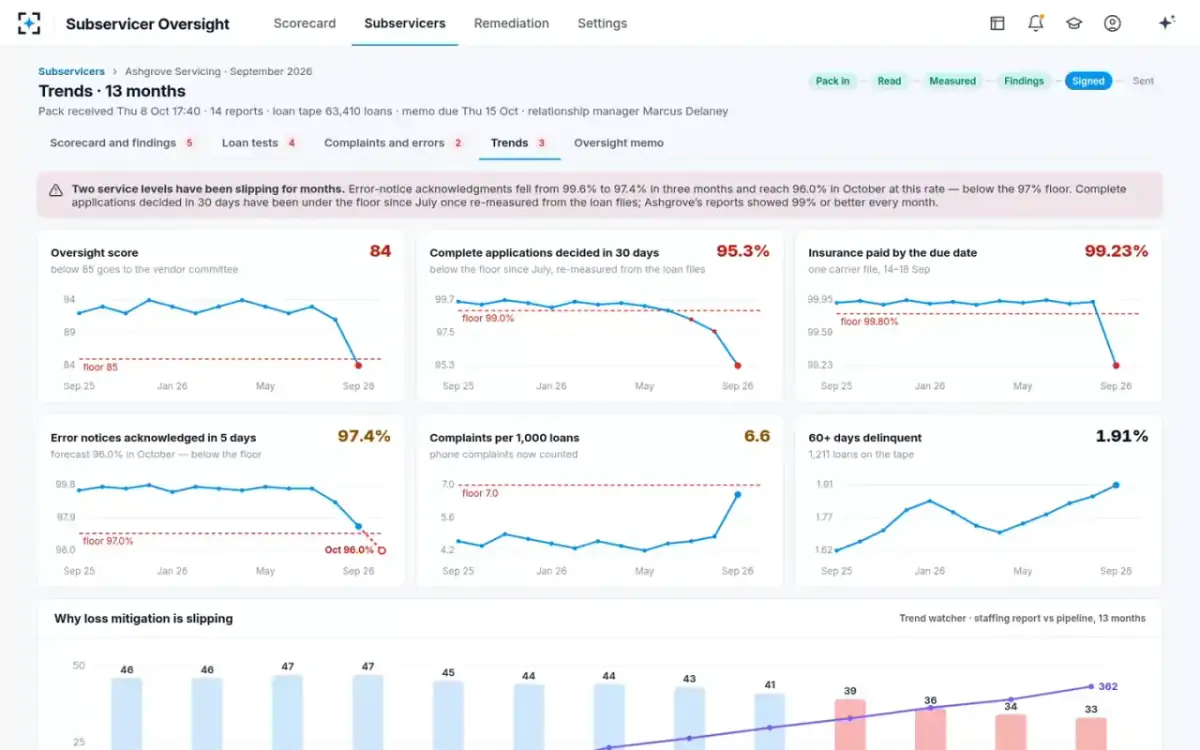
For an owner, the practical defence is early warning. A subservicer under strain shows it in the measures before it shows it in a default: staffing falls, queues lengthen, acknowledgments slip. Each owner sees only its own book, but each owner’s monthly oversight is how the slide is caught at all.
One owner, three subservicers, and a slide visible a month before it breaches
Who regulates mortgage subservicers?
Several bodies, none of them completely. Nonbank subservicers are licensed and examined by the states; bank subservicers have a prudential regulator; the CFPB supervises large servicers and service providers to supervised firms; and the investors control who may subservice their loans. FHFA, which oversees Fannie Mae and Freddie Mac, “does not have express statutory authority to supervise nonbank seller/servicers” (FHFA OIG, 2024).
Who oversees a subservicer, and with what power
| Overseer | Over whom | What it can do |
|---|---|---|
| State regulators | Licensed nonbank servicers and subservicers | Licensing, examination, enforcement; the CSBS standards adopted in 12 states, which count loans subserviced for others toward coverage |
| OCC, Fed, FDIC | Bank and thrift subservicers | Prudential supervision; the OCC’s 2021 order required its no-objection before the largest subservicer added new clients |
| CFPB | Large servicers and service providers to supervised firms | Examination and enforcement under federal consumer financial law |
| Ginnie Mae, Fannie Mae, Freddie Mac | Issuers and approved servicers | Approval of subservicing arrangements and eligibility requirements; Ginnie Mae may cap how much one issuer subservices |
| FHFA | The Enterprises | Sets eligibility through the Enterprises; no express authority to supervise nonbank servicers directly |
| The owner of the servicing rights | Its own subservicers, by contract | Monthly oversight, credits, remediation and termination under the agreement |
FSOC asked Congress to close part of the gap: “Congress should consider providing FHFA and Ginnie Mae with additional authority to establish appropriate safety and soundness standards and to directly examine nonbank mortgage servicer counterparties” (FSOC, 2024). Until that happens, the owner of the servicing rights is the party with the clearest view of a subservicer’s work on its own loans, and the clearest duty to look.
What to ask a subservicer before signing
Ask the questions that reveal capacity and evidence, because those are what fail first. How many loss-mitigation underwriters does it staff per hundred complete applications, and how did that ratio move in the last delinquency rise? How many clients share the same operation? What orders or findings has it received from a regulator or investor, and what changed afterwards? Which subcontractors does it use, and for what?
Then ask how it measures itself. For each service level, which event starts the clock and which stops it; whether it will deliver a loan-level tape every month with the fields each test needs; whether the owner may read loan files, letters and call notes; and whether every figure in its monthly pack reconciles to that tape. A subservicer that answers those questions in writing has agreed to be overseen. One that cannot has told the owner how its scorecard will be built. The subservicing agreement clause that decides when each clock starts turns the answers into contract terms.
What the growth of subservicing means for owners
It means oversight has become a core function for a large share of the market rather than a back-office check. An owner with one subservicer depends on that firm’s operations as if they were its own; an owner with three, like the fictional sample owner, which uses three subservicers on 81,740 loans, sees three operations through three report packs that each grade themselves. In the sample month the largest of them reported 24 of 24 service levels met, and the owner’s testing found two missed.
Botminds’ Subservicer Oversight gives each owner a monthly view graded from evidence for every subservicer it uses: reports read in full, every loan tested, files read where the tape cannot show the clock, and trends kept for thirteen months. For an owner deciding what it keeps when the work goes out, what a subservicer does and what stays with the owner sets out the line; for Ginnie Mae issuers, Ginnie Mae’s subservicer rules add approval and concentration limits.
Questions people ask
What are the top mortgage subservicing companies?
FSOC’s 2024 report lists the ten largest by subserviced balance at the end of 2023, drawn from Inside Mortgage Finance rankings. The largest held 21.9% of an estimated $3.99 trillion market, the four largest together just over half, and seven of the ten were nonbanks.
Do banks use subservicers too?
Yes. FSOC notes that “both banks and NMCs can perform subservicing and use subservicers”, and its market estimate includes loans held on bank books. The largest subservicer in FSOC’s table is a federal savings bank.
Is subservicing growing or shrinking?
It doubled as a share of nonbank-owned servicing between 2015 and 2023, from about a quarter to about half, according to FSOC. No regulator or independent study we found publishes a later share; the drivers FSOC names, passive ownership of servicing rights and scale economics, have not reversed.
How do subservicers get paid?
Under the subservicing agreement, usually a monthly fee per loan with higher fees for delinquent loans and special services, while the owner keeps the servicing fee from the investor. In the fictional sample, the base fee is $7.25 per loan per month, with default and transfer fees on top.
Can an owner use more than one subservicer?
Yes; FSOC notes owners “can use multiple subservicers” and that subservicers “can have many clients”. Ginnie Mae allows only one subservicer per pool or loan package, so splitting is done at the pool level.