Mortgage servicing quality control requirements for an owner that uses a subservicer come down to one obligation with several sources: be able to audit, periodically and with real evidence, whether the servicing on your loans complied with the contract and the law. Reg X 1024.38(b)(3) requires procedures that let the owner’s staff “audit compliance by service providers”, CFPB examiners test by sampling servicing records, and the interagency third-party guidance expects regular testing scaled to risk. The hard part is coverage: a hand-run QC review samples a few dozen files from a tape of tens of thousands. Botminds’ Subservicer Oversight was built to close that gap, with one agent, the loan-level tester, running 18 tests on every loan each month and reading loan files only where the tape cannot show when a clock started.
The worked example is a fictional sample owner, Meridale Home Lending, and its subservicer Ashgrove Servicing, whose September tape holds 63,410 loans. Every company, person and loan in it is invented.
How the loan-level tester works a month: tape first, files where the tape is blind, people for findings
Agent
Load the tape and the clocksReads the month’s loan tape (412 fields in the sample) and the clocks to test: Reg X, Reg Z, investor and contract service levels, each with the start event the rule names.
Never: Never changes a loan or a field on the tape.
Agent
Test every loanRuns 18 tests across the full tape, joining reports where one test needs two systems, such as the loss-mitigation pipeline and the foreclosure timeline.
Never: Never substitutes a sample for a test the tape can answer.
Agent
Read files where the tape is blindWhere a field cannot show the start event, such as the day an application became complete, reads a risk-based sample of loan files and letters in full.
Agent
Widen on failureWhen a sample fails, reads every file in that population and reports the true rate with each late loan.
A person decides
Decide the findingsThe oversight manager decides which exceptions are findings, directs the subservicer and signs the memo; critical findings go to the chief compliance officer the same day.
What the rules actually require of servicing QC
No federal rule prescribes a servicing QC sample size or test list for an owner overseeing a subservicer; the rules require the capability to audit and the evidence that it was used. Reg X requires policies and procedures reasonably designed to “facilitate periodic reviews of service providers, including by providing appropriate servicer personnel with documents and information necessary to audit compliance by service providers with the servicer’s contractual obligations and applicable law” (12 CFR 1024.38(b)(3)(ii)).
The CFPB’s guidance adds the testing expectation. Bulletin 2016-02, still listed on the CFPB’s supervisory guidance index, names “establishing internal controls and on-going monitoring to determine whether the service provider is complying with Federal consumer financial law” as a step every supervised firm should take (CFPB Bulletin 2016-02). The 2023 interagency guidance, written for banks but read across the industry, lists “regular testing of the banking organization’s controls” and adds that “based on risk, a banking organization may also perform direct testing of the third party’s own controls” (Interagency guidance, 2023).
Investors add their own requirements on top. Ginnie Mae and FHFA set eligibility and responsibility rules (covered in subservicer oversight requirements), and each investor’s servicing guide has quality-control provisions that a servicing QC plan must also meet; those are outside the scope of this page.
How do examiners test mortgage servicing?
CFPB examiners start from policies, procedures and complaints and then pull a sample of servicing records to test. The July 2026 servicing exam procedures repeat the instruction in module after module: for loss mitigation, examiners “should review policies, procedures, complaints, and obtain a sample of servicing records of consumers who are delinquent or at imminent risk of default” (CFPB Mortgage Servicing Examination Procedures, July 2026).
For service providers, the same document tells examiners to weigh “the level of risk of consumer injury presented by a service provider” and then check whether the servicer’s procedures achieve the oversight objectives “for each major service provider”. A subservicer handling default servicing on tens of thousands of loans is as major as service providers get.
The implication for an owner’s QC design is direct. An examiner who pulls twenty loss-mitigation files can find a late evaluation the owner’s own review missed. The owner’s defence is a review that already tested those loans, found what was wrong and showed what was done about it.
Loan-level testing vs sampling: what each can and cannot see
Testing the full tape catches rare failures that a sample will usually miss; reading files catches the failures the tape cannot express. A good QC design uses both and is explicit about which test needs which.
Sampling the files and testing the tape answer different questions
A file sample, by hand: A few dozen files a month from tens of thousands of loans; a failure in one loan in a thousand is usually not drawn.
Every loan on the tape, plus files where the tape is blind: Every loan in scope for each test, every month; the sample is used only where a field cannot show the clock.
A file sample, by hand: A foreclosure sale scheduled against a pending complete application may sit outside the sample for months.
Every loan on the tape, plus files where the tape is blind: Joined across the loss-mitigation pipeline and the foreclosure timeline, so each such loan appears by number.
A file sample, by hand: A careful reader sees the real date in the letter, but only in the files sampled.
Every loan on the tape, plus files where the tape is blind: Reads the letter in a risk-based sample; a failed sample widens to every file in the population.
A file sample, by hand: Usually accepted, because there is no independent count to set beside it.
Every loan on the tape, plus files where the tape is blind: Recounted from the tape and set beside the subservicer’s number, so the difference is itself a finding.
A file sample, by hand: Month-by-month samples are too small to show a measure drifting toward its floor.
Every loan on the tape, plus files where the tape is blind: Thirteen months of the same measure on the full population, with a forecast against the floor.
Sampling is not wrong; it is the right tool for questions the data cannot answer. The mistake is using it for questions the data can. A test such as “was an escrow disbursement made on or before the penalty date” can usually be answered for every loan from payment and disbursement fields. A test such as “was this application decided within 30 days of becoming complete” often cannot, because the tape’s complete date is whatever the subservicer’s system recorded, which may be a later event.
How to test a subservicer’s loss mitigation timelines
Test each loss-mitigation clock from the start event the regulation names, and read the file wherever the tape carries a different date. The 30-day evaluation clock runs from receipt of a complete application: if a servicer “receives a complete loss mitigation application more than 37 days before a foreclosure sale, then, within 30 days of receiving the complete loss mitigation application”, it must evaluate the borrower and send a written decision (12 CFR 1024.41(c)(1)). Which protections apply is fixed “as of the date a complete loss mitigation application is received” (1024.41(b)(3)).
Loss-mitigation and error clocks a servicing QC plan should test, with where the start date lives
| Test | Rule | Start event | Where the date usually lives |
|---|---|---|---|
| Live contact attempted by day 36 | 1024.39(a) | The delinquency | Tape: due date and contact history |
| Written early-intervention notice by day 45 | 1024.39(b) | The delinquency | Tape: due date and letter log |
| Application acknowledged within 5 days | 1024.41(b)(2)(i)(B) | Receipt of the application, excluding weekends and holidays | Tape or imaging log, if every channel is indexed on receipt |
| Complete application decided within 30 days | 1024.41(c)(1) | Receipt of a complete application (or the facially complete date) | The file: the complete-application notice and the documents’ receipt dates |
| No sale or judgment motion while a complete application is pending | 1024.41(g) | Complete application more than 37 days before the sale | Tape joined to the foreclosure timeline and the pipeline |
| Notice of error acknowledged within 5 days | 1024.35(d) | Receipt of the notice, excluding weekends and holidays | Correspondence log, if notices are distinguished on receipt |
| Notice of error answered within 30 days (15-day extension allowed) | 1024.35(e)(3) | Receipt of the notice | Correspondence log and response letter |
Two details decide whether a timeline test is valid. First, the complete date: Reg X treats an application as facially complete when the borrower submits the items listed in the acknowledgment notice, and if more information is needed later and the borrower supplies it in the time given, the application counts as complete from the date it first became facially complete (1024.41(c)(2)(iv)). Second, the foreclosure handoff: the official commentary requires servicer personnel to “promptly inform service provider personnel handling foreclosure proceedings that the servicer has received a complete loss mitigation application and promptly instruct foreclosure counsel to take any step required by § 1024.41(g)” (comment 38(b)(3)(iii)-1). The QC test is not only “was a decision made in time” but “did the sale calendar know”.
What a failed sample does: three late in fourteen becomes seventeen in 362
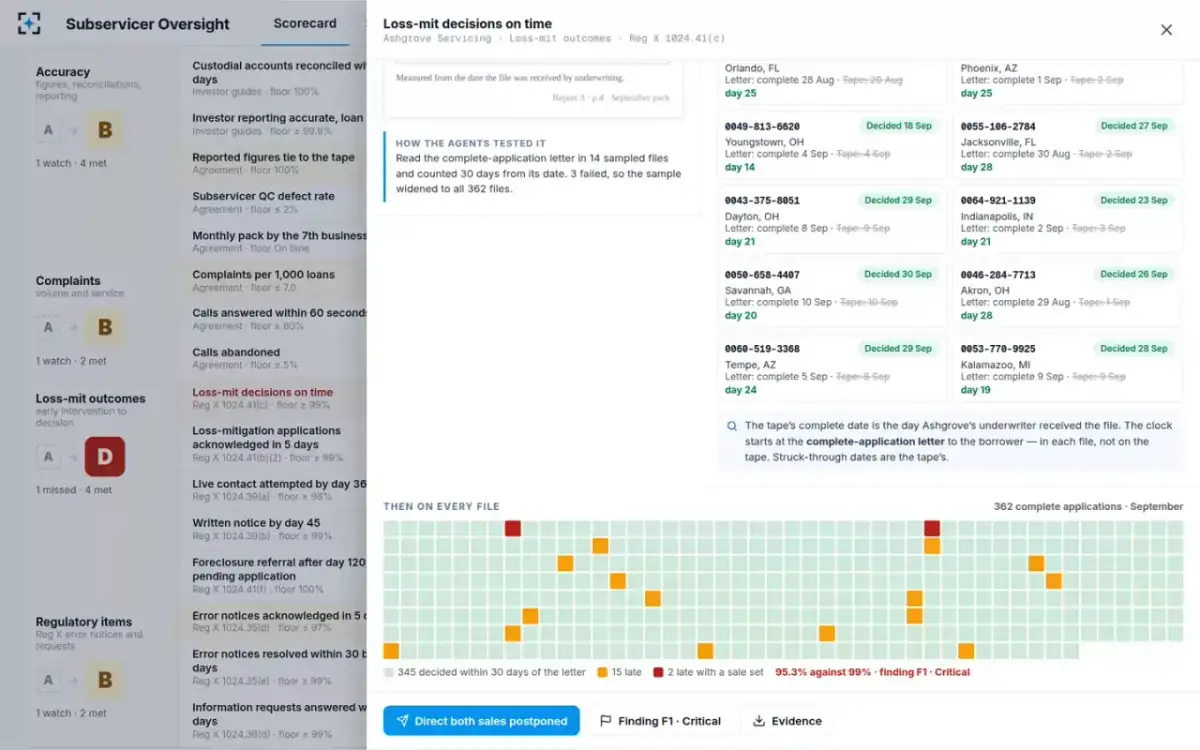
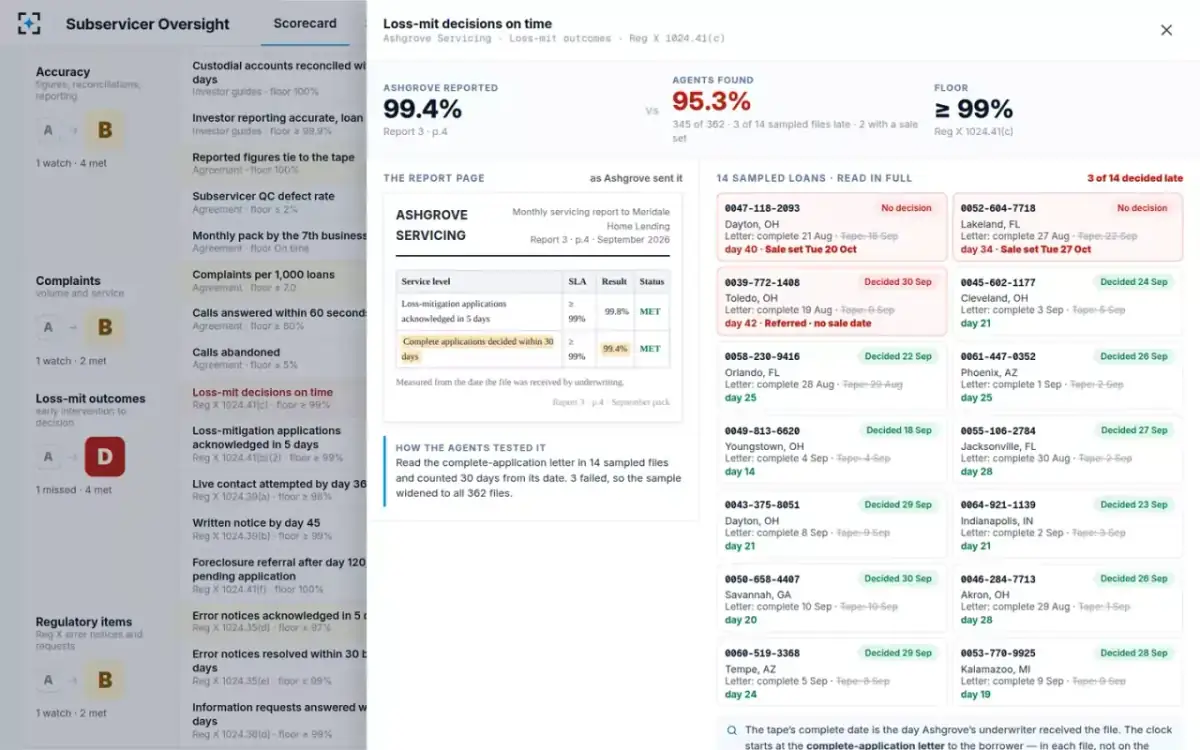
A failed sample should stop being a sample. In the sample month, Ashgrove reported 99.4% of complete applications decided within 30 days, against a 99% floor, measured from the date its underwriting team received the file. The tape could not show when each application had become complete, so the agents read the complete-application letter in 14 sampled files. Three were late.
The sample said something was wrong; every file said how wrong
The sample rate is not the answer, and should not go in a memo. A risk-based sample is drawn toward files more likely to fail, so 3 of 14 overstates the problem; a random sample of 14 could as easily have drawn none. Reading all 362 gives the figure the owner can defend: 95.3%, a missed service level and a critical finding, because two of the seventeen late applications belonged to borrowers with a sale date set.
Every complete application in the month, read from its letter
What should a servicing QC program test?
A servicing QC program over a subservicer should test the clocks that protect borrowers, the money that moves through custodial accounts, the accuracy of what the subservicer reports, and the handling of complaints and errors. In the sample configuration that is 18 loan-level tests plus recalculation of every reported figure from the tape.
The tests group into four families. Timeliness covers payment crediting, escrow disbursements by the penalty date under 1024.17(k), payoff statements and lien releases. Default covers early intervention, the loss-mitigation clocks and the foreclosure protections. Errors and complaints cover acknowledgment and response clocks for notices of error and requests for information, and whether calls that meet the complaint definition were logged as complaints. Accuracy covers investor reporting at loan level, custodial reconciliations with items older than 30 days, and whether each figure in the pack ties to the tape.
That last family is where many owners find their first finding. In the sample month the delinquency report showed 1,184 loans 60 or more days delinquent and the tape showed 1,211. Neither number is necessarily wrong, but a report that does not tie to its own data is evidence that the subservicer’s reporting process, not just its performance, needs attention. How to re-measure each KPI from its start event works through the measures one at a time.
Mortgage servicing quality control software: what to look for
Judge any servicing QC or oversight software on whether it can test the full population, read the documents the data cannot replace, and leave a reviewer an evidence trail an examiner can re-perform. Speed matters less than those three.
Questions to put to a vendor of servicing QC or subservicer oversight software
- Does it test every loan, or a sample?
Ask which tests run on the full tape and which rely on files, and why.
- Whose start date does it use?
A tool that inherits the subservicer’s dates inherits its errors. Ask how it finds the complete date, the receipt date of a notice and the penalty date of a bill.
- What happens when a sample fails?
The answer should be: it widens to the population and reports the true rate.
- Can every exception be traced?
Each failed loan should come with the fields, the page or the letter that proves it.
- Does it keep the reported figure?
The subservicer’s number and the measured number side by side is what makes the gap a finding.
- Who decides?
Software can measure and draft; a named person should decide findings and sign, and the tool should never contact borrowers or change loans.
- How is “fixed” proven?
A remediation item should close on a re-test of the loan data, not on the subservicer’s say-so.
Where Subservicer Oversight fits: owners of servicing rights who use one or more subservicers and receive a monthly pack and loan tape. It does not replace the subservicer’s own quality control or an investor’s QC plan requirements, it does not review origination files, and it can only test what the subservicer’s data and files contain; if the agreement does not give the owner the tape and file access, the subservicing agreement is the first thing to fix. The agents never contact a borrower or change a loan; they measure and draft, and the oversight manager signs.
Each grade opens to the report page, the method and the loans
How many loan files should a servicing QC sample include?
There is no regulatory number for an owner’s file sample; size it to the risk of the population and to what the tape cannot show, and let a failure widen it. In the sample configuration the file sample is risk-based, 156 files in the month, drawn toward the tests where the tape is blind and the populations where a miss is costly. A fixed alternative, 10 or 25 files per service level, is easier to explain but spends reading on populations the tape already covers.
The more important design choice is what a failure triggers. A program that records “3 of 14 late” and moves on has measured the sample, not the subservicer. Botminds’ Subservicer Oversight treats a failed sample as a reason to read the population, so the memo carries the true rate and the late loans by number.
Questions people ask
What is mortgage servicing quality control?
It is the testing a servicer, or an owner overseeing one, does to confirm that loans were serviced according to the investor’s guide, the servicing rules and the contract. For an owner using a subservicer it is the evidence behind Reg X’s requirement to be able to audit a service provider’s compliance.
What is a dual tracking test?
It looks for loans where foreclosure moved forward while a complete loss-mitigation application was pending. Under 1024.41(g), once a complete application arrives more than 37 days before a sale, the servicer may not move for judgment or conduct the sale until the borrower is found ineligible and any appeal runs its course, rejects the options offered, or fails to perform under an agreement.
Does an owner have to test every loan?
No rule requires it; Reg X asks for periodic reviews and the capability to audit. Testing the full tape is a design choice that makes rare, severe failures visible, which a sample of a few dozen files usually cannot.
How often should servicing QC run over a subservicer?
Monthly is the practical minimum because subservicers report monthly and the borrower clocks run in days. Loans with a sale date and a pending application merit a daily check, since a missed protection cannot be fixed after the sale.
Can the subservicer’s own QC results be relied on?
They are useful evidence about the subservicer’s controls, and the interagency guidance lists reviewing a provider’s reports as normal monitoring. They do not replace the owner’s own testing, because Reg X expects the owner to show it used its information to oversee the provider.