Mortgage servicing oversight is the work of the analyst and manager roles at a company that owns mortgage servicing rights but pays a subservicer to do the servicing: each month they read the subservicer’s report pack, test its work against the subservicing agreement and the law, chase what is wrong and sign a memo for the vendor committee. The work is hard because the team is small and the evidence is large, often a fourteen-report pack and a loan tape with tens of thousands of rows, while Reg X expects the owner to show it actually used that information to oversee its providers. Botminds’ Subservicer Oversight was built for that desk: agents read the whole pack, test every loan and read loan files where the data cannot show a clock, so the people in these roles start from findings rather than from page one.
The examples come from a fictional sample owner, Meridale Home Lending, which holds the servicing rights on 81,740 loans and uses three subservicers; the largest, Ashgrove Servicing, works 63,410 of them. Every person, company and loan named here is invented. The rules and research are real and linked where they appear.
The scale one oversight desk answers for
~50%
of nonbank-owned servicing balances worked by a third-party subservicer, Q4 2023 (about 25% in 2015)
$3.99T
estimated subservicing market, Q4 2023
19,850
compliance officers employed in credit intermediation, May 2025; BLS has no line for servicing oversight
What does a servicing oversight analyst do?
A servicing oversight analyst checks that a subservicer did what the subservicing agreement and the servicing rules require, on the owner’s loans, and proves it with evidence an examiner or investor could re-perform. In practice that means four kinds of work each month: reading the subservicer’s reports, testing loans against the clocks in Reg X and the investor guides, reviewing complaints and notices of error, and turning what was found into findings, credits and remediation items.
The job exists because the owner cannot hand off its responsibility with the work. Reg X requires every servicer’s policies and procedures to be reasonably designed so that it can “facilitate periodic reviews of service providers, including by providing appropriate servicer personnel with documents and information necessary to audit compliance by service providers with the servicer’s contractual obligations and applicable law” (12 CFR 1024.38(b)(3)(ii)). The “appropriate servicer personnel” in that sentence are the people in these jobs.
The rule names two other duties that land on the same desk. The owner must give its own staff “access to accurate and current documents and information reflecting actions performed by service providers” (1024.38(b)(3)(i)), and it must share the status of loss-mitigation evaluations and foreclosures with the provider personnel handling foreclosure (1024.38(b)(3)(iii)). The first is the monthly pack and tape. The second is the reason an oversight analyst watches sale dates against pending applications, because the official commentary requires counsel to be told promptly when a complete application arrives.
The people behind one subservicer’s month
Oversight is a small group with distinct seats, and the seats map onto how the review is signed. At the sample owner the subservicer oversight manager signs the monthly memo, one analyst covers two of the three subservicers, the chief compliance officer acknowledges critical findings, vendor management runs the committee and internal audit reads everything after the fact. That is two people doing the testing for 63,410 loans at one subservicer and 2,140 at another.
Five seats in mortgage servicing oversight, before and after the reading is done for them
Today
Gets fourteen reports a month and has time to read about four; the memo rests on the subservicer’s own scorecard.
With agents
Opens a scorecard graded from all fourteen reports, the full tape and sampled loan files, and spends the morning on the two loans that need a decision today.
Still theirs: Directs the subservicer, applies the credit and signs the memo.
Today
Tests a sample of loans by hand and takes the rest of the scorecard on trust.
With agents
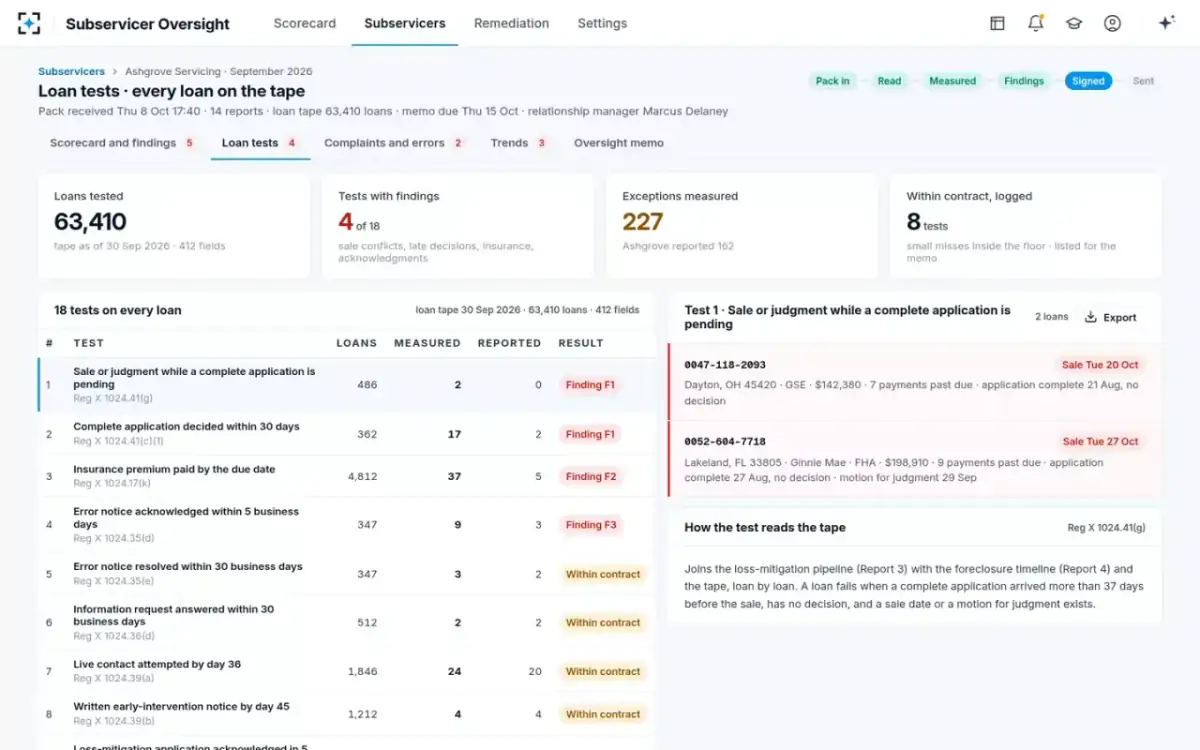
Starts from 18 tests run on every loan, with the exception loans and their timelines already listed.
Still theirs: Decides which exceptions are findings and what the subservicer must fix.
Today
Learns of a serious failure when an examiner or investor does.
With agents
Acknowledges each critical finding the same morning it is signed.
Still theirs: Owns the escalation and the conversation with regulators.
Today
Sees one month at a time, without the trend or the cause.
With agents
Brings 13 months of each measure to the committee, with the contract floor and the forecast.
Still theirs: Runs the committee and the relationship, including renewal and termination.
Today
Finds conclusions in the memo but not the evidence behind them.
With agents
Reads every finding with its report page or loan, and every closed item with its re-test.
Still theirs: Independent assurance that the oversight itself works.
The interagency third-party guidance that bank owners follow treats this staffing as part of the control, not an overhead line: “a banking organization dedicates sufficient staffing with the necessary expertise, authority, and accountability to perform a range of ongoing monitoring activities” (Interagency Guidance on Third-Party Relationships, 2023). Nonbank owners are not bound by that text, but the CFPB applies the same logic through Bulletin 2016-02 and, in its July 2026 servicing exam procedures, tells examiners to evaluate “policies, procedures, complaints, and copies of any agreements” with service providers (CFPB Mortgage Servicing Examination Procedures, July 2026).
How big should a subservicer oversight team be?
No regulator sets a headcount; the size of an oversight team is a risk decision that should follow the size, default level and complaint history of the subserviced book. Reg X’s commentary says exactly that about servicer procedures generally: a servicer has flexibility “in light of the size, nature, and scope of the servicer’s operations, including, for example, the volume and aggregate unpaid principal balance of mortgage loans serviced, the credit quality, including the default risk, of the mortgage loans serviced, and the servicer’s history of consumer complaints” (comment 38(a)-1).
Default risk is the variable that moves the answer most. A performing loan generates a payment, an escrow line and the occasional call; a delinquent one generates early-intervention letters, a loss-mitigation file with its own clocks, and possibly a foreclosure with counsel and a court. The more of a book is delinquent, the more of the subservicer’s month falls under the clocks an analyst has to test, and the more expensive each sampling miss becomes.
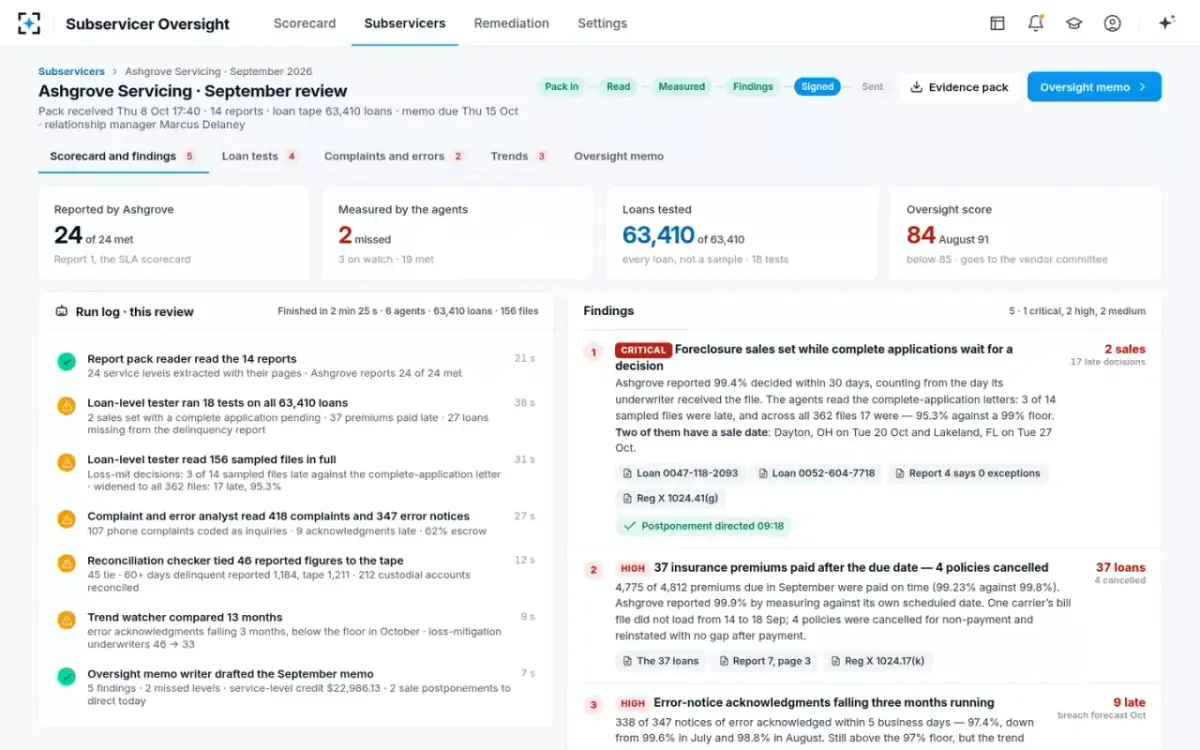
The useful sizing question is therefore not “how many analysts per 10,000 loans” but “what can this team actually test each month?” If the answer is a few dozen files and a read of the scorecard, the team is relying on the subservicer to measure itself. That is the gap the sample owner’s September shows: the scorecard said 24 of 24 service levels met, and the evidence said 19 met, 3 on watch and 2 missed.
Where a monthly review’s days go when it is done by hand
Most of a hand-run review goes on reading and pulling, not on judgement. The estimate below splits about three weeks between the pack landing and a signed memo: testing loans and pulling files is the largest block, reading the pack the next, and the memo itself a small slice at the end.
Fifteen working days for one subservicer’s month, mostly spent before any judgement is made
The last bar is not a smaller job; it is the same job with the reading moved off the desk. Memo and sign-off keep half a day because those are the decisions only the oversight manager can take: which exceptions become findings, what to require of the subservicer and by when, and whether a service-level credit applies.
How often should an MSR owner review its subservicer?
Reg X requires reviews to be “periodic” and leaves the period to the owner; most owners review monthly because subservicers report monthly and the costliest failures run on clocks measured in days. Five-day acknowledgments, 30-day loss-mitigation evaluations and the 37-day line before a foreclosure sale all expire inside a quarter, so a quarterly review finds a missed sale protection after the sale.
The interagency guidance takes the same view: monitoring “may be conducted on a periodic or continuous basis, and more comprehensive or frequent monitoring is appropriate when a third-party relationship supports higher-risk activities, including critical activities” (2023 guidance). Default servicing is plainly one of them. A practical cadence is a full review monthly, with a daily watch on sale dates against pending complete applications for the loans where a mistake cannot be undone.
What the oversight job does each month, line by line from the rule
| What Reg X asks the owner to be able to do | What the oversight desk does with it | Evidence it keeps |
|---|---|---|
| See “actions performed by service providers” (1024.38(b)(3)(i)) | Receives the report pack, the loan tape and access to loan files and letters | The pack as sent, each figure with its page |
| Run “periodic reviews” and “audit compliance” (1024.38(b)(3)(ii)) | Tests loans against Reg X, Reg Z, investor and contract clocks; reads files where the tape is blind | Exception loans with the fields that prove them |
| Share loss-mitigation and foreclosure status with counsel (1024.38(b)(3)(iii)) | Watches sale and judgment dates against pending complete applications | The direction to the subservicer and its confirmation |
| Get information to correct a provider’s errors (comment 38(b)(1)(ii)-1) | Reads notices of error and complaints, ties them to root causes | Complaint coding, clock results, root cause |
| Show the information was actually used (2013 preamble) | Writes findings, required actions, credits and re-tests | Signed memo and closed remediation items |
Why “we have the reports” is not oversight
Holding a provider’s reports satisfies the first half of the rule and none of the second. When the CFPB adopted 1024.38(b)(3) it said so plainly, and the sentence is the best job description the role has:
The Bureau expects that servicers seeking to demonstrate that their policies and procedures are reasonably designed to achieve these objectives will demonstrate that, in fact, the servicer has been able to use its information to oversee its service providers effectively.
CFPB, Mortgage Servicing Rules under Regulation X, 78 FR 10696 (2013)
“In fact” is the operative phrase. An examiner reading the file wants to see a finding that came from the owner’s own testing, a direction to the subservicer, and a re-test showing it was fixed. A memo that restates the subservicer’s scorecard shows the owner received information, not that it used it.
The same lesson came from inside government. FHFA’s Inspector General found in March 2024 that the agency’s examiners had done effective oversight of how Fannie Mae and Freddie Mac manage nonbank servicer risk, but that the division “has not developed policies and procedures for reviews of nonbank seller/servicers”, which “increases the risk that (1) DER examiners might not consistently or effectively plan and perform reviews” (FHFA OIG, AUD-2024-003). A written method is what lets a two-person desk produce the same quality of review in a hard month as in an easy one.
What the oversight manager opens on Monday: reported against measured, with the run log
What skills does a mortgage servicing oversight analyst need?
The analyst who does this well reads regulation as a set of start events and deadlines, reads a loan tape as evidence, and writes a finding a subservicer cannot argue with. Servicing operations experience helps, because a good analyst knows which report a subservicer would produce from which system and where the two can drift apart.
Skills that make an oversight analyst effective
- Clock literacy
Knows the start event of each Reg X clock: receipt of a complete application for the 30-day evaluation, receipt of a notice of error for the five-day acknowledgment, the penalty date for an escrow disbursement.
- Data reading
Can join a loss-mitigation pipeline to a foreclosure timeline by loan and see which field on the tape cannot show what the rule measures.
- File reading
Knows which letter or notice in a loan file evidences the date the tape gets wrong, and how to read it quickly.
- Contract reading
Can tie each service level in the agreement to its definition, floor and credit, and spot a definition that drifts from the rule.
- Finding writing
Writes what was found, the evidence, the rule, what is required of the subservicer and the date, in that order.
- Escalation judgement
Knows when a finding cannot wait for the memo: a sale date against a pending complete application is a same-day call.
Why the oversight seat keeps growing at MSR owners
It is a growing seat in a market that keeps outsourcing the work. FSOC reports that third-party subservicers handled about half of the balances for which a nonbank held the servicing rights at the end of 2023, against about a quarter in 2015 (FSOC, 2024). Every one of those portfolios needs someone at the owner who can tell whether the subservicer is doing the job.
The staffing risk is the shape of the work. A role spent reading reports and pulling files teaches less than one spent deciding what the evidence means. The direction of the tools, including the solution described here, is to leave the analyst with the deciding, so the people who do this work well get better at the part that is hard to replace. How to test every loan, not a sample and why a subservicer’s KPIs can read green while the borrower’s clock runs out go deeper on the two skills that matter most.
The analyst’s starting point: 18 tests already run on all 63,410 loans
What the oversight job looks like once the reading is automated
The job moves from reading to deciding, and the day starts with what cannot wait. In the sample month the oversight manager opened the review to find two borrowers whose complete loss-mitigation applications were more than 37 days ahead of a scheduled sale and still had no decision, one of them in Dayton, Ohio, on day 40 with a sale nine days away. The subservicer’s foreclosure report showed no such loans. By 09:18 she had directed the subservicer to postpone both sales and decide both applications.
The rest of the morning was the memo: five findings, each with its evidence, a service-level credit under the agreement and five remediation items that close only when the agents re-test them on the loan data. Botminds’ Subservicer Oversight drafted all of it; the oversight manager decided every line and signed it. That is the version of the job worth training for.
Questions people ask
What does a subservicer oversight manager do?
The manager owns the monthly review of each subservicer: decides which exceptions are findings, directs the subservicer to fix them, applies service-level credits and signs the memo to the vendor committee. In the sample owner the manager also directs urgent actions, such as postponing a foreclosure sale, the same day the evidence shows one.
What does Reg X 1024.38(b)(3) require?
It requires a servicer’s policies and procedures to be reasonably designed so that its staff can see accurate, current information about what service providers did, run periodic reviews with the documents needed to audit their compliance with the contract and the law, and share loss-mitigation and foreclosure status with provider staff handling foreclosures. It applies to the owner of the servicing rights as the servicer, whoever does the work.
Do small servicers need subservicer oversight?
Reg X exempts small servicers, those servicing 5,000 or fewer loans that they or an affiliate own or originated, from 1024.38. An owner that uses a subservicer usually holds rights it acquired, so it rarely fits that definition, and investor and state requirements apply regardless of size.
Where should an MSR owner find its oversight analysts?
Most come from servicing operations, servicing quality control or compliance testing, where they learned the clocks and the systems. The skills that transfer are reading a loan tape, reading a loan file for dates, and writing a finding with its evidence and required action.
Is subservicer oversight first-line or second-line work?
It is usually a first-line control owned by the business that holds the servicing rights, with compliance as the second line and internal audit as the third. The interagency guidance expects independent reviews of the oversight process itself, which is why audit needs every finding traceable to its evidence.