State specific leave laws are the rules a state adds on top of the federal Family and Medical Leave Act: a paid family and medical leave program that replaces wages, a job-protection statute that often reaches smaller employers than the FMLA does, and in a few states a disability program. Thirteen states and the District of Columbia have paid family and medical leave laws, by the Department of Labor's count (Women's Bureau, page as captured 16 October 2026), fourteen once Virginia's 2026 law is counted, and none of them displaces the FMLA: where a state gives more, the employer owes both. So a single leave question has up to four answers, one per layer, and the employer's policy is the fourth. Botminds' State Leave Law Compliance answers that question for every state a client employs people in, each answer tied to its passage, and leaves three people to sign for what they own: the leave specialist who researched it, the compliance analyst who approves it and the client's HR lead who tells the employee.
The chain matters because each signature means something different and a wrong answer travels. A specialist who reads the wrong year's maximum produces a wrong payment; an analyst who approves a policy that is silent on a new program leaves employees without a benefit the law gives them; an HR lead who repeats an answer that is not FMLA leave as if it were can use up weeks the employee still has.
From a plain question to a signed answer: five agents read, three people sign
Agent
Question interpreterTurns the question into reason, relation, states, client and dates.
Never: Answers the question itself
Agent
Statute researcherReads each state program, job-protection law and agency page, then the FMLA rule, and writes one cell per state and layer.
Never: Writes a cell without a passage
Agent
Plan readerReads the client policy clause by clause and marks it Yes, Partly, Silent or Gap.
Never: Sends a plan change
Agent
Effective-date watcher and answer checkerDraws laws not yet in force with their date, and reads every cell back against its passage.
Never: Shows a bill as law
A person decides
Leave specialistDecides the answer and saves it to the case: researched.
A person decides
Compliance analystApproves new rulings and every policy change: approved.
A person decides
Client HR leadTells the employee and the managers: communicated.
What are state specific leave laws? Four layers on one question
They are the state's own leave rules, and on any one question they come as layers. The federal FMLA gives an eligible employee "a total of 12 workweeks of leave during any 12-month period", unpaid, and only where the employee has worked 12 months, 1,250 hours, and at a site with 50 or more employees within 75 miles (29 CFR 825.110). A state paid leave program pays part of the wage. A state job-protection law guarantees the job back, often on easier terms: Connecticut's family and medical leave statute defines an employer as one that "employs one or more employees" (Conn. Gen. Stat. § 31-51kk). And the employer's policy may add paid caregiver days, top-ups or waiting-week pay.
The layers do not move together. Washington's paid leave now protects the job of an employee who has worked 180 days for an employer with 25 or more workers (Washington ESD, 2026 paycheck insert), far below the FMLA's thresholds. Delaware's program covers caregiving only for a parent, child or spouse (19 Del. C. § 3701), narrower than most. An answer that collapses the layers into one yes or no is wrong somewhere.
One question, four layers: who writes each rule, and who enforces it
| Layer | What it gives | Written by | Enforced by |
|---|---|---|---|
| State paid leave program | Wage replacement for a share of pay, up to a weekly maximum set each year | The state legislature and its program agency | The state agency, or an approved private plan |
| State job-protection law | The job, or an equivalent one, on return | The state legislature | The state labor department or the courts |
| Federal FMLA | 12 unpaid, job-protected workweeks for eligible employees | Congress and the Department of Labor (29 CFR 825) | The Department of Labor, Wage and Hour Division |
| The employer policy | Whatever the employer promised: caregiver days, top-ups, waiting-week pay | The employer | The employer, and the law where the policy falls short |
Who is responsible for leave law compliance?
The employer, in every case, even when a carrier, a third-party administrator or a consultant does the work. The FMLA rule leaves no exception: designating leave as FMLA leave, and telling the employee so, is always the employer's job (29 CFR 825.300(d); FMLA designation notice requirements quotes the rule and its five-day clock). State statutes do the same for their own notices; Virginia's new law, for example, makes the employer give written notice at hiring, every year and whenever it learns an employee may need leave (Va. Code § 60.2-811).
Inside a carrier or an administrator, though, the answer is made by a team, and the employer relies on it. That is where the chain of signatures comes from. The person who researched the answer is not the person who approves a new interpretation, and neither is the person who tells the employee. A file that cannot show who did which is a file nobody can defend when the answer turns out to be wrong.
Does state leave law override FMLA?
No: neither law overrides the other, and the employer must comply with both. The Department of Labor's FMLA rule leaves in place any state law that gives greater leave rights, and where a leave qualifies under both, the time used comes off both entitlements at once (29 CFR 825.701(a)). The more generous rule wins on each point, not the more generous law as a whole.
That point-by-point reading is why the answer is a grid and not a sentence. A state may give longer leave, a wider family list and pay, while the FMLA still gives the continued group health coverage the state law does not. How the two count against each other is the subject of FMLA and state leave laws; the narrower question of who counts as family is in covered family members under FMLA and state leave laws.
Three signatures, and what each one means
Each signature in the chain certifies a different thing, and it should be possible to tell from the file which.Researched means the specialist read the passages for every state and layer and the answer follows from them. Approved means the compliance analyst accepts a new reading of the law, or a change to a client's policy, as the team's position, to be reused. Communicated means the client's HR lead has told the employee what the employee gets and what it costs them.
Three people sign a state leave answer; each signs for something different
Today
Answers 30 to 40 rule questions a day from a spreadsheet chart, an agency site and the client policy, then checks the chart is still right.
With agents
Asks in plain words, reads one grid with a passage under every cell, decides and saves the answer to the case.
Still theirs: The decision, and the words the client hears
Today
Keeps the state rule library current and is asked to sign without seeing the passages behind the answer.
With agents
Receives each new ruling and each policy redline with the passage beside every change, and signs as themselves.
Still theirs: Approval of new rulings and policy changes
Today
Runs one leave policy across many states and needs a yes or no per state, and a deadline.
With agents
Gets the signed answer per state, the employees each change touches, and a letter drafted for HR to send.
Still theirs: What the employee is told, and when
What the specialist checks before calling an answer researched
The specialist's signature is only as good as what they could see. For each state and each layer they need the verdict, one line of reasoning, the passage itself, the version of the law in force on the date of the leave, and when the passage was last read. Washington is a good test: its definition of family member includes a grandparent, and it also reaches a person who lives with the employee or relies on the employee for care (RCW 50A.05.010). A chart cell that says "grandparents: yes" is right and incomplete.
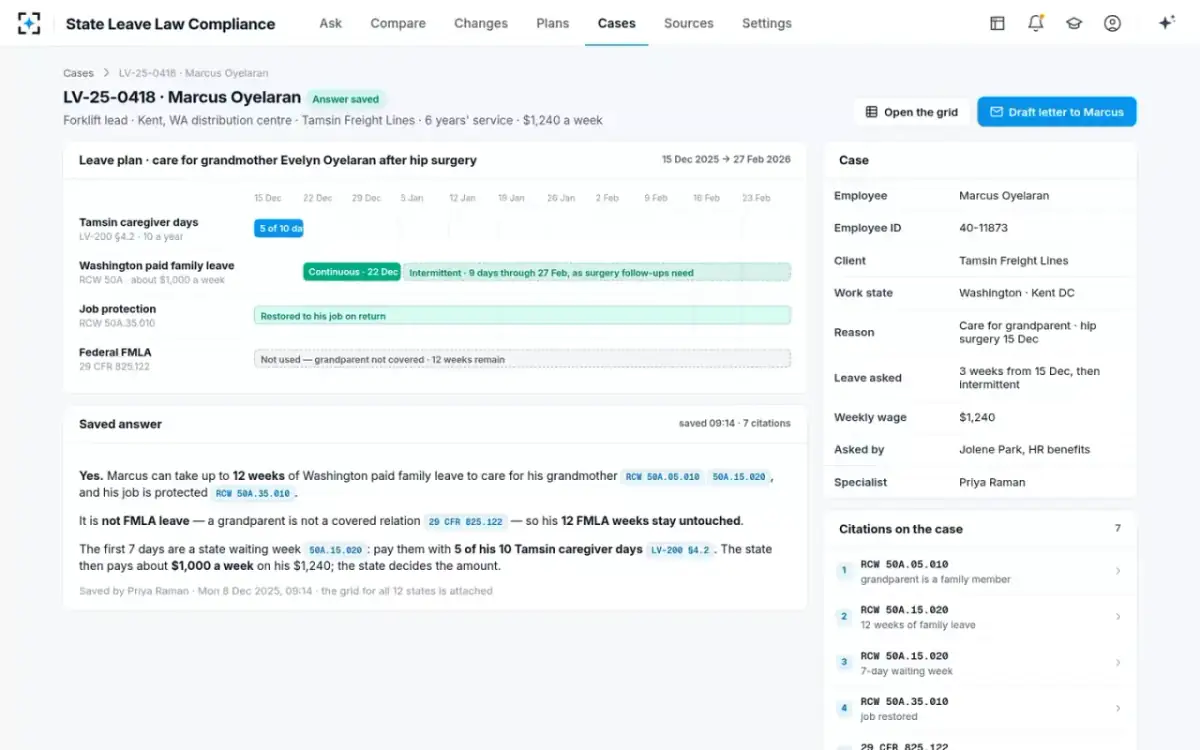
In the solution's sample case, a specialist at a benefits administrator answers whether a forklift lead in Washington can take paid leave for his grandmother's surgery. The saved answer carries seven citations, each beside the sentence it supports, and lays the leave out lane by lane: five of the employer's caregiver days for the state waiting week, state family leave after it, the job restored on return, and the FMLA not used at all.
What the specialist signs: an answer whose every sentence carries its passage
What the compliance analyst approves, and when a second signature is needed
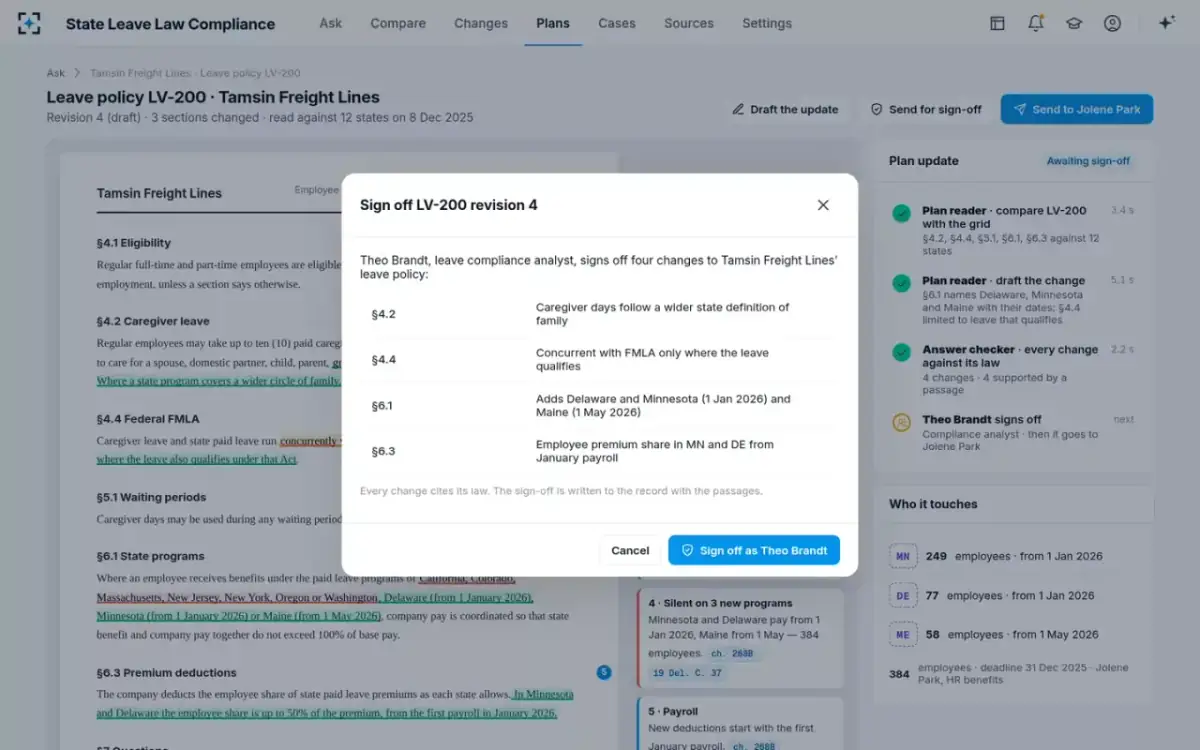
The analyst approves two kinds of thing: a new reading of the law that the team will reuse, and any change to a client's leave policy. Both outlive the case that raised them, which is why they need a second pair of eyes. The analyst should see each proposed change with the passage that requires it, and the people it touches.
Size thresholds are where approvals most often go wrong, because the same program treats employers differently. Delaware's program applies only its parental leave provisions to employers with 10 to 24 employees and all its provisions at 25 or more (19 Del. C. § 3701(7)). A policy change approved for one client can be wrong for a client next door with 20 staff. The solution's sample settings route every policy change to the analyst and then to the client's HR lead, and require a second sign-off from the head of absence when a client has more than 1,000 employees in the state; those are settings the team owns, not rules of law.
What the analyst approves: four policy changes, each with the law behind it
What client HR needs before telling an employee
The HR lead needs the answer in the employee's terms: what leave they can take, what it pays and who pays it, whether the job is protected, which other balances it uses, and what the employee has to file and by when. Some of that is the state's to decide: the program sets the benefit amount, and an employer's estimate is only an estimate.
The letter is the HR lead's to send. In the solution's sample setting a letter is drafted from the saved answer for HR to send, and nothing goes to an employee from the agents. That keeps the signature where the employment relationship is, and it keeps the employer's notice duties, which the law places on the employer, with the employer.
Three signatures, three meanings: researched, approved, communicated. A file that cannot show which person signed for which is a file nobody can defend.
What should a leave answer cite?
Every sentence that states a rule should cite the passage it comes from, the version of that passage in force on the leave dates, and, for any figure, the year it applies to and the agency page it was read on. The checklist below is the standard a compliance analyst can hold any answer to, whoever wrote it.
Seven things a state leave answer should carry before anyone signs it
- The section, not just the law
RCW 50A.05.010 for who is family, not "Washington PFML".
- The version in force on the leave dates
A law enacted but not yet paying is not yet the answer; show its effective date.
- Each figure with its year and its page
Weekly maximums and premium rates change on dates each agency sets, not always 1 January.
- The employer-size test
Which threshold applies to this client in this state: 10, 15, 25, 30 or 50 employees.
- Each layer separately
Paid, job-protected and FMLA can each be yes or no on the same question.
- The employer policy clause
Silent is not yes: say which clause, and whether it falls short of the law.
- Who decided, and who approved
Named people, with the date, on the case.
How often do state leave laws change?
Every few weeks somewhere, and not only on 1 January. In 2026 Delaware began taking claims on 1 January (Delaware Department of Labor, 1 January 2026); Maine's benefits started on 1 May (Maine Department of Labor); Oregon's new maximum applies to benefit years from 28 June (Oregon Employment Department, 29 May 2026); Rhode Island's temporary disability maximum rose for claims from 1 July (Rhode Island DLT); and the District of Columbia set new weeks of leave from 1 October (DC Department of Employment Services).
The next year is already arriving. Washington announced on 16 October 2026 that its premium rises to 1.2% in 2027 (Washington ESD); Massachusetts' Chapter 101 of the Acts of 2026 moves employer contributions from medical to family leave from 1 January 2027 (Massachusetts DFML); Virginia's 2026 law starts collecting contributions by 1 April 2028 (Va. Code § 60.2-801). A chart reviewed once a year is wrong for part of every year; three tests for a state leave laws chart sets out how to tell.
State leave law changes in 2026 fell across the whole year
| Date | Change | Where it is written |
|---|---|---|
| 1 Jan 2026 | Delaware starts taking claims; Washington job protection at 25+ workers after 180 days | Delaware DOL; Washington ESD |
| 1 May 2026 | Maine benefits begin, up to 12 weeks in a benefit year | Maine DOL |
| 28 Jun 2026 | Oregon maximum weekly benefit $1,692.16 for new benefit years | Oregon Employment Department |
| 1 Jul 2026 | Rhode Island temporary disability maximum $1,150 for new claims | Rhode Island DLT |
| 1 Oct 2026 | District of Columbia: 2 weeks prenatal, 12 parental, 10 medical, 6 family | DC DOES |
| 16 Oct 2026 | Washington announces a 1.2% premium for 2027 | Washington ESD |
Errors cost the employer, not the chart. In fiscal 2025 the Wage and Hour Division's concluded FMLA compliance actions covered 342 employees and $1,029,463 in back wages (DOL WHD FMLA data), and those are only the cases the Division closed, not private suits or state claims.
Questions people ask
Who approves a leave decision?
The employer is legally responsible for designating FMLA leave and giving notice. Inside a carrier or administrator the answer is usually researched by a leave specialist, approved by a compliance analyst where it sets a new position or changes a policy, and communicated by the employer's HR. Each signature should be visible on the case.
What are state leave laws for 2026?
The federal Department of Labor counts thirteen states and the District of Columbia with paid family and medical leave laws, plus Hawaii's temporary disability law; Virginia's 2026 law makes fourteen states. Delaware and Minnesota began paying in January 2026 and Maine in May; Maryland's benefits start in January 2028 and Virginia's in December 2028. States with paid family leave in 2026 lists each.
Does a state program run at the same time as FMLA leave?
Where the leave qualifies under both, yes: it counts against both entitlements under 29 CFR 825.701, and states such as Colorado and Virginia say so in their own statutes. Where the reason is not covered by the FMLA, such as caring for most grandparents, the state leave does not reduce the FMLA balance.
Can a small employer ignore state leave laws because the FMLA does not cover it?
No. The FMLA starts at 50 employees within 75 miles, but state laws reach far smaller employers: Colorado's program applies to every employer with one or more employees in the state, and Connecticut's leave statute covers an employer of one. An employer covered by only one law must comply with that one.
How long should a leave answer be kept?
As long as the employer's leave files, and at least as long as the case could be questioned. What matters is that the answer can be rebuilt: the passages, their versions, the figures with their years and who signed. Maryland, for example, tells private-plan employers to keep application files for at least five years.