Covered family members under the FMLA are three: a spouse, a son or daughter, and a parent. A parent includes anyone who stood in loco parentis to the employee as a child, but "does not include parents 'in law'"; a son or daughter must be under 18, or 18 or older and incapable of self-care because of a disability; and a spouse means a marriage recognised under state law, not a domestic partnership (29 CFR 825.122). State paid family leave programs define family far more widely, and differently from one another: parents-in-law, grandparents, grandchildren, siblings, domestic partners and, in several states, people who are family in fact. For an employer in many states, that mismatch is where leave answers go wrong: a leave paid and job-protected by the state may not be FMLA leave, and the employer's own policy may promise neither. Botminds' State Leave Law Compliance reads the state law, the FMLA and the employer's policy for each family-member question and answers each layer separately, with the passage behind every answer.
Every definition on this page is quoted from the statute, regulation or program agency, linked where it appears. The worked case comes from the solution's sample data: a fictional employer with 4,770 employees in 12 states.
Who counts as family: the FMLA's three relations against the states' longer lists
Federal FMLA: A marriage recognised where it was entered into, including same-sex and common law marriages.
State paid family leave programs: Spouse, and in most programs a domestic partner as well.
Federal FMLA: Under 18, or 18 or older and incapable of self-care because of a disability.
State paid family leave programs: Several programs cover a child of any age.
Federal FMLA: Includes anyone who stood in loco parentis; never a parent-in-law.
State paid family leave programs: Parent-in-law covered in most programs.
Federal FMLA: Not covered, except through in loco parentis or as next of kin for military caregiver leave.
State paid family leave programs: Covered in most programs; not in Delaware.
Federal FMLA: Not covered.
State paid family leave programs: Covered in New Jersey, Washington, Minnesota, Maine, Oregon and Colorado, each with its own test.
Federal FMLA: Unpaid leave, up to 12 workweeks.
State paid family leave programs: A share of wages up to the state’s weekly maximum.
Who are covered family members under the FMLA?
A spouse, a son or daughter, and a parent, and for military caregiver leave, the servicemember's next of kin. The rule defines parent as "a biological, adoptive, step or foster father or mother, or any other individual who stood in loco parentis to the employee when the employee was a son or daughter," and adds: "This term does not include parents 'in law'" (29 CFR 825.122(c)). A son or daughter is "a biological, adopted, or foster child, a stepchild, a legal ward, or a child of a person standing in loco parentis, who is either under age 18, or age 18 or older and 'incapable of self-care because of a mental or physical disability'."
Incapable of self-care has its own test: the individual "requires active assistance or supervision to provide daily self-care in three or more of the activities of daily living." That test decides most adult-child cases, and it is one an absence team has to document. Spouse means a husband or wife under a marriage valid where entered into, "including an individual in a same-sex or common law marriage"; a domestic partnership is not a marriage for this purpose.
Grandparents, siblings and aunts and uncles appear in one place only: as possible next of kin of a covered servicemember, in a fixed order of priority that runs through "brothers and sisters, grandparents, aunts and uncles, and first cousins" (§ 825.122(e)). That reaches a sibling caring for a servicemember, not a sibling with an ordinary serious health condition.
The chart: covered family members in nine programs
State programs agree on the core and part on the edges. The chart sets the FMLA beside eight programs whose definitions are quoted on this page. Where a cell says yes, the relation is named in the program's own definition; where it says no, it is absent from it.
Covered family members, relation by relation, in the FMLA and eight state programs
| Program | Parent-in-law | Grandparent | Grandchild | Sibling | Domestic partner | Chosen family |
|---|---|---|---|---|---|---|
| Federal FMLA | No | Only in loco parentis | Only in loco parentis, and under 18 or incapable of self-care | No | No | No |
| California PFL | Yes | Yes | Yes | Yes | Registered | No |
| New York PFL | Yes | Yes | Yes | Yes | Yes | No |
| New Jersey FLI | Yes | Yes | Yes | Yes | Yes | Yes: chosen family |
| Washington PFML | Yes | Yes | Yes | Yes | State registered | Yes: lives with or depends on the employee for care |
| Minnesota Paid Leave | Yes | Yes, and spouse’s | Yes | Yes | Yes | Yes: expectation and reliance of care |
| District of Columbia | Yes | Yes | No | Yes | Yes | No |
| Maine PFML | Yes | Yes, incl. de facto | Yes | Yes, incl. de facto | Yes | Yes: one designated person |
| Delaware Paid Leave | No | No | No | No | No | No |
Four more programs follow the wider pattern. Massachusetts covers "a grandchild, grandparent or sibling of the covered individual" and the parent of a spouse or domestic partner (M.G.L. c. 175M, § 1). Connecticut's family and medical leave statute lists "a spouse, sibling, son or daughter, grandparent, grandchild or parent" (Conn. Gen. Stat. § 31-51kk). Oregon covers a grandparent and "any individual related by blood or affinity whose close association with a covered individual is the equivalent of a family relationship" (ORS 657B.010). Colorado reaches anyone with whom the employee has "a significant personal bond that is or is like a family relationship, regardless of biological or legal relationship" (C.R.S. § 8-13.3-503). Maryland and Virginia, whose programs pay from 2028, name grandparents including step, foster and adopted relations (Md. Code, Lab. & Empl. § 8.3-101; Va. Code § 60.2-800).
Four relations that cause most mismatches
The chart's disagreements cluster in four places, and each produces a predictable error in a leave answer or an employer policy.
In-laws. The FMLA excludes them in so many words; most state programs include them, and Washington and Minnesota do it by defining parent to include the employee's spouse's parent. An answer that says "parent: yes" without checking which definition applies is wrong in one direction or the other. Grandparents. Covered by nearly every state program, but by the FMLA only where the grandparent raised the employee. Siblings. Covered by every state program on the chart except Delaware's, and not by the FMLA. Adult children. New Jersey covers "children of any age," Washington a child "regardless of age or dependency status" and Maine a child "regardless of age," while the FMLA needs the incapable-of-self-care test.
One sample employer's exposure to definitions that differ from the FMLA
12
states where the fictional employer has staff
4,770
employees whose leave questions the absence team answers
384
employees in Minnesota, Delaware and Maine touched by one policy update
Chosen family and designated persons: what an absence team has to verify
Where a program covers people who are family in fact, the question changes from "what is the relation?" to "does this relationship meet the statute's test?" And the tests differ. Washington covers an individual "who regularly resides in the employee's home or where the relationship creates an expectation that the employee care for the person, and that individual depends on the employee for care," but not one "who simply resides in the same home with no expectation that the employee care for the individual" (RCW 50A.05.010). Minnesota covers "an individual who has a personal relationship with the applicant that creates an expectation and reliance that the applicant care for the individual without compensation, whether or not the applicant and the individual reside together" (Minn. Stat. § 268B.01).
Maine requires a designation: "As designated by the covered individual in accordance with rule, an individual with whom the covered individual has a significant personal bond that is or is like a family relationship, regardless of biological or legal relationship" (26 M.R.S. § 850-A). New Jersey lists "chosen family" and "any other individuals with whom you consider to be family" among those a worker may care for (NJ Family Leave Insurance). In each of these states, the state program decides the benefit claim; the employer's job is to know whether its own policy, and any job-protection law, follow the same definition.
Does leave for a state-only family member use up FMLA weeks?
No. Leave for a relation the FMLA does not cover is not FMLA leave, so it does not reduce the employee's 12 workweeks. The Department of Labor's rule uses exactly this case:
“If State law provides six weeks of leave, which may include leave to care for a seriously-ill grandparent or a ‘spouse equivalent,’ and leave was used for that purpose, the employee is still entitled to his or her full FMLA leave entitlement, as the leave used was provided for a purpose not covered by FMLA.”
29 CFR 825.701(a)(3)
The order matters, and the same paragraph sets it out: "If FMLA leave is used first for a purpose also provided under State law, and State leave has thereby been exhausted, the employer would not be required to provide additional leave to care for the grandparent or 'spouse equivalent.'" An absence team that designates every family-care leave as FMLA leave out of habit miscounts in both directions: it uses up FMLA weeks the employee still has, and it may exhaust state entitlement that would have covered a later grandparent or sibling. FMLA and state leave laws covers how the two layers are counted together.
Documenting the relationship: what an employer may ask for
Under the FMLA, a statement from the employee can be enough. "The employer may require the employee giving notice of the need for leave to provide reasonable documentation or statement of family relationship. This documentation may take the form of a simple statement from the employee, or a child's birth certificate, a court document, etc." The employer may examine an official document, but "the employee is entitled to the return of the official document submitted for this purpose" (29 CFR 825.122(k)).
Answering a family-member leave question, layer by layer
Agent
Read the questionNames the reason for leave, the relation and the states that apply: work state, and any state whose law follows the employee.
Agent
Read each definitionReads the FMLA rule, each state program’s definition and each job-protection law, with the version in force on the leave date.
Never: Never infers a relation the definition does not name
Agent
Read the employer’s policyFinds the clause that defines family for the employer’s own leave and pay, and whether it is narrower or silent.
A person decides
Decide and documentThe absence specialist decides, asks for the relationship statement the law allows, and saves the answer to the case.
A person decides
Sign policy changesWhere the policy is narrower than a law, a compliance analyst signs the redline before it reaches the client.
States set their own documentation rules for their benefits, and for chosen-family and designated-person relations the attestation the program asks for is part of the claim. An employer that asks for more than the FMLA permits when it designates FMLA leave, or that asks for a birth certificate where a statement would do, creates a compliance issue of its own.
Writing the employer's policy so it does not promise the wrong thing
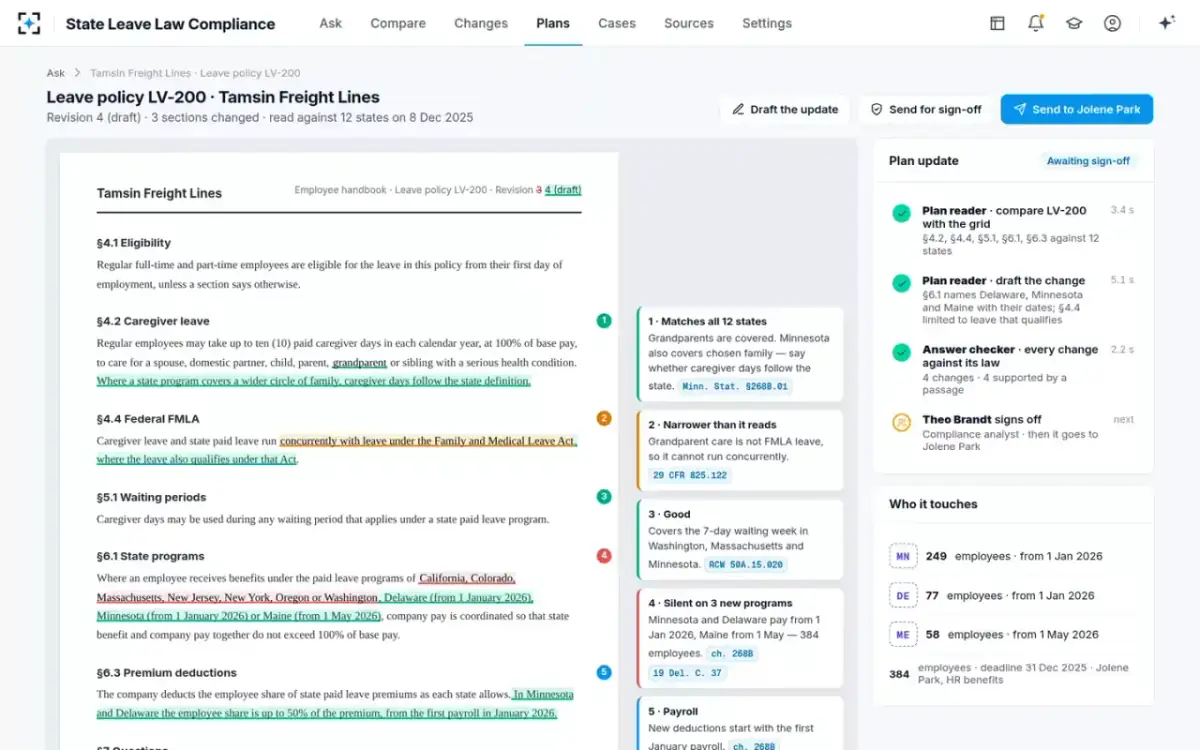
The most common policy error is a clause that borrows the FMLA's definition for leave the state defines more widely, or says that all family-care leave "runs concurrently with FMLA." In the sample case, the plan reader found the client's policy section on caregiver days narrower than it reads: grandparent care is not FMLA leave, so it cannot run concurrently with the FMLA, and the caregiver days had to follow the wider state definition of family in the states that have one.
A policy narrower than the law, marked and redlined before the new programs pay
Six checks on an employer's family definition
- Which leave each clause governs
Unpaid FMLA leave, state-paid leave, employer pay, or job protection: each can define family differently.
- In-laws named, or excluded on purpose
The FMLA excludes them; most state programs include them.
- Concurrency limited to qualifying reasons
Leave for a state-only relation cannot be counted as FMLA leave.
- Chosen family addressed state by state
New Jersey, Washington, Minnesota, Maine, Oregon and Colorado each use a different test.
- Documentation no stricter than the law allows
Under the FMLA, a simple statement can suffice.
- Effective dates for new programs
A definition that arrives with a new program applies from its first day of benefits.
Definitions that arrive with new programs
Each new state program brings its own definition of family, effective the day it starts paying. Minnesota and Delaware began on 1 January 2026, and their definitions sit at opposite ends of the chart: Minnesota's includes a spouse's grandparent, sons- and daughters-in-law and a relationship of expectation and reliance, while Delaware's adopts the FMLA's parent and spouse and adds only a child. Maine pays from 1 May 2026 with a designated-person clause; Maryland and Virginia follow in 2028.
For a multi-state employer the practical consequence is a calendar, not a table: a relation that is not covered in a state today may be covered next quarter. States with paid family leave in 2026 sets out each program's weeks, pay and start date, and the state leave laws chart for 2026 covers how such a chart is kept accurate.
How State Leave Law Compliance answers a family-member question
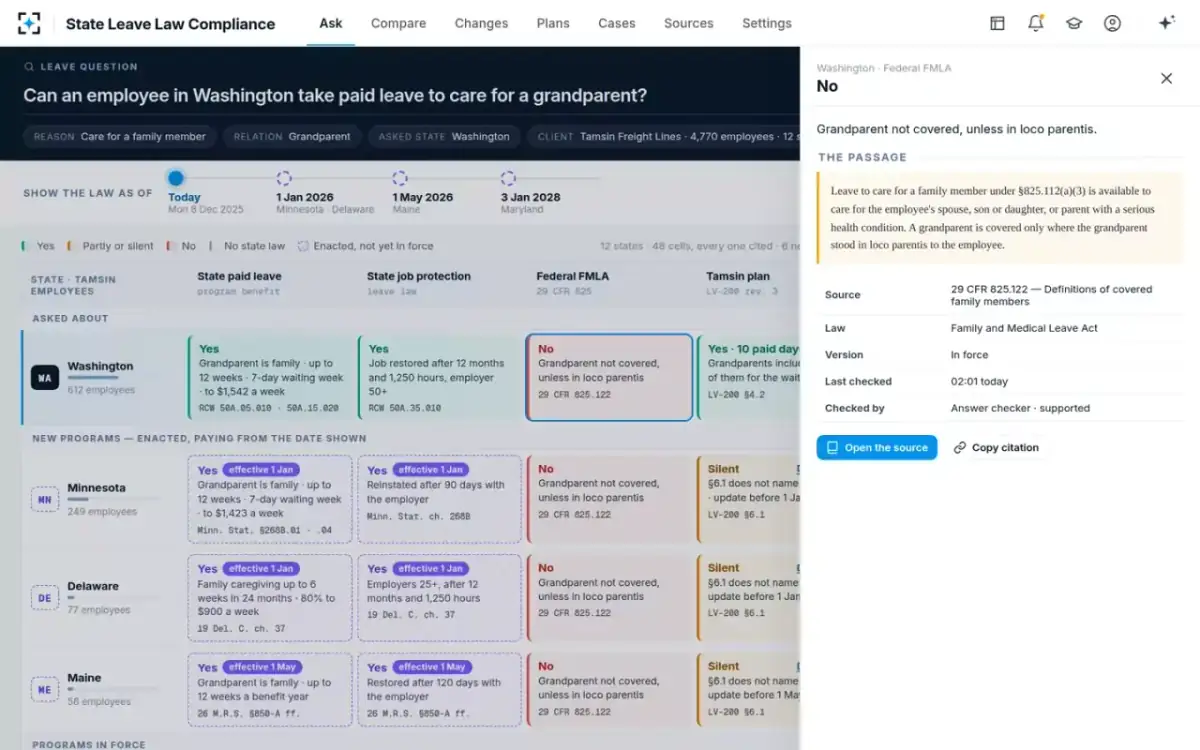
The solution answers each layer separately, so the difference between them is visible. In its sample case, a forklift lead in Washington needs about three weeks, then intermittent days, to care for his grandmother after surgery. The Washington cell says yes: a grandparent is a family member, up to 12 weeks, job protected. The FMLA cell says no: a grandparent only when they stood in loco parentis to the employee, so the leave is not FMLA leave and all 12 FMLA weeks remain. The employer's caregiver days cover the state's seven-day waiting week.
The FMLA layer: grandparent not covered unless in loco parentis, with the rule quoted
What the solution does not do is decide a state benefit claim or advise an individual employee. The state program decides the claim, and the absence specialist and compliance analyst decide what the employer does. Where pay is also involved, California SDI integration with employer pay covers how the employer's top-up and the state benefit fit together.
Questions people ask
Does the FMLA cover care for a parent-in-law?
No. The FMLA rule defines parent and states that the term "does not include parents 'in law.'" Most state paid family leave programs do cover parents-in-law, including California, New York, New Jersey, Washington, Minnesota, Maine and the District of Columbia.
Is a sibling a covered family member under the FMLA?
Not for ordinary family care. A sibling appears in the FMLA rule only as possible next of kin of a covered servicemember for military caregiver leave. Every state program on the chart above covers siblings except Delaware's.
Does the FMLA cover domestic partners?
No. The FMLA's spouse means a marriage recognised where it was entered into, including same-sex and common law marriages, but not a domestic partnership. California covers registered domestic partners, and New York, New Jersey, Minnesota, Maine and the District of Columbia cover domestic partners.
Can an employer ask for proof of a family relationship?
Under the FMLA, yes, within limits: the employer may require reasonable documentation or a statement of family relationship, which can be a simple statement from the employee, and an official document submitted must be returned. State programs set their own documentation for their benefits.
Which states cover chosen family in paid leave?
New Jersey, Washington, Minnesota, Maine, Oregon and Colorado each cover some form of chosen or designated family, with different tests: dependence and residence in Washington, an expectation and reliance of care in Minnesota, a designated person in Maine, and a relationship equivalent to family in Oregon and Colorado.
Does Delaware paid leave cover grandparents?
No. Delaware's statute defines family member as a parent and a spouse as defined under the FMLA, and a child. Grandparents, siblings and in-laws are not covered, unless a grandparent stood in loco parentis and so counts as a parent.