California SDI integration means coordinating the state's wage-replacement benefits, Disability Insurance (DI) and Paid Family Leave (PFL), with what the employer pays: sick leave, vacation or paid time off, a salary-continuation policy or a short-term disability (STD) plan. The state pays about 70 to 90 percent of base-period wages, up to $1,765 a week for claims beginning in 2026; integration fills some or all of the gap. The rule that governs it is simple to state and easy to break: the EDD treats employer pay received during the claim as wages, and if wages and benefits together exceed the employee's regular weekly wage, the state benefit is reduced. Getting it right needs the employer's policy, the employee's base period and the state chart read together, for each employee and each claim. Botminds' State Leave Law Compliance reads the state law, the federal FMLA and the employer's own plan side by side for the absence team, quotes the year's figures with the year they apply to, and any estimate on screen is labeled as one, because the EDD decides the benefit.
The rules and figures are the EDD's and the Department of Labor's, linked where they appear. The worked earners are fictional, and the arithmetic on them is ours.
The 2026 numbers an integration policy works around
$1,765
maximum weekly DI or PFL benefit for claims beginning in 2026
1.3%
SDI withholding on all wages in 2026, with no taxable wage limit
8wks
of PFL in any 12-month period; DI pays up to 52 weeks
100%
of regular weekly wages: the line above which the state benefit is reduced
What is SDI integration in California?
It is an employer's choice to pay part of an employee's wages during a DI or PFL claim so that, with the state benefit, the employee receives up to their regular pay. The EDD does not run integration; it reacts to it. Its employer guidance says "We treat paid sick leave as wages earned," and that where an employer lets employees combine sick pay with their state benefit, it "will not affect their DI or PFL benefit amount," unless sick pay and benefits together exceed the employee's usual wages (EDD, employer eligibility and benefits FAQs).
Integration is not a requirement on either side. The EDD tells employers that employees "are not required by law to use vacation, paid time off, or sick leave while receiving benefits." And since 1 January 2025 the employer cannot insist on it up front: the EDD's eligibility guidance says "your employer can't require you to use sick leave or any other paid time off before you get PFL benefits" (EDD, PFL eligibility FAQs). Before that date, an employer could require up to two weeks of unused vacation first. A policy written before 2025 that still says so needs rewriting.
The rule that sets the ceiling: wages plus benefits, against regular wages
The EDD reduces the weekly benefit by the amount that wages and benefits together exceed regular weekly wages. Its own worked example: an employee with regular wages of $1,000 a week earns $500 part-time during the claim and has an estimated benefit of $600. "$500 part-time wages + $600 WBA = $1,100," which is $100 over regular wages, "So you would be eligible for a partial WBA of $500 ($600 WBA - $100 over your regular wage)" (EDD, Calculating PFL benefit payment amounts). The DI page uses the same example (EDD, Calculating DI benefit payment amounts).
The integration top-up an employer can pay without reducing the state benefit
Regular weekly wage
What the employee normally earns in a week
From payroll, not the base period
The employer
State weekly benefit
About 70–90% of high-quarter wages ÷ 13, up to $1,765
From the EDD’s Notice of Computation
The EDD
Top-up
Regular weekly wage − state weekly benefit
Paid from sick leave, PTO or salary continuation
The employer’s policy
Over-payment
Any employer pay above the top-up
Reduces the state benefit dollar for dollar
Avoided by the policy
The trap is the regular weekly wage. The state benefit is computed from a base period that ended five to eighteen months before the claim, while the reduction rule compares against today's regular wage. An employee who had a raise since the base period has a benefit below 70 or 90 percent of current pay, and a larger top-up available. An employee on reduced hours since the base period may have almost none.
Three earners, integrated: what the employer can add each week
The benefit band decides how much is left for the employer to fill. Lower earners receive about 90 percent and have little gap; higher earners hit the $1,765 maximum and can have a large one. The table works the 2026 chart for three fictional employees whose regular wage equals their high-quarter wage divided by 13.
Integration top-up for three fictional earners on 2026 PFL claims
| Step | Ana: $9,000 high quarter | Ben: $18,500 high quarter | Cara: $40,000 high quarter |
|---|---|---|---|
| Regular weekly wage | $692.31 | $1,423.08 | $3,076.92 |
| PFL weekly benefit, 2026 chart | about $623 (90% band) | $1,120 to $1,129 (flat band) | $1,765 (maximum) |
| Gap the employer may fill | about $69 | about $294 to $303 | about $1,312 |
| Gap as a share of the regular wage | about 10% | about 21% | about 43% |
| Eight weeks of top-up | about $555 | about $2,350 to $2,425 | about $10,496 |
| Eight weeks of top-up in PTO hours at the regular rate | about 32 hours | about 66 to 68 hours | about 136 hours |
Two policy questions follow from the table. A flat "integrate up to 100%" policy costs the employer about four times as much per week for a senior employee as for a middle earner, because the state maximum caps the benefit and not the wage. And PTO balances run out at different speeds: Cara's eight weeks of integration use about 136 hours, which many employees do not have. A policy that does not say what happens when the balance runs out invites a pay dispute mid-leave.
How do short-term disability plans integrate with SDI?
Usually by offset: the plan promises a share of pre-disability earnings and pays that share minus the state benefit, so the employee receives the plan's promise in total and the plan pays only the difference. The offset is a design term of the plan, not a state rule, and it has to be read in the plan document. What the state rule adds is the ceiling: if STD and DI together exceed regular weekly wages, the EDD reduces DI.
The federal FMLA treats a disability plan's absence the same way whether or not the state benefit is integrated. Leave under a disability plan counts as FMLA leave if the condition qualifies, and "because leave pursuant to a disability benefit plan is not unpaid, the provision for substitution of the employee's accrued paid leave is inapplicable, and neither the employee nor the employer may require the substitution of paid leave." The Department of Labor adds that "employers and employees may agree, where state law permits, to have paid leave supplement the disability plan benefits, such as in the case where a plan only provides replacement income for two-thirds of an employee's salary" (29 CFR 825.207(d)).
Integration with sick leave or PTO: The employer, from accrued balances or salary continuation
Integration through an STD plan: The plan (insured or self-funded), net of the state benefit
Integration with sick leave or PTO: The employer’s leave policy; the EDD’s reduction rule
Integration through an STD plan: The plan document’s offset clause; the EDD’s reduction rule
Integration with sick leave or PTO: No: PFL cannot be conditioned on using PTO since 2025, and the EDD says employees need not use leave while on benefits
Integration through an STD plan: Under the FMLA, neither side may require substitution of paid leave during a disability plan absence
Integration with sick leave or PTO: Top-up computed on an estimate; balance runs out unannounced
Integration through an STD plan: Offset uses a different benefit amount from the EDD’s notice; DI plus STD exceeds wages
Integration with sick leave or PTO: Regular weekly wage, the EDD’s weekly benefit, PTO balance
Integration through an STD plan: Plan percentage and maximum, the EDD’s weekly benefit, the claim dates
Do PFL and CFRA or FMLA run at the same time?
They can, and the employer decides whether they do. The EDD is explicit that DI and PFL "do not change the federal or state leave laws in any way and are completely separate from them," that they "provide wage replacement benefits only; they do not provide job protection," and that a covered employer "may require you to take FMLA and CFRA leave while you're receiving Disability Insurance or Paid Family Leave benefits" (EDD, FMLA and CFRA FAQs).
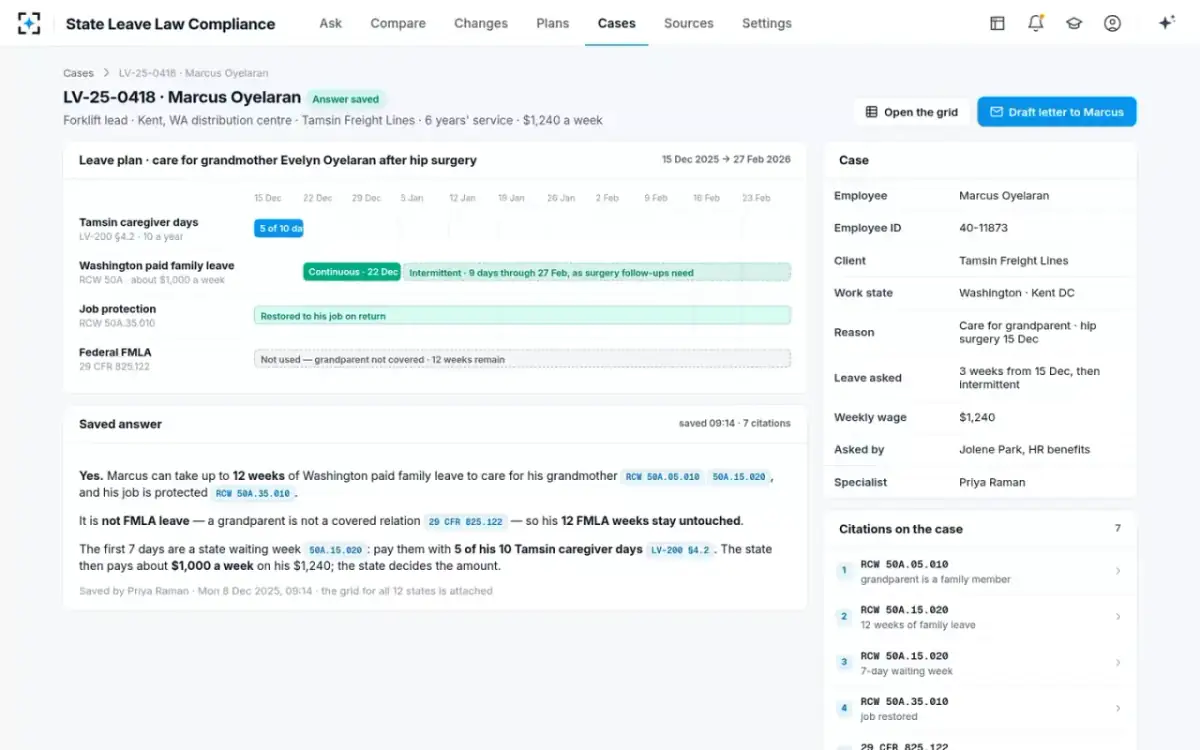
So an integration policy sits inside a leave plan with at least three lanes: the job-protected leave (FMLA, CFRA or both), the state benefit, and the employer's pay. They overlap only where the reason qualifies for each. Care for a grandparent is paid by California PFL but is not FMLA leave for most employees, so FMLA weeks are not used; covered family members under FMLA and state leave laws sets out where the definitions part. FMLA and state leave laws covers how the layers are read together.
Employer pay, state benefit and job protection as separate lanes on one case
Voluntary plans and the employers that replace SDI
An employer cannot opt out of SDI, but it can replace it. The EDD says "state law requires the State Disability Insurance program and contributions," and the alternative is an EDD-approved Voluntary Plan that the employer, or most of its employees, applies for (EDD). Under a voluntary plan, integration is a question about the plan's own benefit, not the state's chart, and the reduction rule that applies is the plan's.
Some cities add their own layer on top. The EDD notes that San Francisco's Paid Parental Leave Ordinance may require employers with 20 or more employees worldwide to pay part of the wages of San Francisco employees on PFL for bonding. And the EDD warns that "other benefits, like employer-paid baby bonding, may affect PFL benefits," which is the same reduction rule in a different form.
What the 2026 figures mean for an integration budget
The state benefit keeps rising, which shrinks the employer's top-up for most employees and leaves it large for the highest earners. The EDD's fund forecast gives the maximum weekly benefit as "$1,620 in 2024, increased to $1,681 in 2025, increased to $1,765 in 2026," and projects $1,791 for 2027, a projection and not a published figure (EDD, DI Fund Forecast, May 2026). The forecast also lists SDI withholding of 1.1% in 2024, 1.2% in 2025, 1.3% in 2026 and a projected 1.4% in 2027, on all wages since the taxable wage limit was removed on 1 January 2024. PFML 2026 rates sets California beside every other state.
There is also evidence that the benefit level affects return to work, which matters to an employer deciding how generously to integrate. A study of California administrative data by Bana, Bedard and Rossin-Slater found "no evidence that a higher weekly benefit amount (WBA) increases leave duration" among the workers studied, and that a higher benefit "leads to an increased likelihood of returning to the pre-leave firm" (NBER Working Paper 24438). The study measured the state benefit, not employer top-ups, so it bears on integration only by analogy.
What should an integration policy say?
Enough that two absence specialists would compute the same top-up for the same employee. Most disputes come from a policy that says "integrate" without saying with what, up to what, and until when.
Eight clauses a California SDI integration policy needs
- Whether integration is offered, and for DI, PFL or both
Bonding, family care and the employee’s own disability may be treated differently.
- Which balances may be used
Sick leave, vacation, PTO, or salary continuation; in what order.
- That it is the employee’s choice for PFL
Since 2025 an employer cannot require PTO before PFL benefits.
- The ceiling: 100% of the regular weekly wage
Defined from payroll, with how overtime and variable pay are treated.
- Which state benefit figure is used
The EDD’s Notice of Computation, not an estimate; recomputed if the EDD changes it.
- What happens when balances run out
The employee continues on the state benefit alone, with notice.
- How STD offsets the state benefit
Matching the plan document, with DI plus STD kept at or below regular wages.
- How it runs alongside FMLA and CFRA
Whether the employer requires the job-protected leave to run concurrently.
Where State Leave Law Compliance fits
The solution answers the coordination question for the team that handles it: the absence specialist at an employer or a leave administrator, and the disability claim examiner who coordinates STD with state benefits. It reads the California layer beside the FMLA, the job-protection law and the client's own leave policy, cites each answer to the passage it rests on, and quotes the year's maximum and withholding rate with their year. When the client's policy still says employees must use vacation before PFL, the plan reader marks the clause and drafts the change for a compliance analyst to sign.
What it does not do is pay, file or set the benefit. The EDD computes the weekly benefit and sends the Notice of Computation; the employer's payroll pays the top-up; the plan pays the STD. Any benefit figure the solution shows before the EDD's notice arrives is labelled as an estimate, with the state named as the one that decides. States with paid family leave in 2026 covers the other programs a multi-state employer integrates with.
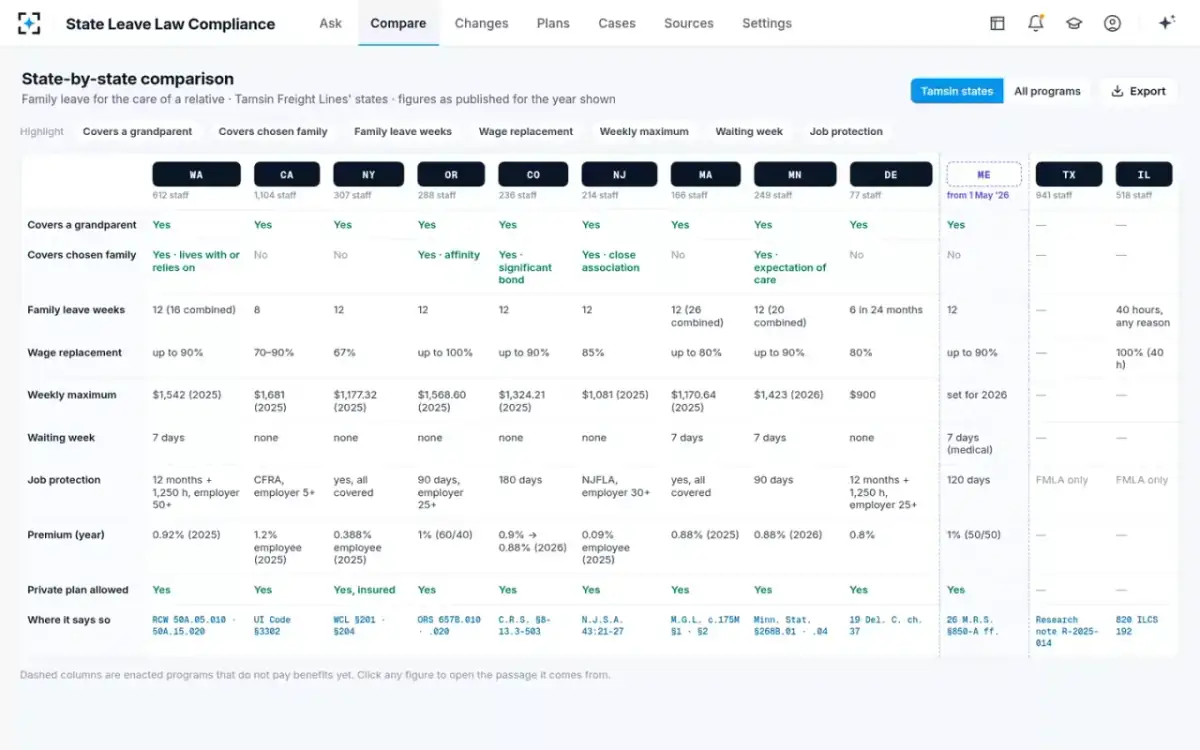
California beside the client's other states, each figure with its source
Questions people ask
Can an employer require PTO before California PFL?
No, not since 1 January 2025. The EDD says an employer "can't require you to use sick leave or any other paid time off before you get PFL benefits." Before 2025, an employer could require up to two weeks of unused vacation first.
Does integrating sick leave reduce the SDI benefit?
Not if the total stays within the employee's regular wages. The EDD treats paid sick leave as wages; where an employer lets employees combine sick pay with DI or PFL, the benefit is unaffected unless sick pay and benefits together exceed usual wages, in which case the benefit is reduced by the excess.
Is PFL the same as short-term disability?
No. PFL pays for time off to care for a family member, bond with a new child or for a military family need; DI pays for the employee's own disability. An employer's STD plan is a separate benefit that commonly offsets DI, paying its promised share minus the state amount.
Do CFRA and PFL run concurrently?
They can. The EDD says DI and PFL do not change the federal or state leave laws and provide no job protection, and that a covered employer may require FMLA and CFRA leave to be taken while DI or PFL benefits are paid.
What is the maximum SDI benefit in 2026?
$1,765 a week for DI and PFL claims beginning on or after 1 January 2026, per the EDD's 2026 chart. The EDD's May 2026 forecast projects $1,791 for 2027; that figure is a projection until published.
Can an employer avoid SDI with its own plan?
Only through an EDD-approved Voluntary Plan; the EDD says state law requires the SDI program and contributions otherwise. Under a voluntary plan, integration is governed by the plan's benefit rather than the state chart.