Colorado's private plan PFML exemption is not an opt-out from paid leave; it is approval to provide FAMLI benefits through a private plan instead of paying premiums to the state. The FAMLI Division approves a plan that is either a policy from a state-approved insurance carrier or self-insurance backed by a surety bond worth a year of premiums, after the employer registers, pays a $500 administration fee and waits at least 60 calendar days from its application. The plan must give every employee the same or better benefits, protections and rights as the state plan, cost employees no more, and file quarterly summaries; the employer keeps paying premiums until the plan's effective date, and keeps its notice and job-protection duties throughout. Botminds' State Leave Law Compliance compares every clause of an employer's plan or policy with the law in each of its states, so a Colorado plan's gaps show before the Division finds them.
What moves to a private plan, and what stays with the employer either way
State FAMLI plan: 0.88% of wages in 2026, half of it deductible from employees.
Approved private plan: Paid to the carrier or the self-insured account; employees cannot be charged more than the state plan.
State FAMLI plan: The FAMLI Division.
Approved private plan: The carrier or the plan administrator, at least the state’s benefits.
State FAMLI plan: —
Approved private plan: Wage data and premiums continue to the Division until the effective date.
State FAMLI plan: Quarterly wage reports.
Approved private plan: Quarterly plan summaries; overpayments of $25 or more reported to the Division.
State FAMLI plan: The state plan’s notices.
Approved private plan: Written notice at least 30 days before the plan takes effect, and a posted notice.
State FAMLI plan: The employer’s duty under § 8-13.3-509.
Approved private plan: Still the employer’s duty; the plan notice must tell employees of those rights.
State FAMLI plan: An employee cannot be required to use it.
Approved private plan: The same rule: a plan may not add conditions.
Can Colorado employers opt out of FAMLI?
Not out of coverage, only out of the state plan. The Division puts it in two sentences: "Colorado Paid Family and Medical Leave Insurance (FAMLI) coverage is mandatory for all employers with one or more employees working in Colorado. Employers have the option to meet FAMLI obligations by using an approved Private Plan" (FAMLI Division, private plans). Every employer registers first; only then can it apply.
The word "exemption" in searches reflects how it feels to payroll: once a plan is approved, the employer stops remitting premiums to the state. The Act says an employer with an approved private plan "shall not be required to remit premiums" (C.R.S. § 8-13.3-507(8)). The obligation to provide the benefit does not move; only the vehicle does.
What is a FAMLI private plan?
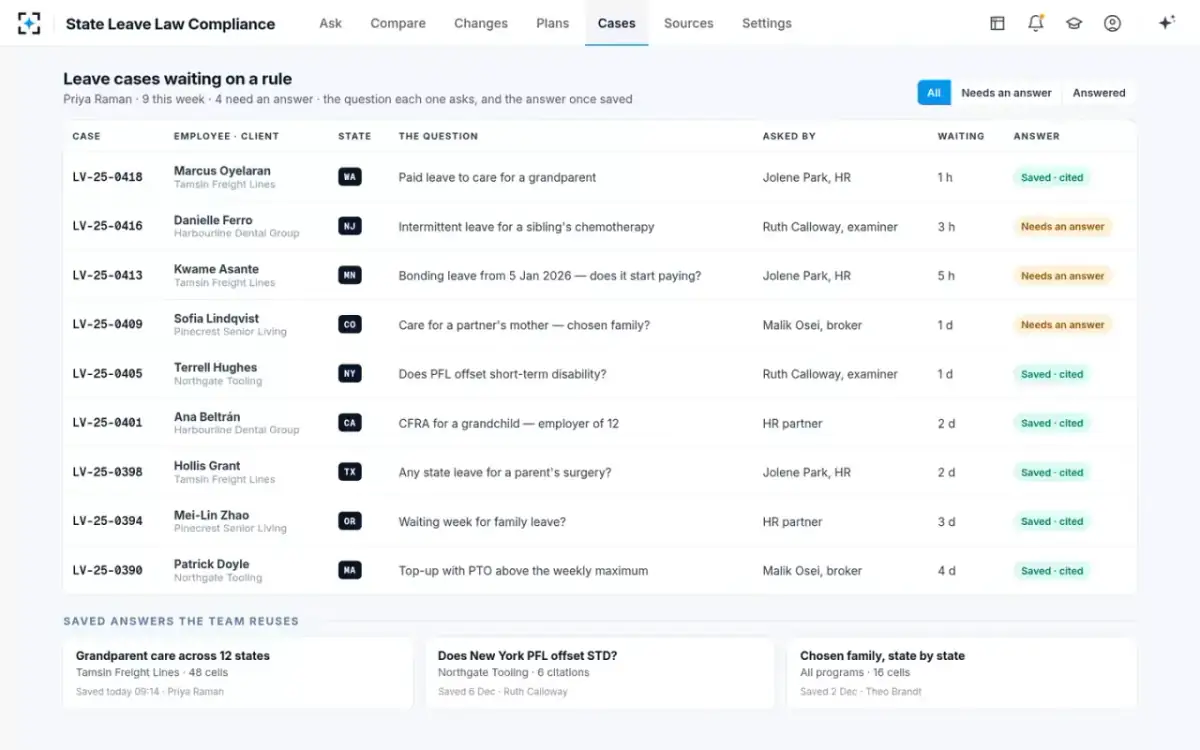
It is a plan that delivers FAMLI's benefits through an insurer or the employer's own fund. "In order to be approved, a private plan must confer all of the same rights, protections and benefits provided to employees" under the Act, the statute says, and then lists what that includes (C.R.S. § 8-13.3-521(1)). The list is the checklist any plan document has to pass.
What C.R.S. § 8-13.3-521 asks of a Colorado private plan
- Every FAMLI purpose
Bonding, care for any family member, the employee’s own serious health condition, military exigency and safe leave.
- The full number of weeks
12 weeks in an application year, and up to 4 more for pregnancy or childbirth complications.
- At least the state’s wage replacement
In 2026, 90% of the first $804.46 of the average weekly wage and 50% of the rest.
- At least the state’s maximum
$1,448.02 a week on the 2026-2027 state average weekly wage.
- Intermittent leave
As the Act allows it.
- No added conditions
No restrictions beyond those in the Act or its regulations.
- Every eligible employee
For their whole period of employment.
- No higher employee cost
Not more than the state plan charges employees.
- Security
An approved insurer’s policy, or a surety bond for self-insurance.
Can a private plan be insured?
Yes. "An approved Private Plan may be in the form of either self-insurance or a policy from an insurance carrier approved by the State" (FAMLI Division). The insurer side runs through the Division of Insurance, which requires that carriers "have the appropriate line of authority to write short-term disability insurance to offer fully-insured private PFML products in Colorado" and reviews their forms and rates in SERFF (Colorado DOI).
“The Division’s approval of a carrier’s PFML policy forms and rates does not act as an approval for an employer’s use of a fully-insured private PFML insurance plan in place of paying premiums to the state Family and Medical Leave Insurance Fund.”
Colorado Division of Insurance
Two approvals, then: the carrier's product by the Division of Insurance, and the employer's use of it by the FAMLI Division. The FAMLI Division lists the carriers whose policies have been approved (five, as read on 27 October 2026) and warns that "Choosing a carrier on this list DOES NOT constitute an automatic approval for an employer's use of a Private Plan" (FAMLI Division). The employer still applies, in its own account.
How much does a FAMLI private plan application cost?
$500 to apply, plus an annual maintenance fee, plus, for self-insurance, a bond and a separate account. The Division's list of application steps includes "Pay a $500 administration fee", and "Starting in January of 2025, employers with approved Private Plans will be subject to an annual maintenance fee based on FAMLI Division costs specific to each employer" (FAMLI Division). Material changes to an approved plan bring further maintenance fees.
Self-insurance costs more in capital than in fees. The employer must include "a surety bond in an amount equal to one year of premiums they would otherwise owe to the Division", and must "Establish and maintain a separate account where all employee contributions are deposited, all benefits are paid, and from which Private Plan administrative costs may be paid" (FAMLI Division). For an employer with a $6 million Colorado payroll, a year of premiums at 0.88% is $52,800, the size of the bond by our arithmetic.
How long does private plan approval take?
At least 60 calendar days from the application to the plan's effective date, and the premiums continue until then. "Once your Private Plan is approved, employers are required to pay premiums until the effective date of the Private Plan. That effective date will be no earlier than 60 calendar days after the Private Plan application was submitted" (FAMLI Division). Employees must have written notice at least 30 days before the effective date, and the application must include that notice.
From registration to a private plan in force: at least 60 days
- Preparebefore day 0
- Application fileddays 0–30
- Notice perioddays 30–60
- In forceDay 60+
State plan or private plan: what the employer keeps doing either way
Most duties stay put. The employer registers, keeps every employee covered, delivers and posts notices, protects jobs and keeps leave information confidential whichever plan pays. What changes is who receives the premium, who decides claims and who reports to the Division: a plan administrator "must submit quarterly summaries of the previous calendar quarters" and report any overpayment of $25 or more (FAMLI Division).
Two statutory rules keep a private plan from being cheaper for the employer at the employees' expense. The plan must impose "no additional conditions or restrictions", and an employer can never require an employee to use up vacation, sick leave or other paid time off before or while receiving benefits (C.R.S. §§ 8-13.3-521(1)(i), 8-13.3-510(1)(c)). A plan that requires a waiting week of paid time off fails on both.
What happens if a private plan is denied or withdrawn?
The employer stays on, or returns to, the state plan, and pays for the gap. The Division may revoke approval for failing to pay benefits, failing to keep the bond, misusing plan money, failing to report or otherwise breaking the Act. Once it notifies the employer, "No more than seven days after the day the employer was sent the notification of revocation, the employer must notify all employees of the revocation" (FAMLI Division).
Coming back is costly. An employer that returns to the state plan "must remain on the state plan for at least three years", or pay what it would have remitted over those three years to leave early. If a self-insured plan ends, the Division collects the whole surety bond and the plan's account balance. And any day an employee is left without coverage carries a fine per employee, the lesser of the daily premium or $500 (FAMLI Division).
Checking a private plan against FAMLI, clause by clause
The fastest test of a plan document is a worked benefit at three wages. Colorado's 2026 formula replaces 90% of the first $804.46 of the average weekly wage and 50% of the rest, up to $1,448.02 (FAMLI calculator). A plan that pays a flat 60%, or caps benefits at a round number, fails somewhere on that curve.
One plan clause, three workers: where a flat 60% benefit falls short of FAMLI
| Average weekly wage | FAMLI benefit, 2026 | Plan at 60%, capped at $1,000 | Result |
|---|---|---|---|
| $800 | $720 (90% of $800) | $480 | Fails by $240 a week |
| $1,600 | $1,121.78 ($724.01 + 50% of $795.54) | $960 | Fails by $161.78 a week |
| $2,500 | $1,448.02 (the maximum) | $1,000 | Fails by $448.02 a week |
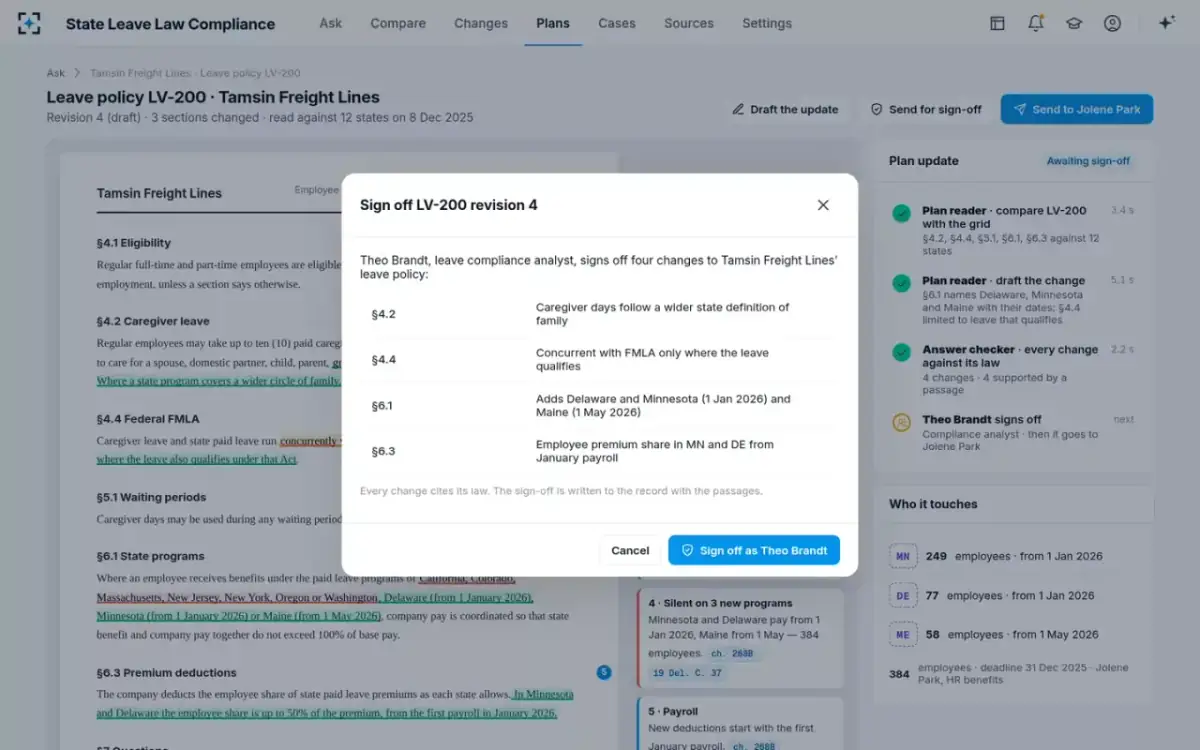
The same reading applies to every other clause: the purposes covered, who counts as family (Colorado includes anyone the employee shows to have a bond like a family relationship, a clause that plans copied from disability wording can miss), the weeks, intermittent leave, the claim process and the employee contribution. In State Leave Law Compliance the plan reader marks each clause Yes, Partly, Silent or Gap against the law, drafts a cited redline where the plan falls short, and a compliance analyst signs it before it goes to the employer.
How Colorado's private plan rules compare with other states'
Most programs allow private plans on the same principle, with different steps to approval. Washington requires that a voluntary plan's benefits "meet or exceed the state plan's benefits" and charges "a $250 fee, except for mandated renewals" (Washington Paid Leave). Minnesota's private plans "must confer all of the same rights, protections, and benefits provided to employees under this chapter" (Minn. Stat. § 268B.10). Connecticut lets employers apply to offer "the same or better benefits" (CT Paid Leave). Maryland, starting in 2027, has its own declaration window and limits self-insurance to employers with 50 or more employees (Maryland FAMLI).
Private plan approval in five states, as each publishes it
| State | Standard | To apply | Lock-in or penalty |
|---|---|---|---|
| Colorado | Same or better rights, protections and benefits; no higher employee cost | $500 fee, 60+ days, bond for self-insurance | Three years on the state plan after returning |
| Washington | Benefits meet or exceed the state plan | $250 application fee, except mandated renewals | Not read for this guide |
| Minnesota | All of the same rights, protections and benefits | Insurer forms and rates filed 60 days before use | Not read for this guide |
| Maryland (2027) | Same level of benefits and service, or better | Declaration 1 Sep–15 Nov 2026; applications due 1 Oct 2027 | At least one year in a private plan |
| Maine | Private plans allowed | Not read for this guide | About a third of the covered population in private plans, early 2026 |
For an employer in several of these states, the decision is rarely Colorado alone; the same carrier may be approved in one state and not filed in another, and the rates differ. How each state's premium is split between employer and employee, before any private plan, is in PFML 2026 rates by state; the wider map of programs is in states with paid family leave in 2026.
Where State Leave Law Compliance fits in a private plan decision
It does the reading that the approval depends on. For a benefits administrator, carrier or broker advising an employer, the work is to compare the plan document with the Act clause by clause, to keep the 2026 figures dated, and to show what changes when the state's average weekly wage moves the maximum. The plan reader marks each clause, the answer checker reads each cell back against its passage, and a compliance analyst signs any change before it reaches the employer; nothing is filed with the Division by an agent.
A plan correction, signed: caregiver days follow the wider state definition of family
A Colorado question that a plan must answer the same way the state would
Questions people ask
What are the Colorado FAMLI private plan rules?
The plan must give all employees the same or better benefits, protections and rights as the state plan, cost them no more, impose no extra conditions, and be either an approved carrier's policy or bonded self-insurance. The employer registers, applies with a $500 fee, and keeps paying premiums until the effective date, at least 60 days later.
Does a Colorado private plan application need an attestation or notice?
It needs a copy of the employee notification with an effective date no earlier than 60 days after the application, proof of the carrier policy or a completed self-insured template, the surety bond for self-insurance, and benefit claim forms. Employees must receive the written notice at least 30 days before the plan takes effect.
Can a private plan charge employees more than FAMLI?
No. The Act requires that the cost to employees covered by a private plan not be greater than the cost charged under the state plan, which in 2026 is half of the 0.88% premium.
Can a small employer use a private plan?
The Division's private plan page sets no size limit; any registered employer can apply. A business with nine or fewer employees already pays only the 0.44% employee share to the state, which leaves less to save.
What happens to employees if an approved plan ends?
The employer returns to the state plan and must stay at least three years. It must keep coverage until the termination date, tell employees at least 30 days ahead if it ends the plan itself, and within seven days of a revocation notice if the Division withdraws approval.