The states with paid family leave in 2026 are California, New Jersey, New York, Rhode Island, Washington, Massachusetts, Connecticut, Oregon, Colorado, Delaware, Minnesota and Maine, which all pay benefits this year, plus the District of Columbia; Maryland's program pays from January 2028 and Virginia's, enacted in 2026, from December 2028. The Department of Labor counts "Thirteen states and the District of Columbia" with paid family and medical leave laws (Women's Bureau, page as captured 16 October 2026). Delaware and Minnesota began on 1 January 2026 and Maine on 1 May. What each one pays differs widely: from eight weeks in California to sixteen combined in Washington, at 67% of wages in New York and up to 100% for lower earners in Oregon, with 2026 maximums from $900 in Delaware to $1,765 in California. Botminds' State Leave Law Compliance keeps every one of these figures with its year and its passage for the leave teams that answer questions across states; the table below is the map as each agency publishes it.
States with paid family leave in 2026: weeks, pay and the 2026 maximum
| Program | Paying in 2026? | Weeks | Wage replacement | 2026 maximum weekly benefit |
|---|---|---|---|---|
| California | Yes | 8 weeks of family leave in 12 months | About 70% to 90% | $1,765 (claims from 1 Jan) |
| New Jersey | Yes | Up to 12 weeks in 12 months, continuous | 85% of average weekly wage | $1,119 |
| New York | Yes | Up to 12 weeks | 67% of average weekly wage | $1,228.53 |
| Rhode Island | Yes | Not read for this guide | Not read for this guide | $1,150 temporary disability (claims from 1 Jul) |
| Washington | Yes | 12 family or medical; 16 combined; 18 with pregnancy complications | 90% up to half the state wage, 50% above | $1,647 |
| Massachusetts | Yes | 12 family, 20 medical, 26 combined | Not set out here | $1,230.39 |
| Connecticut | Yes | Not read for this guide | 95%, then 60% above 40 times the minimum wage | $1,016.40 |
| Oregon | Yes | 12 weeks; up to 14 for some pregnancies | 100% up to 65% of the state wage, then a portion | $1,692.16 (benefit years from 28 Jun) |
| Colorado | Yes | 12 weeks; up to 4 more for pregnancy complications | 90% up to $804.46 a week, 50% above | $1,448.02 |
| District of Columbia | Yes | 12 parental, 10 medical, 6 family, 2 prenatal (from 1 Oct) | Not read for this guide | $1,100 |
| Delaware | Yes, from 1 Jan | 12 parental; 6 medical or family in any 24 months | 80% of average weekly wage | $900 (2026 and 2027) |
| Minnesota | Yes, from 1 Jan | 12 medical, 12 family, 20 combined | Average employee 77% (DEED) | 2026 figure not confirmed on the agency’s page; not printed |
| Maine | Yes, from 1 May | Up to 12 weeks in a benefit year | Tiered | Set at the state average weekly wage; 2026 figure not read |
| Maryland | From January 2028 | Up to 12 weeks | Not set out here | Up to $1,000 a week |
| Virginia | From 1 Dec 2028 | Up to 12 weeks in a benefit year | 80% of average weekly wages | 100% of the state average weekly net earnings |
What states have paid family leave in 2026?
Twelve states and the District of Columbia pay paid family and medical leave benefits during 2026, two more have enacted programs that start paying later, and a handful of others offer something narrower. The twelve paying states run state-administered insurance funded by payroll contributions, most of them with an option for an employer to use an approved private plan instead. Hawaii and Puerto Rico cover the worker's own disability rather than family care: the Women's Bureau notes that "Hawaii has a law providing paid temporary disability leave to eligible workers, while Puerto Rico has laws providing paid temporary disability and maternity leave to eligible workers" (DOL Women's Bureau).
The programs differ on every term that matters to an employee. Pay ranges from New York's flat 67% of the average weekly wage (NY Paid Family Leave) to Oregon's 100% for those earning 65% or less of the state average (Oregon Employment Department). Leave runs from California's eight weeks of family leave to Massachusetts' 26 weeks of combined family and medical leave in a benefit year (Massachusetts DFML).
The 2026 paid family leave map, in four numbers
13+ DC
states with paid family and medical leave laws, by the Department of Labor’s count
Women’s Bureau, October 2026
3
programs that began paying in 2026: Delaware, Minnesota, Maine
2
enacted programs not yet paying: Maryland (2028) and Virginia (2028)
8–26wk
range of leave in a year, from California’s family leave to Massachusetts’ combined maximum
How many states have paid family leave?
Thirteen states and the District of Columbia, by the Department of Labor's count. Twelve states pay benefits in 2026; add Maryland, whose law is enacted and pays from 2028, and the list matches the Department's thirteen. The same page counts three states, New Hampshire, Vermont and Virginia, with voluntary programs under which some workers and employers can buy private family or medical leave insurance (DOL Women's Bureau, as captured 16 October 2026). Virginia has since moved: its 2026 law adds a state program to the Code, which by our reading of the statutes makes fourteen states with a paid family and medical leave law, two of them not yet paying.
Counts differ because sources draw the line in different places: whether a law that is enacted but not paying counts, whether Hawaii's disability-only program counts, whether voluntary insurance counts. A leave team should not rely on a count at all; it should rely on a dated list of programs with their start dates, which is what the timeline below shows for the five newest.
Which states started paid leave in 2026?
Delaware and Minnesota began on 1 January 2026, and Maine began paying benefits on 1 May. Delaware's Department of Labor announced on New Year's Day that "Beginning today, eligible employees can start submitting claims for Delaware Paid Leave", for employers with 10 or more Delaware-based employees (Delaware DOL, 1 January 2026). Minnesota's DEED told workers that "Starting January 1, 2026" they would have paid family and medical leave (Minnesota DEED). Maine's program says "Paid Family and Medical Leave Benefits will start May 1st, 2026" (Maine DOL).
Five newer programs: contributions come first, benefits follow
- Before benefits2025
- Benefits paidBenefits from Jan 2026
- Before benefits2025
- Benefits paidBenefits from Jan 2026
- Contributions onlyContributions from Jan 2025
- Benefits paidBenefits from May 2026
- Before contributions2025–2026
- Contributions only2027
- Benefits paidFrom Jan 2028
- Before contributionsJan 2025 – Mar 2028
- Contributions onlyApr–Nov 2028
- BenefitsFrom Dec 2028
When does Maine paid family leave start?
Benefits started on 1 May 2026 and are paid only for time off on or after that date; contributions came first, with payroll withholding from January 2025 (Maine DOL). Eligible workers "can take up to 12 weeks of paid time off in a benefit year", and the job is protected for an employee who has worked for the employer for at least 120 consecutive days (Maine DOL).
Maine's family definition is among the widest: beyond grandparents, grandchildren and siblings it reaches a person the employee designates with a bond like a family relationship, whatever the biological or legal tie (26 M.R.S. § 850-A). Private plans are common: the program's authority reported private plan usage of "approximately 33% of covered population" in its first-quarter 2026 meeting (Maine PFML Authority).
Is Virginia paid family leave mandatory?
Since 2026, Virginia's Code creates a state program that employers pay into, with the Commonwealth's own payroll excluded and employers of ten or fewer remitting only the employee's half, starting in 2028; the federal summary that still calls it voluntary predates the law. The Code sets the dates: "By April 1, 2028, the Commission shall begin collecting contributions as provided in this chapter. By December 1, 2028, the Commission shall begin receiving claims and paying family and medical leave benefits to covered individuals" (Va. Code § 60.2-801, 2026 Acts chapters 981 and 1093). From 1 April 2028 every employer must remit contributions; employers of more than 10 may deduct up to half from wages, and employers of 10 or fewer remit only the employee half (Va. Code § 60.2-806).
Benefits will be 80% of average weekly wages up to a maximum of 100% of the state average weekly net earnings, for up to 12 weeks in a benefit year (§ 60.2-804; § 60.2-803). The rate is still to be fixed, by 1 October 2027. Until then, a Virginia cell on any chart should read "enacted, not yet in force", with those dates.
Which state has the highest paid family leave benefit?
California's $1,765 a week is the highest 2026 maximum read for this guide, followed by Oregon's $1,692.16 for benefit years from 28 June and Washington's $1,647. The maximum matters only to higher earners; for most workers the replacement formula decides the benefit, and there Oregon pays 100% of wages up to 65% of the state average, and Washington and Colorado 90% of the first part of the wage.
2026 maximum weekly benefits, as each agency publishes them
Who counts as family in each state program
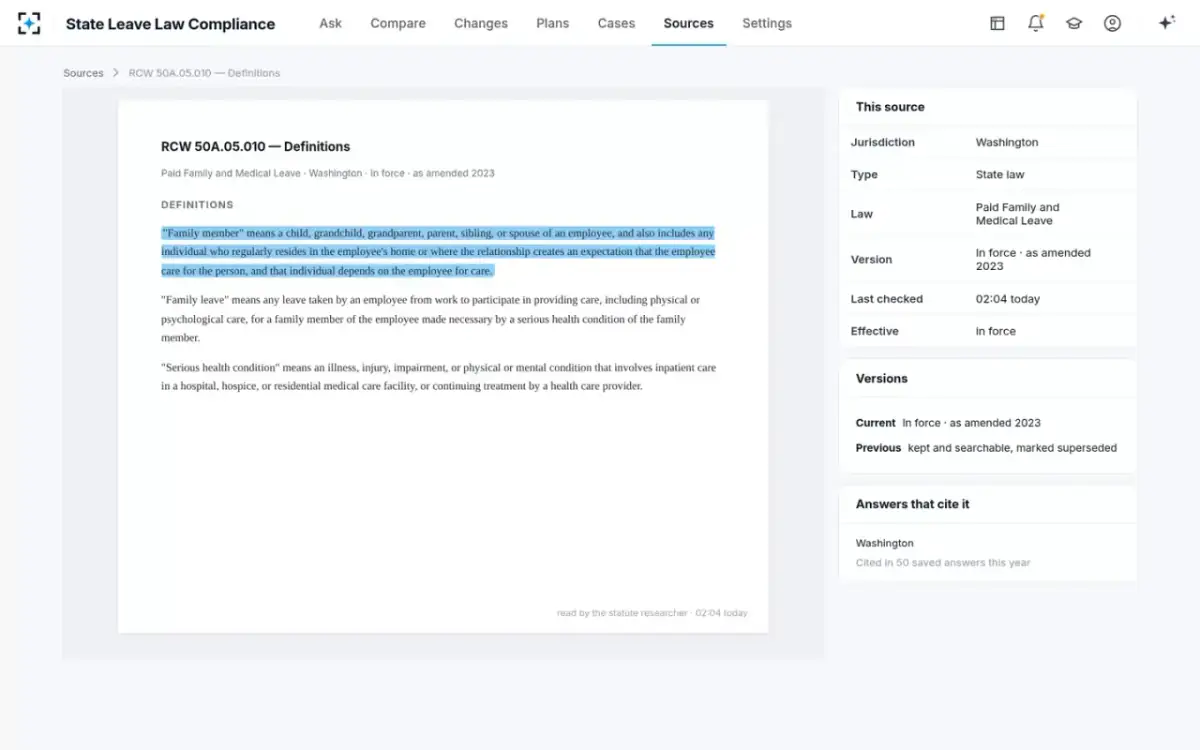
Every paying program covers a spouse, a child and a parent; most add grandparents, grandchildren and siblings; and a growing group reaches people who are family in fact. Washington covers a person who lives with the employee or relies on the employee for care (RCW 50A.05.010); Oregon covers a person related by blood or affinity whose close association is the equivalent of a family relationship (ORS 657B.010). Colorado, Minnesota, Connecticut, Maine and, from 2028, Virginia have their own versions, and New Jersey's agency lists "chosen family" (NJ FLI).
Delaware is the narrow end: its family member is a parent as defined under the FMLA, a child or a spouse (19 Del. C. § 3701(11)), so caring for a grandparent is not covered there. The family lists, and how they compare with the FMLA's, are set out relation by relation in covered family members under FMLA and state leave laws.
Who counts as family: the widest and narrowest 2026 lists
| Program | Grandparent | Beyond relatives | Where it says so |
|---|---|---|---|
| New Jersey | Yes | “Chosen family” and others the worker considers family | NJ FLI page |
| Washington | Yes | Someone living with or depending on the employee for care | RCW 50A.05.010 |
| Oregon | Yes | Blood or affinity, close association equivalent to family | ORS 657B.010 |
| Colorado | Yes | A significant personal bond like a family relationship | C.R.S. § 8-13.3-503 |
| Connecticut | Yes | Blood or affinity, close association equivalent to family | Conn. Gen. Stat. § 31-51kk |
| Minnesota | Yes, and a spouse’s grandparent | An expectation and reliance of care | Minn. Stat. § 268B.01 |
| Maine | Yes | A designated person with a significant personal bond | 26 M.R.S. § 850-A |
| Virginia (2028) | Yes | Someone living with or depending on the employee for care | Va. Code § 60.2-800 |
| California, New York, Massachusetts, DC, Maryland | Yes | No such clause in the list read | Each agency or statute |
| Delaware | No | No: parent, child, spouse only | 19 Del. C. § 3701 |
Does my state have paid family leave? If not, what applies
If the state is not on the list above, three things may still apply. The federal FMLA gives eligible employees 12 unpaid, job-protected weeks. Hawaii's temporary disability insurance pays for the worker's own disability, "from the eighth day of disability for a maximum of 26 weeks, at 58% of the employee's average weekly wages" (Hawaii DLIR). New Hampshire's voluntary program offers "60% wage replacement (up to the Social Security wage cap) for up to 6 weeks per year" (State of New Hampshire).
And the employer's own policy may pay. A federal tax credit encourages it: the Women's Bureau notes the employer credit for paid family and medical leave "was established by the 2017 Tax Cuts and Jobs Act and became permanent under the One Big Beautiful Bill Act in 2025" (DOL Women's Bureau). Even in states with programs, few leave-takers draw state benefits: in the Department of Labor's 2018 survey, "20 percent of employees in paid leave states report receiving state paid family leave" (DOL, 2020 report), measured before most of today's programs existed.
Keeping the 2026 map current with State Leave Law Compliance
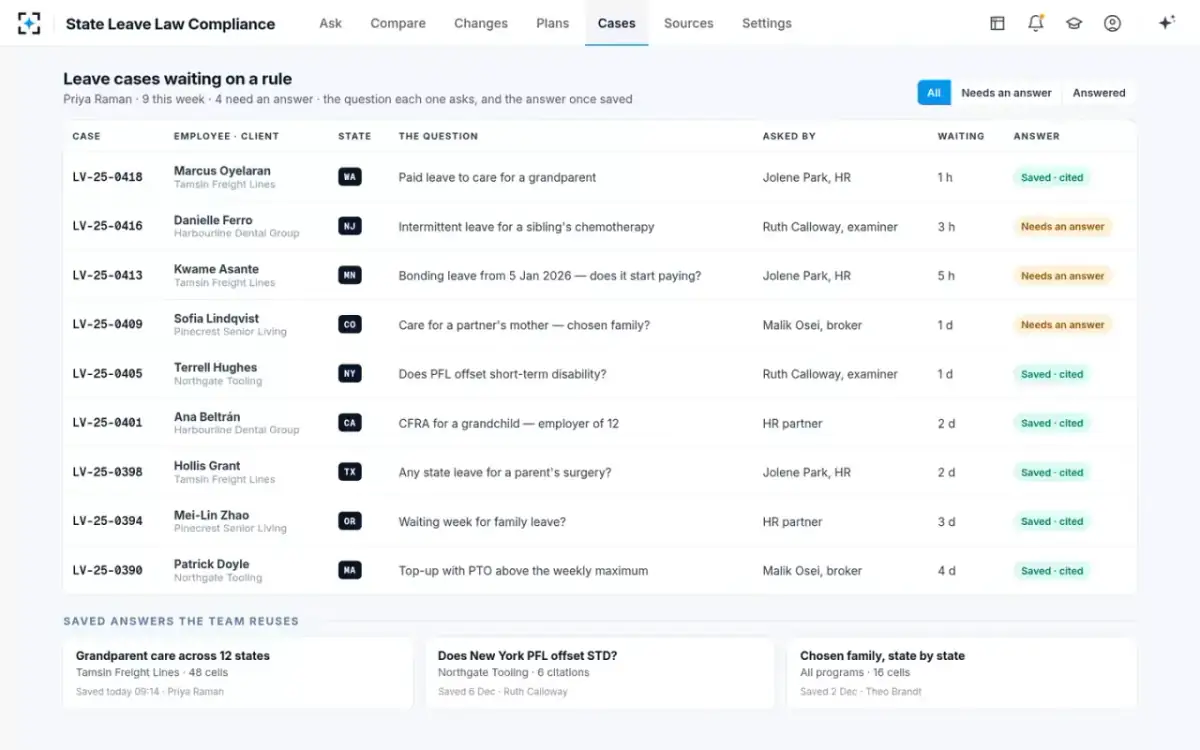
The table at the top of this page will be wrong in parts by the end of the year, and the question for a leave team is how it finds out. State Leave Law Compliance keeps each program as a set of cited cells (weeks, pay, maximum, job protection, premium, private plans, family list), reads the sources each night, and draws enacted programs such as Maryland's and Virginia's dashed with their dates until they pay. When a question comes in for a client's states, the answer is built from those cells, and the team reuses saved answers such as one on caring for chosen family, state by state.
The map in use: one question per case, from nine different states
Each cell on the map opens to the passage it came from
Questions people ask
Which states have paid family leave for 2026 that is new this year?
Delaware and Minnesota, from 1 January 2026, and Maine, from 1 May 2026. Delaware's program covers employers with 10 or more Delaware-based employees; Minnesota's and Maine's each allow up to 12 weeks of family leave in a year.
Does Texas have paid family leave?
No Texas program is among the state programs above, each read from its own agency or statute. Employees there rely on the federal FMLA, which is unpaid, and on whatever their employer's policy provides.
When does Maryland paid family leave start?
Contributions begin with payroll in January 2027 and benefits in January 2028, up to 12 weeks at up to $1,000 a week. Maryland paid family leave 2027 sets out the dates and what employers should do this year.
Is paid family leave the same as short-term disability?
Not quite. Paid family leave covers caring for others and bonding, and most programs also cover the worker's own serious health condition; short-term disability covers only the worker's own disability. Hawaii's program covers the worker's own disability, Puerto Rico's adds maternity, and New Jersey and New York run disability and family leave as separate programs.
Do all employers in these states have to participate?
Mostly yes, with size rules that change what they pay rather than whether employees are covered. Colorado covers employers with one or more employees; Delaware's program applies from 10 employees, in full from 25; Maryland has no size exemption from registration. Many states let an employer use an approved private plan instead of the state's.