The 2026 PFML rates, as each state agency publishes them, are 1.3% of all wages in California (paid by the employee, with no wage cap), 1.13% in Washington, 1% in Oregon and Maine, 0.88% in Colorado, Massachusetts and Minnesota, 0.8% in Delaware, 0.5% in Connecticut, 0.432% in New York and 0.42% for New Jersey workers, with Maryland's 0.9% starting in January 2027. The rate is the easy part. Who pays it turns on each state's split and on lines drawn at 9, 10, 15, 25, 30 and 50 employees, so the same $70,000 salary costs an employer nothing in one state and close to $300 a year in another. Botminds' State Leave Law Compliance quotes each premium with the year it applies to and the size line that applies to the client, never recalculated, so a payroll change rests on the agency's own figure.
PFML 2026 rates: the total premium as a share of wages, by state
What are the PFML rates for 2026?
Each rate is a share of wages, set by the state agency or by statute, and most reset on 1 January. California's is "1.3 percent (.013), which provides for both State Disability Insurance (SDI) and Paid Family Leave (PFL) benefits", and there has been no SDI taxable wage limit since 1 January 2024 (EDD, Employer's Guide 2026). Washington's is 1.13% (Washington ESD). Oregon's total contribution "is 1% of gross wages up to $184,500" (Paid Leave Oregon). Colorado's is 0.88% (Colorado FAMLI).
Massachusetts asks employers with 25 or more covered individuals for 0.88% and smaller employers for an effective 0.46% (Massachusetts DFML). Minnesota's rate "for 2026 and 2027" is 0.88%, 0.27% for family leave and 0.61% for medical leave, with a small-employer rate of 0.66% (Minnesota Paid Leave). Delaware's statute sets 0.4% for medical, 0.08% for family caregiving and 0.32% for parental leave in 2025 and 2026, 0.8% together (19 Del. C. § 3705). Connecticut's board kept its rate "at 0.5% for 2026" (CT Paid Leave). New York's PFL rate is 0.432% with a maximum of $411.91 a year (NY Paid Family Leave), and New Jersey workers pay 0.19% for temporary disability and 0.23% for family leave insurance on the first $171,100 (NJ TDI; NJ FLI).
How is the PFML premium split between employer and employee?
By a fixed share in most states, and by a ceiling on what the employer may deduct in the rest. Washington's 2026 split puts 28.57% of the total premium on the employer and 71.43% on the employee (Washington ESD). Oregon's large employers pay 40% and employees 60% (Paid Leave Oregon). Colorado splits 0.44% and 0.44% (Colorado FAMLI). In Massachusetts up to 40% of the medical contribution may be withheld and employers pay the remaining 60%, while the whole family contribution may be withheld (Massachusetts DFML). Minnesota's employers "must pay a minimum of 50 percent" (Minn. Stat. § 268B.14). California, Connecticut and New York PFL are paid by employees.
Who carries the 2026 premium at a large employer, as a share of the total
California
- Employee · 100%
Washington (50+ employees)
- Employee · 71.43%
- Employer · 28.57%
Oregon (25+ employees)
- Employee · 60%
- Employer · 40%
Massachusetts (25+, most an employer may withhold)
- Employee, most that may be withheld · 52.3%
- Employer · 47.7%
Colorado, Minnesota, Delaware, Maryland 2027
- Employee, at most · 50%
- Employer, at least · 50%
Do small employers pay PFML premiums?
Usually they collect the employee share and are excused the employer share, below a line each state draws in its own place. Washington employers "with fewer than 50 employees employed in the state are not required to pay the employer portion" (RCW 50A.10.030(5)), but must still collect the employee premium or pay it for them. Oregon excuses employers with fewer than 25 employees on average from the employer portion (Paid Leave Oregon). Colorado businesses with nine or fewer employees "should submit wage reports and send in 0.44% of their employees wages each quarter" (Colorado FAMLI).
Others change the rate rather than the split. Massachusetts employers with fewer than 25 covered individuals send 0.46%, because they owe no employer share of the medical contribution; Minnesota's small employers, 30 or fewer employees in each quarter with an average wage under the state's test, pay 0.66% (Minnesota DEED). Delaware applies only its parental leave provisions to employers with 10 to 24 employees (19 Del. C. § 3701). Maryland will exempt employers with fewer than 15 employees from the employer portion, which it says more than 80% of its employers will qualify for (Maryland Labor).
What one $70,000 salary costs in 2026, by state and employer size
| State | Employee share | Employer share | Size line used |
|---|---|---|---|
| California | $910 | $0 | All employers |
| Washington | $565.01 | $225.99, or $0 under 50 employees | 50 employees |
| Oregon | $420 | $280, or $0 under 25 employees | 25 employees |
| Colorado | up to $308 | $308, or $0 at nine or fewer | 10 employees |
| Massachusetts | up to $322 | $294, or $0 under 25 | 25 covered individuals |
| Minnesota | up to $308 | $308; at the small rate, $154 | 30 employees and wage test |
| Delaware | up to $280 | $280 at 25+; parental only at 10 to 24 | 10 and 25 employees |
| Connecticut | $350 | $0 | All covered employers |
| New York PFL | $302.40 | $0 | All covered employers |
| New Jersey | $294 | TDI 0.10% to 0.75% of the first $44,800 | Employer TDI rate varies |
| Maryland (2027) | up to $315 | $315, or $0 under 15 | 15 employees |
Which state has the highest PFML rate in 2026?
Of the rates read for this guide, California's 1.3% is the highest, and it is paid by the employee on every dollar of wages, since California removed its wage ceiling in 2024. Its Disability Insurance fund forecast projects 1.4% for 2027, a projection rather than a set rate (EDD, DI Fund Forecast, May 2026). Washington's 1.13% is the highest rate shared with the employer, and it rises to 1.2% in 2027 (Washington ESD, 16 October 2026).
The comparison is less useful than it looks. California's rate funds both disability and family leave benefits; New Jersey's worker rate leaves a separate employer temporary disability rate on top; New York's PFL rate covers family leave only, while its statutory disability benefit is separate coverage. Compare what each premium buys before comparing the percentages, and see what each state pays for the benefit side.
Is there a wage cap for PFML contributions?
Yes in most states, usually the Social Security wage base, and no in California. Washington and Oregon apply their rates to wages up to $184,500 in 2026 (Washington ESD; Paid Leave Oregon), as does Colorado (Colorado FAMLI). Minnesota quotes the limit "rounded to the nearest thousand dollars (currently $185,000)" (Minnesota DEED). Connecticut employees contribute "up to the Social Security contribution limit" (CT Paid Leave). New Jersey's worker cap is $171,100 and New York's PFL contribution stops at $411.91 for the year.
The cap is where per-employee arithmetic goes wrong for high earners. At $250,000, California's 1.3% takes $3,250, while Washington's 1.13% stops at $184,500 of wages: a maximum total premium of about $2,085, of which the employee share is about $1,489. Those are our calculations on the published rates.
The rate is a quarter of the answer. The split, the size line and the wage cap decide what the paycheck shows.
When do PFML rates change?
Mostly on 1 January, announced in the autumn, with some rates fixed for two years and some by statute. Washington announced its 2027 rate and its new split, employers 29.3% and employees 70.7%, on 16 October 2026; reports for the rest of 2026 keep the 2026 rate (Washington ESD). Massachusetts' Chapter 101 of the Acts of 2026 moves the employer share from the medical to the family contribution from 1 January 2027 (Massachusetts DFML). Minnesota fixed 0.88% for 2026 and 2027, and its statute caps the rate at 1.1% (Minn. Stat. § 268B.14). Colorado's director recalculates each year, with a 1.2% ceiling in current law (Colorado FAMLI).
Three new programs set rates on their own timetables. Maryland reaffirmed 0.9% in April 2026 for wages paid in 2027 and will announce each following year's rate every November from 2027 (Maryland Labor FAQ, April 2026). Delaware's rates are fixed by statute through 2026, after which the Department sets them. Virginia's Commissioner must fix the first rate by 1 October 2027 for contributions from 1 April 2028 (Va. Code § 60.2-806). The Maryland sequence is laid out in Maryland paid family leave 2027.
Private plans change who sets the rate
Where a state allows a private plan, the employer's premium goes to an insurer or into a self-insured fund instead of the state, but the employee's cost is capped at the state's. Colorado bars a private plan from taking more out of employees' paychecks than the state plan would (Colorado FAMLI), and Washington requires a voluntary plan's benefits to equal or better the state plan's (Washington Paid Leave). In Maine about a third of the covered population was in a private plan in early 2026, by the program authority's own figure (Maine PFML Authority, Q1 2026).
Two programs outside the main list work differently again. Hawaii's temporary disability law lets employers insure the benefit, and an employee's contribution "cannot exceed 0.5% of the employee's weekly wages" (Hawaii DLIR). New Hampshire's voluntary plan says its cost "will be no more than $5 per week" (State of New Hampshire). What the Colorado approval involves is in Colorado private plan PFML exemption.
Four payroll errors the published rates do not warn about
The rate tables are correct; the errors happen where they meet a payroll system. Four recur, and each is visible in the agencies' own words if someone reads past the headline rate.
Deductions that do not stop at the cap. Washington, Oregon and Colorado charge their 2026 rates on wages up to $184,500, so a high earner's deduction should stop part way through the year. California is the reverse: since 2024 there is no ceiling, and a payroll still set to stop at the old SDI wage limit under-withholds.
A late start that cannot be made up. Colorado tells employers plainly that "Employers cannot collect missed premiums from employees in later pay periods" (Colorado FAMLI). An employer that sets up a new state a quarter late pays the employee share it missed itself.
A headcount taken on the wrong date. Washington fixes an employer's size for the next calendar year on 30 September, from the average of the last four quarters (RCW 50A.10.030), and Minnesota's small-employer test looks back over a basis period ending on the same date. An employer that crosses 50 employees in Washington in March owes the employer share from the following January at the earliest, and only if the four-quarter average is 50 or more; one that falls below the line keeps owing until the next count says otherwise.
A split that moves inside an unchanged total. Two states are changing which contribution the employer pays without changing how much. Massachusetts' Chapter 101 of the Acts of 2026 moves the employer share from medical to family leave from 1 January 2027 (Massachusetts DFML). Washington's Second Substitute House Bill 2345 "modifies the distribution of employer and employee contributions between family and medical leave premiums without affecting how the total premium is divided between employees and employers" (Washington ESD). Both responded to IRS guidance on how the benefits are taxed, and both change the deduction codes a payroll system uses, if not the paycheck.
Keeping 2026 rates right across a client book with State Leave Law Compliance
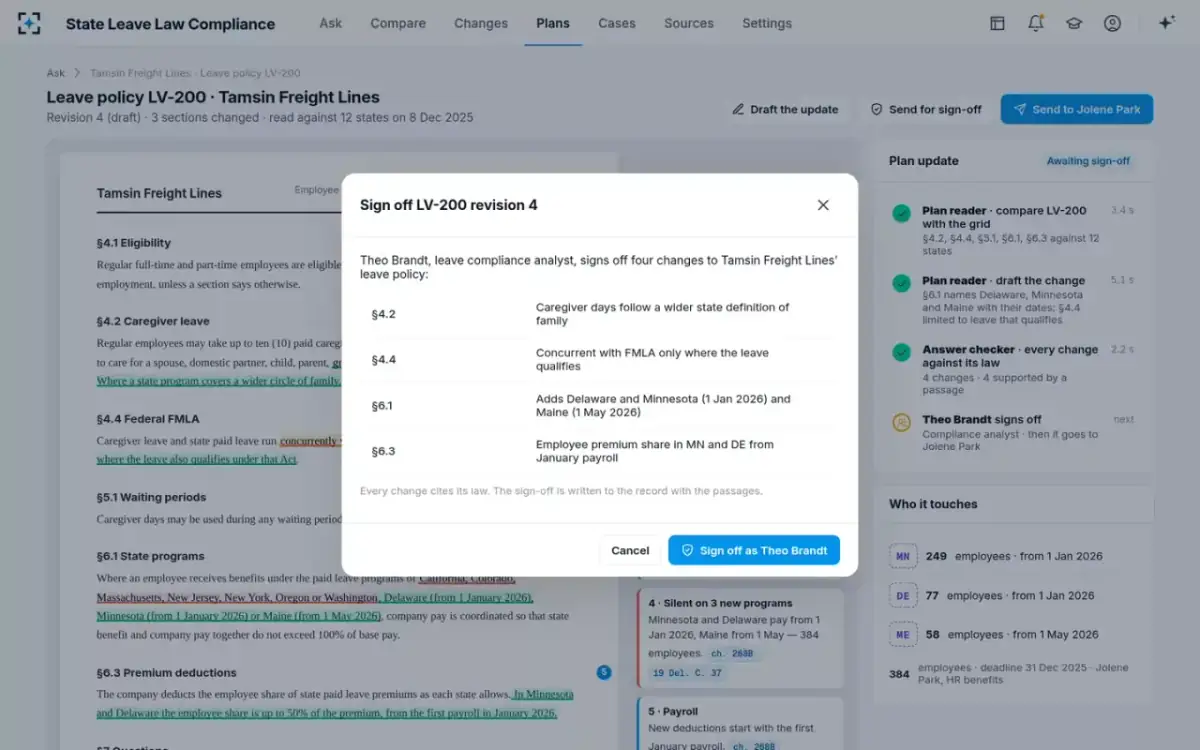
A benefits administrator or carrier holds these figures for every client and state at once, and each client sits on a different side of each size line. State Leave Law Compliance quotes caps and rates with the year they apply to, never recalculated, and flags each change by the date it takes effect, with how many clients and employees it touches. In the solution's sample setting, the premium deductions in one client's policy changed for its Minnesota and Delaware employees from the first January 2026 payroll, and the change went to the compliance analyst to sign before it reached the client.
A premium change, signed: the employee share in two new states from January payroll
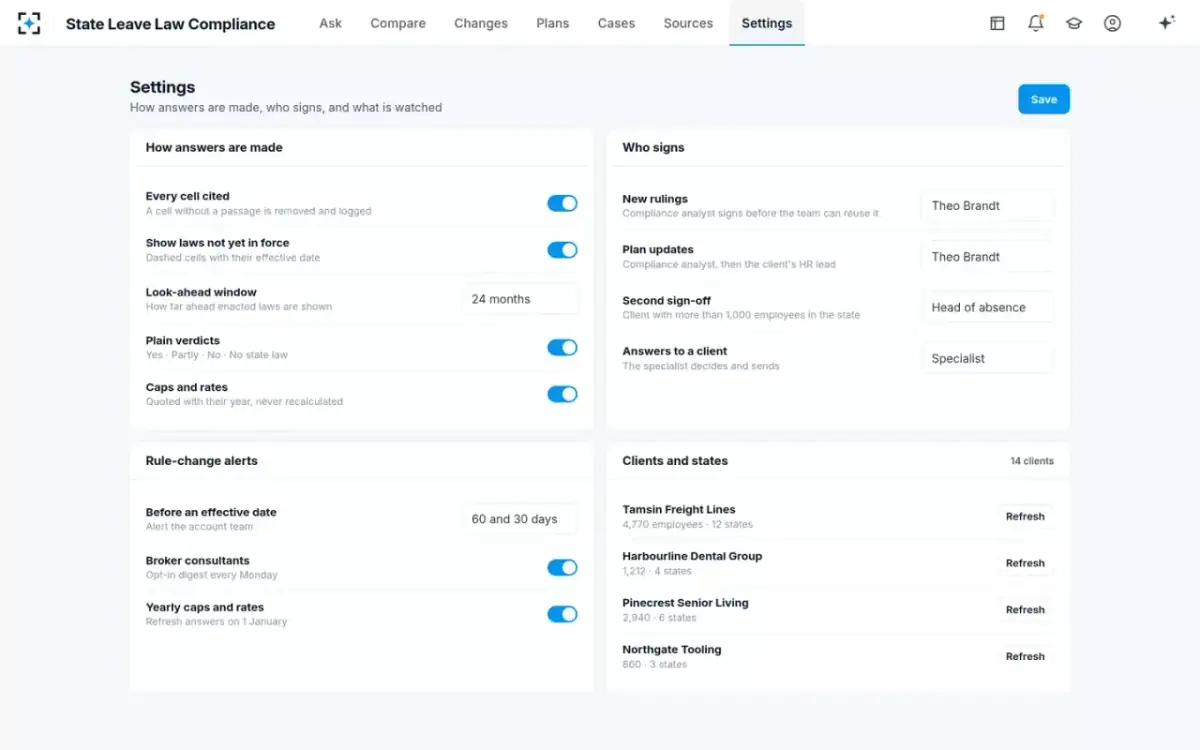
Rates quoted with their year, and alerts set before each effective date
Questions people ask
What are the PFML rates for Washington state in 2026?
The total premium is 1.13% of gross wages up to $184,500, split 71.43% employee and 28.57% employer. Employers with fewer than 50 employees in the state do not pay the employer share. For 2027 the rate rises to 1.2%, split 70.7% and 29.3%.
Can an employer pay the employee's share of the premium?
Yes, in every state that sets a ceiling on deductions rather than a fixed employee charge: Washington, Colorado, Minnesota, Delaware and Maryland all let the employer pay more. Colorado also bars collecting missed premiums from employees in later pay periods, so a late start is the employer's cost.
Are PFML premiums deducted from all wages?
Up to the state's wage cap, which in most states is the Social Security wage base ($184,500 in 2026 in Washington, Oregon and Colorado). California is the exception: its 1.3% applies to all wages, with no ceiling since 2024.
Is New York PFL included in the disability premium?
No. New York's paid family leave contribution is 0.432% of gross wages in 2026, up to $411.91 a year, and is community-rated insurance. New York's statutory disability benefit is separate coverage, and the statute still caps its weekly benefit at $170.
When will Maryland and Virginia employers start paying?
Maryland employers start withholding from the first pay period of January 2027 at a 0.9% total rate, with the first payment due on 30 April 2027. Virginia's Commission begins collecting contributions by 1 April 2028, at a rate to be fixed by 1 October 2027.