Leave of absence tracking software logs each leave, counts it against every entitlement it touches, keeps the notice and certification clocks, and tells payroll what to pay. It is only as current as what is loaded into it: the employer's headcount in each state, counted the way each state counts it; every leave policy, clause by clause; the cases already open, with clocks already running; the rules for who signs; and the list of state and federal sources the rules come from. Bring those on day one and check each before it goes in, and the tool answers correctly from the start. Botminds' State Leave Law Compliance is the rule layer beside a tracker: it answers a leave question against the FMLA, each state program, each state's job-protection law and the employer's own policy, with a passage under every cell. It does not track hours or run payroll, and this guide says plainly where each job belongs.
What to bring on day one, and the check each input needs before it goes in
- Headcount by state, counted each state’s way
Check: the count matches the method and date each program uses, not one company-wide number.
- Every leave policy and plan document, current revision
Check: the revision in force, with its effective date, and every state it names.
- The open cases and their clocks
Check: eligibility notice, designation and certification dates already set for each one.
- Past rulings and procedures
Check: each one still matches the law; mark the ones a newer law overtook.
- Who signs, and at what threshold
Check: named people for rulings and policy changes, and a second signer for large clients.
- The source list
Check: each state’s statute, agency pages and rules, plus 29 CFR 825, with how often each is read.
What is leave of absence tracking software?
It is software for three jobs that are easy to confuse when buying: tracking time against entitlements, administering the leave (notices, certifications, claims and payroll messages), and answering what the law allows. Most products do the first two; how to test the counting itself on your own closed FMLA leaves is set out in best FMLA tracking software. The third is where multi-state employers and the carriers and administrators who serve them run into trouble, because the rules change by state, by date and by employer size.
Three jobs sold as leave software, and what each one needs from you
| Job | What it does | What it needs on day one | Where it usually fails |
|---|---|---|---|
| Tracking | Counts leave against the FMLA, state and policy balances; handles intermittent hours | Hours worked, schedules, leave taken to date | Counting state-only leave against the FMLA |
| Administration | Sends notices, collects certifications, tells payroll what to pay | Open cases, notice templates, payroll links | Clocks that started before the tool did |
| Rule answers | Says what each law and the policy allow for this employee, in this state, on these dates | Sources, policies, headcount by state, sign-off rules | Figures out of date; size lines missing |
What data does a leave tracking system need?
It needs data about the employer, the employees and the rules, and the employer data is the part most often loaded wrong. The federal FMLA turns on 12 months of service, 1,250 hours and 50 employees within 75 miles of the worksite (29 CFR 825.110). State programs add their own tests: hours or earnings in a base period for benefits, days of service for job protection, and employer headcount for premiums and coverage.
Employee data is the easier half: hire date, hours, work state, schedule and leave history. Rule data is the half that decays. A tool loaded with 2025 maximums in January 2026 pays the wrong amounts until someone notices, and a tool loaded with a policy that predates a new state program answers "Silent" where the law now pays.
Input 1: headcount by state, counted the way each law counts
Bring headcount per state, and the counting method behind it, because states count differently and on different dates. Washington averages the employees reported on the last day of each quarter over the past four quarters, on 30 September each year (RCW 50A.10.030(7)(c)). Colorado counts the employees on the payroll "for a total of 20 or more calendar workweeks in the preceding calendar year" (Colorado FAMLI). Minnesota's small-employer test looks at each quarter of a basis period ending 30 September (Minnesota DEED).
Five ways to count the same workforce
| Law | How employees are counted | What the count decides |
|---|---|---|
| Federal FMLA | 50 or more employees within 75 miles of the worksite | Whether the employee is eligible at all |
| Washington | Average of employees reported on the last day of each of four quarters, set on 30 September | Employer premium share (50) and job protection (25) |
| Colorado | Employees on payroll for 20 or more calendar workweeks in the prior year | Whether the employer remits its own 0.44% |
| Minnesota | 30 or fewer employees in each quarter of the basis period, plus a wage test | Small-employer rate of 0.66% |
| Delaware | Employees during the previous 12 months | Parental only at 10 to 24; every type of leave at 25 or more |
Input 2: every leave policy, read clause by clause
Bring the current revision of every leave policy and plan, because the policy is the layer the employer controls and the one most often out of step with the law. State laws decide what a policy may do: Colorado lets an employer require its program to run with a disability policy or a separate bank of leave only with "written notice of this requirement", and says that "under no circumstances shall an employee be required to" use up vacation or sick time first (C.R.S. § 8-13.3-510). Virginia's new law has the same written-notice condition for coordinating with an employer policy (Va. Code § 60.2-810(B)).
Reading a policy against twelve states by hand takes hours, and it is where the most expensive silences sit: a policy that lists the state programs by name stops being right the day a new program starts paying. In State Leave Law Compliance the plan reader marks each policy cell Yes, Partly, Silent or Gap with its clause, and drafts a cited redline; a compliance analyst signs it before it reaches the client.
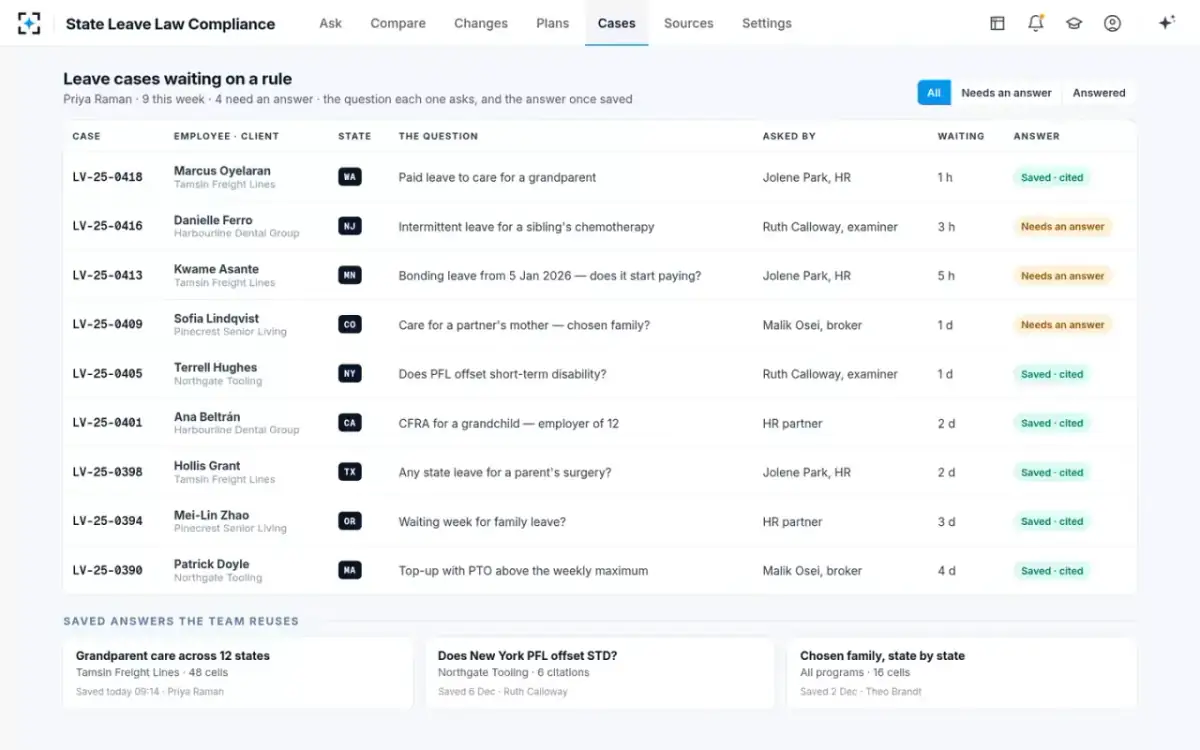
Input 3: the open cases, and the clocks already running
Bring every open leave with its dates, because the law's clocks started before the software did. The FMLA asks the employer to give the eligibility notice "within five business days, absent extenuating circumstances" (29 CFR 825.300(b)), and gives the employee 15 calendar days to return a requested certification (29 CFR 825.305(b)). States set their own: New Jersey asks for 30 days' notice of bonding leave taken in one block and 15 days' notice for leave taken in pieces (NJ Family Leave Insurance); Minnesota pays a non-bonding claim only for a qualifying event "of at least seven calendar days" (Minn. Stat. § 268B.04).
The open cases a team brings, each with the rule question it is waiting on
Input 4: who signs, and at what threshold
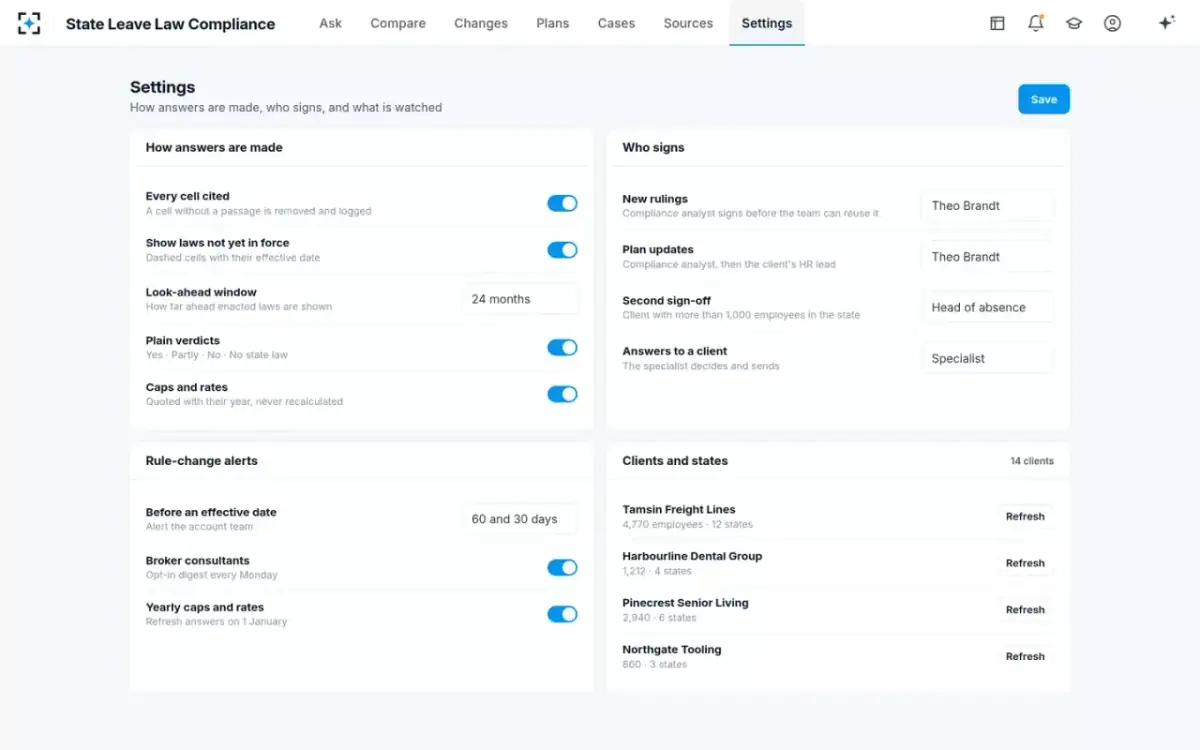
Bring the sign-off rules as named people and thresholds, not as a habit. Who may approve a new reading of a state law? Who signs a policy change before it goes to a client? Is a second signature needed for a large client? In the solution's sample setting, new rulings and policy updates go to a named compliance analyst, a client with more than 1,000 employees in a state needs a second sign-off from the head of absence, and the specialist decides what the client is told. Those are the team's settings, set once and visible to everyone.
Day-one settings: who signs, what is shown, and how far ahead the team looks
Can leave software track state leave laws?
Only if it reads the laws from their sources, keeps the version and date of each, and shows laws that are enacted but not yet paying as exactly that. A tool that stores a state's rules as settings someone typed in is as current as the last person who typed. What to ask for is the passage behind each answer, the date it was last read and the date it applies from.
State Leave Law Compliance reads legislatures, agencies and the Federal Register each night, keeps every cell tied to its passage, and draws a law that is enacted but not in force dashed with its effective date. In the sample setting it watches 212 statutes, agency pages, client plans and rulings; that is the sample's count, not a guarantee of coverage, and the source list is one of the inputs a team brings and checks. How to test any chart or tool cell by cell is in state leave laws chart 2026.
Does leave software handle intermittent leave?
It must, because intermittent leave is common and every law counts it differently. In the Department of Labor's 2018 survey, "about a third (31 percent) took multiple occasions of leave for the same reason, termed 'intermittent leave'—a rate higher than in 2012 (24 percent)" (DOL, Employee and Worksite Perspectives of the FMLA, 2020). The FMLA lets an employer count intermittent leave in its usual increment for other leave, so long as it is no greater than one hour (29 CFR 825.205(a)).
The states then prorate in their own units. Washington prorates the weekly benefit "by the percentage of hours on leave compared to the number of hours provided as the typical workweek hours" and rounds hours down to the next whole hour (RCW 50A.15.020(2)). Minnesota prorates the weekly benefit for intermittent leave (Minn. Stat. § 268B.085). Virginia, from 2028, pays claims for "at least eight hours of family and medical leave accrued in one workweek unless the Commission sets a lower threshold" (Va. Code § 60.2-804(E)). A tracker that counts in days cannot follow any of them.
How long does it take to set up leave tracking software?
The software is the short part; the inputs take the time. The estimate below is Botminds' planning sequence for one benefits administrator with a dozen clients, not a measured result, and its longest step is the one most teams skip: running the tool on questions the team has already answered and comparing.
Most of a leave tool's setup is the inputs, then a test on answered questions
- Headcount and sources1.5 wk
- Policies read and marked1.5 wk
- Test on closed questions2 wk
- Sign-off rules and go-live1 wk
What should leave tracking software cost? Price it against the hours
Price it against the hours it replaces, because list prices are rarely published and the hours are yours to count. For the rule-answer job, most of the time is not reading: it is waiting for someone more senior to confirm the reading. Botminds' estimate for one leave question across a client's 12 states puts 16 of 28.5 working hours on waiting for legal or sign-off when the specialist is unsure.
Where the hours go on one 12-state leave question, by hand and with the solution
By hand: 28.5 working hours
- Waiting on legal or sign-off · 56.1%
- Reading state programs and guidance · 21.1%
- Policy and changes · 14%
- FMLA and write-up · 8.8%
With State Leave Law Compliance: about 2 hours
- Waiting on sign-off · 51.3%
- Reading state programs and guidance · 12.8%
- Policy and changes · 17.9%
- FMLA and write-up · 18%
Multiply by your own volume and rates. In the solution's sample setting a specialist answers 30 to 40 rule questions a day for 14 employer clients; most are single-state and quicker than the 12-state case, so count your own mix before pricing anything.
Where State Leave Law Compliance fits beside a leave tracker
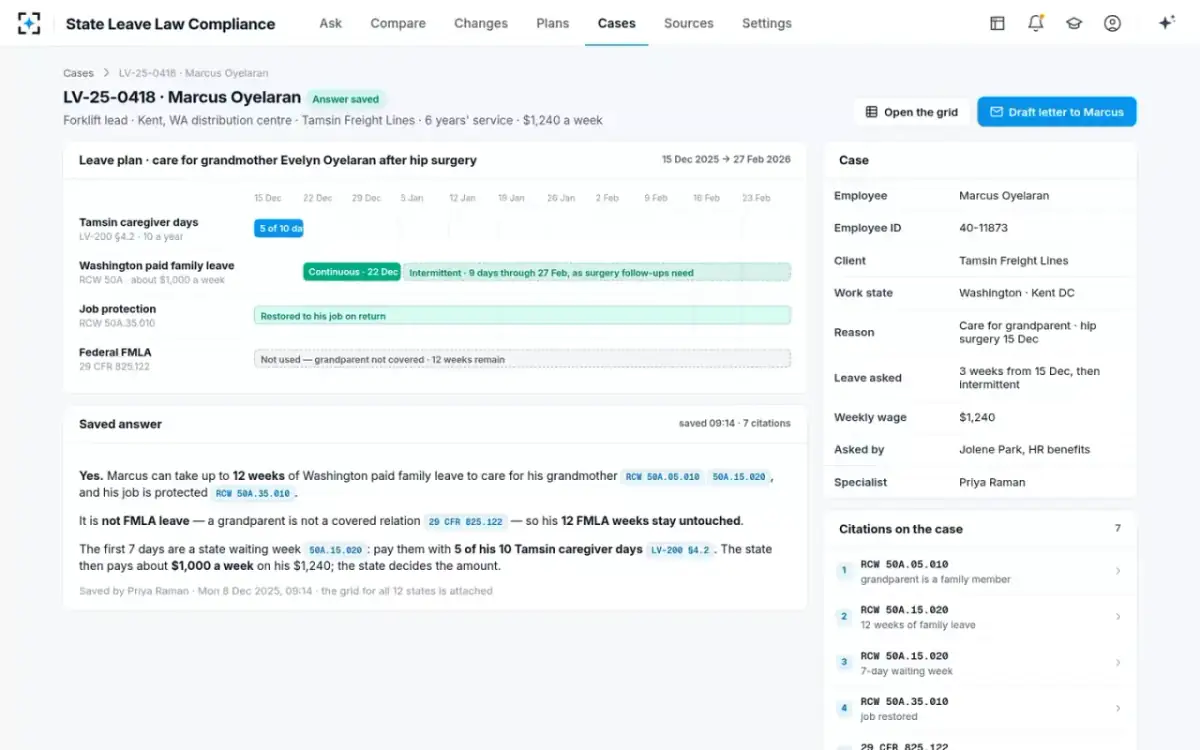
It answers the rule question and leaves the counting to the tracker. For each question it returns one grid, the client's states down the side and four layers across (state paid leave, state job protection, the FMLA and the client's plan), every cell cited, and the specialist saves the answer to the case with its citations. The answer shows the leave lane by lane, which is what a tracker then counts. Who counts as family, the question most leave cases turn on, is worked through in covered family members under FMLA and state leave laws.
What the rule layer hands the tracker: each lane of the leave, cited
Questions people ask
Is a leave of absence tracking spreadsheet template enough?
For a single-state employer with few leaves, a spreadsheet can count weeks. It cannot tell you when a state's figures change, which size line applies or whether a leave is FMLA leave at all, and it keeps no passage behind its numbers. Once leaves span states, the rule question outgrows the template.
What is the difference between leave tracking and leave administration?
Tracking counts time against entitlements; administration runs the process around it: notices, certifications, claims and messages to payroll. Both depend on a correct answer to what the law allows, which is a third job and the one most often done by hand.
Can leave software send FMLA notices automatically?
It can prepare them, but the employer remains responsible for designating leave and giving notice under 29 CFR 825.300. In State Leave Law Compliance nothing is sent to an employee by an agent; a letter is drafted from the saved answer for the employer's HR to send.
Does leave tracking software handle state paid leave as well as the FMLA?
Only if it holds each state's rules with their dates and size lines. Ask to see a state-only leave, such as care for a grandparent, counted against the state balance while the FMLA balance stays untouched.
What should we test before buying?
Run twenty questions your team has already answered, across states and employer sizes, and compare. Include a law enacted but not yet in force, a mid-year cap change, a policy that is silent and an intermittent leave counted in hours.