The FMLA and state leave laws apply at the same time, each on its own terms. The FMLA gives an eligible employee up to 12 unpaid, job-protected workweeks a year; a state program pays part of the wage and many states protect the job at employers far below the FMLA's 50-employee line. Where a leave qualifies under both, it counts against both; where it qualifies under only one, as when an employee cares for a grandparent, it uses only that one. The employer has to apply the more generous rule point by point. Botminds' State Leave Law Compliance reads all four layers for every state a client employs people in (the FMLA, the state paid program, the state job-protection law and the employer's own policy) with five agents, each with a narrow job and a list of things it may not do, and leaves the answer to the leave specialist and the compliance analyst.
Five agents, four layers: what each reads, what it writes, and what it may never do
Reads: The question as typed: “Can an employee in Washington take paid leave to care for a grandparent?”
Writes: The reason for leave, the relation, the states, the client and the dates
Never: Answers the question; assumes a relation that is ambiguous (it asks)
Reads: Each state’s statute, rules and agency pages; then 29 CFR 825 and Department of Labor guidance
Writes: One cell per state and layer: a verdict, one line and the citation
Never: Writes a cell without a passage; recalculates a cap; presents an estimate as the state’s amount
Reads: The client’s leave policy and plan, clause by clause
Writes: Yes, Partly, Silent or Gap for each plan cell, and a cited redline where the policy falls short
Never: Sends a plan change; shows a client’s plan outside its account team
Reads: Legislatures, agencies and the Federal Register, each night
Writes: Laws enacted but not in force, drawn dashed with their date; yearly caps and rates
Never: Shows a bill as law; moves a date it cannot cite
Reads: Every cell, against its passage
Writes: Supported or removed; conflicts and policy gaps sent to the compliance analyst
Never: Edits a cell silently; removes one without a trace
How does FMLA interact with state leave laws?
As two separate entitlements that the employer must honour at once. The Department of Labor's rule is short: "Nothing in FMLA supersedes any provision of State or local law that provides greater family or medical leave rights than those provided by FMLA." It adds that "The Department of Labor will not, however, enforce State family or medical leave laws, and States may not enforce the FMLA" (29 CFR 825.701(a)).
Two further sentences decide most cases. Employees do not have to say which law they are using: "Employees are not required to designate whether the leave they are taking is FMLA leave or leave under State law, and an employer must comply with the appropriate (applicable) provisions of both." And the counting rule: "If leave qualifies for FMLA leave and leave under State law, the leave used counts against the employee's entitlement under both laws." The job of reading both falls on the employer, or on whoever answers the question for it.
Does FMLA run concurrently with state paid leave?
Yes, when the leave qualifies under both, and several states write that into their own statutes. Colorado's says leave taken with wage replacement that also qualifies under the FMLA "runs concurrently with leave taken under the 'Family and Medical Leave Act'" (C.R.S. § 8-13.3-510(1)(a)). Virginia's new law uses nearly the same words: "Leave taken with wage replacement under this chapter that also qualifies as leave under the FMLA shall run concurrently with leave taken under the FMLA" (Va. Code § 60.2-810(A)).
The qualifier is the whole question. A leave runs concurrently only if it qualifies under the FMLA: the employee must be eligible, the employer covered and the reason one the FMLA recognises. Care for a grandparent who did not raise the employee, care for a sibling, and leave at a 30-person employer all fail one of those tests, so the state leave runs alone and the FMLA balance is untouched. The FMLA's own family list, and the states that reach further, are set out in covered family members under FMLA and state leave laws.
Same state program, two different outcomes for the FMLA balance
Counts against the FMLA as well: Eligible employee at a covered employer: the state weeks and the FMLA weeks run together.
Uses only the state program: Employee with under 12 months or 1,250 hours: state leave only, if the state allows it.
Counts against the FMLA as well: A covered family member under 29 CFR 825.122: concurrent.
Uses only the state program: Care for a parent-in-law: the FMLA excludes in-laws, so state leave only.
Counts against the FMLA as well: Only where the grandparent stood in loco parentis to the employee.
Uses only the state program: Every other grandparent: state leave only, FMLA balance intact.
Counts against the FMLA as well: 50 or more employees within 75 miles of the worksite.
Uses only the state program: A 30-person employer in a state program: no FMLA at all.
Counts against the FMLA as well: Leave under a disability plan that meets the FMLA tests can be designated FMLA leave (29 CFR 825.207).
Uses only the state program: A disability absence that is not FMLA-qualifying uses no FMLA time.
FMLA and state family leave: pay, eligibility and family, side by side
The difference is in three things: whether the leave is paid, who qualifies, and who counts as family. The FMLA is unpaid; every state program pays a share of wages up to a weekly maximum. The FMLA asks for 12 months of service, 1,250 hours in the past year and a worksite with 50 employees within 75 miles (29 CFR 825.110); the states set their own, mostly lower, lines.
Who qualifies: the FMLA's lines and a sample of the states'
| Law | Benefit or leave eligibility | Job protection | Source |
|---|---|---|---|
| Federal FMLA | 12 months, 1,250 hours, 50 employees within 75 miles | 12 unpaid workweeks, job restored | 29 CFR 825.110, 825.200 |
| Washington paid leave | 820 hours worked in Washington in the past year | Employer with 25+ workers, after 180 days (from 1 Jan 2026) | ESD 2026 paycheck insert |
| Oregon paid leave | At least $1,000 earned in Oregon in the base year | After 90 consecutive days with the employer | Paid Leave Oregon |
| Maine paid leave | Program from 1 May 2026 | After 120 consecutive days with the employer | Maine DOL |
| Maryland FAMLI (from 2028) | 680 hours in a Maryland-based position | Position held while on leave | Maryland Labor FAQ, April 2026 |
| Delaware paid leave | 12 months and 1,250 hours with the employer | Restored to the same or an equivalent position | 19 Del. C. §§ 3701, 3707 |
| Connecticut leave statute | Three months of employment | Employer of one or more employees | Conn. Gen. Stat. § 31-51kk |
The family lists diverge most. The FMLA covers a spouse, a son or daughter and a parent, and it says outright that a parent does not include a parent-in-law (29 CFR 825.122). Most state programs add grandparents, grandchildren and siblings, and several reach people who are family in fact if not in law. Coverage is the other gap: in the Department of Labor's 2018 survey, only 56 percent of employees were eligible for the FMLA at all (DOL, Employee and Worksite Perspectives of the FMLA), so for many leaves the state layer is the only one that applies.
Can state leave be longer than FMLA?
Yes, and the extra weeks are where most counting mistakes happen. Washington allows up to 12 weeks of family or medical leave and, with both, "a combined total of 16 times the typical workweek hours", with two more for a pregnancy complication (RCW 50A.15.020). Minnesota allows 12 weeks of each and a combined 20 (Minnesota DEED). The FMLA stays at 12, so an employee who uses 16 Washington weeks in one year has used at most 12 FMLA weeks in it.
The rule's own example shows the limit in the other direction: where state law gives 16 weeks over two years, an employee can take 16 one year and 12 the next, but "An employee would not be entitled to 28 weeks in one year" (29 CFR 825.701(a)(1)). Concurrent weeks come off each entitlement once; they are not added together.
Which law applies when FMLA and state law differ?
Both apply, each to the extent it covers the employer and the employee. The rule settles the edge cases: "An employer covered by one law and not the other has to comply only with the law under which it is covered. Similarly, an employee eligible under only one law must receive benefits in accordance with that law" (29 CFR 825.701(a)). A 30-person Oregon employer owes no FMLA leave but must restore an employee who has worked there 90 consecutive days (Paid Leave Oregon).
Within a leave both laws cover, the employee gets the better term on each point. The state may pay and protect for longer; the FMLA may impose its own notice and designation duties. The answer is therefore a set of answers, which is what the solution produces: one cell per state per layer, never one merged verdict.
How the agents in State Leave Law Compliance divide the reading
Each agent reads one kind of source and writes one kind of output, so a reviewer can tell which agent produced which line. The question interpreter fixes the details the law turns on: the reason for leave and the relation, which is why it asks rather than assumes when the relation is ambiguous. The statute researcher reads the state layers and the FMLA and writes the cells. The plan reader reads the client's policy. The effective-date watcher keeps laws that are enacted but not yet in force on the grid, dashed with their date. The answer checker reads every cell back.
One question through State Leave Law Compliance, from typed words to a saved answer
Agent
Question interpreterReads “care for a grandparent, Washington, this client, this case”.
Never: Guesses the relation
Agent
Statute researcherReads the program, job-protection law and agency page for each client state, then 29 CFR 825.122.
Never: Writes a cell without a passage
Agent
Plan readerReads the client policy and marks each plan cell.
Never: Changes the policy
Agent
Effective-date watcherDashes laws enacted but not yet paying, with their dates.
Never: Shows a bill as law
Agent
Answer checkerReads all cells back against their passages; flags gaps to the analyst.
Never: Edits a cell silently
A person decides
Leave specialistDecides, and saves the answer to the case.
The decisions no agent makes
Three decisions stay with people, and each has a reason in the law. Designation: under the FMLA the employer is the one that designates leave and gives notice, so the agents may say a leave qualifies and the employer's people decide. The benefit amount: the state program sets it, so an estimate on screen is labelled as one and a cap is quoted with its year. Policy changes: the employer's promise to its employees changes only when someone with authority signs it.
Below those sit the limits that keep the agents' output checkable. No cell exists without a passage; a cell the answer checker cannot support is removed and logged, never shown. Nothing is sent to a client or an employee by an agent. Each limit is the kind of rule an auditor can test: pick a cell, open the passage, and see whether the words support it.
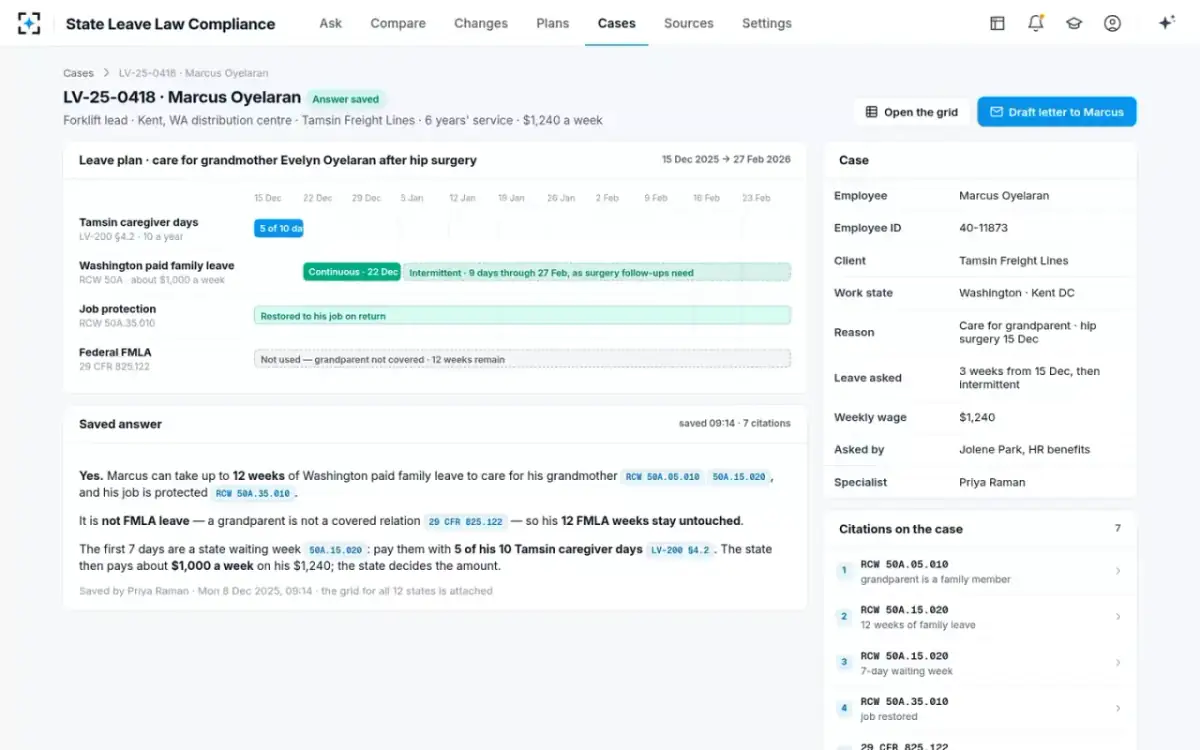
The layers kept apart on the case: paid by the state, job protected, not FMLA leave
Where each agent's limits come from
Every limit answers a way the four layers trip people up. The rule against recalculating a cap exists because caps are set on dates the agencies choose: Colorado publishes its maximum for 2026-2027 from the state's average weekly wage (Colorado FAMLI), and a figure rebuilt from last year's formula is the wrong year's figure. The rule that the interpreter asks when a relation is ambiguous exists because the relation decides the FMLA layer outright: a grandmother who raised the employee is a parent under the FMLA; one who did not is not.
The rule that a bill is never shown as law, and an enacted law is drawn dashed until it applies, exists because the gap between enactment and benefits is long. Virginia's 2026 law has the program collecting contributions by 1 April 2028 and paying benefits by 1 December 2028 (Va. Code § 60.2-801). A question about a Virginia employee today has an answer for now and a different one for 2028, and both belong on the screen.
Testing the agents before you rely on them
Test them the way an auditor would test a person: on your own questions, with the answers you already know. The checklist below turns that into a session of an afternoon. The pass mark is not speed; it is that every cell opens to a passage that supports it, and that the hard cases come back as questions rather than guesses. The same three tests apply to a chart as to a tool; state leave laws chart 2026 shows how to score one cell by cell, and state specific leave laws covers who signs the answer once it passes.
Seven tests to run on any tool that answers FMLA and state leave questions
- A grandparent who raised the employee
The FMLA layer should turn on in loco parentis, and the tool should ask, not assume.
- A 30-person employer
No FMLA; the state layers should still answer, with the size threshold cited.
- A law enacted but not yet paying
Virginia or Maryland today: shown with its date, never as current law.
- A cap that changed mid-year
Oregon or Rhode Island: the figure for the leave dates, with the year it applies to.
- Leave longer than 12 weeks
Washington’s 16 combined: the FMLA counter should stop at 12.
- A policy that is silent
The plan cell should say Silent or Gap with the clause, not Yes.
- Open any cell
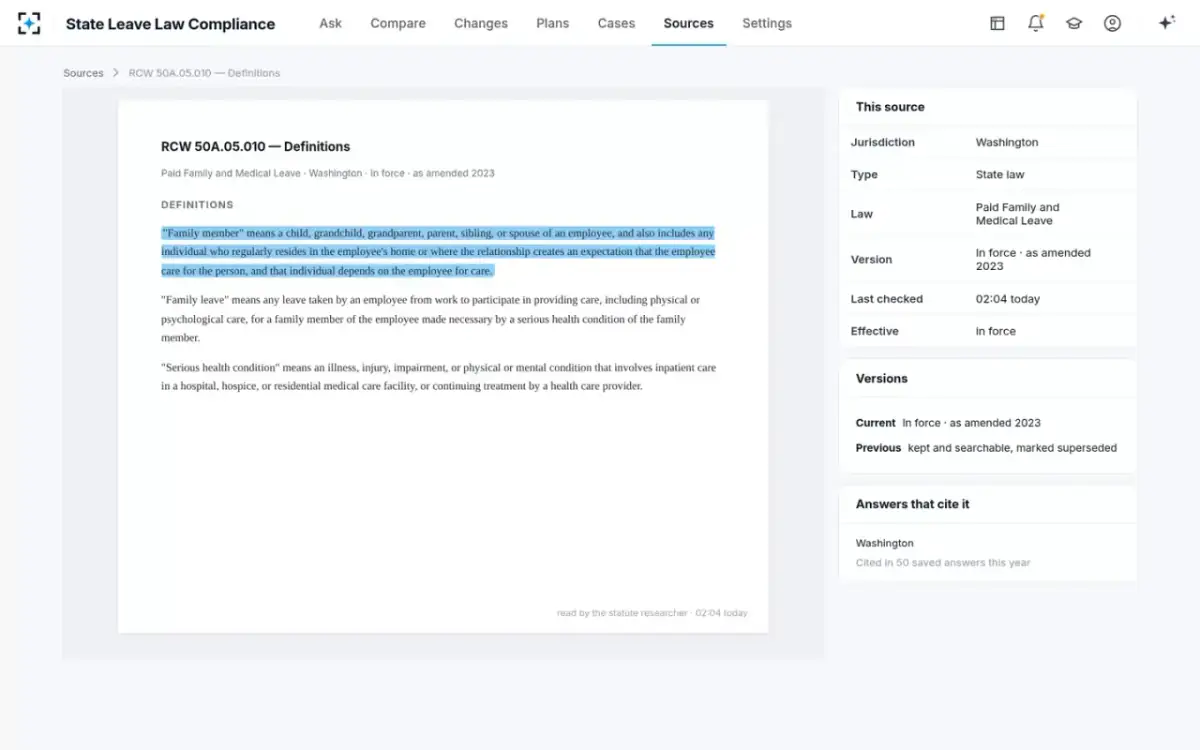
The passage, its version and when it was read should be one click away.
What a passed test looks like: the cell opens to the statute, highlighted
Questions people ask
Is FMLA federal or state?
The FMLA is a federal law, enforced by the Department of Labor's Wage and Hour Division under 29 CFR part 825. States have their own family and medical leave laws and paid programs, which their own agencies enforce. The Department will not enforce state laws and states may not enforce the FMLA.
Do employers have to follow the more generous law?
They have to follow both, which in practice means the more generous rule on each point. The FMLA does not override a state law that gives greater rights, so a longer state leave, a wider family list or a lower eligibility line applies alongside the FMLA's own terms.
Does state paid leave count toward the 12 FMLA weeks?
Only when the leave also qualifies under the FMLA. Then the same weeks come off both entitlements. Leave for a reason the FMLA does not cover, or by an employee the FMLA does not cover, leaves the FMLA balance unchanged.
Can an employee take state leave after using all 12 FMLA weeks?
Often, yes, where the state allows more: Washington's combined limit is 16 weeks and Minnesota's is 20. The FMLA protection ends at 12 weeks, so what protects the job after that is the state statute's own job-protection rule.
Who decides whether a leave counts as FMLA leave?
The employer, through its designation notice under 29 CFR 825.300. A carrier, administrator or tool can tell the employer that the leave qualifies, but the designation is the employer's act, and the employee does not have to name the law they are using.