An SBA seller note on full standby is a note from the seller of a business to its buyer on which no principal and no interest are paid for the whole term of the 7(a) loan, under a standby agreement on SBA Form 155 or the lender's equivalent. Under SOP 50 10 8.1, in force from 1 October 2026, only debt on full standby "may be considered as equity for SBA's purposes", and seller notes, other standby debt and small minority investments together may supply no more than half of the buyer's required equity injection. That rule is recent. Until 31 May 2025, SOP 50 10 7.1 counted a seller note that was on standby for only the first 24 months, even on interest-only standby, and many brokers still structure deals that way. Botminds' SBA Loan Structuring Calculator reads the seller note's terms from the term sheet, counts it only as the SOP in force allows, and shows the seller and the buyer exactly what the difference costs them.
The seller note's three lives: what each SOP required for it to count as equity
SOP 50 10 7.1
15 Nov 2023 to 31 May 2025
- Standby needed to count
- Full standby for the first 24 months, or interest-only standby if historical cash flow covers the interest
- Share of the injection
- No cap stated for a full-standby note; on interest-only standby, at least a quarter of the injection from another source
- Other conditions
- No balloon payment
- Refinancing the note
- After 24 months in place and current, not on standby
SOP 50 10 8
1 Jun 2025 to 30 Sep 2026
- Standby needed to count
- Full standby for the life of the SBA loan: no principal, no interest
- Share of the injection
- No more than half of the SBA-required injection
- Other conditions
- Form 155 or the lender’s equivalent, with the note attached
- Refinancing the note
- After 24 months in place and current, not on standby
SOP 50 10 8.1
From 1 Oct 2026
- Standby needed to count
- Subordinated and on full standby for the term of the 7(a) loan
- Share of the injection
- Seller note, other standby debt and small minority investors together: no more than half
- Other conditions
- A price above the valuation may be bridged only by more limited sources on full standby
- Refinancing the note
- After 36 months in place and current, not on standby
What is full standby on an SBA seller note? No principal, no interest, for the whole term
Full standby means the seller receives nothing on the note while the 7(a) loan is outstanding. SOP 50 10 8.1 defines it in a parenthesis that does a great deal of work: "no payments of principal or interest for the term of the 7(a) loan". The lender "must use SBA Form 155 or its own equivalent Standby Agreement form, and a copy of the Note must be attached to the standby agreement and included in the credit file."
Full standby does not mean the note is forgiven or interest-free. The SOP allows that "the standby debt may accrue interest and may be added to the standby debt and amortized after the 7(a) loan is paid in full". The seller's position is subordinated: the standby creditor "must subordinate any lien rights in collateral securing the loan to Lender's rights in the collateral and take no action against Borrower or any collateral securing the Standby Debt without Lender's consent", and "the provider of standby debt may not take an equity investment in the business". For a seller, a full-standby note on a ten-year SBA loan is a claim that starts to pay in year eleven, behind the bank.
"Seller debt that is subordinated to the Lender and on full standby (no payments of principal or interest for the term of the 7(a) loan) may be considered as equity for SBA's purposes."
SBA, SOP 50 10 8.1, Appendix 15
Does a seller note count toward SBA equity injection? Only on full standby, and only up to half
A seller note counts toward the injection only if it is on full standby for the term of the 7(a) loan, and then only up to half of the required injection. SOP 50 10 8.1 places seller debt among the "limited equity injection sources", which "whether individually or in the aggregate, may provide no more than half of the required Equity Injection". The other limited sources are other standby debt and investments by non-controlling minority investors holding less than 20%. The rest must come from unlimited sources: cash that is not borrowed, cash from a personal loan repaid from outside the business, grants with no clawback, and verified prepaid expenses.
The half cap applies to the required injection, not to the note. A $460,000 note against a $463,148 required injection counts for $231,574, however willing the seller is. The other $228,426 is standby debt: subordinated, silent for ten years, and worth nothing toward the injection. A note that is paid while the 7(a) loan runs counts for nothing at all, and its payments count in the debt service coverage test.
The seller note's three lives, in practice
The rule moved twice in under three years, and each move took something away. Under SOP 50 10 7.1, a note on full standby for the first 24 months counted with no stated cap, and a note paying interest only counted too if the business's history could carry the interest and a quarter of the injection came from the buyer. SOP 50 10 8, effective 1 June 2025, demanded full standby "for the life of the SBA loan" and capped the note at "half of the SBA-required equity injection"; SBA described that SOP as "largely re-implementing requirements that were in place before January 2021" (Information Notice 5000-866746). SOP 50 10 8.1 kept the standby and the cap, put the note in a wider group of limited sources that share the half, and extended the waiting period before a non-standby seller note may be refinanced from 24 to 36 months.
The change most often missed is the first one. A broker who learned to structure SBA deals before mid-2025 knows that a 24-month standby works; for applications since then, it has not. On the sample deal in the solution, the seller note term sheet still read "24-month standby, then payments".
How much of the injection can a seller note be? Worked on one $4.2 million deal
Half of the required injection, at most. Take the fictional sample deal in the solution: Owen Delacroix is buying Harbor Line HVAC Services in Durham, North Carolina, from its founder, Frank Odell, for $4,200,000. With working capital, closing costs and the financed guaranty fee, total project cost is $4,631,476, so the required injection for an initial acquisition is $463,148. Frank offered a $460,000 note at 6%, ten-year amortization, on a 24-month standby. Owen brought $189,000.
Where Frank's $460,000 note goes once it is on full standby
The $460,000 seller note
- Counted toward the injection · $231,574 · 50.3%
- Standby debt above the cap · $228,426 · 49.7%
The approved $471,500 injection
- Buyer cash · $240,000 · 50.9%
- Seller note counted · $231,500 · 49.1%
As submitted, the note counted for nothing, and its $61,283 a year of payments sat in the debt service, pulling coverage on the quality of earnings figure to 1.20x, below the 1.25x floor for an acquisition. Putting it on full standby did two things at once: $231,574 of it counted, and its payments left the coverage test, which rose to 1.32x. It also exposed a third rule. With the note at its cap, the buyer's cash has to cover the other half of the injection, and Owen's $189,000 was $42,574 short. Adding $51,000 of his cash fixed both. The SBA equity injection requirements set out the other sources that can and cannot fill the buyer's half.
Equity counted toward the 10% injection at each step
SBA Loan Structuring Calculator: one slide of the standby lever, and what it does to the deal
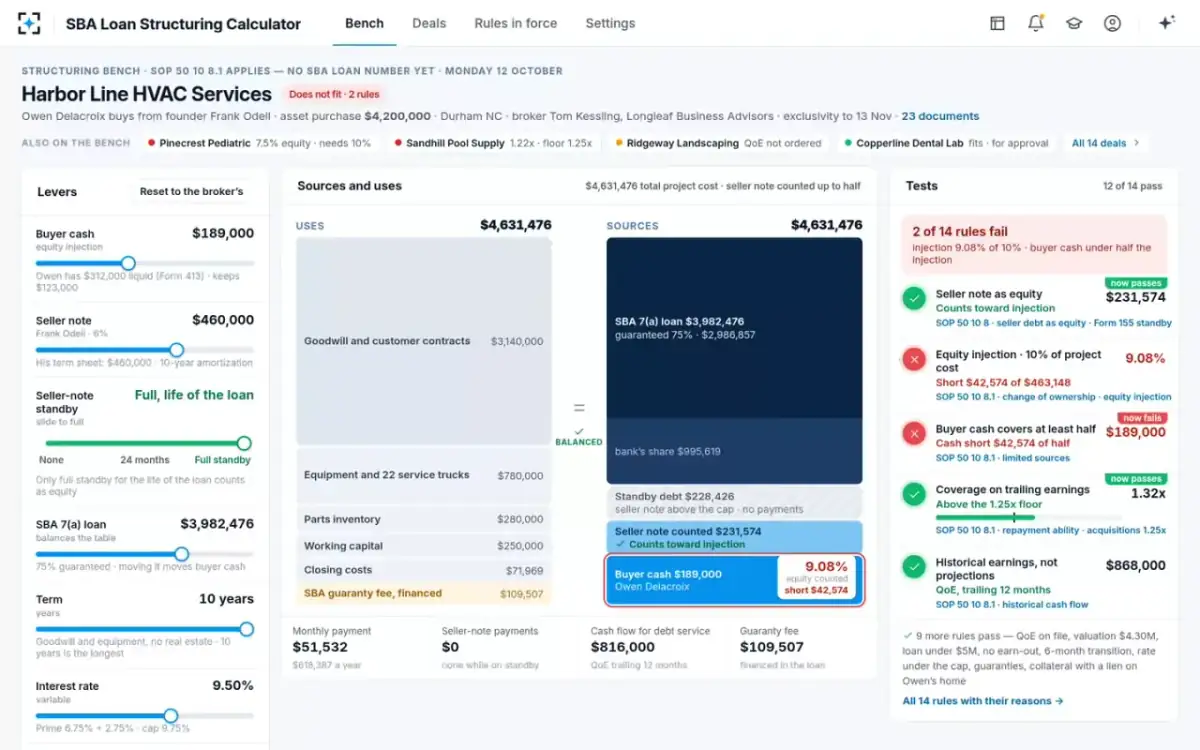
When can an SBA seller note be paid? After the 7(a) loan, or refinanced after 36 months if it is not on standby
A note on full standby is paid after the 7(a) loan is paid in full; accrued interest may be added and amortized then. A seller note that is not on standby, one that is paid alongside the 7(a) loan, can be refinanced with SBA financing later, but SOP 50 10 8.1 requires it to "have been in place and current (not on standby) for at least 36 months following the change of ownership", and the refinancing must reduce the installment by at least 10% "and must not reduce the Lender's exposure". SOP 50 10 7.1 and 8 required 24 months.
That gives the seller two very different instruments. A paid note reaches him from month one, or month 25 after a short standby, but counts nothing toward the injection, adds to debt service and must fit within the business valuation with all the other debt. A full-standby note helps the buyer qualify but pays the seller nothing until the bank is gone. Many deals use both: part of the note on full standby to reach the injection, part paid. The solution models each tranche separately.
The same $460,000 note over the life of a ten-year 7(a) loan
- Loan repaid monthly120 monthly payments
- Afterloan repaid
- Standbystandby 24 mo
- Paidpayments $61,283 a year · in debt service
- Full standbyno principal, no interest; interest may accrue
- Paidthen amortized
Can a seller note be forgivable in an SBA deal? What the SOP does and does not say
The SOP does not use the word "forgivable", and a lender should read the note's terms against three rules it does state. First, "seller earnouts are prohibited", so a note whose payments rise with performance is out. Second, "buyer rebates based on business performance are allowed", and any rebate cash "must be applied to pay down the principal balance of the 7(a) loan that funded the change of ownership". Third, "for transactions involving external capital, the Lender must underwrite and review the terms of all other debt and equity investments".
A note that forgives itself if the business underperforms behaves like a rebate to the buyer, paid in reduced debt rather than cash. Whether that fits within the rebate rule, and how a forgiven standby balance affects the counted injection, are questions SBA answers; its notice for SOP 50 10 8.1 directs policy questions to 7aQuestions@sba.gov (Information Notice 5000-882227). A structuring tool should flag forgiveness terms for a person to decide rather than count the note as if they were not there.
What if the price is above the valuation? Full-standby sources fill the gap
When the price exceeds the business valuation, the difference is equity's problem. SOP 50 10 8.1 says that if the amount paid "exceeds the business valuation, the difference must be made up by equity", and that "additional Limited Equity Sources may be used when additional funds are required to supplement the purchase when the sales price exceeds the value supported by the Business Valuation and Quality of Earnings report. In this situation, any additional funds provided must be on full standby."
That makes a full-standby seller note the natural bridge for a price the appraiser would not support: the seller funds the gap and waits for it. It cannot be a paid note, because total debt including "seller debt that is not on full standby" is "limited to the business valuation amount". SOP 50 10 8 had already capped 7(a) proceeds at the valuation and required that any financed gap be subordinate to the 7(a) loan. On Harbor Line the question did not arise: the $4,300,000 valuation supported the $4,200,000 price.
What the seller is giving up, and why it is often still worth it
On the sample deal, full standby cost Frank roughly ten years of payments. On a 24-month standby he would have started receiving $61,283 a year in the third year; on full standby the note pays nothing while the ten-year 7(a) loan runs, though interest may accrue. In exchange the deal closes. Without the standby, Owen would have needed $274,148 more cash to reach the injection on his own, $463,148 in all, against the $312,000 his personal financial statement showed.
A plain explanation helps the seller decide. In the solution, once the credit officer approves, the term sheet drafter writes a note to the buyer and broker that says what changed from their proposal and why: the 24-month standby could not count toward the 10% injection and its payments fell in the coverage test. Brokers who see the arithmetic can take it to the seller the same day, inside the buyer's exclusivity.
The structure as the broker sent it: the note hatched as not counted, paid from month 25
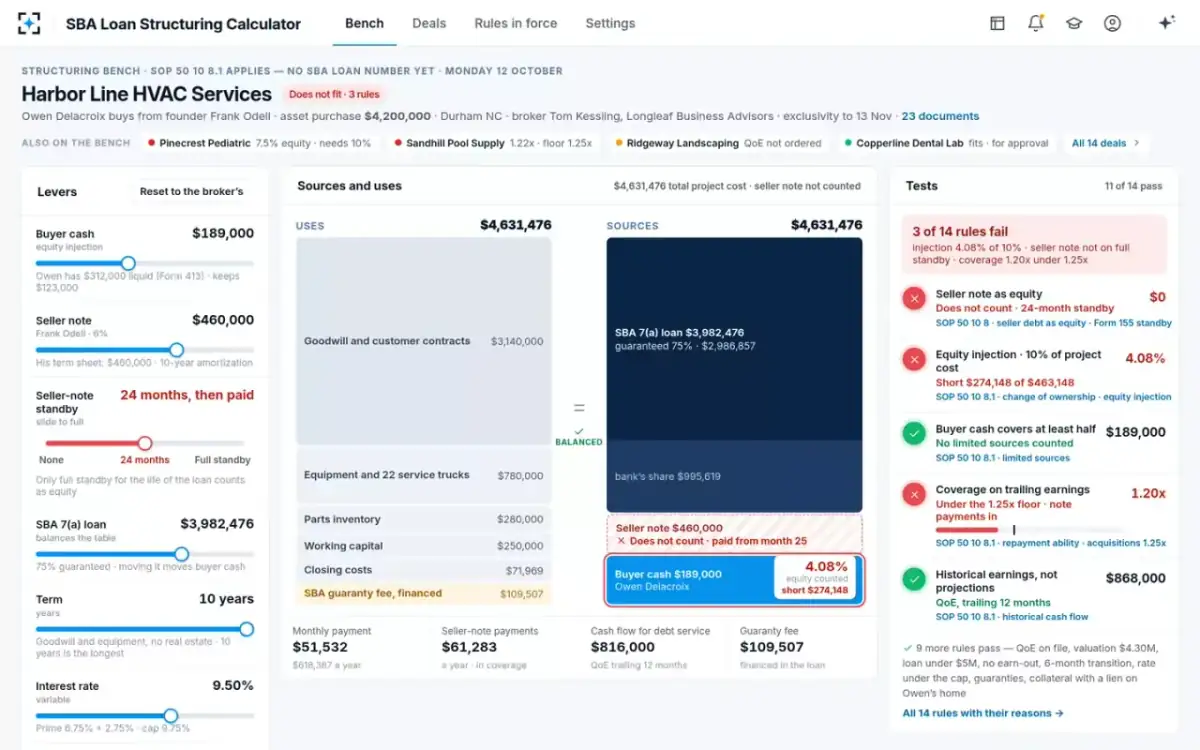
How the solver arrived at the extra $51,000, and why it puts the note on standby before it asks the buyer for more cash, is set out in the SBA deal calculator that solves for the smallest fix. To test seller notes on your own deals, start from the SBA Loan Structuring Calculator.
Questions people ask
What was the old 24-month seller note rule?
Under SOP 50 10 7.1, effective 15 November 2023, a seller note with no balloon counted toward the injection if, for the first 24 months of the 7(a) loan, it was on full standby, or on interest-only standby with historical cash flow to pay the interest and at least a quarter of the injection from another source. SOP 50 10 8 replaced it on 1 June 2025.
Can an SBA seller note accrue interest while on full standby?
Yes. SOP 50 10 8.1 allows standby debt to accrue interest, add it to the balance and amortize it after the 7(a) loan is paid in full. What it may not do is pay principal or interest while the 7(a) loan is outstanding.
Can the seller be paid on part of the note?
Yes, if the notes are split. The part on full standby can count toward the injection, up to the half cap; the paid part counts as ordinary debt, enters the coverage test and, with all other debt, must fit within the business valuation.
Is SBA Form 155 required for a seller note?
For a note counted as equity, the lender must use SBA Form 155 or its own equivalent standby agreement, with a copy of the note attached and kept in the credit file. The standby creditor subordinates its liens and agrees to take no action without the lender's consent.
Does a seller note count toward the injection in an owner buyout?
The same limited-source rules apply, with the injection based on the purchase price rather than total project cost. In a buyout the lender may also reduce or eliminate the 10% requirement if the business has enough liquidity and no negative net worth, which can make the note's role smaller.