An SBA loan calculator in Excel, the workbook a business development officer uses to size a 7(a) acquisition loan, is usually not a "model" under the interagency guidance on model risk management issued on 17 April 2026, which "excludes simple arithmetic calculations, such as those found within spreadsheets, as well as deterministic rule-based processes". That does not make it low-risk. The workbook decides whether a structure meets SBA's loan program requirements, and under 13 CFR 120.524 a lender's material failure to meet them can release SBA from its guaranty. The right control for an SBA structuring spreadsheet is therefore not model validation but rule fidelity: the coverage definition, the amortization of acquisition debt, the add-backs and the SOP version must be SBA's, and someone must be able to prove it. Botminds' SBA Loan Structuring Calculator is built around that test; this page is written for the second line and model risk teams who have to decide what to do about the workbooks.
What the April 2026 guidance says, and what it means for an SBA structuring workbook
Revised Guidance on Model Risk Management: A model is "a complex quantitative method, system, or approach that applies statistical, economic, or financial theories to process input data into quantitative estimates."
For a 7(a) structuring spreadsheet: Sources and uses, an amortization schedule and a coverage ratio apply no such theory. On its own the workbook is arithmetic.
Revised Guidance on Model Risk Management: "Simple arithmetic calculations, such as those found within spreadsheets, as well as deterministic rule-based processes and software."
For a 7(a) structuring spreadsheet: SBA’s tests (10% injection, half cap on limited sources, 1.25x coverage) are deterministic rules. They are excluded from the definition, not from the bank’s risk.
Revised Guidance on Model Risk Management: "Expected to be most relevant to banking organizations with over $30 billion in total assets."
For a 7(a) structuring spreadsheet: Most SBA lenders are far smaller and far less active: 711 of 1,336 made five or fewer 7(a) loans in fiscal 2025.
Revised Guidance on Model Risk Management: "Does not set forth enforceable standards or prescriptive requirements."
For a 7(a) structuring spreadsheet: SBA’s rules do: they are loan program requirements, and the guaranty depends on them.
Revised Guidance on Model Risk Management: "Generative AI and agentic AI models are novel and rapidly evolving. As such, they are not within the scope of this guidance."
For a 7(a) structuring spreadsheet: A tool that reads documents with AI is outside both the definition and the guidance; its controls are the bank’s to design.
Is an SBA loan calculator in Excel a model? Under the 2026 guidance, usually not
No, in the usual case. The revised guidance, which the Federal Reserve says "supersedes and replaces SR letter 11-7", narrows the word "model" to methods that apply "statistical, economic, or financial theories to process input data into quantitative estimates". A 7(a) structuring workbook adds up uses, balances them with sources, amortizes a loan at a stated rate and divides cash flow by debt service. Its SBA tests are thresholds. That is the "simple arithmetic" and "deterministic rule-based" processing the guidance excludes.
Two kinds of workbook may still cross the line. One that projects earnings with a growth model or a regression to size the loan is producing an estimate, not a calculation. One that scores the borrower, with a credit model that weighs factors, is a model by any reading, and SBA has its own words on that: a lender using a scoring model for 7(a) Small loans may do so only if its primary federal regulator permits it, it is used for similar non-SBA loans, and it "does not rely solely on consumer credit scores" (SOP 50 10 8.1). Neither describes the typical structuring sheet.
The guidance also pulls back from smaller banks. It is "expected to be most relevant to banking organizations with over $30 billion in total assets", it "does not set forth enforceable standards", and it repeats the OCC's 2025 statement that its model risk guidance does not "require community banks to perform annual model validation" (OCC Bulletin 2026-13). For the community banks that make most SBA acquisitions, the model risk framework is not where the workbook's risk lives.
Why "not a model" does not mean "not a risk": the guaranty rides on the workbook
The risk is compliance, and it is concentrated. SBA's 13 CFR 120.10 defines loan program requirements to include "SBA Standard Operating Procedures (SOPs); Federal Register notices; and official SBA notices and forms". Under 13 CFR 120.524, SBA is released from its guaranty, in whole or in part, if "the Lender has failed to comply materially with any Loan Program Requirement for 7(a) loans", or has failed "to make, close, service, or liquidate a loan in a prudent manner".
For a delegated lender the workbook is often the only test the structure gets before closing. Under PLP, SBA "does not review the Lender's analysis of the credit or structure of the loan … prior to issuing a loan number"; it reviews it when the lender asks SBA to buy the guaranty. In fiscal 2025, 64.1% of 7(a) loans went through PLP and another 30.9% through SBA Express, also delegated, by our computation from SBA's loan file. A workbook that counts a seller note SBA would not count, or tests coverage on a figure SBA would not use, approves loans whose guaranty is in doubt from the first day, and nobody finds out until a default.
How is SBA historical DSC defined? The formula a workbook must carry
For a change of ownership, SOP 50 10 8.1 defines it in one sentence: "The historical DSC ratio is defined as earnings before interest, taxes, depreciation, and amortization (EBITDA) divided by the combined debt service post-transaction." Combined debt service means every business debt after the deal: the new 7(a) loan, any seller note that is not on full standby, and existing debt that stays. The measurement period is "either the last fiscal year-end or an average of the last two fiscal year-end statements", and when a quality of earnings report is required, its earnings are the ones used.
Historical debt service coverage for an SBA change of ownership, term by term
EBITDA
last fiscal year, or the average of the last two; the QoE figure when a QoE is required
Historical or adjusted basis; projections may not be used to meet the minimum.
Returns, statements, QoE
Adjustments
± each documented adjustment
Unfunded capex, non-recurring income, distributions, S-corporation tax distributions, seller discretionary expenses, owner pay; each with a written reason.
Lender’s credit memorandum
Debt service
Σ principal and interest on all business debt after the deal
New 7(a) loan; seller debt not on full standby; interest-only acquisition debt on an amortization of 10 years or less.
Structure
Minimum
1.25x initial acquisition, owner buyout, ESOP; 1.15x expansion
Plus 1:1 on a global basis where owner pay is adjusted.
SOP 50 10 8.1, App. 15
Two details trip workbooks up. The SOP allows "an addback for rent payments when the owner-occupied commercial real estate is part of the transaction", because the rent disappears when the buyer owns the building; a sheet that adds back rent on a leased location overstates coverage. And the earnings basis is a choice between two historical figures, not the better of the historical figure and the broker's adjusted one.
What amortization does SBA require on interest-only debt? No more than ten years
Ten years at most, in the coverage test. SOP 50 10 8.1 says that "when a change of ownership transaction includes additional debt to support the purchase that is not on full standby and is structured with interest-only payments, the Lender must apply an amortization that does not exceed 10-years", so that "the business can service all debt associated with the acquisition, regardless of the source or structure". Lines of credit are excepted.
The rule closes a gap that spreadsheets used to exploit. An interest-only seller note or investor loan adds little to year-one debt service, so a sheet that models it on its contractual terms shows comfortable coverage on a structure that will need refinancing or a balloon later. The 7(a) loan itself is bounded the same way: a loan financing a change of ownership "must not have an amortization that exceeds 10 years", except for an owner-occupied special purpose property, and where real estate is in the deal only its share may run longer, to 25 years, on a blended maturity.
What add-backs does SBA accept? Only those with a written reason
SBA accepts prudent adjustments the lender can justify; it does not accept a list. The SOP names the kinds of adjustment it expects, such as unfunded capital expenditures, non-recurring income, distributions, distributions for S-corporation taxes, seller discretionary expenses and owner compensation, and requires that "the Lender must outline why each adjustment is prudent, necessary, and how it can be supported by the ongoing operations of the business". Then it closes the door: "Adjustments to cash flow without the Lender's supporting analysis and justification will be ineligible."
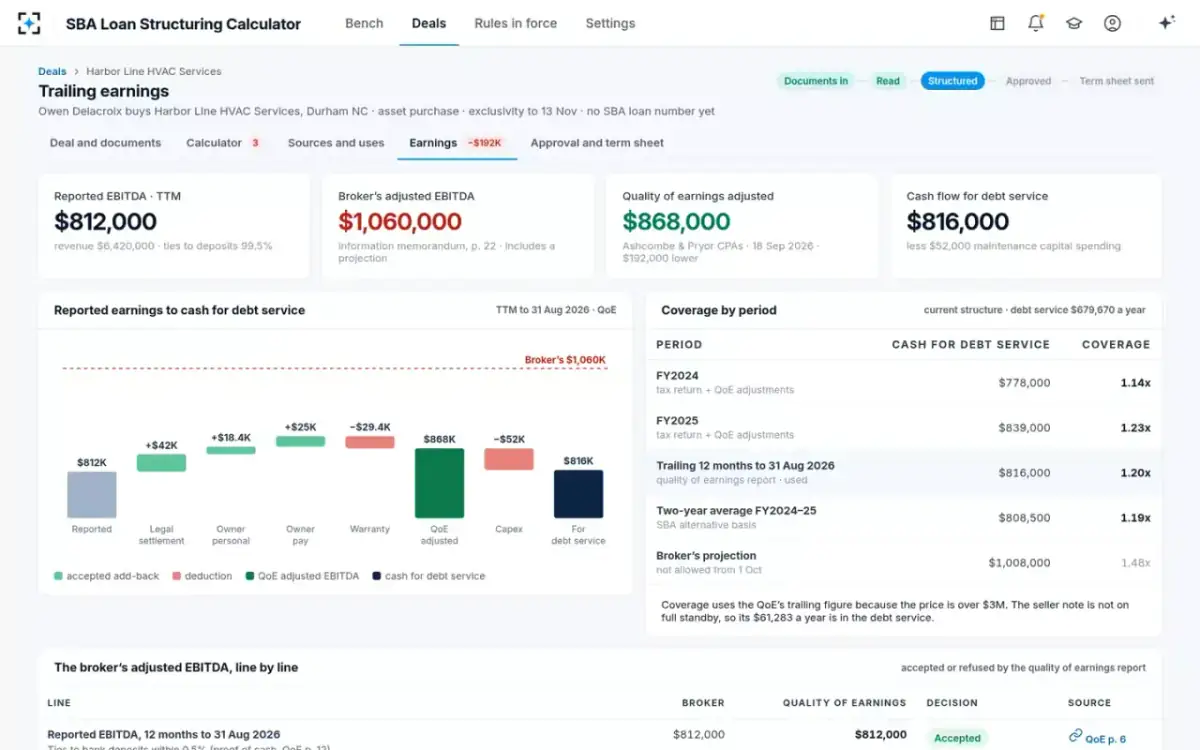
Owner compensation carries an extra test. An adjustment to it "must also be substantiated by a global cash flow analysis" showing the owners can meet their obligations on the adjusted pay, at 1:1 globally. On the fictional Harbor Line HVAC deal in the solution, the quality of earnings report accepted the owner's pay above a market general manager's salary as an add-back of $25,000 and refused a $36,000 salary for the founder's spouse, because the bookkeeping job continues after the sale. A workbook that carries the broker's add-backs as a single "adjusted EBITDA" input has nowhere to record either decision.
SBA Loan Structuring Calculator: earnings from the returns and the QoE, every add-back with its decision
How do you version a calculator to the SOP? Three versions in three years
Version a structuring calculator by rule, with an effective date and a source for each, and keep every version it has ever applied. The SOP behind 7(a) acquisitions changed three times between November 2023 and October 2026, and the notices in between changed fees, scoring and rates. SOP 50 10 8.1 alone folded in nine notices issued under its predecessor; its text was reissued with technical updates on 25 September 2026, less than a week before it took effect. SBA's two notices for 8.1 even described the governing date differently: the August notice by the date an application is "issued an SBA loan number", the September one by applications "received by SBA" (Information Notice 5000-882227).
The rule changes an SBA structuring workbook had to absorb, November 2023 to October 2026
- SOP 50 10 7.17.1 · from 15 Nov 2023
- SOP 50 10 88 · from 1 Jun 2025
- SOP 50 10 8.18.1
- SBSS scoreSBSS score screen (155, then 165)
- DSC 1.10x1.10x from 1 Mar 2026
- Before FY2026earlier fiscal-year tables
- FY2026FY26: 0% to manufacturers ≤ $950K
- FY2027FY27
A workbook usually holds one version: the one in force when someone last edited it. Deals in a pipeline straddle versions. The test for a structuring tool is whether it can show, for a deal approved on a given date, which rules it applied and where each came from, and whether every deal in the pipeline was retested when the rules changed. The sample pipeline in the solution had nine deals without an SBA loan number when SOP 50 10 8.1 took effect; all nine were retested overnight, and three no longer fitted.
Five ways an SBA structuring spreadsheet goes wrong
The errors that matter are not formula errors; they are rule errors that the arithmetic carries faithfully. Each of the five below produces a structure that looks sound and fails a loan program requirement.
Rule errors a structuring workbook carries, and where SBA would find them
| The error | The rule it breaks | Where it surfaces |
|---|---|---|
| A seller note on 24 months of standby counted as equity | Only debt on full standby for the term of the 7(a) loan counts; limited sources at most half | Equity verification before disbursement; SBA purchase review |
| Coverage on the broker’s adjusted EBITDA | Historical or adjusted basis only; the QoE figure when one is required | Credit review; at purchase, a repayment-ability finding |
| Interest-only acquisition debt at its contractual payment | Amortize non-standby interest-only debt over 10 years or less | Credit review |
| Injection on the price instead of total project cost | 10% of total project cost for an initial acquisition; price only for owner buyouts | Underwriting; equity verification |
| Last year’s fee table | Upfront fee per the fiscal-year notice for the approval date | The fee SBA bills within 90 days of approval |
Two of them are worth a second look because they interact. Counting a 24-month standby note as equity also takes its payments out of debt service, so the same mistake inflates both the injection and the coverage. On the Harbor Line sample, the broker's structure claimed 1.48x coverage; on the quality of earnings figure, with the note's $61,283 a year in the debt service, it was 1.20x. The SBA rules for a seller note on full standby explain why the note has to be on standby for the life of the loan to count at all.
How should banks validate a loan structuring spreadsheet? Test the rules, not the arithmetic
Validate a structuring spreadsheet the way an examiner would test a compliance control: against the rulebook, on files where the answer is known. The checklist below is ours. It is sized for a community bank's second line, and it assumes no model validation function.
A control set for an SBA structuring workbook, sized to the risk
- A rule register with sources
Every threshold the workbook applies, the SOP paragraph or notice it comes from, and its effective date.
- A change trigger
A named owner who reads each SBA notice and SOP release, decides whether the workbook changes, and records the decision.
- Golden files
Five or six closed acquisitions with known answers, including one with a seller note, one above $3 million and one owner buyout; rerun after every change.
- Locked definitions
Historical DSC as EBITDA over post-transaction debt service; injection on total project cost; the half cap on limited sources. Users enter facts, not ratios.
- An add-back log
Each adjustment with its amount, reason and evidence, so the credit memorandum and the SBA Loan System figures can be traced.
- Version on the file
The workbook version and rule version saved with each approved structure, so a purchase review years later can be answered.
- Second-person review
The credit officer sees the rule results and their sources, not only the outputs.
The golden files do most of the work. A workbook that reproduces the structure SBA accepted on six real deals, and fails the way SBA would on a seventh with a planted error, has been tested on what matters. The same files are the fair way to evaluate a replacement.
Where the SBA Loan Structuring Calculator sits in that picture
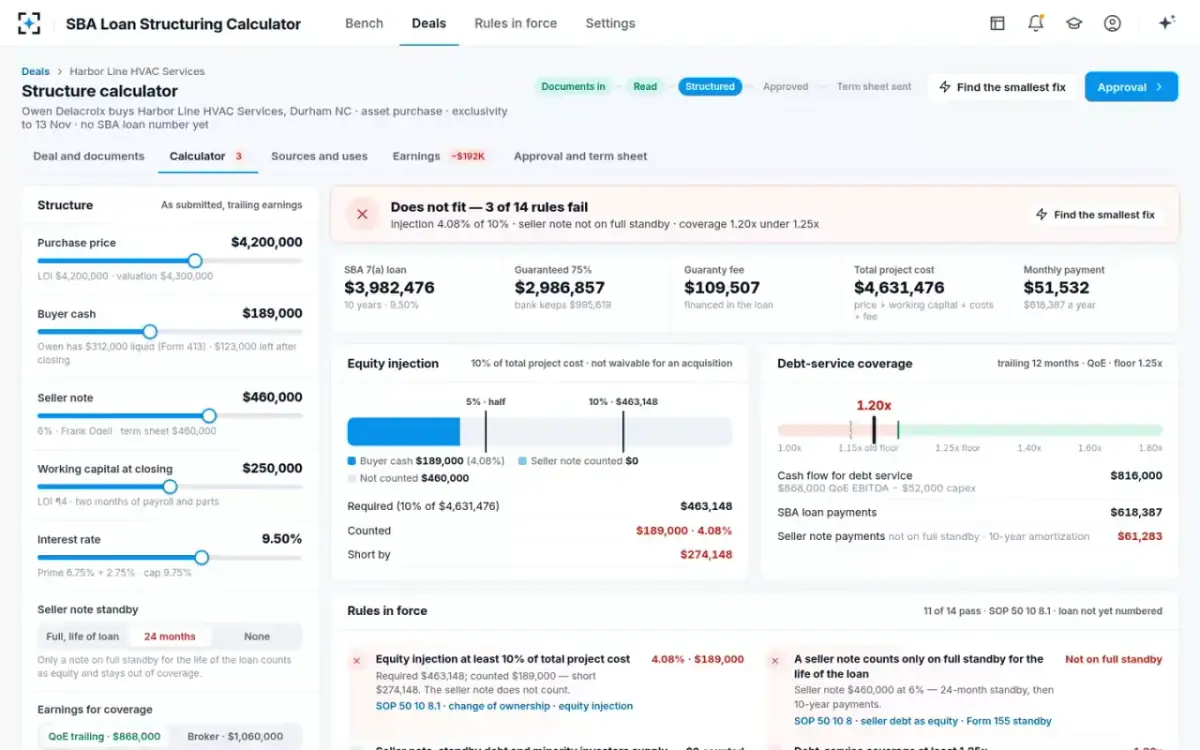
The solution is built so that a second line can answer the checklist from the tool itself. Each of its fourteen tests shows its figure and the SOP paragraph it applies, and the rule versions are dated settings, versioned and on the activity trail. Earnings come from the returns, the trailing statements and the quality of earnings report, each figure linked to its page, with each add-back marked accepted or refused. The structure solver only proposes; a banker puts a proposal on the bench and a credit officer approves before anything leaves.
Every input as a lever, every rule with its figure and its SOP reference
The 2026 guidance leaves one question open that a bank should answer for itself. Its definition puts deterministic rules outside model risk, and it puts generative and agentic AI outside its scope altogether. The solution uses AI agents to read documents and propose structures; its arithmetic and rule tests are deterministic. A sound control design treats the two differently: the rules are tested against the SOP like any calculation, and the reading is tested against the documents, figure by figure, on the bank's own files. The case for a calculator BDOs and credit officers will both trust starts from the same place. To see it on your own deals, start from the SBA Loan Structuring Calculator.
Questions people ask
Does SR 11-7 still apply to spreadsheets?
SR 11-7 no longer applies at all. The Federal Reserve's SR 26-2 of 17 April 2026 "supersedes and replaces" it, and the revised guidance excludes simple spreadsheet arithmetic and deterministic rule-based processes from the definition of a model. A bank may still choose to inventory important spreadsheets as end-user tools under its own policy.
Is there an SBA loan calculator in Excel from SBA?
SBA publishes its rules, fee notices and forms, not a structuring workbook; lenders build or buy their own. Any workbook used to size 7(a) acquisitions has to carry SBA's definitions itself: the injection on total project cost, the half cap on limited sources, and coverage on historical earnings.
Does an SBA amortization schedule in Excel need to change for SOP 50 10 8.1?
The payment arithmetic does not change; what feeds it may. For a change of ownership, the 7(a) loan may not amortize over more than 10 years except for special purpose property, and interest-only acquisition debt that is not on full standby must be tested on an amortization of no more than 10 years.
Who should own an SBA structuring spreadsheet?
The business line uses it, but the rule content needs an owner outside the sales team, usually SBA credit or compliance, who reads each SBA notice and decides what changes. SBA's notices carry an expiry date, typically a year after they take effect, and are folded into the next SOP, so the rulebook moves on a schedule nobody controls.
What does an examiner look at in an SBA structuring tool?
For a delegated lender, SBA's lender oversight reviews and its purchase reviews test the loan file: whether the structure met the SOP in force, with support for every adjustment. A tool that saves its rule version and results with each approved structure makes that file easier to defend.