The SBA minimum debt service coverage ratio for a 7(a) loan is 1.15x for a standard loan, on historical or projected cash flow, with 1:1 on a global basis; 1.10x for a 7(a) Small loan that is not a change of ownership; and, since SOP 50 10 8.1 took effect on 1 October 2026, 1.25x for an initial business acquisition, an owner buyout or an ESOP or cooperative purchase, measured on history and never on projections. A business expansion stays at 1.15x, and 504 loans need 1.15x on history. Coverage is EBITDA divided by all the business's debt service after the loan, and when a quality of earnings report is required, its earnings are the ones used. Before October 2026, SOP 50 10 8 applied a single 1.15x to all of these and let an acquisition lean on projections. Botminds' SBA Loan Structuring Calculator tests the right minimum on every structure, with the figure and the paragraph, which is the subject of this page.
The SBA coverage minimum by deal type, June 2025 to October 2026
- SOP 50 10 81.15x · history or projections
- SOP 50 10 8.11.25x · history
- SOP 50 10 81.15x
- SOP 50 10 8.11.25x
- SOP 50 10 81.15x
- SOP 50 10 8.11.15x
- SOP 50 10 81.15x · history and/or projections
- SOP 50 10 8.11.15x
- Score screenSBSS score ≥ 165
- 1.10x1.10x from 1 Mar 2026
What is the SBA minimum debt service coverage ratio? It depends on the deal type
There is no single SBA minimum. SOP 50 10 8.1 sets one floor for each kind of 7(a) loan, and for a change of ownership it sets the floor by the category of the transaction, which the lender must document and enter in the SBA Loan System. Initial acquisition is the default category; a deal qualifies as a business expansion, owner buyout or ESOP only if the lender documents why in its credit memorandum. Getting the category wrong is therefore a way of getting the minimum wrong.
SBA minimum debt service coverage by type of 7(a) loan under SOP 50 10 8.1
| Type of loan | Minimum | Earnings basis | QoE at $3 million or more? |
|---|---|---|---|
| Initial acquisition | 1.25x | Last fiscal year or two-year average, historical or adjusted; no projections | Yes |
| Owner buyout (existing or partial) | 1.25x | As above | No |
| ESOP or cooperative purchase | 1.25x | As above | No |
| Business expansion | 1.15x | As above; adjustments may combine both businesses if the acquired one operates separately | Yes |
| Standard 7(a), not a change of ownership | 1.15x, and 1:1 global | Historical and/or projected | — |
| 7(a) Small, not a change of ownership | 1.10x | Last year-end, year-end plus interim, or 12-month projections; two months of bank activity | — |
| 7(a) Small or SBA Express financing a change of ownership | As for its category | Appendix 15 rules apply in full | Yes, by category |
| 504 loan | 1.15x | Last fiscal year or two-year average, historical | — |
What DSCR does SBA require for a business acquisition? 1.25x on history
For an initial acquisition, SOP 50 10 8.1 requires 1.25x, "satisfied using either the last fiscal year-end or an average of the last two fiscal year-end statements on either a historical or adjusted basis". The same 1.25x applies to owner buyouts and to ESOP and cooperative purchases. A business expansion, in which an existing business that has operated at least two full fiscal years buys 100% of another in the same four-digit NAICS industry group, needs 1.15x.
The higher floor is the largest credit change in the October 2026 SOP for acquisitions, and it interacts with the others. The lender "must evaluate the Applicant's post-closing financial projections but may not rely on them to meet the DSC requirement", so the buyer's plans for the business do not count. When the business purchase price is $3 million or more, the quality of earnings report's earnings must be used, and if they do not support the structure, "the loan amount must be reduced accordingly". SBA leaves the borrower one remedy in the same paragraph: it "may contribute additional unlimited or limited equity to reduce the loan amount and corresponding debt service in order to meet the DSC requirement".
How is SBA DSCR calculated? EBITDA over post-transaction debt service
SBA calculates it as EBITDA divided by debt service after the transaction. For a change of ownership the SOP's words are: "The historical DSC ratio is defined as earnings before interest, taxes, depreciation, and amortization (EBITDA) divided by the combined debt service post-transaction." For a standard 7(a) loan, debt service "is defined as the future required principal and interest payments on all business debt inclusive of new SBA loan proceeds". The numerator may be adjusted for unfunded capital expenditures, non-recurring income, distributions and owner compensation, each with a written justification.
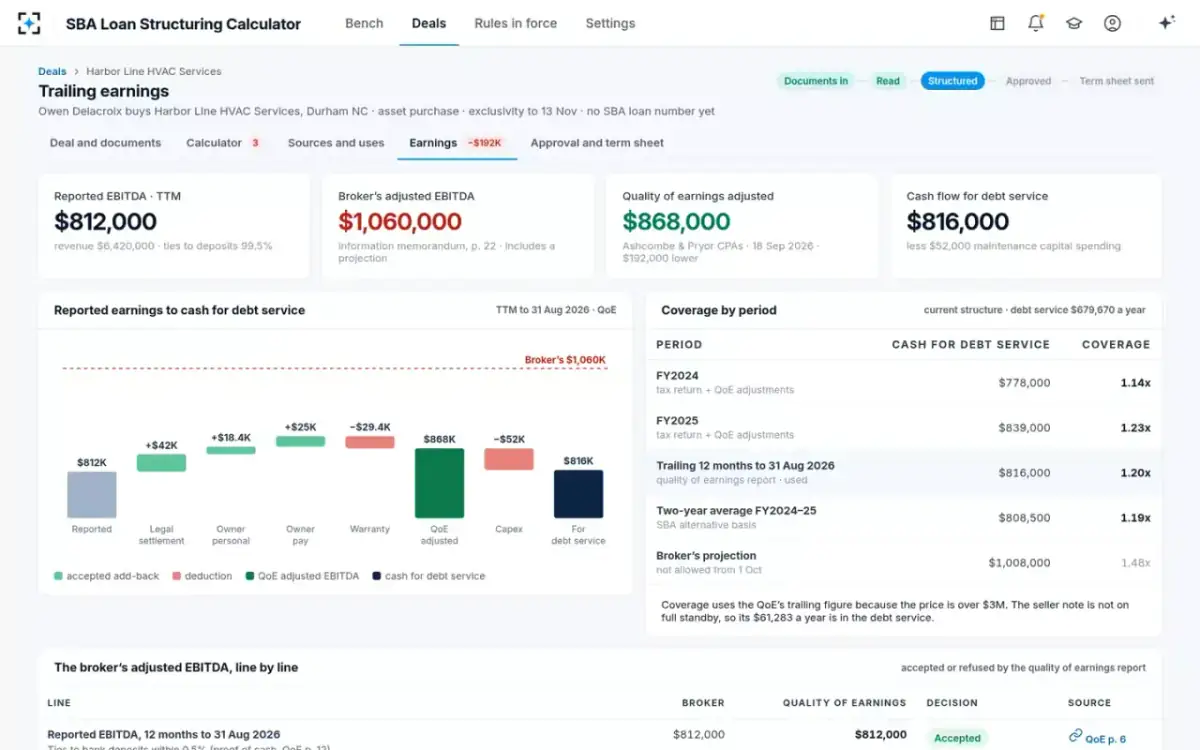
The denominator is where structures go wrong. It includes the new 7(a) loan at its approved amount and term, existing business debt that stays, and any seller debt that is not on full standby. Interest-only acquisition debt that is not on full standby is counted on an amortization of no more than ten years. A seller note on full standby, with no payments of principal or interest for the term of the 7(a) loan, is not debt service at all. Take the fictional Harbor Line HVAC acquisition in the solution: the step-by-step calculation below shows why the broker's structure failed and the approved one passed.
Harbor Line's coverage, worked step by step on the quality of earnings figure
| Step | As the broker sent it | As approved |
|---|---|---|
| 1. QoE adjusted EBITDA, trailing 12 months | $868,000 | $868,000 |
| 2. Less maintenance capital spending | − $52,000 → $816,000 | − $52,000 → $816,000 |
| 3. 7(a) loan payments, 10 years at 9.50% | $3,982,476 → $618,387 a year | $3,930,000 → $610,236 a year |
| 4. Seller note payments | $61,283 a year (24-month standby, then paid) | $0 (full standby) |
| 5. Debt service after the deal | $679,670 | $610,236 |
| 6. Coverage | $816,000 ÷ $679,670 = 1.20x | $816,000 ÷ $610,236 = 1.34x |
| 7. Against the 1.25x floor | Fails by 0.05x | Passes by 0.09x |
The capital spending line is the sample bank's policy, not an SBA rule: it takes maintenance capital spending off EBITDA before coverage, as an unfunded capital expenditure adjustment. The SOP lists unfunded capital expenditures as one of the adjustments a lender may justify. A bank that does not deduct it would show higher coverage on the same deal, and should be able to say why.
Is SBA DSCR historical or projected? Historical for acquisitions; projections elsewhere, with conditions
For an acquisition it is historical. For other 7(a) loans, projections may carry the test. A standard 7(a) loan needs 1.15x "on a historical and/or projected cash flow basis", and a start-up has no history to use. A 7(a) Small loan that is not a change of ownership may use 12-month projections showing 1.10x within one year of funding, a method the SOP says "is not applicable to change of ownership transactions".
The one acquisition exception is narrow. When a buyer acquires an owner-occupied special purpose property, a hotel or self-storage facility for example, that is integral to the business, and the appraised value fully secures the loan, the lender may rely on two years of projections that reach the required coverage within two years. It must still calculate the historical figure and explain the variance. Under SOP 50 10 8, by contrast, changes of ownership were listed among the applications that could rest on projections reaching 1.15x within two years of funding. That is the change brokers' models most often miss.
Harbor Line's coverage on each basis, and the one that is not allowed
SBA Loan Structuring Calculator: coverage by period, with the projection marked as not allowed
What DSCR does a 7(a) Small loan need? 1.10x, but not for a change of ownership
A 7(a) Small loan, up to $350,000, needs 1.10x for any purpose other than a change of ownership, on a historical or projected basis. The lender must also review "the two most recent months of commercial bank activity or statements" on the primary operating account to confirm that all debts are in the calculation. SBA's own answer to lenders is that an acceptable ratio of at least 1.10:1 together with two months of bank activity used "to confirm the debts and obligations" satisfies the repayment ability requirement, including catching sales-based obligations such as merchant cash advances (Information Notice 5000-877673).
The 1.10x test replaced a credit score. Until 28 February 2026, 7(a) Small applications were screened with the FICO Small Business Scoring Service; SBA discontinued it from 1 March 2026 and moved the test to coverage (Procedural Notice 5000-875701). For an acquisition, none of this applies: SOP 50 10 8.1 lets 7(a) Small and SBA Express loans finance a change of ownership, but "no reduced or alternative DSC standard applies solely because the loan is a 7(a) Small or SBA Express loan". A $300,000 acquisition loan needs 1.25x like a $3 million one.
The global test: 1:1 on the owners as well as the business
Business coverage is not the only test. A standard 7(a) loan needs 1:1 "on a global basis", and for a change of ownership, adjustments to owner compensation "must also be substantiated by a global cash flow analysis that demonstrates that the principals have the financial wherewithal to meet their obligations based upon the adjusted compensation proposed and must meet the 1:1 DSC on a global basis". The point is simple: an add-back that lowers the owner's salary to raise the business's coverage has to leave the owner enough to live on.
Global analysis is the place where SBA coverage meets the rest of a commercial credit file, and banks build it differently. What SBA fixes is the floor, 1:1, and the requirement to include affiliates' cash flow and their effect on repayment. A structuring tool that tests only business coverage can approve a deal whose owner cannot pay his personal debts on the salary the structure assumes.
What changed in DSCR in SOP 50 10 8.1? Five things
Five changes matter to anyone structuring an acquisition after 1 October 2026, and each one appears in the checklist below. SBA's own summary of the September technical updates is in Information Notice 5000-882227; the coverage rules themselves are in Appendix 15.
What SOP 50 10 8.1 changed in the coverage test for changes of ownership
- Minimums by category
1.25x for initial acquisitions, owner buyouts and ESOPs; 1.15x for expansions. SOP 50 10 8 used 1.15x throughout.
- History only
Projections may be evaluated but not relied on, except for owner-occupied special purpose property that fully secures the loan.
- QoE earnings bind
At a business purchase price of $3 million or more, the QoE’s earnings are the ones used, and the loan shrinks if they do not support it.
- Interest-only debt amortized
Non-standby, interest-only acquisition debt is tested on an amortization of no more than ten years.
- Both ratios reported
Historical and, when used, adjusted coverage are entered in the SBA Loan System.
For a pipeline that straddles the change, the date matters. SBA's September notice applies SOP 50 10 8.1 to applications received from 1 October 2026 and keeps SOP 50 10 8 for those submitted through 30 September; the August notice had used the date the SBA loan number is issued. A lender with deals near the line should know which date its own process treats as governing, and test each deal on the matching version.
How the SBA Loan Structuring Calculator tests coverage
The solution tests coverage on every structure as two of its fourteen rules: the floor for the deal's category, and the earnings basis. Earnings come from the returns, the trailing statements and the quality of earnings report, each figure linked to its page, with the add-backs the report refused marked and kept out. The floor is SBA's by default; a bank can set a higher one for acquisitions or expansions in its settings. When a structure fails, the structure solver searches for the smallest change that clears the floor, putting a seller note on full standby first and then adding buyer cash within his verified liquidity, as the SBA deal calculator's run shows step by step.
Coverage at 1.34x once the structure fits, on trailing earnings, with the seller note out of debt service
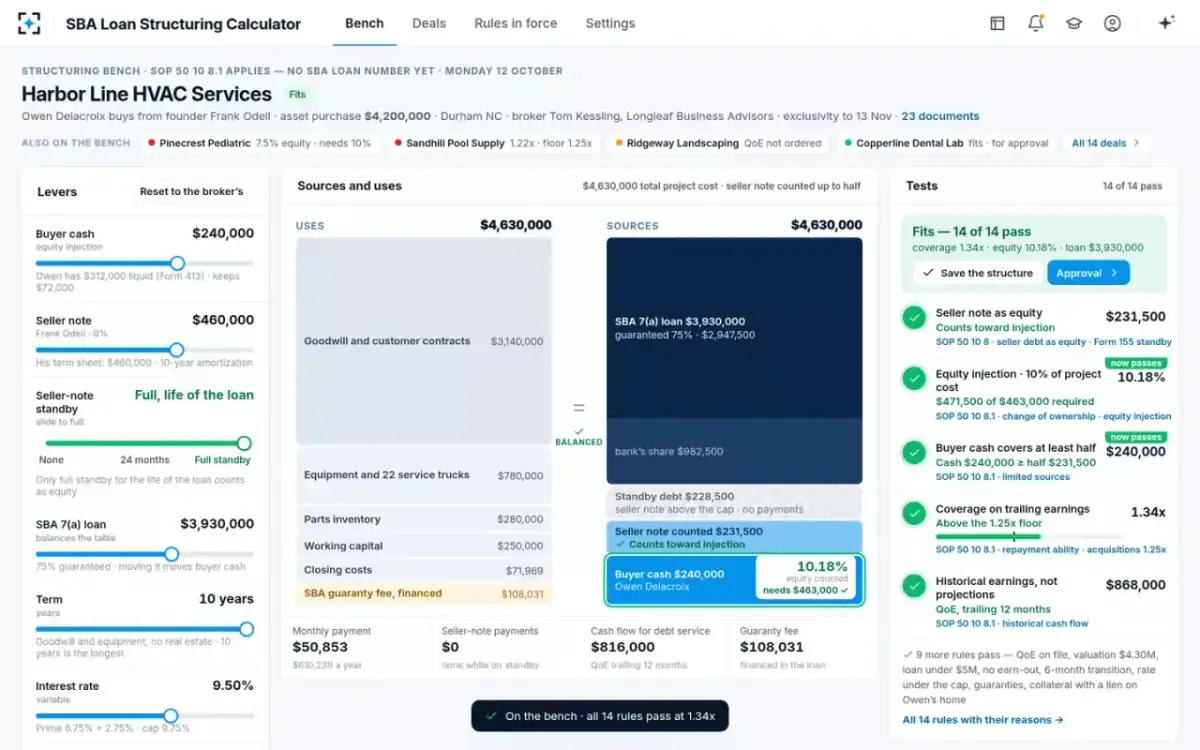
A 1.34x result is not a large cushion. On Harbor Line it means cash flow for debt service could fall by about 6.5%, roughly $53,000, before coverage reached 1.25x. A credit officer looking at a seller who is leaving, and a business whose last two years were 1.14x and 1.23x on the broker's structure, may want more. The solver can be asked for any target; asked for 1.40x, it reported that the limits on the file allow 1.36x at most, and named the two that would have to move. How the seller note gets out of debt service is set out in the SBA seller note full standby rules. To test coverage on your own deals, start from the SBA Loan Structuring Calculator.
Questions people ask
What DSCR does SBA require for a business acquisition in 2026?
1.25x for an initial acquisition under SOP 50 10 8.1, for applications from 1 October 2026, measured on the last fiscal year or a two-year average, historical or adjusted. Applications submitted through 30 September 2026 under SOP 50 10 8 needed 1.15x and could use projections.
What is the SBA 504 debt service coverage ratio?
1.15x, calculated on a historical basis using the last fiscal year-end or an average of the last two. The certified development company must make prudent adjustments with a global cash flow and assume interest-only payments on fully drawn lines of credit.
Does SBA use the borrower's or the business's cash flow for DSCR?
The business's, for the main test: EBITDA of the business divided by its debt service after the loan. The owners' personal cash flow enters through the global test at 1:1, which is required where owner compensation is adjusted.
Can a bank require a higher DSCR than SBA?
Yes. SBA's figures are minimums; a lender's credit policy may set a higher floor, and many do for acquisitions. The SBA Loan Structuring Calculator keeps the bank's floor as a setting above SBA's.
Does a seller note count in SBA debt service coverage?
Only if it is paid while the 7(a) loan is outstanding. A note on full standby, with no principal or interest paid for the term of the 7(a) loan, is not in debt service. A note paid on its own terms is, and an interest-only one that is not on standby is counted on an amortization of no more than ten years.
How is DSCR rounded for SBA?
The SOP does not set a rounding rule; it states minimums such as 1.25:1. Comparing the unrounded ratio with the minimum avoids approving a 1.246x that a two-decimal display shows as 1.25x.