SBA's equity injection requirements, the cash and other contributions a borrower must put into a 7(a) project, are set by SOP 50 10 8.1 for applications from 1 October 2026. An initial acquisition of a business needs at least 10% of total project cost, and that cannot be reduced. A business expansion or an owner buyout needs 10% too, of total project cost for an expansion and of the purchase price for a buyout, but the lender may reduce or waive it if the business has enough liquidity and working capital and no negative net worth. An ESOP buying 51% or more needs none. A start-up needs 10% of total project cost. In every case, seller notes on full standby, other standby debt and small minority investments may together supply no more than half of the required amount; the rest must be the buyer's own unborrowed cash or another unlimited source. Botminds' SBA Loan Structuring Calculator tests both halves of that rule on every structure, which is where many broker-built deals fail first.
Three ways to fill the same $463,000 injection, and the one that fails
All buyer cash · passes
- Buyer cash · $463,000 · 100%
Half cash, half seller note on full standby · passes
- Buyer cash · $231,500 · 50%
- Seller note, full standby · $231,500 · 50%
Cash, a 15% investor and a standby note · passes
- Buyer cash · $231,500 · 50%
- Investor · $100,000 · 21.6%
- Seller note · $131,500 · 28.4%
Less than half in cash · fails
- Buyer cash · $189,000 · 40.8%
- Limited sources · $274,000 · 59.2%
How much equity injection does SBA require? 10%, measured differently by deal type
The number to remember is 10%, and the details sit in what it is 10% of and whether it can move. For changes of ownership, SOP 50 10 8.1 says the requirement is "based on the total project cost (all costs required to become operational, regardless of the source of funds, except for lines of credit and 504 loans)", except that "for Owner Buyout transactions, the equity requirement is based upon the purchase price of the business, as reflected in the purchase and sale agreement". For start-ups, a separate section sets 10% of total project cost.
SBA equity injection requirements by deal type, SOP 50 10 8.1
| Deal type | Minimum | Measured on | Can it be reduced? |
|---|---|---|---|
| Initial acquisition (a new majority or largest owner) | 10% | Total project cost | No: “cannot be reduced or eliminated” |
| Business expansion (an existing business, 2+ fiscal years, buys 100% of one in the same 4-digit NAICS group) | 10% | Total project cost | Yes, with sufficient liquidity and working capital and no negative net worth |
| Owner buyout, existing or partial | 10% | Purchase price in the purchase and sale agreement | Yes, on the same conditions |
| ESOP buying a controlling interest (51% or more) | None | — | Not required |
| Cooperative buying a controlling interest | 10% | Total project cost | Not listed among the reducible types |
| Start-up (revenue for one year or less) | 10% | Total project cost | No |
Initial acquisitions: 10% of total project cost, and it cannot be reduced
An initial acquisition is the default category for any change of ownership: a deal that results in "a new majority or largest individual owner who was not previously a direct or indirect owner, or an individual who has been employed for fewer than 24 months by the business being acquired". For it, the SOP is categorical: "Initial Acquisition: 10%. For Initial Acquisitions, the required equity injection cannot be reduced or eliminated."
The base is total project cost, which is larger than the price. Take the fictional sample deal in the solution: Harbor Line HVAC Services in Durham, North Carolina, bought for $4,200,000. Add $250,000 of working capital, $71,969 of closing costs including the quality of earnings report and the valuation, and a financed guaranty fee, and the project is about $4.63 million. The requirement is $463,000, not $420,000. A structure that budgets 10% of the price is $43,000 short before anyone has looked at the seller note.
Can SBA equity injection be reduced? For expansions and buyouts, if the business can carry it
Yes, for business expansions and owner buyouts only. The lender "may reduce or eliminate this requirement if they have determined that the Borrower has sufficient liquidity and working capital to sustain operations following the transaction", and only if "the Applicant's balance sheet must not have a negative net worth as of the last fiscal year-end". The reduction comes with a string: when the equity is eliminated, "the Lender cannot include dedicated permanent working capital in this or any other 7(a) term loan request within 90 days", beyond a de minimis amount of no more than "$10,000, or one half of one percent of the loan amount, whichever is greater".
The logic is that a waiver says the business is already adequately capitalized, so it cannot then need new working capital from SBA-guaranteed debt. "Any working capital necessary to support the transaction must come from existing cash or a line of credit." A lender that waives the injection on a buyout and books a working capital term loan to the same borrower a month later has contradicted its own credit memorandum.
Does an ESOP need equity injection? Not when it buys 51% or more
No. "Loans to ESOPs for the purpose of purchasing a controlling interest (at least 51 percent) in the employer small business are not subject to the SBA requirement for equity injection." The exemption is for the employee stock ownership plan buying control; an ESOP buying a minority stake falls under the general rules. A cooperative buying a controlling interest is listed with the 10% types and is not among those the lender may reduce. ESOP and cooperative purchases also sit at the 1.25x coverage minimum and are exempt from the quality of earnings requirement.
What is the start-up equity requirement? 10% of total project cost
A start-up, for this purpose, is a business that "has been in operation (i.e., generating revenue from intended operations) for 1 year or less". SOP 50 10 8.1 says "SBA considers an equity injection (Applicant contribution) of at least 10 percent of the total project costs … to be necessary for a Start-Up Business to operate on a sound financial basis", and that "all 7(a) loans made to a Start-Up Business require a 10% equity injection based on the project cost". When an acquisition has no clear continuity of operations, the lender may evaluate it as a start-up and apply the start-up rules instead.
What counts as equity injection for SBA? Unlimited and limited sources
SOP 50 10 8.1 sorts sources into two groups. Unlimited sources can supply the whole injection; limited sources, alone or together, can supply no more than half of it. Anything not on either list is not equity for SBA's purposes, however it is described in the purchase agreement.
What can fill an SBA equity injection under SOP 50 10 8.1
- Cash that is not borrowed (unlimited)
On the business’s balance sheet or from other sources, gifts included. It must be verified before the first disbursement.
- Cash from a personal loan to a guarantor (unlimited)
Only if repayment comes from outside the business; the owner’s salary from the business does not qualify.
- Grants (unlimited)
Only with no repayment, clawback or other provision that could require repayment during the 7(a) loan.
- Verified prepaid expenses (unlimited)
Supported by paid invoices, cancelled checks or bank statements; education, advisory and agent fees do not count. Spending on the valuation and QoE reports can count.
- Seller debt on full standby (limited)
Subordinated, with no principal or interest paid for the term of the 7(a) loan, on Form 155.
- Other standby debt (limited)
Same standby terms; the provider may not take equity in the business.
- Non-controlling minority investment (limited)
Under 20% and no control; no agreement to repay before the guaranty is released, and no distributions beyond the investor’s taxes until the loan is repaid.
Limited sources have one more use: when the price is above what the valuation and the quality of earnings report support, "additional Limited Equity Sources may be used", but "any additional funds provided must be on full standby". They fill the gap; they do not reduce the 10%. How a seller note became the most restricted of these sources, over three SOPs, is set out in the SBA seller note full standby rules.
Can a gift be equity injection? Yes, as cash, if it is proven
Yes. The SOP lists "cash that is not borrowed, whether on the business's balance sheet or from other sources (e.g. gift)" as an unlimited source. What it does not accept is a letter on its own. Before any disbursement the lender must verify the injection with the transfer, a statement covering at least 30 days of the account the money came from, and evidence that it reached the borrower or the closing; "a promissory note, 'gift letter,' or financial statement is not sufficient evidence of cash injection without corroborating evidence". A gift that is really a loan to be repaid from the business is borrowed money, and borrowed money is not an unlimited source.
The verification is not a formality. Under SBA's servicing and liquidation SOP, a lender's failure to document a material part of a required injection on a loan that defaults early "raises a rebuttable presumption that the Early Default was caused by the absence of the required equity injection and justifies a full Denial of Liability on the SBA guaranty" (SOP 50 57 4).
Why injections are where SBA fraud cases start
Equity injection is the rule fraud schemes most often attack, because it is the buyer's own money that SBA relies on. Federal prosecutors' accounts of recent 7(a) cases describe it directly.
Two prosecutions built on false equity injections
$35M+
in SBA 7(a) loans sought by a hotel-buying ring that misrepresented “the nature and amount of the equity injected”
$6.0M
restitution ordered against one of the ring in July 2025, alongside 36 months in prison
4 yrs
sentence for a Maryland broker who submitted false bank statements to substantiate borrowers’ injections
$2.27M
ordered forfeited in that case in November 2015
In the 2025 Maryland case, prosecutors said the defendants "made and caused others to make material misrepresentations and omissions to financial institutions regarding the sellers' identity, familial relationships between parties, and the nature and amount of the equity injected by the borrowers" (U.S. Attorney, District of Maryland). In the 2015 case, a loan broker compiled "the documentation necessary to substantiate the borrowers' equity injection" and submitted "false copies of the borrowers' monthly bank statements to reflect more money than was actually in the borrowers' bank accounts" (FDIC Office of Inspector General). A structuring tool cannot detect forged statements on its own; it can make sure the structure relies on the buyer's verified figure and flags when the cash needed exceeds what the documents show.
How the SBA Loan Structuring Calculator tests the injection
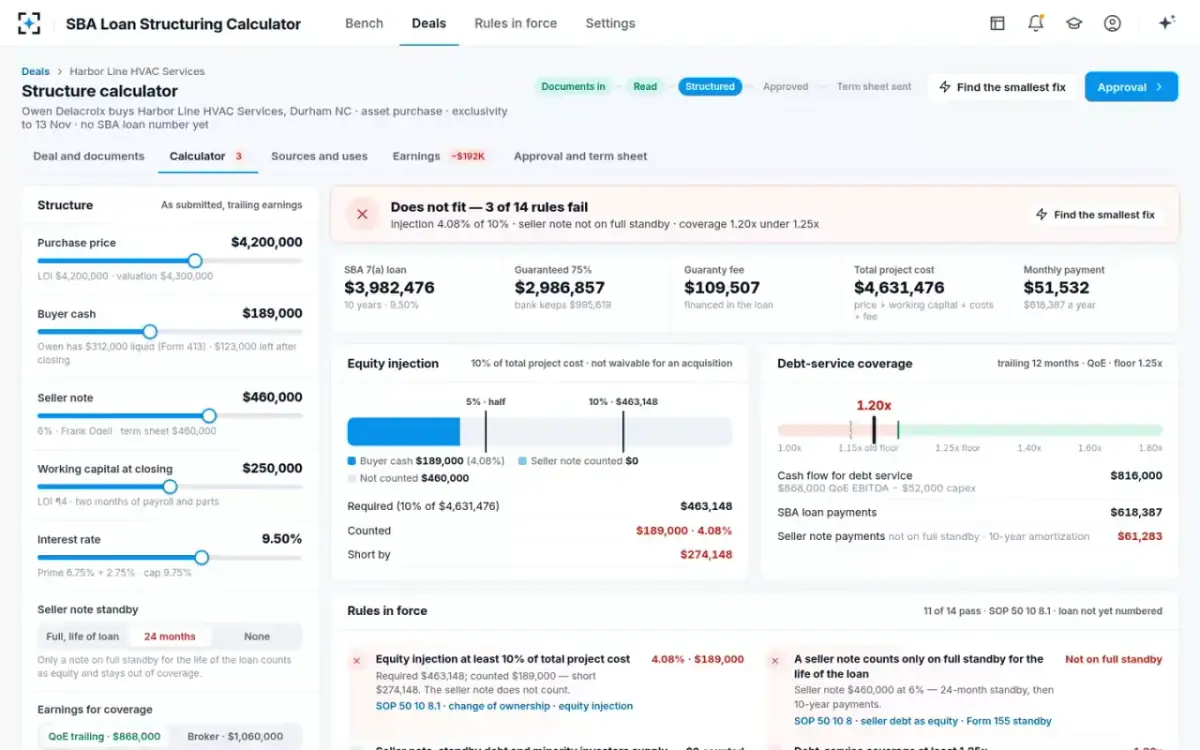
The solution tests the injection as three of its fourteen rules: the minimum for the deal's type and base, the half cap on limited sources, and the corollary that unlimited sources cover at least the other half. It reads the buyer's liquidity from his personal financial statement on SBA Form 413 and never proposes cash beyond it. On Harbor Line, the broker's structure counted only Owen Delacroix's $189,000: 4.08% of total project cost. With the seller note moved to full standby, $231,574 of it counted, but the buyer's cash was now below half the requirement. The structure solver proposed $240,000 of cash, inside the $312,000 Owen's statement showed; equity counted reached $471,500, or 10.18%.
SBA Loan Structuring Calculator: the equity injection gauge with its half-way line
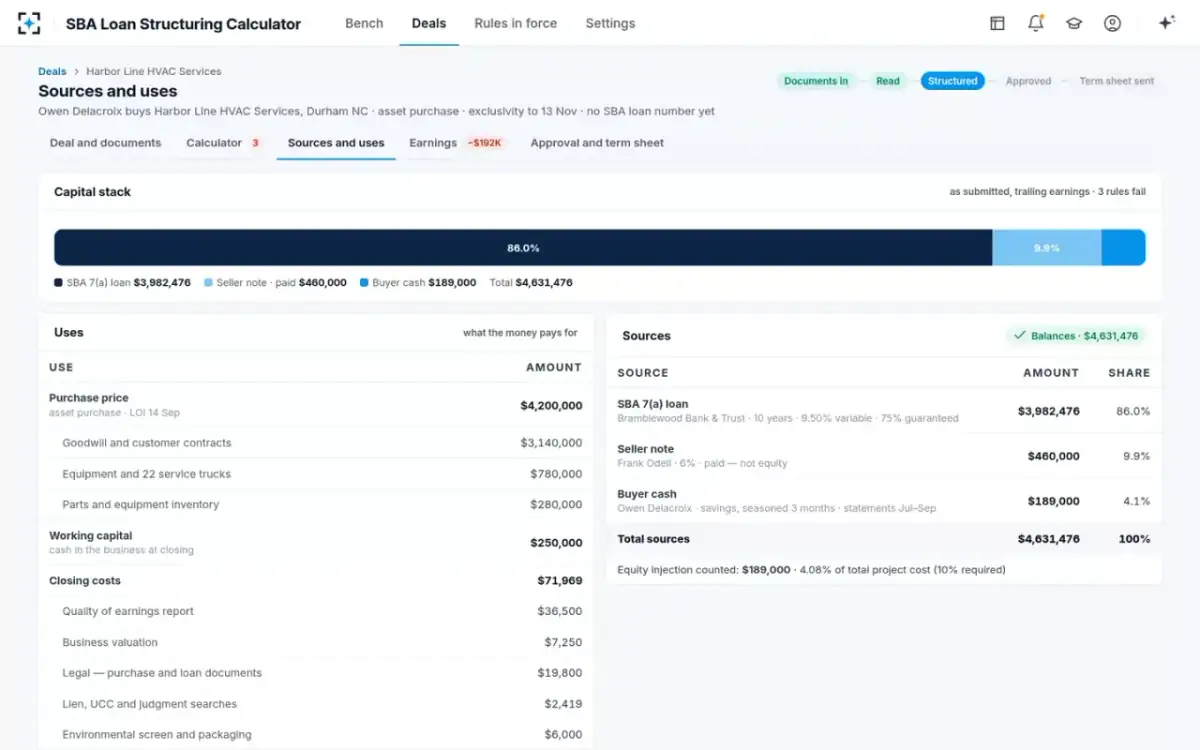
Sources and uses are drawn to scale beside the tests, so the base of the injection is visible: every use, down to the lien searches, is part of total project cost. When a structure moves, the requirement moves with it, because the financed guaranty fee and the loan depend on each other. What the fee itself costs on each structure is worked through in the SBA guaranty fee calculator for 2027.
Every use in the base of the injection, every source with its share
What the solution leaves to people is the judgement SBA gives the lender: whether a buyout's liquidity justifies reducing the injection, and whether a prepaid expense or a non-cash asset really is equity. Those are settings and approvals, not calculations. To test injections on your own deals, start from the SBA Loan Structuring Calculator.
Questions people ask
Is SBA equity injection based on purchase price or project cost?
On total project cost for initial acquisitions, business expansions and start-ups: every cost needed to close and operate, whatever the source of funds, except lines of credit and 504 loans. On the purchase price, as written in the purchase agreement, for owner buyouts.
Can a HELOC be used for SBA equity injection?
A home equity loan is borrowed money, so it is not "cash that is not borrowed". It can count as an unlimited source only as a personal loan to a guarantor whose repayment comes from outside the business; the owner's salary from the business does not qualify. The lender must also address the repayment terms in its analysis.
What was the equity injection rule under SOP 50 10 8?
For a complete change of ownership, at least 10% of total project cost, with a seller note counting only on full standby for the life of the loan and for no more than half. Buyouts between owners and partial changes turned instead on a 9:1 debt-to-worth test, with a cash contribution, the lesser of the amount needed to reach 9:1 or 10% of the price, when the test was not met.
Does SBA Express require an equity injection?
For most purposes SBA leaves it to the lender's business judgment, applied as on its similar non-SBA loans. For a change of ownership financed with SBA Express, the Appendix 15 rules apply in full, including the 10% injection for an initial acquisition.
Can a business's own cash count toward the injection?
Yes: unborrowed cash "on the business's balance sheet" is an unlimited source. It must be verified before the first disbursement like any other cash, and the lender should be satisfied that the business can spare it: working capital the business needs after the deal is a use, not a source.