An SBA partial change of ownership is an owner buyout in which a 7(a) loan funds the purchase of all or part of one or more owners' interests, or the business buys back its own shares, while at least one of the original owners stays as an owner and personally guarantees the loan. Under SOP 50 10 8.1, in force for applications from 1 October 2026, it differs from buying a whole business in five ways that matter to the structure: every new owner, even at 1%, must be a co-borrower; a selling owner who keeps less than 20% must give a full guaranty for at least two years; the 10% equity injection is measured on the purchase price and may be reduced if the business has enough liquidity; coverage is 1.25x on history with no quality of earnings report required; and the seller may stay as an owner, officer or employee. A buyer who has not worked in the business for 24 months may take less than half and may not become the largest owner, or the deal is underwritten as an initial acquisition. Botminds' SBA Loan Structuring Calculator keeps each deal's category and applies that category's rules, because the category decides every other rule.
One partial change of ownership, owner by owner
Ana, founder
Before50%
After50%
In the loanFull personal guaranty
WhyOwns 20% or more; at least one original owner must stay and guarantee
Ben, founder, selling
Before40%
After10%
In the loanFull guaranty of the whole loan for at least two years
WhyA selling owner left with under 20%; released only after 12 consecutive current months
Carla, operations manager for six years
Before0%
After20%
In the loanCo-Borrower
WhyA new owner; also 20% or more
Dev, outside investor, never employed
Before0%
After10%
In the loanCo-Borrower
WhyAny new owner, even at 1%; under 50% and not the largest, so the buyout rules still apply
Eli, early employee
Before10%
After10%
In the loanNo SBA guaranty requirement
WhyUnder 20% and not selling; the lender may still ask for one
What is an SBA partial change of ownership? A buyout where an original owner stays
SOP 50 10 8.1 defines it in a sentence: "Loan proceeds may be used to fund the purchase of all or a portion of one or more owner's interest in the business or of the business itself (e.g., the purchase of treasury stock or membership units) and where at least one of the original owners remains as an owner after the sale and personally guarantees the loan." It is one of two kinds of owner buyout, a category defined as "a change of ownership transaction that modifies the ownership structure of the Applicant business and does not involve the acquisition of another entity or asset".
The category matters because SBA sorts every change of ownership into one of four: initial acquisition, business expansion, owner buyout, and ESOP or cooperative. "Initial Acquisition is the default category", and for a deal to be treated as an owner buyout "the Lender must document how the Applicant satisfies the requirement in their credit memorandum" and enter the type in the SBA Loan System. A partial change documented as an initial acquisition is underwritten more strictly than it needs to be; an initial acquisition documented as a buyout is under-underwritten, and the purchase review will notice.
What is an SBA owner buyout? Existing owner buyouts and partial changes
An owner buyout is either an existing owner buyout or a partial change. In an existing owner buyout, the business ends up 100% owned by people already inside it: current owners or employees "actively participating in the business operations for at least the last 24 consecutive months" buy out another owner, the business redeems an owner's stake, or a single owner sells 100% to an employee of at least 24 months. In a partial change, ownership is reshuffled, outsiders may come in, and an original owner stays and guarantees.
The rules that set a buyout apart from buying a business are compact, and the table below sets them side by side. For partners, brokers and deal attorneys the useful habit is to ask the category question first: is anyone gaining control who was not an owner, or not employed for 24 months?
How a partial change of ownership differs from an initial acquisition under SOP 50 10 8.1
| Rule | Initial acquisition | Owner buyout, partial change |
|---|---|---|
| Equity injection | 10% of total project cost; cannot be reduced | 10% of the purchase price; may be reduced or eliminated with enough liquidity and no negative net worth |
| Minimum coverage | 1.25x, history only | 1.25x, history only |
| Quality of earnings report | Required at a $3 million business purchase price | Not required |
| Business valuation | Independent above $350,000 | Independent above $350,000 |
| Who borrows | The business, and an individual buyer as co-borrower | The operating company and every new owner, at any percentage |
| The seller afterwards | Consultant only, 24 months at most | May stay as owner, officer, director, key employee or employee |
| Seller’s guaranty | None as seller | Full guaranty for two years or more if left with under 20% |
Can a new minority owner be a co-borrower? Must be, even at 1%
Yes, and it is not optional. "Both the Operating Company and any new direct and/or indirect owner (including individuals and entities) who are acquiring any direct and/or indirect ownership interest in the Operating Company must be Co-Borrowers on the new loan, regardless of the percentage of ownership being acquired." The SOP gives the example itself: "a Person who will be a new owner and who is gaining 1% direct and/or indirect ownership in the Operating Company must be a Co-Borrower." Indirect new owners, through a holding company for instance, must also personally guarantee.
The rule applies only to new owners, "who did not have equity in the business until the partial change of ownership". Existing owners who stay fall under the ordinary guaranty rule: anyone with 20% or more must give an unlimited full guaranty, and a person who signs the note as a borrower need not also sign a guaranty. In the example above, Carla and Dev sign as co-borrowers; Ana guarantees; Eli, at 10% and not selling, has no SBA guaranty requirement, though the lender may ask for one for credit reasons. Co-borrowers also matter for collateral: when the loan is not fully secured, the collateral shortfall rules apply "for all Borrowers and Co-Borrowers".
Does the selling partner have to guarantee? Under 20% left: two years, in full
A selling owner who stays with less than 20% must guarantee the whole loan. SOP 50 10 8.1: "Any selling owner (one who receives loan proceeds in exchange for selling part of their ownership) who remains as a direct or indirect owner and owns less than 20% of the business post-sale must provide a full guaranty for the full loan amount pursuant to 13 CFR 120.160(a)." The term "must be for at least two years after final loan disbursement", and the guarantor "may be released only if the loan has been current for the consecutive 12 months period prior to release".
The guaranty is unsecured by design: "SBA does not require these guarantors that are providing a 2-year guaranty to pledge their personal assets (i.e. Personal residences) in the event of a collateral shortfall." For a seller like Ben, who takes $900,000 in proceeds and keeps 10%, it means two years of contingent liability for a loan used to pay him. Sellers who keep 20% or more guarantee under the ordinary rule instead, without the two-year limit. Guaranties for partial changes are otherwise set on post-sale ownership percentages, under 13 CFR 120.160 and the SOP's guaranty chapter.
Does a partner buyout need equity injection? 10% of the price, unless the business can carry it
Yes, 10%, but measured on the purchase price and reducible. For owner buyouts, "the equity requirement is based upon the purchase price of the business, as reflected in the purchase and sale agreement", and the lender "may reduce or eliminate this requirement if they have determined that the Borrower has sufficient liquidity and working capital to sustain operations following the transaction", provided the balance sheet does not show a negative net worth at the last fiscal year-end. If the requirement is eliminated, no dedicated permanent working capital may go into this or any other 7(a) term loan within 90 days.
In the example, Ben's 30 points sell for $900,000, so the injection is $90,000 unless the lender finds the business liquid enough to reduce it. Carla and Dev can fund it with cash, or partly with limited sources such as a note from Ben on full standby, subject to the half cap. In the solution's sample pipeline, a partner buyout at the fictional Copperline Dental Lab in Greensboro shows the reduction in use: a $1,600,000 price, a $1,488,000 7(a) loan, the injection reduced to 5% and coverage of 1.38x. The SBA equity injection requirements by deal type set out every case side by side.
What DSCR applies to a partner buyout? 1.25x, on history, with no QoE
1.25x. SOP 50 10 8.1 lists "Owner Buyout: 1.25:1" among the change of ownership minimums, satisfied "using either the last fiscal year-end or an average of the last two fiscal year-end statements on either a historical or adjusted basis", and projections may not be relied on. Because the business is not changing hands, the quality of earnings report is not required: buyouts "are not subject to the QoE requirement because the existing owner(s) retain operational knowledge of the business and the transaction does not result in a change to the management or operating structure".
The coverage test still includes everything the buyout adds. Debt service is all business debt after the transaction, including any note to the selling partner that is not on full standby, and interest-only acquisition debt is tested on an amortization of no more than ten years. Adjustments to owner pay, common when a selling partner's salary disappears, need the global cash flow analysis at 1:1. The derivation is set out in the SBA minimum debt service coverage ratio.
SBA Loan Structuring Calculator: every change of ownership rule with its figure and paragraph
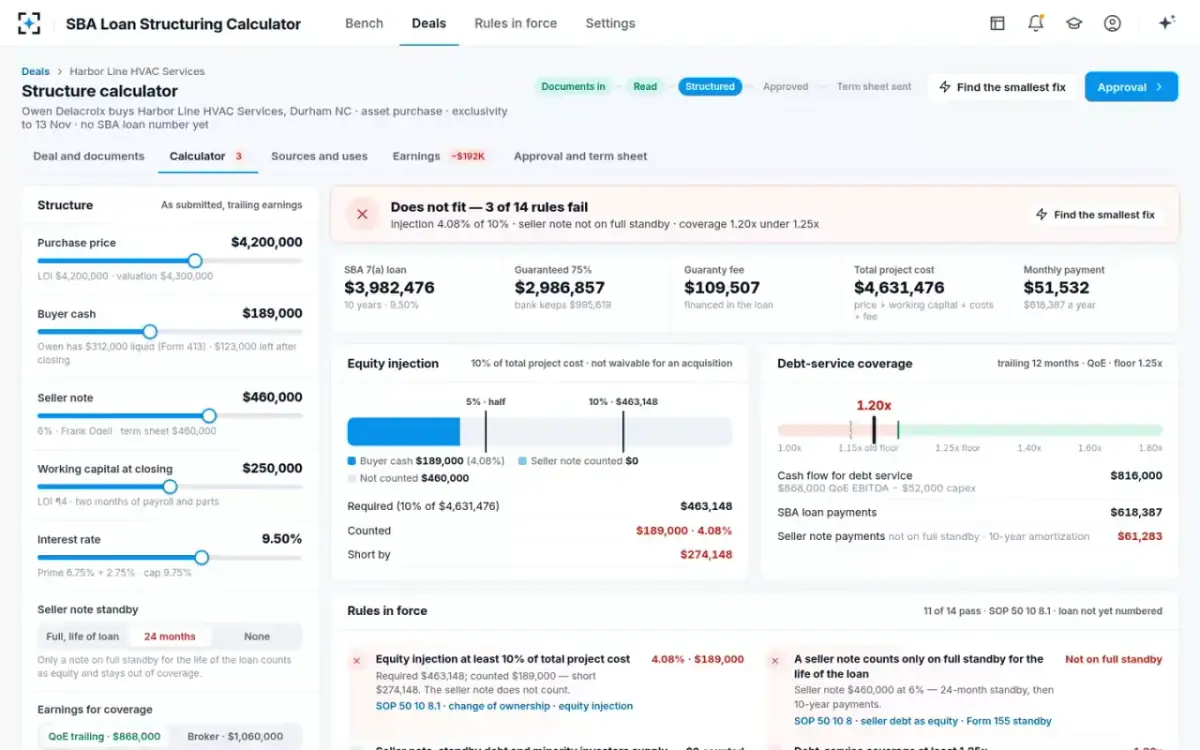
The 24-month line: when a buyout is underwritten as an acquisition
A buyout that puts an outsider in charge is treated as an acquisition. SOP 50 10 8.1: "For all Owner Buyout transactions, individuals not currently employed by the business for a minimum of 24 months may only acquire less than 50% of the total equity and may not become the largest direct or indirect shareholder." Indirect interests through holding companies, trusts or partnerships are added to direct ones. A transaction that breaks the limit "must be processed following the requirements … for Initial Acquisition (specifically the minimum DSC, minimum equity injection and Quality of Earnings requirements)", though "sellers retain their ability to remain as an owner and employee of the business as allowed under an Owner Buyout".
In the example, Dev has never worked in the business and takes 10%, so the buyout rules hold. Had he bought all 30 points and also held a stake through an investment company, the aggregate might have made him the largest owner, and the deal would have needed 10% of total project cost with no reduction and, at a $3 million business purchase price, a quality of earnings report. That is why the category has to be settled from the full ownership table, direct and indirect, before any other test is run.
What is not eligible: multi-step changes and EPC buyouts
Two structures are ruled out. "Multi-step partial changes of ownership are not eligible", which the SOP defines as a change "structured such that some or all of the existing owners are bringing on a new owner(s) via the formation of a new entity that will become the 100% owner of the Operating Company". And for a business structured as an eligible passive company leasing to an operating company, 7(a) loans "may not fund a partial change of ownership in an EPC", though they may fund one in the operating company.
For ESOPs there is a statutory twist: if the seller of the business remains as a partial owner, the seller "must provide a full, unlimited guarantee regardless of ownership", a requirement that "cannot be waived". The two-year limit for small remaining sellers does not reach it.
How SOP 50 10 8 treated the same deal
The October 2026 rules replaced a different test. Under SOP 50 10 8, effective 1 June 2025, a partial change needed the business's balance sheet to show debt-to-worth no worse than 9:1 before the change, and if it did not, the new or existing owners had to put in cash, the lesser of the amount needed to reach 9:1 or 10% of the purchase price. A complete partner buyout financed more than 90% by the 7(a) loan also needed the remaining owners' certification of 24 months' active participation.
A partial change of ownership under SOP 50 10 8 and under SOP 50 10 8.1
SOP 50 10 8 (applications through 30 Sep 2026): Debt-to-worth of 9:1 or better before the change; otherwise cash, the lesser of the amount to reach 9:1 or 10% of the price
SOP 50 10 8.1 (applications from 1 Oct 2026): 10% of the purchase price, which the lender may reduce or eliminate on a liquidity finding, with no negative net worth
SOP 50 10 8 (applications through 30 Sep 2026): 1.15x, historical and/or projected
SOP 50 10 8.1 (applications from 1 Oct 2026): 1.25x, historical or adjusted; projections not relied on
SOP 50 10 8 (applications through 30 Sep 2026): Not part of the SOP
SOP 50 10 8.1 (applications from 1 Oct 2026): Not required for buyouts
What a partial change file needs, and how the calculator handles it
Most of what goes wrong in a partial change is a missing signature or a misread percentage, not a ratio. The checklist below is the file a lender should be able to show, drawn from the rules above.
The partial change of ownership file, under SOP 50 10 8.1
- Ownership before and after, direct and indirect, to 100%
Every owner entered in the SBA Loan System; indirect stakes aggregated for the 24-month and largest-owner tests.
- The category documented
Why the deal is an owner buyout and not an initial acquisition, in the credit memorandum, and the type entered in the SBA Loan System.
- Every new owner on the note
Co-Borrowers at any percentage; indirect new owners also guarantee.
- The remaining original owner’s guaranty
At least one original owner stays and guarantees personally.
- The small seller’s two-year guaranty
Form 148L or the lender’s equivalent, for the full loan, two years from final disbursement.
- The equity decision
10% of the purchase price, or the liquidity analysis and net worth that justify reducing it.
- Coverage at 1.25x on history
All post-transaction debt, with any non-standby note to the seller included.
- An independent valuation above $350,000
Ordered by the lender; the price must be supported by it.
The SBA Loan Structuring Calculator treats a buyout as its own category with its own rules: the injection base, the reduction a bank can approve, the absence of a QoE, the seller who may stay. Its settings carry the coverage floor for acquisitions and buyouts, 1.25x by default, which a bank may raise. The structure solver works the same way as on an acquisition, proposing the smallest change that passes, and the approval and term sheet steps are the same: nothing leaves before the SBA credit officer approves.
A structure that fits, ready for the credit officer
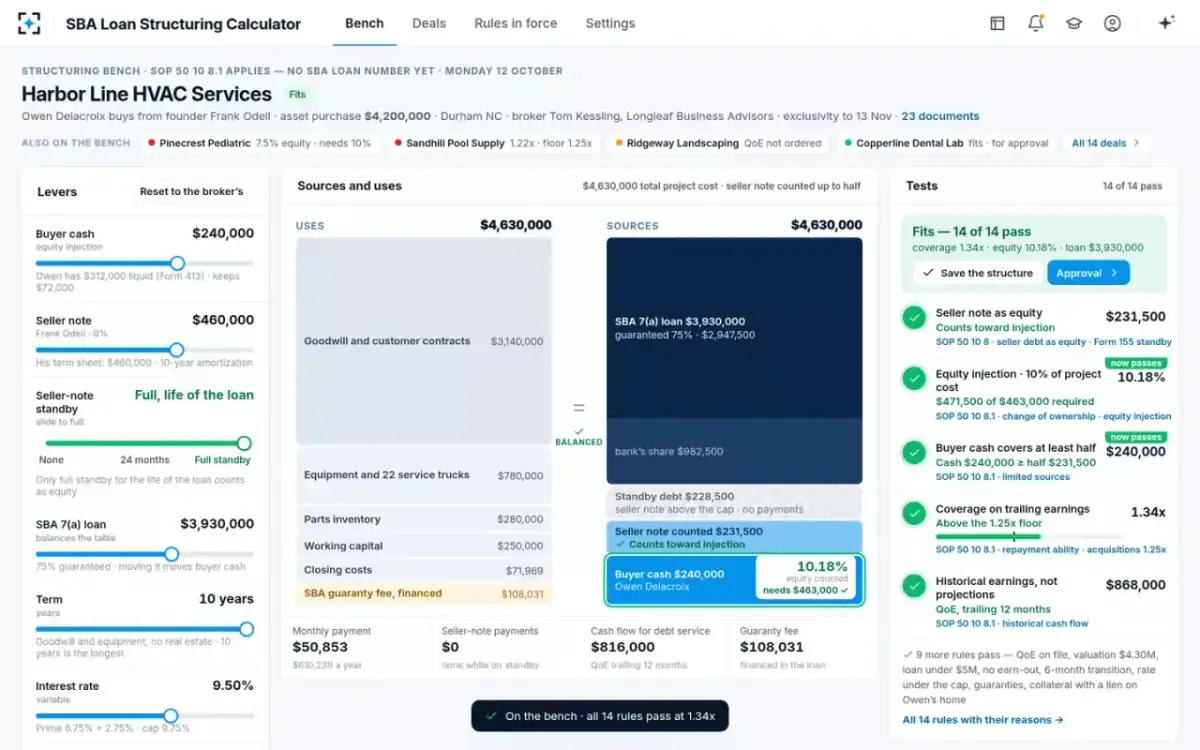
What the calculator cannot do is decide the category for the bank where the facts are unclear, such as whether an employee's 24 months were continuous or whether a trust's donors make someone the largest indirect owner. Those go to a person, with the ownership table in front of them. For the full set of hand-offs in an outright acquisition, see buying a business with an SBA loan. To try it on your own buyouts, start from the SBA Loan Structuring Calculator.
Questions people ask
Can an employee buy out the owner with an SBA loan?
Yes. An employee of at least 24 months may buy a single owner's 100% interest as an existing owner buyout, with the business and the employee as co-borrowers. An employee of less than 24 months who buys control is treated as an initial acquisition, with a non-reducible 10% injection on total project cost and, at $3 million, a quality of earnings report.
Can the selling partner stay on after a partial buyout?
Yes. In a partial change of ownership, the seller may stay as an owner, officer, director, stockholder, key employee or employee. The 24-month consultant limit applies only to initial acquisitions and business expansions.
Can a partner buyout use a seller note?
Yes, on the same terms as an acquisition. A note to the selling partner counts toward the injection only on full standby and only up to half of the requirement; a paid note counts in debt service, and all debt not on full standby must fit within the business valuation.
Can an SBA 7(a) Small or Express loan fund a partial change of ownership?
Yes. SOP 50 10 8.1 lets 7(a) Small and SBA Express loans finance changes of ownership under Appendix 15, with the same coverage minimum for the category; the main difference is that the lender may do an internal valuation when the business purchase price is $350,000 or less.
Can a 7(a) loan refinance debt as part of a buyout between owners?
Yes, if the refinancing meets SBA's debt refinancing rules in Appendix 14 of SOP 50 10 8.1, which the SOP applies when existing business debt is refinanced in a change of ownership between existing owners.