SBA acquisition loan requirements turn the purchase of a business with a 7(a) loan into a relay: a buyer, a seller, usually a broker, a lender's business development officer and underwriter, an accredited business appraiser, often a quality of earnings firm and sometimes SBA itself each finish a piece of work the next one needs. Under SOP 50 10 8.1, in force from 1 October 2026, the order is largely fixed by rule: the lender, not the seller, commissions the business valuation; a quality of earnings report is required for acquisitions with a business purchase price of $3 million or more; and the loan must clear 1.25x debt service coverage on the business's historical earnings. Most of the waiting in an SBA acquisition comes from one avoidable source: a structure, usually drawn up in a spreadsheet from the broker's numbers, that turns out not to fit those rules after the reports arrive. Botminds' SBA Loan Structuring Calculator reads the deal's documents and tests the structure against the rules on the first day, so the people downstream wait on work that will hold.
The rules on this page are SBA's, quoted from SOP 50 10 8.1 and its notices. The deal used to show the hand-offs is fictional sample data: Harbor Line HVAC Services in Durham, North Carolina, bought from its founder for $4,200,000, as it runs through the solution.
Most SBA acquisitions are decided by the lender alone, and most lenders do few
78,078
7(a) loans SBA approved in fiscal 2025, for $37.29 billion
64.1%
made under a lender’s delegated PLP authority, with no SBA credit review before the loan number
4.2%
sent to SBA for a non-delegated decision
711of 1,336
lenders made five or fewer 7(a) loans in the year
How does an SBA acquisition loan move? Eight parties and the order they move
An SBA acquisition moves in a fixed order because each party's work is an input to the next. The buyer and seller agree a price in a letter of intent. The broker assembles the seller's package: three years of returns, the trailing twelve months, an information memorandum with adjusted earnings. The lender's business development officer, the BDO, sketches a structure: the 7(a) loan, the buyer's cash, any seller note. Then the reports are ordered, the underwriter builds the credit memorandum, and under non-delegated processing SBA's loan guaranty processing center decides.
The order is not a matter of habit. SOP 50 10 8.1 makes financial due diligence "part of the primary underwriting and eligibility determination" on every change of ownership, and sets its scope by the business purchase price, which "excludes all owner-occupied commercial real estate assets". A $4.2 million business purchase triggers both an independent valuation and a quality of earnings report; a $340,000 one can be valued by the lender itself. The structure has to wait for both reports, and the credit memorandum has to wait for the structure.
The eight seats in an SBA acquisition, and how each one's week changes
Today
Signs the LOI on the broker’s structure and learns weeks later that more cash, a different seller note or a lower price is needed.
With agents
Hears in the first days of exclusivity what the structure must be, and why, from a note written for him.
Still theirs: The decision to buy, and the cash.
Today
Expects to be paid on the note from month 25, as his broker described it.
With agents
Learns at the term sheet that his note counts as equity only on full standby, and decides on that basis.
Still theirs: Whether to accept standby, and the price.
Today
Sends a package with adjusted earnings and a structure, then waits on the bank.
With agents
Gets the term sheet and a plain explanation of every change inside the buyer’s exclusivity.
Still theirs: The relationship between buyer and seller.
Today
Builds the structure in a spreadsheet from the broker’s figures.
With agents
Starts from a structure tested against all the SBA rules, with the smallest fix proposed.
Still theirs: Every change to the deal, and the conversation with the buyer.
Today
Values the business for the lender; the price may already be agreed.
With agents
Same engagement, ordered on a structure that already fits.
Still theirs: The conclusion of value.
Today
Rebuilds earnings and the cash proof; its figure may undo the structure.
With agents
Its figure flows straight into coverage, with every add-back it refused marked.
Still theirs: Which add-backs are supported.
Today
“Show me the rule each number passes, and the page it comes from.”
With agents
Approves a structure with every rule result and its SOP reference in front of them.
Still theirs: The credit decision and every exception.
Today
Decides eligibility, structure and equity on the lender’s submission.
With agents
Receives a package whose structure was tested against the same SOP.
Still theirs: The guaranty decision on non-delegated loans.
Who orders the business valuation for an SBA loan? The lender, never the seller
The lender orders it. SOP 50 10 8.1 says the valuation "must be requested by and prepared for the Lender" and that the lender "may not use a business valuation prepared for the Applicant or the seller". The appraiser must be a "Qualified Source": someone regularly paid for business valuations, accredited as an ASA, CBA, ABV, CVA or BCA, independent of loan production and with no appearance of a conflict.
That rule creates the first hard wait. A broker's opinion of value, or a valuation the seller commissioned to support the asking price, cannot be reused, so the clock for the valuation starts when the lender engages its own appraiser. The one exception is small: when the business purchase price is $350,000 or less, the lender may value the business itself, unless buyer and seller have a close relationship. In fiscal 2025, 68.8% of 7(a) loans were $350,000 or less by loan amount, but an acquisition loan of that size usually funds a purchase price above it, so most acquisitions still need the outside appraiser.
The valuation also caps the deal. Total debt supporting the purchase, "including seller debt that is not on full standby", is "limited to the business valuation amount", and if the price exceeds the valuation "the difference must be made up by equity". The lender must also check the financial data the appraiser relied on against the seller's IRS transcripts. A price agreed in the LOI is therefore provisional until the appraiser has finished, which is why how much equity the buyer needs cannot be settled before the valuation is in.
When is a quality of earnings report needed? At $3 million, and it resets the structure
A quality of earnings report is required for initial acquisitions and business expansions whose business purchase price is $3 million or more, measured "before the application of buyer equity, seller debt, or other financing sources". Owner buyouts and ESOP or cooperative purchases are exempt, because the existing owners stay. The report must reconcile the accountant-prepared statements, the returns, internal statements and IRS transcript data, document every add-back, and include a cash proof on the trailing twelve months and the last two fiscal years.
The report is the hand-off most likely to send everyone back a step, because SBA makes its figure binding: the lender "must use the earnings from the QoE in the Debt Service Coverage (DSC) determination", and if coverage then fails, "the loan amount must be reduced accordingly". On the Harbor Line sample, the broker's memorandum claimed adjusted EBITDA of $1,060,000; the quality of earnings report supported $868,000. Every structure drawn on the broker's figure was a structure that would have to be redrawn. What an SBA quality of earnings report must contain, and who may prepare it, is worked through separately.
SBA Loan Structuring Calculator: the deal, its documents and what each one supplied
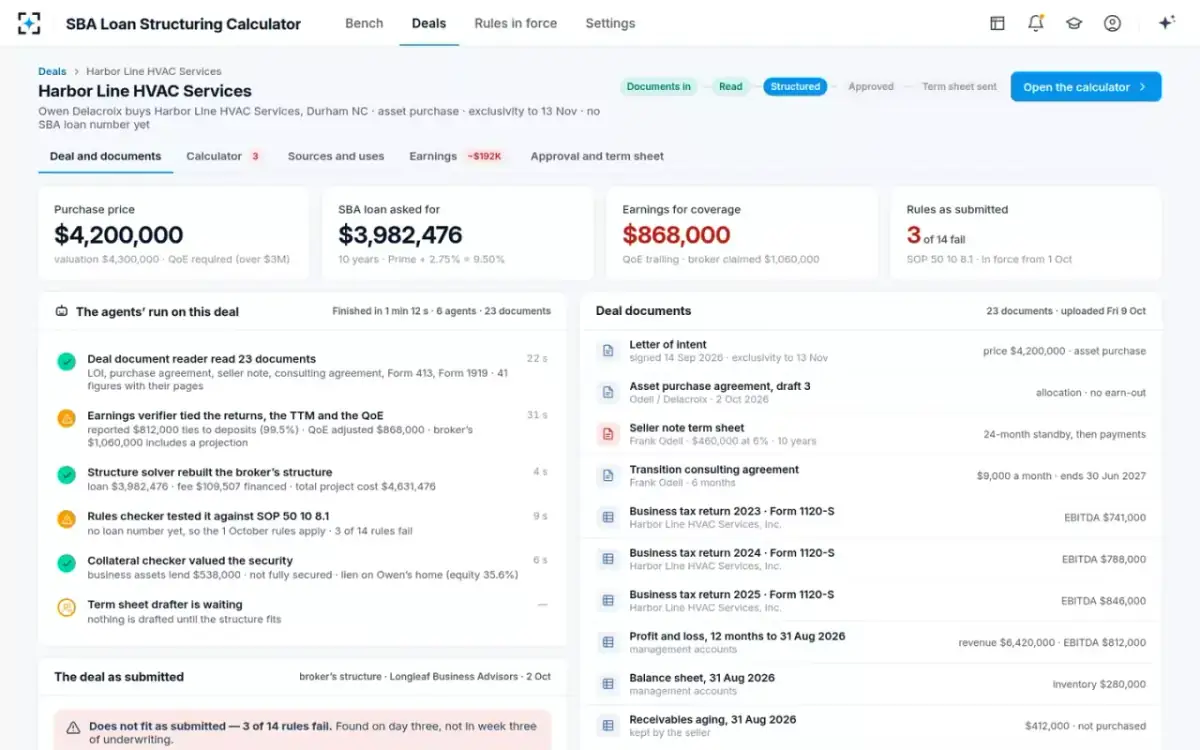
What does SBA approve on a non-delegated loan, and what it leaves to a PLP lender?
On a non-delegated loan SBA decides the credit; on a PLP loan it does not look until something goes wrong. Under non-delegated processing, the SOP says, "SBA will make the final determination as to the eligibility and creditworthiness of the Applicant, including approving the uses of proceeds, the adequacy of the collateral being pledged, the structure of the loan, and any equity contribution". Under PLP, "the Agency does not review the Lender's analysis of the credit or structure of the loan … prior to issuing a loan number"; that analysis is reviewed when the lender asks SBA to buy the guaranty, or in an oversight review.
The difference changes who waits. A non-delegated acquisition must include the valuation and the quality of earnings report with the application, so SBA waits on the reports and the lender waits on SBA. A PLP lender may take the loan number first, provided both reports are "formally engaged (i.e., a vendor must have been retained, and an engagement letter must be in place)" at that moment, with an estimate of value in the credit memorandum and an update once the reports land. Speed under PLP is borrowed against the purchase review: a structure that passed the lender's own check and fails SBA's reading years later costs the guaranty, not a few days.
Who waits on whom in an SBA acquisition, and the rule that makes them wait
| Party | Cannot finish until | The rule behind the wait |
|---|---|---|
| Business appraiser | The lender engages it, with a scope naming asset or stock sale and any assumed debt | Valuation "must be requested by and prepared for the Lender" (App. 15, C.1) |
| Quality of earnings firm | The lender engages it, or reviews a report the buyer commissioned; the seller supplies bank statements for the cash proof | Required from a $3 million business purchase price; not "prepared by or for the seller" |
| Business development officer | The QoE figure is known, if a QoE is required | The lender "must use the earnings from the QoE" for coverage |
| Buyer | The valuation is final | Price above valuation "must be made up by equity" |
| Underwriter | The structure fits every rule, and the transcripts reconcile | Coverage 1.25x on history; limited equity sources at most half the injection |
| PLP lender (loan number) | Valuation and QoE are formally engaged | Engagement letter in place when the number issues |
| SBA (non-delegated) | The package includes both reports | Business valuation and QoE "submitted as part of the loan application" |
| Seller | The structure decides whether his note is paid or on full standby | Seller debt counts as equity only on full standby |
What the buyer must bring before anyone else can move
The buyer's cash is the one input nobody else can supply, and SOP 50 10 8.1 fixes its minimum for an initial acquisition at 10% of total project cost, which "cannot be reduced or eliminated". Total project cost is everything needed to close, not the price: Harbor Line's $4,200,000 price became a $4,631,476 project once $250,000 of working capital, $71,969 of closing costs and the financed SBA guaranty fee were added, so the injection required was $463,148, not $420,000.
A seller note on full standby, other standby debt and small minority investors can together supply at most half of that. The other half must be cash that is not borrowed, cash from a personal loan repaid from outside the business, a grant with no clawback, or verified prepaid expenses. The buyer's personal financial statement, SBA Form 413, is therefore an early document, not a closing formality: on the sample deal it showed Owen Delacroix had $312,000 of liquid funds, which set the outer limit for every structure that followed.
What a buyer can have ready before the letter of intent is signed
- A personal financial statement with seasoned, documented cash
The lender verifies the injection before the first disbursement; a gift letter alone does not prove it.
- The total project cost, not just the price
Working capital, closing costs and the guaranty fee all enter the 10% base for an initial acquisition.
- The seller’s answer on full standby
A note on 24 months of standby, then payments, counts for nothing toward the injection under SOP 50 10 8 and 8.1.
- Three years of the seller’s returns and IRS transcript consent
The lender checks the appraiser’s figures against the transcripts, and the QoE must reconcile them.
- A transition plan that fits 24 months
In an initial acquisition the seller may stay only as a consultant, for no more than 24 months in total.
- No earnout in the purchase agreement
Seller earnouts are prohibited; a buyer rebate tied to performance is allowed and must pay down the loan.
Can the seller stay on after the sale? Twenty-four months as a consultant, not as an employee
In an initial acquisition or a business expansion, the seller "may not remain as an officer, director, stockholder, or employee of the business". If the business needs a transition, it "may contract with the seller as a consultant for a period not to exceed 24 months (in aggregate, including any extensions)". SOP 50 10 8 had allowed only 12 months; the October 2026 version doubled it. The seller may stay as an owner or employee only in an owner buyout where an original owner keeps part of the business, or when an ESOP or cooperative buys a controlling interest.
The rule is enforced at the far end of the loan's life, which is why it belongs in the first structure. In its review of SBA's guaranty purchase decisions, SBA's Inspector General described a loan recommended for denial "because the seller of a business stayed on as a key employee in violation of 7(a) change of ownership requirements"; agency leadership overturned the denial on an explanation the auditors found unsupported (SBA OIG Report 26-12, August 2026). A consulting agreement that runs past 24 months, or an employment letter for the founder, is a problem a lender wants found before closing, not argued over at purchase.
What does the broker do in an SBA deal, and where the broker's numbers stop
The business broker usually represents the seller, prepares the information memorandum and brings the buyer to a lender. When the broker refers the buyer to the lender, SBA treats the broker as a referral agent: it "may be employed and compensated by either an Applicant or a Lender, but not both", and every agent must disclose its fees on SBA Form 159. SBA does not allow contingency fees for agent services on the loan.
What SBA does not do is accept the broker's earnings. The memorandum's adjusted EBITDA is the seller's case for the price; the lender's case for the loan rests on historical cash flow, the quality of earnings figure when one is required, and add-backs the lender can justify in writing. The gap between the two is where many SBA acquisitions are restructured. It is also where fraud has been prosecuted: a Maryland loan broker was sentenced to nine years in 2019 in a scheme that used bank statements "altered to make it look like the borrowers had more cash to inject" and "fake gift letters", with losses over $100 million (U.S. Attorney, District of Maryland).
How long does an SBA business acquisition take? Where the weeks go
SBA publishes no standard timeline for an acquisition, and the answer is that it depends on two clocks the lender does not control: the appraiser's and the quality of earnings firm's. What a lender does control is how often its own structure has to be rebuilt. Each rebuild sends the deal back through the buyer, the seller and the broker, and every one of those conversations happens against the buyer's exclusivity period in the letter of intent.
The product team's estimate for structuring one SBA acquisition by hand is about ten working days of the bank's own time: two reading the package and keying figures, two tying earnings to the returns and the report, one testing the structure against the SOP, three reworking it with buyer and broker, one for credit review and one to draft the term sheet. The rework days are the ones caused by a structure that did not fit the first time.
Where a bank's structuring days go on one SBA acquisition (estimate)
- Read and key2 d
- Tie earnings2 d
- Test vs SOP1 d
- Rework with buyer and broker3 d
- Credit1 d
- Term sheet1 d
- Read, test, rework, credit, term sheet1.4 d
How the SBA Loan Structuring Calculator changes who waits
The solution moves the structure test to the start, so the people downstream receive a deal that will hold. Six agents read the package: a deal document reader takes the price, the note terms, the consulting agreement and the buyer's liquidity, each figure with its page; an earnings verifier ties three years of returns, the trailing statements, bank deposits and the quality of earnings report; a rules checker tests the structure against SOP 50 10 8.1; a structure solver proposes the smallest change that makes it pass; a collateral checker works out the lending value of the assets; and a term sheet drafter waits until a person approves.
On Harbor Line, the broker's 23 documents arrived on a Friday. On Monday morning the bench showed the structure as submitted failing three of fourteen rules: the injection was 4.08% against 10%, the seller note was on a 24-month standby so it counted for nothing, and coverage on the quality of earnings figure was 1.20x against 1.25x. The BDO, Elena Marsh, put the note on full standby and asked the solver for 1.25x and 10%. It proposed $51,000 more buyer cash, within Owen's $312,000. Coverage rose to 1.34x, all fourteen rules passed, and the credit officer approved at 08:05, before the term sheet and a plain note explaining both changes went to the buyer and his broker. How the solver chooses that fix is set out in the SBA deal calculator that solves for the smallest fix.
Approval comes before the term sheet leaves, with the note to buyer and broker beside it
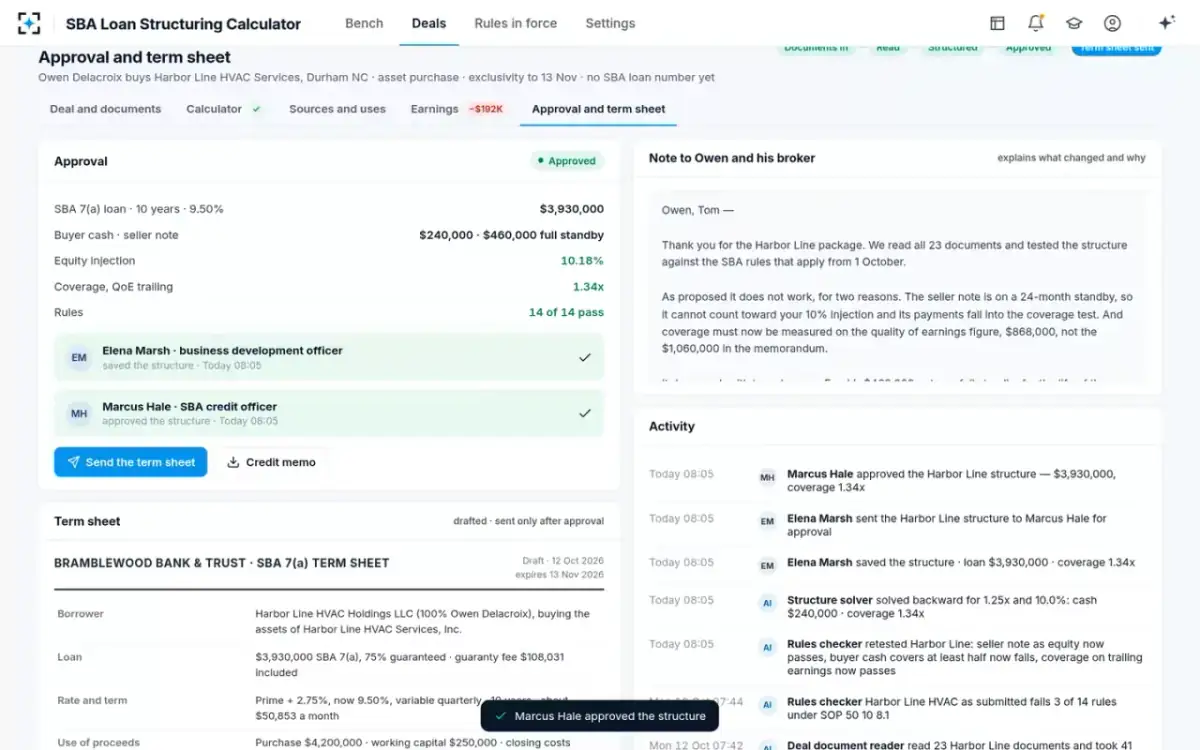
What the solution does not do matters as much. It does not order the valuation or the quality of earnings report, sign anything, or change a term without the banker. It cannot shorten the appraiser's work. The time it gives back is the rework: the conversations that happen because a structure was built on numbers SBA will not accept. To see it on your own acquisition packages, start from the SBA Loan Structuring Calculator.
Questions people ask
Can an SBA acquisition loan include a seller note?
Yes, and many acquisitions combine the two. The seller note counts toward the buyer's 10% equity injection only if it is on full standby, with no principal or interest paid, for the whole term of the 7(a) loan, and limited sources such as that note may supply no more than half of the required injection. A note paid alongside the SBA loan is ordinary debt: it counts in the debt service and must fit within the business valuation.
How much equity injection does an SBA acquisition loan require?
For an initial acquisition, SBA requires at least 10% of total project cost, which includes working capital, closing costs and a financed guaranty fee as well as the price. It cannot be reduced for an initial acquisition. A lender may require more under its own credit policy.
Does SBA review a business acquisition before the lender approves it?
Only if the lender uses non-delegated processing, which applied to 4.2% of 7(a) loans in fiscal 2025. Most acquisitions are approved under the lender's delegated PLP authority, and SBA reviews the lender's analysis only if it is later asked to buy the guaranty or during an oversight review.
Can the seller's broker value the business for the SBA loan?
No. The valuation must be ordered by and prepared for the lender, by an accredited appraiser independent of the deal. Below a $350,000 business purchase price the lender may value the business itself, unless buyer and seller are closely related.
How long can the seller stay after an SBA acquisition?
As a consultant, for no more than 24 months in total, under SOP 50 10 8.1. The seller may not remain an officer, director, stockholder or employee after an initial acquisition or business expansion; the earlier SOP 50 10 8 limited the consulting period to 12 months.
Is an earnout allowed in an SBA acquisition loan?
No. Seller earnouts are prohibited in SBA change of ownership financing. A rebate to the buyer based on business performance is allowed, and any rebate cash must be applied to the principal of the 7(a) loan; a working capital true-up in the purchase agreement is not treated as a rebate.