SBA's quality of earnings requirements, new in SOP 50 10 8.1 for applications from 1 October 2026, apply to initial acquisitions and business expansions financed with a 7(a) loan where the business purchase price is $3 million or more. Above that line the lender must obtain a quality of earnings report, a QoE, in addition to the independent business valuation. The report must be prepared by an independent, experienced financial professional for the lender's benefit, never by or for the seller; it must reconcile the business's statements, tax returns and IRS transcript data, document every add-back, and include a cash proof for the trailing twelve months and the last two fiscal years. Its earnings are then the ones used for the 1.25x debt service coverage test, and if they do not support the structure, the loan must be reduced. Owner buyouts and ESOP purchases are exempt. Botminds' SBA Loan Structuring Calculator reads the QoE alongside the returns and the broker's memorandum, marks each add-back the report accepted or refused, and tests the structure on the report's figure.
What one quality of earnings report changed on a $4.2 million acquisition
Earnings
Before the QoE
$1,060,000
broker’s adjusted EBITDA
After
$868,000
QoE adjusted EBITDA; $816,000 after maintenance capital spending
Coverage
Before the QoE
1.48x
claimed, on a projection
After
1.20x
on the QoE figure, against a 1.25x floor
Structure
Before the QoE
$189,000
buyer cash; note on 24-month standby
After
$240,000
buyer cash; note on full standby; loan $3,930,000; 1.34x
When does SBA require a quality of earnings report? Initial acquisitions and expansions at $3 million or more
SBA requires one when a 7(a) loan finances an initial acquisition or a business expansion and the business purchase price is $3 million or more. SOP 50 10 8.1 puts it plainly: "For Business Expansion and Initial Acquisition transactions where the Purchase Price … is equal to or greater than $3 million, the Lender must also obtain a Quality of Earnings (QoE) in addition to the required Business Valuation." SOP 50 10 8, which governed applications until 30 September 2026, had no such requirement.
Two kinds of change of ownership are exempt. Owner buyouts and ESOP or cooperative purchases "are not subject to the QoE requirement because the existing owner(s) retain operational knowledge of the business and the transaction does not result in a change to the management or operating structure". The purchase of an owner-occupied special purpose property integral to the business, such as a hotel, is also exempt "regardless of the Business Purchase Price", though its valuation rules still apply. Below $3 million the report is not required, but a lender may still order one under its own policy.
The quality of earnings rule in four numbers
$3M
business purchase price at which a QoE becomes mandatory, before buyer equity and seller debt
3
periods the cash proof must cover: the trailing twelve months and the last two fiscal years
1.25x
minimum coverage for an initial acquisition, tested on the QoE’s earnings
$350K
business purchase price at or below which the lender may value the business itself
How the $3 million is measured: before the financing, and without the real estate
The threshold uses the business purchase price, which "excludes all owner-occupied commercial real estate assets being acquired in the transaction"; where real estate is in the deal, the lender removes its appraised value from the contract price. The $3 million "is determined before the application of buyer equity, seller debt, or other financing sources", and the SOP adds that the threshold "is independent of total project costs …, the application of Borrower equity, structuring of seller debt, or any other measure that would reduce the 7(a) loan amount".
The rule closes the obvious workaround. A $3.2 million business purchase financed with a $2.6 million 7(a) loan, a large seller note and the buyer's cash still needs the report. A $3.6 million deal that includes $800,000 of appraised real estate does not, because its business purchase price is $2.8 million. The lender must also enter the business purchase price in the SBA Loan System, so the figure that decided the threshold is kept in SBA's system.
What must an SBA quality of earnings report contain?
SOP 50 10 8.1 describes the report as "a financial due diligence report that examines the reliability, sustainability, and accuracy of a business's historical and projected earnings", and then lists what it must do. The checklist below follows the SOP's order; a lender reviewing a report can use it as a completeness test.
What SOP 50 10 8.1 requires an SBA quality of earnings report to contain
- Independence and purpose
Performed by an independent, experienced financial professional, for the benefit of the lender; not prepared by or for the seller.
- Reconciliation
Accountant-prepared statements, tax returns, internal statements and IRS transcript data reconciled into a normalized earnings figure for recurring, arm’s-length operations.
- A cash proof
Cash receipts and disbursements rebuilt from bank statements and tied to the income statement and return, for the trailing twelve months and the last two fiscal years.
- Every add-back and adjustment
Non-recurring items, owner pay above or below market, related-party transactions, deferred maintenance, and cash-versus-accrual differences, each documented.
- Quality of revenue
Customer concentration, contract continuity and whether revenue and margins are likely to hold after the sale.
- Use in coverage
The lender uses the QoE’s earnings for the debt service coverage test and keeps the report in the credit file.
What is a cash proof? Deposits rebuilt against the income statement and the return
A cash proof is the test that the earnings were real money. The SOP defines it as "a financial analysis that reconstructs cash receipts and disbursements by reconciling bank statement data to the income statement and tax return for each period under review", designed "to identify discrepancies in income and undisclosed expenses". It must be performed for the trailing twelve months and for the last two fiscal years; for a business operating less than two years, SBA's September notice says the report "must use the information for all years in operation" (Information Notice 5000-882227).
The cash proof is what separates an SBA quality of earnings report from an adjusted-EBITDA schedule. Revenue that appears on the income statement but never reached the bank, or expenses paid from an account the seller did not disclose, show up as a gap. On the fictional Harbor Line deal, reported trailing revenue of $6,420,000 tied to bank deposits within 0.5%, which is the kind of result a lender wants to see before relying on anything else in the report.
Can the seller's QoE be used for an SBA loan? No; a buyer's can, with a review or a reliance letter
A report prepared by or for the seller cannot be used. SOP 50 10 8.1 says the QoE "must not be prepared by or for the seller", because it is "part of the financial due diligence of the transaction". A sell-side report commissioned to support the asking price is the document the lender's own report is meant to test.
A report the buyer commissioned before approaching the lender can be used, with a second look. The SOP recognises that "some Applicant buyers may elect to commission their own QoE prior to engaging with the Lender", lets the lender have it "reviewed by one of their approved vendors", requires the review's findings to be filed with the report, and says "the Lender may not rely upon a QoE report prepared by another party without a review being performed by one of their vendors". SBA's summary of the September technical updates describes the same allowance as a report "already prepared for the Applicant" that "may be used if accompanied by a reliance letter or secondary review by a different firm". A reliance letter is the preparing firm's written agreement that the lender may rely on its work; a lender that accepts one in place of a vendor review should be able to point to the notice that permits it.
What happens if the QoE lowers EBITDA? The loan shrinks
The loan is reduced, or more equity goes in. SOP 50 10 8.1: "When a change of ownership transaction requires a Quality of Earnings (QoE) report as part of the necessary financial due diligence, the Lender must use the report's findings to calculate the Debt Service Coverage. If that Debt Service Coverage does not support the business valuation and proposed debt structure, the loan amount must be reduced accordingly. Additional equity (unlimited or limited) may be used to make this adjustment." Projections cannot fill the gap: for an acquisition, the lender "may not rely on them to meet the DSC requirement".
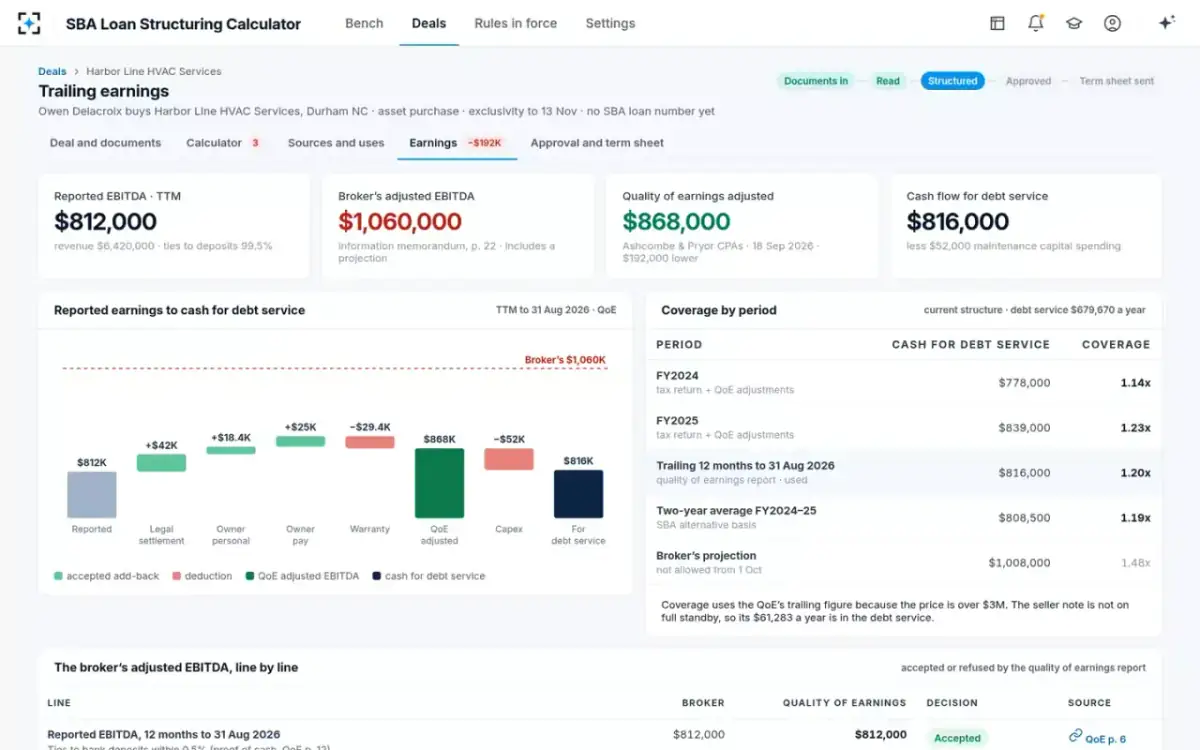
The fictional Harbor Line deal shows how much one report can move. The broker's memorandum claimed adjusted EBITDA of $1,060,000. The quality of earnings report accepted three of the broker's add-backs, refused two, and added a deduction the broker had left out.
The broker's adjusted EBITDA, line by line, against the quality of earnings report
| Line | Broker | QoE | Why |
|---|---|---|---|
| Reported EBITDA, 12 months to 31 August 2026 | $812,000 | $812,000 | Ties to bank deposits within 0.5% |
| Legal settlement, one-off | + $42,000 | + $42,000 | Accepted: non-recurring |
| Owner’s personal expenses run through the business | + $18,400 | + $18,400 | Accepted: will not recur under the buyer |
| Owner’s pay above a market general manager | + $25,000 | + $25,000 | Accepted: owner compensation to market |
| Run-rate of new service pricing | + $126,600 | — | Refused: a projection, not earnings |
| Spouse’s bookkeeping salary | + $36,000 | — | Refused: the job continues after the sale |
| Warranty reserve true-up | — | − $29,400 | Added by the QoE: a cost the broker left out |
| Adjusted EBITDA | $1,060,000 | $868,000 | $192,000 not supported |
On $816,000, the broker's structure covered its debt service 1.20 times, below the 1.25x floor, partly because a seller note on 24-month standby added $61,283 a year of payments. The fix used SBA's own remedy: the seller note went onto full standby, which removed its payments and let half the injection come from the note, and the buyer added $51,000 of cash, which lowered the loan to $3,930,000. Coverage reached 1.34x. A price reduction would also have worked; the parties did not need one. How each coverage minimum is measured is covered in the SBA minimum debt service coverage ratio.
SBA Loan Structuring Calculator: the broker's add-backs against the quality of earnings report
Who can prepare an SBA business valuation? Five credentials, hired by the lender
Every change of ownership also needs a business valuation, and above $350,000 it must come from a "Qualified Source": an individual "who regularly receives compensation for business valuations", accredited as an Accredited Senior Appraiser (American Society of Appraisers), Certified Business Appraiser (Institute of Business Appraisers), Accredited in Business Valuation (AICPA), Certified Valuation Analyst (National Association of Certified Valuation Analysts) or Business Certified Appraiser (International Society of Business Appraisers), "independent of the loan production function" and without the appearance of a conflict.
The valuation "must be requested by and prepared for the Lender"; the lender "may not use a business valuation prepared for the Applicant or the seller". When the business purchase price is $350,000 or less, the lender may value the business itself unless buyer and seller are closely related. The lender must also obtain the financial information the appraiser relied on and verify it against the seller's IRS transcripts. The valuation and the quality of earnings report work together: the valuation caps total debt, including any seller debt not on full standby, and the report decides how much of that debt the earnings can carry.
When must the QoE be ordered? By the loan number under PLP; with the application otherwise
Timing depends on how the loan is processed. For an application sent to SBA's loan guaranty processing center, "the business valuation and QoE must be submitted as part of the loan application". A lender approving under its PLP authority may complete them after the SBA loan number is issued, but both "must have been formally engaged (i.e., a vendor must have been retained, and an engagement letter must be in place) at the time that the SBA Loan Number is issued", with an estimate of value in the credit memorandum and an update afterwards that shows "the findings in the QoE, with any impact to DSC ratio calculations".
The PLP route is faster only if the structure survives the report. A lender that numbers a loan on the broker's earnings and learns from the QoE that coverage fails has to reduce the loan, restructure it with the buyer and seller, and update the credit memorandum, often inside the buyer's exclusivity period. On the sample deal, the report was dated 18 September, before the bank had numbered the loan, which is the order a structuring tool should encourage.
Who pays for the quality of earnings report, and does it count as equity?
The buyer usually pays, and the cost can count toward the injection. SOP 50 10 8.1 says "the out-of-pocket costs associated with all financial due diligence reports may be passed on to the borrower" and "any funds expended by the Applicant on the report can count toward the equity injection". Change of ownership loans may also finance "Borrower out of pocket expenses (including business valuations and QoE)".
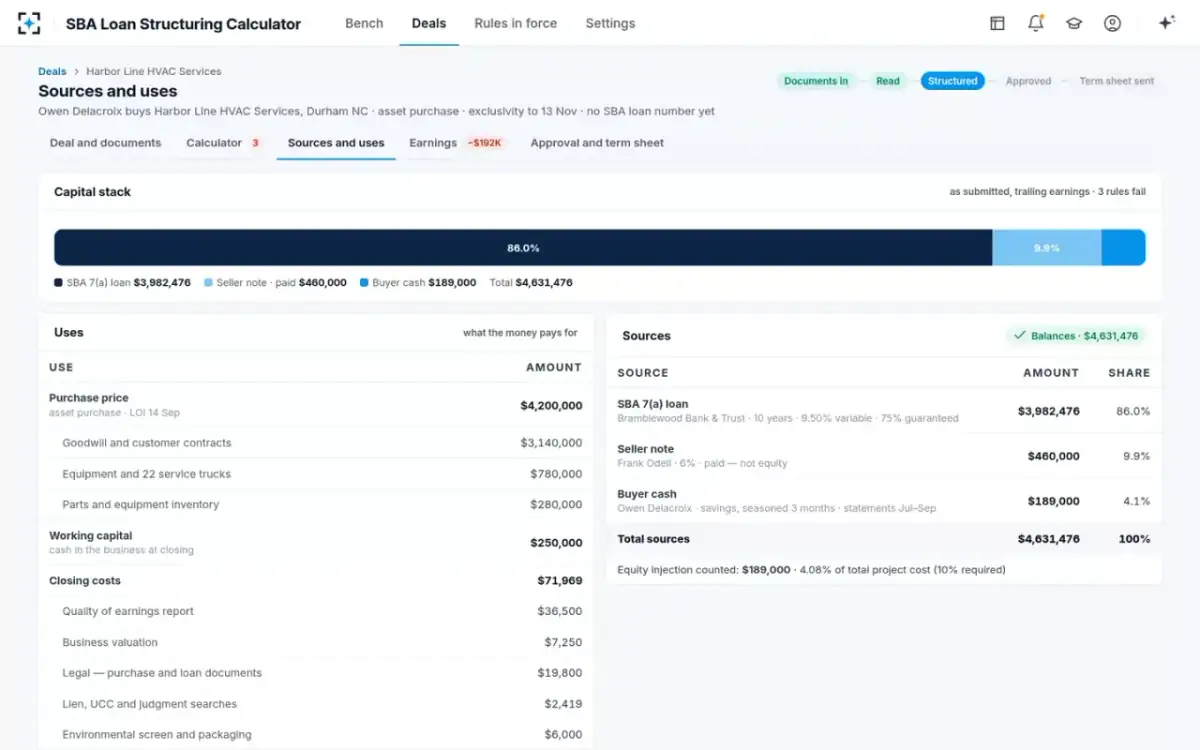
On Harbor Line the closing costs included $36,500 for the quality of earnings report and $7,250 for the business valuation, among $71,969 in all. Those figures are the sample deal's, not market prices, and fees vary with the size and complexity of the business. The point for structuring is that they belong in total project cost, the base for the 10% injection.
The reports in the uses: quality of earnings and valuation among the closing costs
The solution treats the quality of earnings report as the earnings that count whenever the rules require one: its earnings verifier ties the report to the returns, the trailing statements and the bank deposits, and the structure is tested on the report's figure, never on the broker's. When a report has not arrived yet, the structure is tested on the returns and marked as waiting on the QoE. For how the report fits among everyone else waiting on everyone else in an acquisition, see buying a business with an SBA loan. To try it on your own acquisitions, start from the SBA Loan Structuring Calculator.
Questions people ask
Is a QoE required for a partner buyout?
No. Owner buyouts, including partial changes of ownership, and ESOP or cooperative purchases are not subject to the quality of earnings requirement, because the existing owners stay. A buyout by someone who has not worked in the business for 24 months and would take half or more of the equity, or become the largest owner, is processed under the initial acquisition standards, which include it.
Does a 7(a) Small loan for an acquisition need a QoE?
A 7(a) Small loan is at most $350,000, so the business purchase price would rarely reach $3 million. The Appendix 15 rules apply in full to 7(a) Small and SBA Express acquisitions, except that the lender may do an internal valuation when the business purchase price is $350,000 or less.
Was a quality of earnings report required under SOP 50 10 8?
No. SOP 50 10 8, effective 1 June 2025, required an independent business valuation for changes of ownership but did not require a QoE. The requirement arrived with SOP 50 10 8.1 for applications from 1 October 2026.
What happens if the quality of earnings report comes in higher than the broker's figure?
The lender still uses the report's earnings. A higher figure can support a larger loan, but total debt remains capped at the business valuation, and the price must be supported by the valuation regardless of how the debt is structured.
Does a quality of earnings report replace the business valuation?
No. Above $3 million the lender must obtain the QoE "in addition to the required Business Valuation". The valuation supports the price and caps total debt; the QoE decides the earnings the debt is tested against.