An SBA business acquisition loan calculator sizes a 7(a) loan to buy a business: it balances the price, working capital, closing costs and guaranty fee against the loan, the buyer's cash and any seller note, and tests the result against SBA's change of ownership rules. Business development officers use one to answer a broker within a day; credit officers use the answer to decide whether to spend underwriting time on the deal. A calculator is trusted when its "yes" is still a yes three weeks later, after the valuation and the quality of earnings report are in and the underwriter has applied SOP 50 10 8.1. Most front-line calculators fail that test for a handful of known reasons. Botminds' SBA Loan Structuring Calculator was built around them: it reads the deal's documents, tests fourteen SBA rules on every structure with the paragraph each comes from, and shows the BDO and the credit officer one run. This page sets out what a sales and credit leader should require of any such tool, and how to tell whether the bankers are using it.
The front-line spreadsheet and a calculator a credit officer will sign behind
The BDO’s spreadsheet: The broker’s adjusted EBITDA, typed in
A calculator both seats trust: Read from the returns, the trailing statements and the QoE, each figure with its page; refused add-backs marked
The BDO’s spreadsheet: Counted as equity if the box is ticked
A calculator both seats trust: Counted only on full standby, and only up to half the required injection
The BDO’s spreadsheet: Often the price
A calculator both seats trust: Total project cost for an initial acquisition; purchase price for an owner buyout
The BDO’s spreadsheet: Whatever was in force when it was last edited
A calculator both seats trust: Dated versions; deals rescreened when SBA changes the rules
The BDO’s spreadsheet: A ratio and a colour
A calculator both seats trust: Fourteen tests, each with its figure and SOP paragraph
The BDO’s spreadsheet: The BDO; credit rebuilds it
A calculator both seats trust: The BDO and the credit officer see the same run
What is an SBA business acquisition loan calculator? A sizing tool with the SOP inside
It is a sources-and-uses model for one change of ownership with SBA's tests built in. The uses are the business purchase price, working capital, closing costs including the valuation and quality of earnings report, and the upfront guaranty fee if financed. The sources are the 7(a) loan, the buyer's cash, a seller note and any minority investor. The tests that decide an acquisition under SOP 50 10 8.1 are few but exacting: an injection of at least 10% of total project cost that "cannot be reduced or eliminated" for an initial acquisition; limited sources, including a seller note on full standby, supplying no more than half of it; and coverage of at least 1.25x measured on the last fiscal year or a two-year average, never on projections, using the quality of earnings figure when the business purchase price is $3 million or more.
A loan payment calculator is a different thing. It answers "what will this cost a month", and a buyer needs that. A business acquisition loan calculator answers "will SBA guarantee this structure", which is the question the bank is paid to get right.
Why do SBA deals get restructured in underwriting? Four rules the front line prices wrong
SBA acquisitions get restructured when the first structure was built on figures or terms SBA does not accept, and the reports arriving in underwriting expose it. Four account for most of it.
The first is earnings. A broker's information memorandum presents adjusted EBITDA that supports the price; SBA's coverage test takes historical cash flow, the quality of earnings report's figure when one is required, and only adjustments the lender justifies in writing. The second is the seller note. Brokers still describe notes on a 24-month standby, which counted under SOP 50 10 7.1 and has not counted since 1 June 2025. The third is the injection base: 10% of the price is not 10% of total project cost. The fourth is valuation: total debt, including any seller note not on full standby, may not exceed the business valuation, and a price above it must be filled with equity.
One broker's structure, tested on the first morning
1.48x
coverage the broker’s structure claimed, on adjusted EBITDA that included a projection
1.20x
coverage on the quality of earnings figure, against a 1.25x floor
$192K
of the broker’s adjusted EBITDA the quality of earnings report did not support
3 of 14
SBA rules the structure failed under SOP 50 10 8.1
On the sample deal, all four were present in some form. The memorandum claimed $1,060,000 of adjusted EBITDA, including $126,600 of run-rate from new service pricing; the quality of earnings report supported $868,000. The $460,000 seller note was on a 24-month standby, then ten years of payments, so it counted for nothing and its $61,283 a year sat in the debt service. Only the buyer's $189,000 counted toward a $463,148 injection. Found on the first morning, each fix was a phone call. Found in week three, each would have been a renegotiation against the buyer's exclusivity.
Why BDOs stop trusting a calculator: the "yes" that dies in week three
BDOs stop trusting a calculator the first time its answer is overturned by credit on a rule the calculator should have known. The cost lands on the BDO personally: a call to the broker to explain that the structure the bank discussed no longer works, and a buyer whose exclusivity is running out. After two or three of those, the BDO builds a private spreadsheet with a cushion, and the bank's tool becomes a form filled in after the fact.
"I find out in week three that a deal never could have worked."
Elena Marsh, SBA business development officer at the solution's fictional sample bank
The credit officer's distrust runs the other way. A structure that arrives from sales as a ratio, with no trail to the documents, has to be rebuilt before anyone can approve it. The calculator's output is ignored at the moment it should save the most time. Trust, in other words, is a property of the whole loop: the BDO trusts a tool whose answers credit accepts, and credit accepts answers it can check.
The rules are also enforced late, which makes the loop longer than it looks. Under PLP, which covered 64.1% of 7(a) loans in fiscal 2025, SBA "does not review the Lender's analysis of the credit or structure of the loan" before the loan number; it reviews that analysis when the lender asks it to buy the guaranty, often years later. A structure that got past the lender's own check on a rule the calculator misread can stay wrong until the loan defaults, which is the most expensive time to find out. A lender cannot rely on the purchase review to forgive its errors; it can only make the structure right at the start.
What should an SBA calculator show its user? Every rule, its figure, its paragraph and its source
It should show why, not just whether. A BDO talking to a broker needs to say "the note has to be on full standby for the life of the loan to count, and even then it counts for only half of the injection", not "the calculator says no". A credit officer needs to see where each number came from.
What an SBA acquisition calculator must show for both seats to rely on it
- Each test with its figure
“Coverage 1.20x against 1.25x” tells the BDO how far the deal is from passing; a red cell does not.
- The SOP paragraph for each test
The credit officer checks the rule, not the tool.
- The source page for each input
Price from the LOI, note terms from the term sheet, liquidity from Form 413, earnings from the returns and the QoE.
- What was refused, and why
Add-backs the QoE did not accept, and projections that cannot count toward acquisition coverage.
- The smallest fix
Which lever, by how much, inside the limits the buyer and seller have actually agreed.
- The rules version applied
SOP 50 10 8 or 8.1, so a deal that straddles 1 October 2026 is tested correctly.
- A plain note for the buyer and broker
What changed from their proposal and why, in their words, after credit has approved.
SBA Loan Structuring Calculator: the bench as the BDO first sees a deal
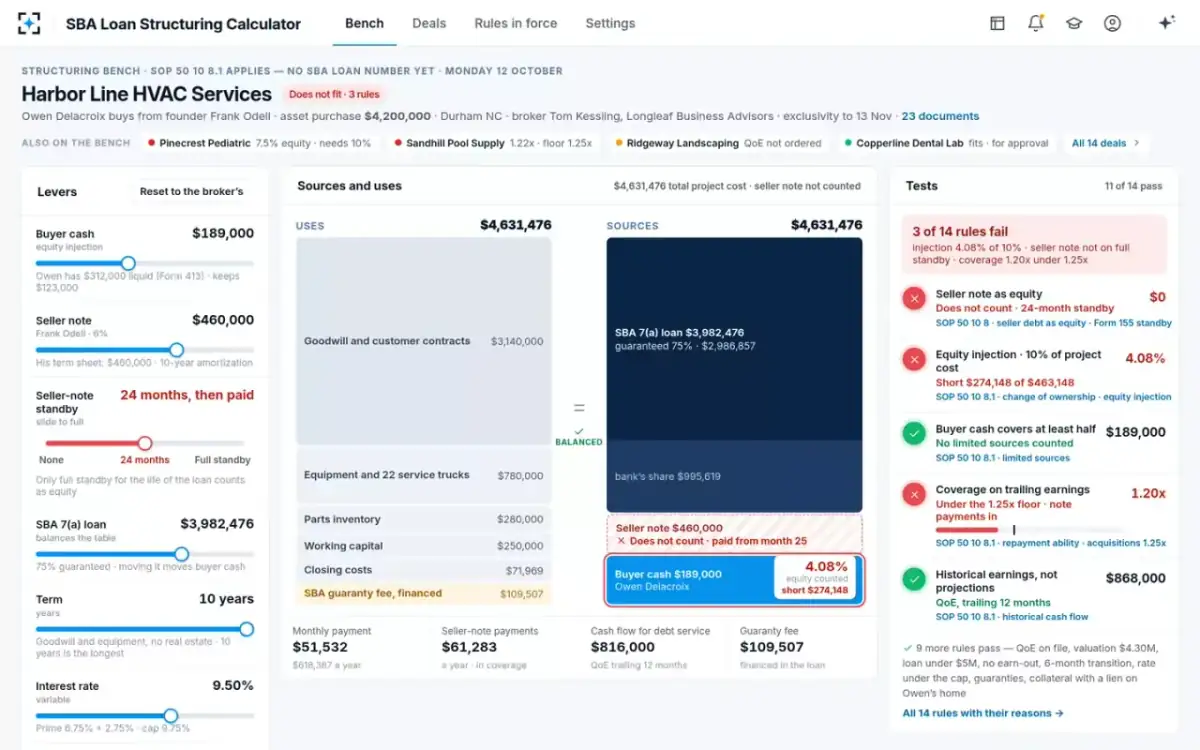
One run, two seats: the BDO and the credit officer see the same thing
The fastest way to end the rebuild is to make it unnecessary. In the solution, the structure the BDO saves is the structure the credit officer opens, with the same fourteen results, the same sources and the same activity trail. The credit officer approves or sends it back; nothing is re-keyed. On the sample deal, the BDO saved the structure at 08:05 on a Monday and the SBA credit officer, Marcus Hale, approved it at 08:05: $3,930,000 of 7(a) loan, $240,000 of buyer cash, the seller note on full standby, 10.18% equity counted, 1.34x coverage, fourteen of fourteen tests passing.
The credit officer's view: the same structure, its rule results and who did what
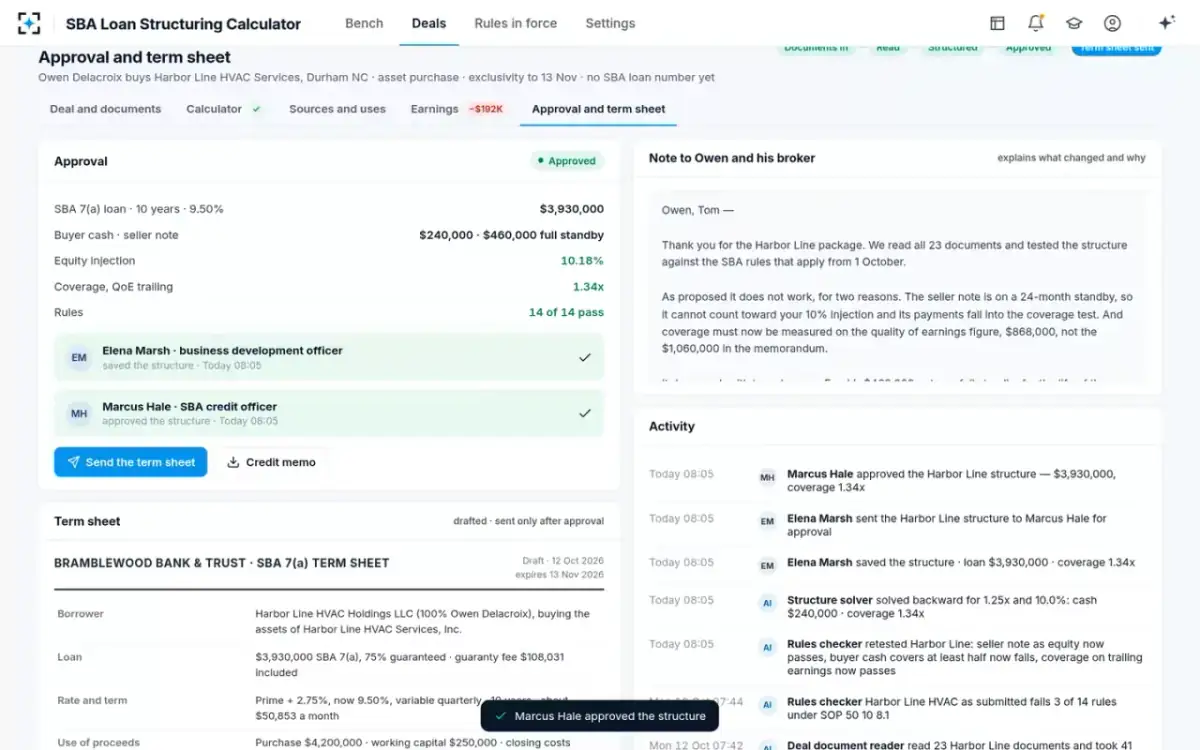
The design also changes what the credit officer spends time on. With the arithmetic and the rule tests settled, the judgement left is the one SBA expects of a prudent lender: whether the business can carry the debt after the seller leaves, whether the buyer can run it, and whether the collateral shortfall is acceptable. Those are the questions a credit officer was hired to answer.
How do you get loan officers to use a new tool? Start from the deals they lost
Start with the deals the team already knows went wrong. Pick five or six recent acquisitions that were restructured in underwriting, withdrawn, or approved only after a renegotiation, and run them through the tool with the documents the BDO had on the first day. If it finds on day one what credit found in week three, the BDOs will use it for the next deal without being told to. If it does not, the bank has learned something important before buying.
Three design choices then decide whether the habit sticks. The tool has to save the BDO time on the first day, which means reading the broker's package rather than asking the BDO to key it. Credit has to accept its output as the structure the bank works from, so the BDO is not maintaining two versions. And the BDO has to stay in charge of the deal: the solution's solver proposes changes, but nothing moves until the banker puts the proposal on the bench, and nothing leaves the bank before credit approves. Bankers adopt tools that make them faster with brokers, not tools that make decisions for them.
How do you measure adoption of a credit tool? Five measures that show use and value
Measure whether the tool is used before the structure is promised, and whether its structures survive. Log-ins and runs count activity, not adoption. The five measures below are our proposal; each can be taken from the deal pipeline the bank already keeps.
Five adoption measures for an SBA structuring tool
| Measure | How to count it | What good looks like |
|---|---|---|
| Structured before the term sheet | Share of SBA acquisitions whose first structure discussed with the broker was a saved run | Rising to nearly all within a quarter |
| Changed in underwriting | Approved structures that credit changed after the reports arrived, with the reason | Falling, and the reasons no longer the four common rule errors |
| Days to an approved structure | Working days from a complete package to a credit-approved structure | Days, not weeks; the solution’s design target is 40 minutes of agent and banker time |
| Deals rescreened on a rule change | Deals in the pipeline retested when SBA changes a rule, and those that no longer fit | All of them, within a day of the effective date |
| Exceptions and overrides | Structures approved outside a bank or SBA threshold, with who approved them | Rare, named and explained |
The second measure is the one to watch. A tool that is used but whose structures are still changed in underwriting for the same reasons is a tool that has not learned the rules; a falling count with the old reasons gone is the evidence that the front line and credit now work from the same book.
Why this matters more at a lender that does few SBA deals
Most SBA lenders are not SBA specialists. In fiscal 2025, 711 of the 1,336 lenders that made 7(a) loans made five or fewer, while the ten largest made about half of all loans, by our computation from SBA's public loan data. A lender doing a handful of acquisitions a year cannot keep a desk current on two SOPs and nine notices in fifteen months, and its BDOs see the change of ownership rules too rarely to know them by heart.
The economics push the same way. A Harvard Business School working paper on small business lending notes that small business loans are "considerably less profitable than large business loans" and that "the higher transaction costs that result are a structural barrier to small business lending" (Mills and McCarthy, HBS Working Paper 15-004). Restructuring a deal twice is transaction cost. For an occasional SBA lender, a calculator that carries the rules is as much about whether to do SBA acquisitions at all as about doing them faster.
What to look for when buying one, and where this one does not fit
Ask for a run on your own closed deals, not a demonstration file. Ask which rules version it applies to a deal submitted on 30 September 2026 and to one received on 1 October. Ask whether a user can type adjusted EBITDA, whether it counts a 24-month standby note, and what it does when the buyer's cash cannot close the gap. Ask who can change the rules and how that change is recorded. The structure solver's step-by-step run shows what good answers look like.
The SBA Loan Structuring Calculator fits 7(a) acquisitions, start-ups and owner buyouts where the documents exist and the structure is the open question. It does not replace the bank's loan origination system or credit memorandum, it hands its structure to them. It does not decide eligibility questions such as owners' citizenship, size or ineligible business types. It does not structure 504 projects. And it cannot make a deal fit that does not: when no structure inside the buyer's and seller's limits passes, it says which limit would have to move. For the second line's view of the same question, see whether an SBA loan calculator in Excel is a model. To try it on your own acquisitions, start from the SBA Loan Structuring Calculator.
Questions people ask
How much can I borrow to buy a business with an SBA loan?
Up to $5 million in one 7(a) loan, with no more than $3.75 million of SBA guaranty outstanding to the business and its affiliates. The practical limit is usually lower: total debt may not exceed the business valuation, and the loan must leave at least 1.25x coverage on the business's historical cash flow after the buyer's 10% injection.
What should an SBA acquisition loan calculator include in total project cost?
Everything needed to close and operate: the price, working capital, closing costs such as the valuation, quality of earnings report and legal fees, and the guaranty fee if it is financed. SOP 50 10 8.1 measures an initial acquisition's 10% injection on that total, not on the price.
Can a business buyer use an SBA calculator before talking to a bank?
A buyer can estimate the payment and the cash needed, and should do so on total project cost, with any seller note counted only if it will be on full standby. The lender's own structure will then use the valuation, the quality of earnings figure if one is required, and its own credit policy, which may be stricter than SBA's.
Why did my SBA lender change the structure after the quality of earnings report?
Because SBA requires it. When a quality of earnings report is required, the lender must use its earnings for coverage, and if coverage then falls short, "the loan amount must be reduced accordingly", usually by more equity or a lower price.
Do SBA lenders have to use a particular calculator?
No. SBA prescribes the rules, the forms and what the lender enters in the SBA Loan System, including the historical and adjusted coverage ratios for a change of ownership. How the lender computes them is its own choice, and its responsibility at purchase review.