An SBA deal calculator sizes the 7(a) loan for a business acquisition from the price, the buyer's cash, any seller note and the business's earnings, and shows whether the result meets SBA's rules. Most stop at the arithmetic: a payment, a guaranty fee and a debt service coverage ratio on whatever earnings the user typed in. The rules that decide an SBA acquisition since 1 October 2026 are less forgiving: a 10% equity injection that cannot be reduced, a seller note that counts only on full standby and only up to half the injection, and 1.25x coverage on historical earnings, from a quality of earnings report when the price is $3 million or more. Botminds' SBA Loan Structuring Calculator tests all of them on every change and, when a deal fails, runs a structure solver that searches for the smallest change that makes it pass. This page follows that solver through one deal.
The deal is fictional sample data: Harbor Line HVAC Services in Durham, North Carolina, which Owen Delacroix agreed to buy from its founder, Frank Odell, for $4,200,000. The rules are SBA's, from SOP 50 10 8.1 and the fiscal 2027 fee notice.
One run of the structure solver, from a failing deal to one that fits
Agent
Rules checkerTests the structure as submitted against the rules for applications from 1 October 2026 and names each failure with its figure and SOP paragraph.
Never: waives or softens a rule
A person decides
Business development officerSets the target (coverage 1.25x, equity 10%) and the limits from the file: the signed price, the seller’s note, the buyer’s liquid cash.
Agent
Structure solverMoves the levers in order of least change, re-running all fourteen tests at each step, and stops at the first structure that passes.
Never: goes outside the limits the banker set
A person decides
Business development officerPuts the proposal on the bench, or rejects it. Nothing changes until she does.
A person decides
SBA credit officerApproves the saved structure with every rule result and its source in front of him; only then can the term sheet go.
What is an SBA deal calculator, and what most of them leave out?
An SBA deal calculator is a sources-and-uses model for one transaction: the uses (price, working capital, closing costs, the guaranty fee if financed) balanced by the sources (the 7(a) loan, buyer cash, seller financing, any investor), with the loan's payment and the coverage it implies. The arithmetic is easy. The rules are where most calculators fall short, in three ways.
First, they test coverage on the number they are given. A broker's adjusted EBITDA usually includes add-backs, and sometimes a run-rate of next year's pricing. SBA does not accept that: for a change of ownership the lender "must evaluate the Applicant's post-closing financial projections but may not rely on them to meet the DSC requirement", and when a quality of earnings report is required, its earnings are the ones used. Second, they count the seller note as equity if the user ticks a box, when SBA counts it only on full standby and only up to half the required injection. Third, they apply one version of the rules, while a lender's pipeline straddles versions: SOP 50 10 8 for applications submitted through 30 September 2026, SOP 50 10 8.1 for applications received from 1 October, as SBA's September notice puts it.
The fourteen tests every structure must pass
The solution tests fourteen rules on every structure, each with its threshold and the SOP paragraph it comes from. Fourteen is the design, not an SBA count: it is the set of rules a change of ownership can fail on structure alone, before eligibility and closing conditions, which the bank's other checks cover.
The SBA Loan Structuring Calculator's fourteen tests for a 7(a) acquisition
| Test | Passes when | Where SBA says so |
|---|---|---|
| 1. Equity injection | At least 10% of total project cost for an initial acquisition | SOP 50 10 8.1, App. 15, equity requirements |
| 2. Limited sources | Seller note, standby debt and minority investors together supply no more than half the required injection | App. 15, limited equity injection sources |
| 3. Seller note as equity | Counted only on full standby: no principal or interest for the term of the 7(a) loan, on Form 155 | App. 15, seller debt; standby agreements |
| 4. Coverage floor | 1.25x for an initial acquisition, owner buyout or ESOP; 1.15x for an expansion | App. 15, credit standards |
| 5. Earnings basis | Last fiscal year or two-year average, historical or adjusted; never projections | App. 15, historical and adjusted DSC |
| 6. Quality of earnings | QoE on file and its figure used, when the business purchase price is $3 million or more | App. 15, C.1 |
| 7. Business valuation | Independent valuation by a qualified source, or the lender’s own at $350,000 or less | App. 15, C.1 |
| 8. Debt within valuation | All debt not on full standby is within the valuation amount | App. 15, A.1 |
| 9. Loan limit | 7(a) loan no more than $5 million; guaranty no more than $3.75 million | 13 CFR 120.151; App. 16 |
| 10. No earnout | No seller earnout in the purchase agreement | App. 15, A.1 |
| 11. Seller transition | Seller stays only as a consultant, 24 months at most | App. 15, A.1 |
| 12. Rate cap | Variable rate within Prime + 3.0% for loans above $350,000 | SOP 50 10 8.1, maximum interest rates |
| 13. Guaranty and fee | Guaranty share and upfront fee per the fiscal-year table | App. 16; Information Notice 5000-881797 |
| 14. Guaranties and collateral | Required guarantors in place; collateral and any residence lien per the collateral rules | Section A, Ch. 5; App. 19 |
Each test reports a figure, not just a tick. "Coverage 1.20x under the 1.25x floor" tells a banker how far the deal is from passing; "fails" does not. That figure is also what the solver searches against.
How do you structure an SBA acquisition loan? The order the levers move
Structure an SBA acquisition by fixing what the buyer and seller have agreed, then moving the levers that change the least for them first. The solver's order is the same one an experienced BDO uses when calling the broker: put the seller note on full standby, then add buyer cash within what the personal financial statement shows, then change the seller note's amount, and only then the price.
The four levers, in the order the solver tries them
| Lever | What it changes in the tests | What it costs the parties |
|---|---|---|
| 1. Seller note to full standby | Up to half the injection becomes equity; the note’s payments leave the coverage test | The seller is paid nothing until the 7(a) loan is repaid; interest may accrue and be paid after |
| 2. More buyer cash | Raises counted equity; lowers the loan, its payment and the fee | Buyer liquidity, bounded by the verified figure on Form 413 |
| 3. A larger or smaller seller note | Moves the loan and, if on standby, the debt service | The seller’s exposure and patience |
| 4. A lower price | Lowers project cost, loan and payment | A renegotiation of the letter of intent |
The order matters because two levers interact. A note on full standby counts toward the injection only up to half of it, so once the note is on standby, the buyer's cash must cover at least the other half. On a deal with a large note, standby alone can fix coverage and break the cash test in the same move. The solver re-tests all fourteen rules after each step for that reason.
The run on Harbor Line: from three failures to fourteen passes
As the broker sent it, Harbor Line was financed with $189,000 of the buyer's cash, a $460,000 seller note at 6% on 24 months of standby followed by ten years of payments, and a 7(a) loan of $3,982,476 balancing a total project cost of $4,631,476. The quality of earnings report supported $868,000 of adjusted EBITDA, $816,000 after maintenance capital spending. Three tests failed: equity at 4.08% against 10%, the note not on full standby, and coverage of 1.20x against 1.25x, because the note's $61,283 a year sat in the debt service.
SBA Loan Structuring Calculator: the bench with the seller note moved to full standby
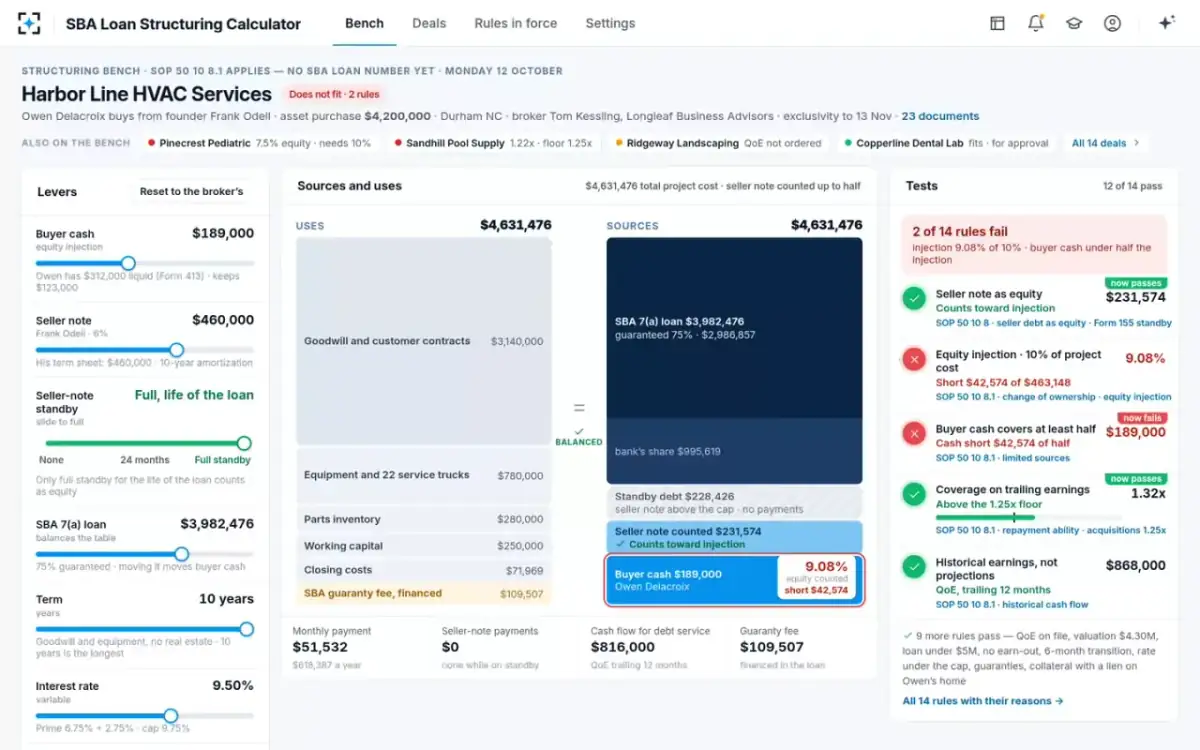
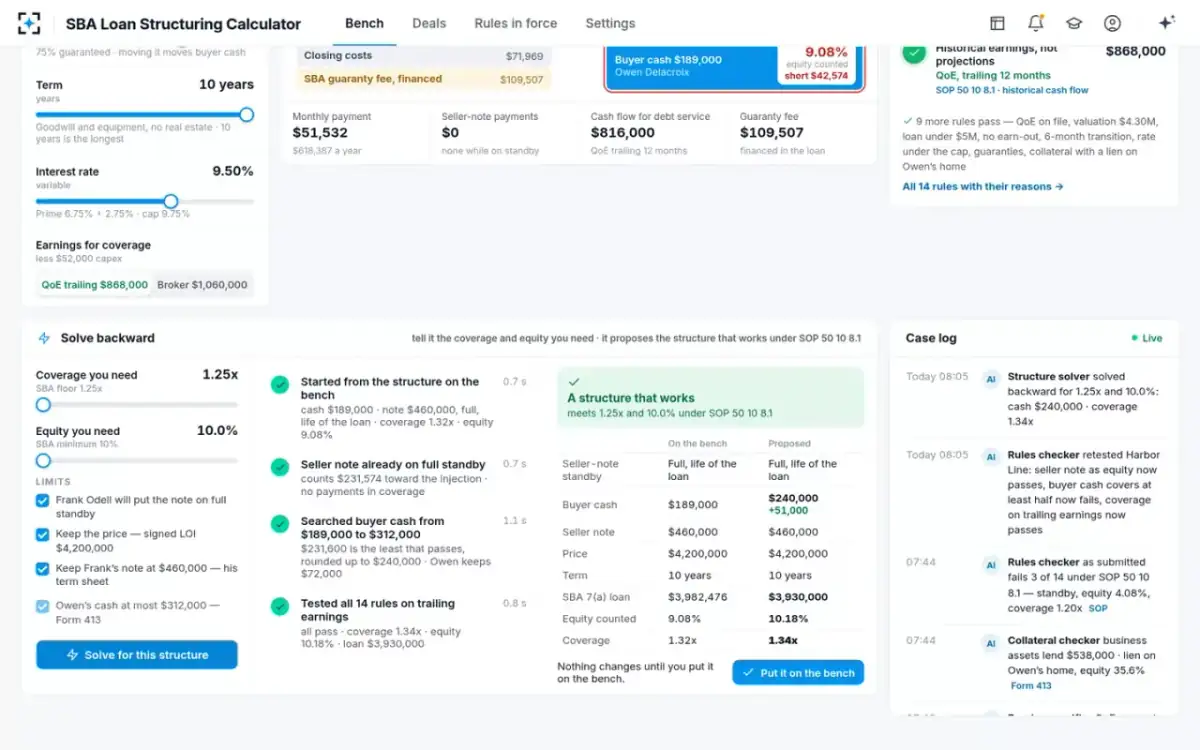
The BDO, Elena Marsh, set the solver to 1.25x and 10% with four limits: Frank will accept full standby, the price stays at the $4,200,000 in the signed letter of intent, the note stays at $460,000, and Owen's cash cannot exceed the $312,000 his Form 413 shows. The solver confirmed the standby, then searched buyer cash from $189,000 upward and found that $231,600 is the least that passes; the bank's setting rounds a proposed cash figure up to the next $10,000, so it proposed $240,000. It then re-ran all fourteen tests on trailing earnings. Each step took under a second and a quarter.
Coverage and equity at each step of the solver's run
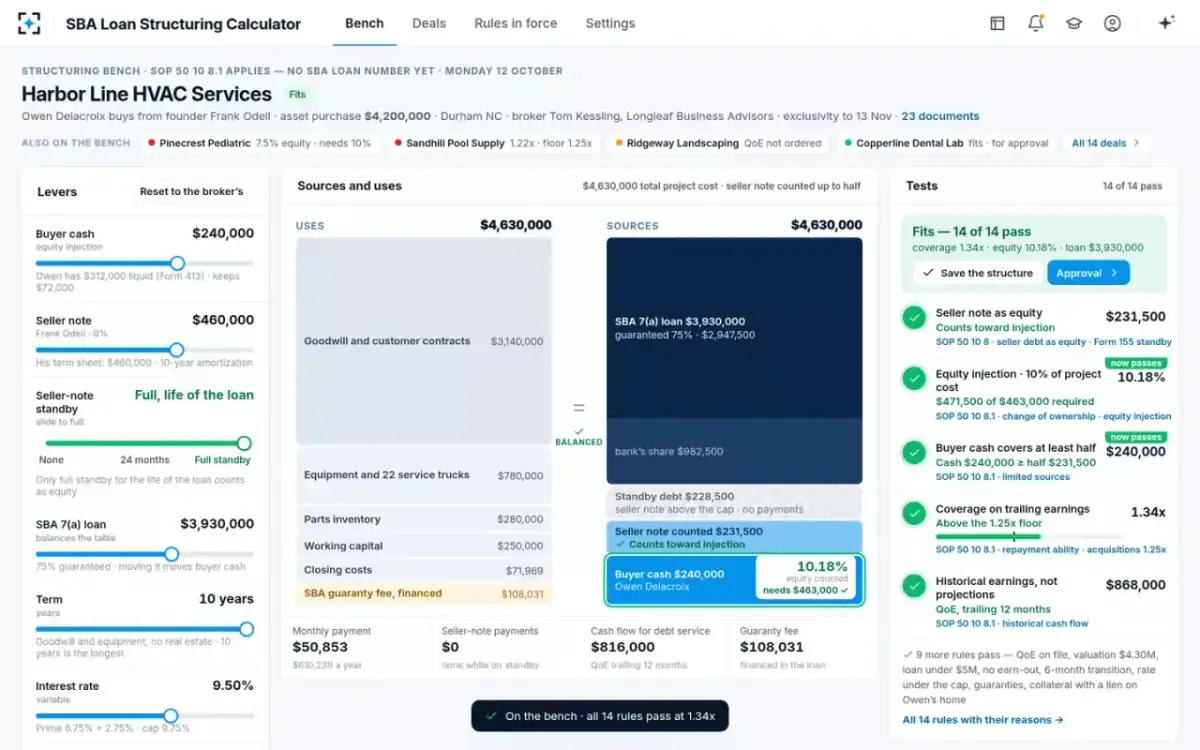
Put on the bench, the proposal moved the loan to $3,930,000, lowered the financed guaranty fee to $108,031 and the payment to $50,853 a month, and counted $471,500 of equity, 10.18% of a $4,630,000 project: $240,000 of cash and $231,500 of note. Owen keeps $72,000 of liquidity. The credit officer approved it the same morning.
A structure that fits: fourteen of fourteen, with the change shown against the broker’s
Can projections be used for SBA debt service coverage? Not for an acquisition
No, with one narrow exception. For a change of ownership, SOP 50 10 8.1 measures coverage on "either the last fiscal year-end or an average of the last two fiscal year-end statements on either a historical or adjusted basis", and says the lender "may not rely on" projections to meet the minimum. The exception is the purchase of an owner-occupied special purpose property, such as a hotel or self-storage facility, that is integral to the business, where the appraised value fully secures the loan; the projections must then show the required coverage within two years.
The solver is built to the rule. It never counts a projection toward acquisition coverage, and it marks the add-backs a quality of earnings report refused. On Harbor Line, the broker's $1,060,000 included $126,600 of run-rate from new service pricing that had not yet been earned; the report refused it as a projection, and the solver never sees it as earnings. Adjustments the lender does make, such as an owner's pay above a market manager's salary, need a written reason: "Adjustments to cash flow without the Lender's supporting analysis and justification will be ineligible." How SBA's coverage minimums are measured, deal type by deal type, is set out in the SBA minimum debt service coverage ratio.
Are earnouts allowed in SBA loans? Why the solver will not model one
Seller earnouts are prohibited in SBA change of ownership financing; SOP 50 10 8.1 states it in one line: "Seller earnouts are prohibited; however, buyer rebates based on business performance are allowed because this is a benefit to the Borrower." Any rebate the buyer receives must pay down the 7(a) loan. A working capital true-up in the purchase agreement is not a rebate and may stay in the business.
A calculator that lets a user close a valuation gap with an earnout is therefore solving a problem SBA has already ruled out. The solver's levers do not include one, and when the deal document reader finds earnout language in the letter of intent or the purchase agreement, the rules checker fails the structure on it and cites the page. When the price is above what the valuation and the quality of earnings support, SBA's own answer is equity: additional limited sources may fill the gap, but "any additional funds provided must be on full standby".
What happens when no structure fits inside the limits?
The solver says so and names the limit that would have to move. Asked for 1.40x coverage on Harbor Line, it reported that the most the limits allow is 1.36x, with the note on full standby and all of Owen's $312,000 in, and that two limits could move: a larger note from Frank on full standby, or a lower price. The banker chooses which conversation to have.
This is the behaviour a credit officer should insist on in any structuring tool. A tool that quietly relaxes a limit, by borrowing more of the buyer's cash than his statement shows or by counting a note above the cap, produces a structure that passes on screen and fails at the verification of equity injection before disbursement, or at SBA's purchase review. Under 13 CFR 120.524, a lender's material failure to comply with a loan program requirement can release SBA from its guaranty in whole or in part.
Solve backward: the limits from the file, each step the solver tried, and the structure that works
What the structure solver may never do
The solver's limits are written down and enforced, because a structuring agent that can change terms on its own is a liability, not a tool. It proposes; it does not decide. It never changes a price, a note or a rate unless the banker has left that lever free. It stays within the buyer's verified liquidity. It never counts a projection or a refused add-back toward coverage, never models an earnout, and never counts a seller note above half the injection.
Around it, the other agents hold their own limits. The deal document reader never fills in a figure that is not in a document; it reports the figure as missing. The rules checker cites a rule for every result and never softens one. The term sheet drafter sends nothing before the SBA credit officer approves the structure. Every step, retest, saved structure and approval is recorded with who, what and when.
What to ask of any SBA deal calculator before you buy one
A deal calculator earns its place if the structures it approves survive underwriting, the equity verification at closing and SBA's purchase review. These questions test that in a demonstration, on one of your own closed acquisitions.
Eight questions for an SBA deal calculator demonstration
- Which SOP version does it apply to a deal submitted on 30 September and one received on 1 October?
SOP 50 10 8 and 8.1 differ on coverage, the QoE and change of ownership categories.
- Does it count a seller note on 24 months of standby toward the injection?
It should not: full standby for the term of the 7(a) loan is the only kind that counts.
- Does it cap limited sources at half the required injection?
And does it then test that buyer cash covers the other half?
- Can a user type adjusted EBITDA, or does it come from the returns and the QoE?
Coverage on the broker’s figure is the most common reason a structure dies in underwriting.
- What does it do with interest-only acquisition debt not on standby?
SBA requires an amortization of no more than ten years in the coverage test.
- Does each failed test show its figure and its SOP paragraph?
A credit officer approves a reason, not a colour.
- When it proposes a fix, can it exceed the buyer’s documented liquidity?
A fix the buyer cannot fund fails at the equity verification before disbursement.
- Does anything change, or anything leave the bank, without a person?
Proposals should change nothing until the banker accepts them, and nothing should be sent before approval.
Where the solution fits, and where it does not
It fits 7(a) changes of ownership, start-ups and owner buyouts where the structure is the open question and the documents exist: a letter of intent, a purchase agreement, returns, a quality of earnings report or a valuation, and the buyer's personal financial statement. It fits best at lenders where the BDO's structure and the underwriter's are built by different people, because both then look at one run of the same tests.
It is not a loan origination system, a pricing engine or a credit memorandum writer; it hands its structure and its rule results to the bank's own systems and memo. It does not decide eligibility questions such as citizenship of owners, size or ineligible business types, which other checks own. A 504 project, where a certified development company and a third-party lender share the debt, is outside what the solver structures. And its answer is only as good as the documents: a quality of earnings report not yet delivered means a structure tested on the returns, marked as such until the report arrives. The commercial case for buying a tool like this is laid out in an SBA business acquisition loan calculator BDOs will trust; to try it on your own deals, start from the SBA Loan Structuring Calculator.
Questions people ask
Is there a free SBA deal calculator?
Many lenders and brokers publish payment calculators for SBA loans, and they are useful for a first look at the monthly payment. They rarely apply SBA's change of ownership rules: the 10% injection on total project cost, the half cap on seller notes and other limited sources, and coverage on historical or quality of earnings figures. Treat their result as a payment estimate, not a structure.
What is the smallest change that makes an SBA deal work?
It depends on which test fails, which is why a solver re-tests everything after each move. On the sample Harbor Line deal, putting the seller note on full standby fixed coverage but left the buyer's cash below half of the injection; $51,000 more cash then passed every test. A lower price would also have worked, at the cost of renegotiating the letter of intent.
Does SBA require 1.25 debt service coverage on every loan?
No. Under SOP 50 10 8.1, 1.25x applies to initial acquisitions, owner buyouts and ESOP or cooperative purchases; business expansions and standard 7(a) loans need 1.15x; and 7(a) Small loans for purposes other than a change of ownership need 1.10x. A lender may set a higher floor.
Can a seller note be counted as equity if it is interest-only?
Not under SOP 50 10 8 or 8.1: only debt with no payments of principal or interest for the term of the 7(a) loan counts. Under the older SOP 50 10 7.1, a note on interest-only standby for the first 24 months could count if historical cash flow supported the payments and at least a quarter of the injection came from elsewhere.
How does the calculator know which SBA rules apply?
It keeps each SOP version with the date it took effect, so a pipeline that straddles a change is tested deal by deal under the version that governs each one. When a new version takes effect, every deal that has no SBA loan number yet is tested again overnight; on 1 October 2026 the sample pipeline's nine such deals were rescreened and three no longer fitted, each returned with its reason.