Vehicle remarketing services are the people, systems and channels that turn a repossessed or returned vehicle back into cash — inspection and condition reporting, valuation, the choice of where to sell, listing and transport, and the accounting that follows the sale. Buying them is really two decisions wearing one name: who physically sells the cars, and what decides where each car goes. Most of the market sells the first and implies the second. This guide is about preparing for the second, because it is the one that moves the recovery rate, and it is the one a lender can only buy well if it brings six specific things to the conversation. Repossessed Vehicle Remarketing is built around that second decision, and the list below is what it needs to work on a lender's own cars.
The worked figures come from a fictional sample lender, Harlow Ridge Auto Finance. They are sample data from the product, not a customer's measured result, and they are used here to show the shape of each input rather than to suggest what anybody's numbers will be.
What are vehicle remarketing services?
The phrase covers four quite different things, and conflating them is how lenders end up buying the same capability twice.
The first is disposal capacity — physical auction lanes, online wholesale platforms, dealer networks, salvage yards. These are places. They compete on fees, speed, buyer depth and the prices they achieve, and a lender usually needs several rather than one, because the right place differs by car.
The second is field services — recovery agents, lots, transport, inspection and condition reporting, reconditioning. These are hands. Increasingly they sit behind an intermediary: in the Consumer Financial Protection Bureau's study of nine lenders, the use of repossession forwarders rose from 31 percent in January 2018 to 66 percent by December 2022, and the Bureau noted that "average repossession costs charged to consumers in the dataset were higher when a forwarder was used" (CFPB, Repossession in Auto Finance, January 2025).
The third is listing and workflow software — getting a car described, photographed, listed and tracked. Useful, and the most crowded part of the market.
The fourth, and the smallest, is the channel decision: pricing one car in every place it could be sold, net of every cost, to each channel's own sale date, and ranking the results so a person can choose with evidence. That is the capability this guide prepares a lender to buy, and the test of it is narrow — can it price your cars, in your channels, with your fee schedules.
The six things a channel comparison cannot work without
The six inputs, and why a comparison is worthless without each one
- Field inspections: condition reports and photographs
The condition grade moves a value more than mileage does, and it is the only adjustment that is an interpretation rather than a lookup. If the photographs are not retained with the report, no grade can be checked and no valuation can be defended.
- Wholesale value guides and recent sale results
A guide value alone is a national model; actual recent sales of the same vehicle are evidence. Bring both, and bring the sales with their channel, date, mileage and distance attached — a median that loses the channel hides the difference the comparison exists to find.
- Sale channels with their fees and transport
Each channel’s seller fee, transport cost, inspection fee, storage rate and typical days to cash. This is the input lenders most often cannot produce in one place, and the one with no substitute: a channel without its fees on file cannot be ranked at all.
- The loan servicing system: balance and fees owed
What is owed on each car, and what has already been charged to the account. Without it a net recovery figure cannot be turned into a recovery rate or an expected shortfall, which are the two numbers finance actually wants.
- The notice file and title status
When the notice of plan to sell went out, its earliest sale date, whether the title is in hand, and whether personal property is held. These decide whether a car may be listed at all, and they belong in the same system as the decision, not beside it.
- Recovery agents, with lots, storage rates and days held
Who is holding each car, at what daily rate, and since when. Storage is the only cost that grows while nobody acts, and a comparison that treats it as a flat charge understates the fast channels.
Note what is not on the list. No model to train, no history of labelled decisions, no integration with a general ledger, no change to how cars are recovered. Four of the six already exist inside the business, and the implementation is mostly plumbing rather than invention — which is also why a provider that asks for far more than this is usually describing a project, not a product.
The fee schedule is the hard part
Of the six, one reliably takes four times as long as anybody estimates: the fee schedules. Lenders know their fees in the sense that someone can find them; they rarely have them written down, per channel, current, in a form arithmetic can be done on.
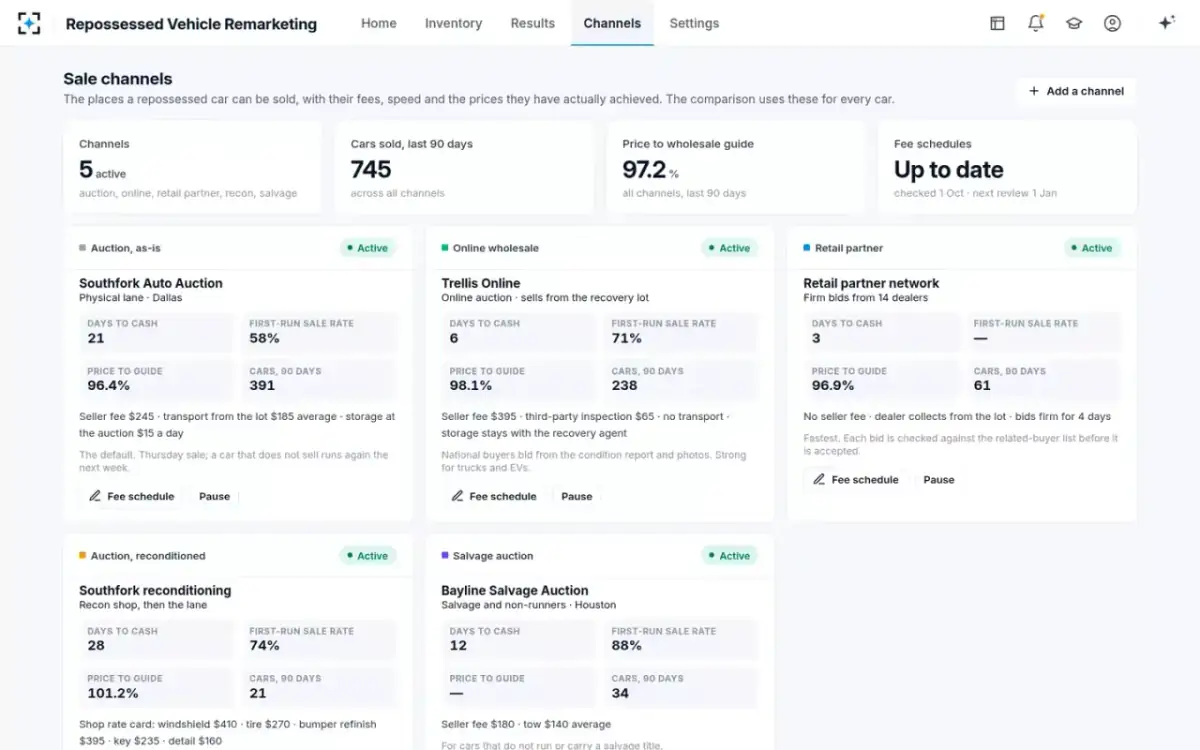
The reason is that fee stacks are not symmetrical. On the sample lender's five channels, they decompose quite differently: the physical lane charges a $245 seller fee, needs the car trailered at $185 on average, and then charges $15 a day to hold it until its run; the online wholesale channel charges $395 plus a $65 third-party inspection but needs no transport, because the car is sold from the recovery lot; a retail partner's firm bid carries no seller fee at all because the dealer collects the car; the reconditioning route adds a shop rate card — $410 for a windshield, $270 a tyre, $395 for a bumper refinish, $235 for a key, $160 to detail; and the salvage channel charges $180 plus a $140 tow.
Three things follow for anyone assembling this. Record the unit, not just the amount — "$15 a day" and "$185 per move" behave completely differently in a comparison. Record what each fee replaces: the online channel's higher seller fee is not worse than the lane's lower one, because it comes with no transport line. And record when each schedule was last checked, with a date for the next review; the sample lender's channels screen carries "checked 1 Oct · next review 1 Jan" at the top for exactly this reason. A comparison running on last year's fees is confident arithmetic on stale inputs, which is worse than no comparison at all.
Five channels, each with the fees, speed and achieved prices a comparison runs on
What data does a remarketing system need, and how far back?
For the comparison itself, only the current car and the current fee schedules. For evidence that the comparison is any good, a trailing quarter of closed sales — and that second requirement is the one worth planning for, because it is what turns a demonstration into a measurement.
745sales
closed in ninety days — enough to replay every channel, including the thin ones
5channels
with their own fee stacks, days to cash and first-run sale rates
97.2%
of wholesale guide achieved across all channels over the same ninety days
21cars
in the thinnest channel — the reason ninety days is the floor, not the target
Each closed sale needs six fields to be replayable: the car and its condition at the decision date, the balance owed then, the channel it actually went to, the date it sold, every cost deducted, and the net it produced. If a lender's history carries gross proceeds but not the cost lines, the replay can only score price and not net — which is the wrong half, because the whole argument between channels is about costs and dates.
How far back depends on the thinnest channel, not the busiest. On the sample lender's figures the lane and the online channel each have hundreds of sales in ninety days, but the reconditioning route has twenty-one and salvage thirty-four. A quarter is enough to say something about all five; a month would say something about two and flatter them both.
The settings that are yours, not the vendor's
The clearest test of whether a provider is selling a decision system or a decision is where these eight live. If any of them is implicit in the software, the lender has outsourced a policy without noticing.
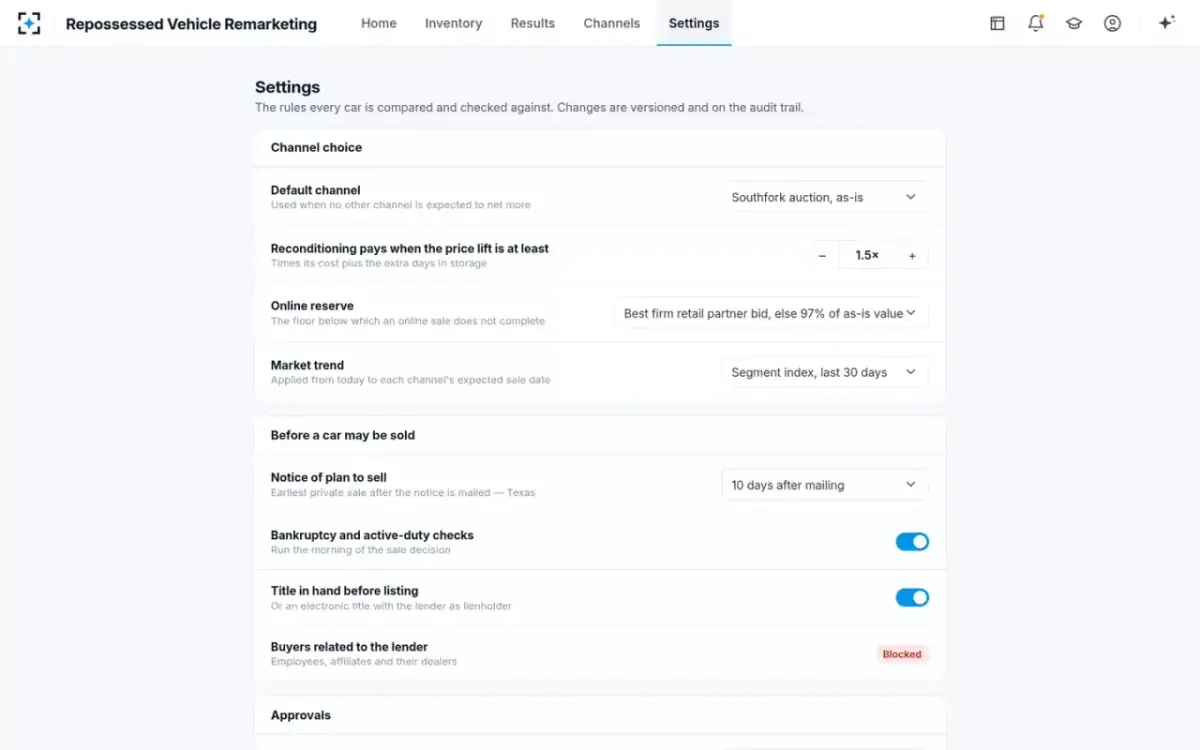
Eight settings a lender has to own, and what each one decides
| Setting | Sample lender’s value | What it decides |
|---|---|---|
| Default channel | The physical auction lane, as-is | Where a car goes when nothing else is expected to net more — and therefore what "a change of channel" means |
| When reconditioning pays | A price lift of at least 1.5× its cost plus the extra days in storage | How much of the book goes through a shop; the single largest cash commitment made before any sale exists |
| Reserve rule | The best firm dealer bid, else 97% of as-is value | The downside the lender is willing to accept, expressed as a rule rather than negotiated per car |
| Market trend window | The segment index, last 30 days | How much recent movement is projected on to each channel’s sale date; a longer window is calmer and slower to turn |
| Notice period before a private sale | 10 days after mailing | The earliest sale date on every notice — a business rule set to the lender’s own state position, not a statement of law |
| Specialist approval limit | $15,000 of expected net, default channel only | How much of the book never reaches the manager, and therefore how much supervision costs |
| Who signs above the limit, and any change of channel | The recovery and remarketing manager | Where accountability for the decision actually sits |
| Buyers related to the lender | Blocked — employees, affiliates and their dealers | A category of sale the lender will not make at all, enforced before anyone can approve it |
Two of these deserve particular attention in a procurement. The reconditioning rule is a cash commitment made before any sale exists, and a provider whose rule is "when the model says so" has made the lender's capital allocation into a model output. And the notice period is a business rule expressing a legal position: it should be visible, versioned and owned by someone who can explain why it is set where it is, because a sale before the date in a notice is the one failure that needs no argument to prove.
The rules every car is compared and checked against, in one place
How do you pilot a remarketing system on your own cars?
In four weeks, on data the lender already owns, without changing where a single car is sold. A pilot that requires the desk to behave differently is a change programme, and it will be judged on the wrong things.
A four-week pilot that measures the decision, not the demonstration
Week 1
Load the fee schedules and the closed sales
Every channel’s seller fee, transport, inspection and storage rate, plus a trailing quarter of sales with what each car actually netted. Nothing is predicted yet.
Week 2
Replay the quarter
Price every closed sale using only what was known on its decision date, in every channel that was open to it. Score the predicted net for the channel actually used against the actual net.
Week 3
Read the disagreements
The cars where the comparison would have chosen differently. For each, what it expected the other channel to net, and whether the evidence behind that is persuasive. This is the week that decides the pilot.
Week 4
Run it live, in parallel
Price this week’s ready cars each morning without changing where they go. Compare the desk’s decisions with the comparison’s, car by car, in a meeting rather than in a report.
Two rules keep a replay honest, and they are the first things to ask a provider to agree to in writing. The comparison may see only what was known on each decision date — not the sale price, not the condition notes added at the lane, not anything discovered afterwards. And the scoring runs on the lender's own fee schedules, not the provider's assumptions, because a comparison scored against generous fees will look better than it will behave.
What to expect from the result is also worth agreeing in advance. The honest outcome of a good pilot is not "every car should move"; it is a proportion. On the sample lender's figures, fourteen of one morning's forty-seven ready cars still belonged at the default auction. A pilot that recommends moving everything has usually been scored on price rather than on net — how to replay closed sales, and what a replay must not do.
Nine questions that separate a comparison from a catalogue
Nine questions to put to any vehicle remarketing provider
- Can you price one of our cars in all five of our channels, today?
Not a demonstration on their data. One of ours, with our fee schedules loaded, with the arithmetic visible line by line.
- Where do your fee schedules come from, and who updates them?
If the answer is "we maintain them", ask what happens when a lane changes its seller fee in March. The right answer is that the lender owns them and the date of last check is on the screen.
- Is the market trend applied to today or to each channel’s sale date?
A car sold in twenty-eight days is sold into a different market than one sold in six. If the trend is not applied per channel, the slowest channel is systematically flattered.
- What does the comparison do with a channel whose fees we have not loaded?
The only safe answer is that it refuses to rank it. A channel ranked on assumed fees produces a confident recommendation built on a guess.
- Does it use retail asking prices anywhere?
Listings are plentiful and systematically above the wholesale market a repossessed car is sold into. One of them inside a valuation biases every car in the same direction.
- What does it refuse to do without a person?
Ask for the written limits. Choosing a channel, ordering reconditioning, listing a car and sending a letter to a borrower should all be on that list.
- What does it keep with each sale if the sale is challenged?
The channels compared, the figures with their sources, the reason, the checks and the signed approval — assembled at the moment of the decision, not reconstructed afterwards.
- Can we run it in parallel for a month without changing anything?
A provider who cannot price this week’s cars alongside the existing desk is asking to be trusted before being measured.
- What happens to our data and our settings if we stop?
Ask for the export format and try it during the pilot. A fee schedule that can only be read inside the product is a fee schedule the lender has lent out.
What goes live first, and what waits
Sequencing matters more than scope, because the fastest thing to switch on is also the one that proves the rest. Start with pricing every ready car in every channel each morning, with no change to where cars are sent. That requires only the fee schedules, the valuations and the loan balances, and it produces a daily, checkable claim that the desk can argue with.
Second, the sale checks — notice, earliest sale date, redemption, title, bankruptcy, active duty, personal property, related buyers — because they are the cheapest insurance in the operation and they do not depend on anybody accepting a recommendation.
Third, approvals and the reason kept with each sale, which is where the defensibility benefit lands. Article 9 asks that the method of a disposition be commercially reasonable (§ 9-610(b)) and treats conformity with reasonable commercial practices among dealers as one route to showing it (§ 9-627(b)); a file assembled while the decision was made is a much better answer than one assembled when it is questioned.
What waits is everything that needs somebody else to change. Renegotiating fee schedules, consolidating recovery agents, adding a new channel, changing the reconditioning shop: all reasonable, none of them a precondition, and each of them easier to argue for once there is a daily number showing what the current arrangement costs.
A listing tool against a channel comparison
Listing and workflow software: Getting the car listed quickly and tracked accurately.
A channel comparison: Where the car is listed, measured as net recovery after every cost at each channel’s own sale date.
Listing and workflow software: Vehicle details and photographs.
A channel comparison: The same, plus every channel’s fee schedule, your storage rates and the balance owed.
Listing and workflow software: A listing, and a status.
A channel comparison: A ranked set of plans per car, each with its price, costs, days to cash and recovery of balance.
Listing and workflow software: Nothing changes; fees are not part of the decision.
A channel comparison: Every car on the lots is repriced, and some change channel.
Listing and workflow software: A record that the car was listed and sold.
A channel comparison: The channels compared, the evidence behind each figure, the reason and the signed approval.
Listing and workflow software: No opinion — the default is wherever it was configured.
A channel comparison: Says so, with the margin: on one sample morning, fourteen of forty-seven cars stayed at the auction.
What you keep when you leave
Ask this first, not last, because the answer shapes everything else. Three assets are created during an implementation, and all three should be the lender's.
The fee schedules and settings, in a format readable outside the product. These are a description of the lender's own commercial arrangements and its own policy; a provider that holds them hostage has sold a subscription to the lender's own facts. Test the export during the pilot rather than reading about it in a contract.
The sale record for every car: the channels compared, the figures with their sources, the reason, the checks and the approval. This is the material that answers a challenge, and challenges arrive after relationships end. It has to be exportable and readable on its own, without the system that produced it.
And the measurement history — each sale against the plan it was given, by channel and by month. It is the only evidence a lender will ever have about which channel decisions worked, and it is worth more in year three than in year one. Finance will want it in the same shape it already uses: the federal retail classification policy values collateral at "the value of the collateral, less cost to sell" (FFIEC Uniform Retail Credit Classification and Account Management Policy), which is the same net figure the desk ranks channels on, and keeping the two in one place is most of what makes the series usable — the recovery-rate series worth building.
To see the six inputs, the eight settings and a replay on a lender's own closed sales, start from Repossessed Vehicle Remarketing.
Questions people ask
What should vehicle remarketing software do?
At minimum: hold every channel's fee schedule and storage rate, value each car from guide values and recent comparable sales, apply a market trend to each channel's own expected sale date, subtract every cost to produce a net recovery and days to cash per channel, run the checks that decide whether a car may be listed at all, and keep what was compared and why with the sale. Anything that produces one value and one destination has not done the part that moves the recovery rate.
What do you need to set up a remarketing system?
Six inputs, four of which already exist inside the lender: field inspections with photographs; wholesale guide values and recent sale results; every sale channel with its fees, transport and storage; the loan servicing system for balances and fees owed; the notice file and title status; and the recovery agents with their lots, daily storage rates and days held. The fee schedules are the input that usually takes the longest, because few lenders hold them in one place in a form arithmetic can run on.
How long does it take to implement remarketing software?
The useful question is how long until the first checkable claim. Pricing every ready car in every channel each morning needs only fee schedules, valuations and balances, and can run in parallel without changing where any car is sent — a four-week pilot is a reasonable plan. The longer items are the ones that need other people to change: renegotiating fees, consolidating agents, adding channels. None of those is a precondition.
How do you compare remarketing providers?
On one test, run twice. Ask each to price the same car of yours in all of your channels with your fee schedules loaded, and look at whether the arithmetic is visible line by line. Then ask each to replay a trailing quarter of your closed sales using only what was known on each decision date, scored on net rather than price. A provider that will do neither is asking to be trusted before being measured.
Can remarketing software work with our existing auctions?
It should require them. The comparison is only meaningful across the channels a lender actually has, with their real fee stacks — a lane's seller fee and transport, an online channel's fee and inspection, a dealer bid with no seller fee at all. A provider that works only with its own disposal channels is selling capacity, not a comparison, and the two should be priced separately.
Who on our side has to be involved?
Fewer people than a typical system purchase. Someone who can produce the fee schedules and storage agreements, someone from servicing who can supply balances and fees owed, whoever owns the notice and title file, and the manager who will actually sign the decisions. The last of those matters most: a comparison nobody with signing authority has argued with during the pilot will be ignored after it.