A deficiency balance after repossession is what is left of a car loan once the lender has sold the car and applied the money: the amount owed, plus the reasonable costs of taking, holding and selling the vehicle, minus the net sale proceeds. The federal consumer regulator's plain-words version is the one most people meet first — "The difference between what you owe on your contract (plus certain expenses) and what your lender gets for selling the car is called a deficiency" (FTC, Vehicle Repossession). Behind that sentence is an order of application and a required explanation, both written into the Uniform Commercial Code, and Botminds' Repossessed Vehicle Remarketing keeps every line of them with the sale that produced them.
The worked examples use a fictional sample lender, Harlow Ridge Auto Finance, as it runs through the solution. The market figures come from the Consumer Financial Protection Bureau's study of 905,000 real repossession sales, linked where they appear.
What a repossession sale usually leaves behind
94%
of 905,000 repossession sales ended with a deficiency balance
$11,340
mean deficiency balance in December 2022, up from $7,971 a year earlier
$367
mean disposal fee charged to near-prime consumers, against $300 for superprime
What a deficiency balance is, and what it is not
It is not the loan balance on the day the car was taken. Three things happen between that moment and the letter. Costs are added: towing, storage, the inspection, the auction's seller fee, transport, any reconditioning, sometimes attorney's fees where the contract allows them. Money comes in: the sale proceeds, and any refund of unearned premiums on products that terminated when the loan did. And interest and fees may continue to accrue under the contract until the account is settled.
It is also not a number the lender chooses. The statute fixes the order the money is applied, specifies what counts as a cost, and — in a consumer-goods transaction — specifies what the written explanation has to say and in what sequence. Where there is money left over, it goes the other way: "the secured party shall account to and pay a debtor for any surplus; and … the obligor is liable for any deficiency" (§ 9-615(d)). Surpluses are rare: in the Bureau's dataset six per cent of sales ended without a deficiency at all, and only part of that six per cent will have left anything over. The same arithmetic produces both.
The order the money is applied, by statute
UCC § 9-615(a) sets a waterfall, and the order matters because it decides who absorbs the costs. Cash proceeds are applied first to "the reasonable expenses of retaking, holding, preparing for disposition, processing, and disposing, and, to the extent provided for by agreement and not prohibited by law, reasonable attorney's fees and legal expenses incurred by the secured party"; then to the obligation the sale was made under; then to any subordinate lien whose holder has demanded the proceeds in writing.
Where a repossession sale’s money goes, in the order the statute sets
| Order | What it pays | Why it is there |
|---|---|---|
| 1 | Reasonable expenses of retaking, holding, preparing for disposition, processing and disposing — plus attorney’s fees where the agreement provides for them and the law allows them | The costs of the sale come out of the sale, so a lender that spends more on the sale reduces what is left for the loan. This is the line that makes the channel choice part of the borrower’s arithmetic. |
| 2 | The obligation secured by the security interest the sale was made under | The loan itself. What is not covered here becomes the deficiency; what is left over moves on. |
| 3 | Any subordinate security interest or lien, if its holder has sent a written demand before distribution is complete | Second lienholders do not get paid automatically; they have to ask, in time. |
| 4 | A consignor with an interest in the collateral, on the same written-demand condition | Rare for vehicles, but it sits in the same list. |
| Then | Surplus to the debtor, or deficiency owed by the obligor | § 9-615(d): one or the other, and the lender has to account for a surplus rather than keep it. |
Notice what line 1 does to the comparison between sale channels. Every dollar of seller fee, transport, inspection and storage is paid before the loan is touched, so two channels with the same gross price produce different deficiencies. Choosing between an auction lane, an online sale and a dealer's bid is therefore not only the lender's economics; it moves the figure on the borrower's letter.
What counts as a reasonable expense
The statute uses one word — "reasonable" — and leaves the rest to the facts. Three practical boundaries do most of the work. A cost has to be actually incurred for this car: a flat internal fee applied to every repossession regardless of what was billed is a different thing from a towing invoice. A cost has to be authorised, by the agreement or by law; attorney's fees are only in the waterfall "to the extent provided for by agreement and not prohibited by law". And a cost has to belong to this stage: storage runs while the lender holds the car, and stops when it is sold, not when the letter is written.
The costs most often disputed are the ones furthest from the sale itself. Examiners have found servicers charging consumers for force-placed insurance for periods after the repossession, when the coverage had already terminated, and withholding personal property from the car until a fee was paid. The second is worth stating plainly: the contents of the car belong to the borrower, and are not collateral.
The six lines a deficiency explanation must carry
In a consumer-goods transaction the lender does not just send a figure. § 9-616 defines an "Explanation" as a writing that "(A) states the amount of the surplus or deficiency; (B) provides an explanation … of how the secured party calculated the surplus or deficiency; (C) states, if applicable, that future debits, credits, charges … may affect the amount", and gives a telephone number or address for more information. The calculation itself has to provide six specified items "in the following order".
UCC § 9-616(c): the six lines, in the order the statute requires
| # | What the line has to state | On the sample truck |
|---|---|---|
| 1 | The aggregate amount of obligations secured, with any rebate of unearned interest indicated, calculated as of a date no more than 35 days before the lender took possession | $38,940 — principal $37,186 plus interest, fees and the repossession fee |
| 2 | The amount of proceeds of the disposition | $26,600 gross, the price at the online wholesale sale |
| 3 | The aggregate amount of the obligations after deducting the proceeds | $12,340 before the costs of the sale are added |
| 4 | The amount and types of expenses — retaking, holding, preparing for disposition, processing, disposing, and attorney’s fees — known to the lender and related to this disposition | $670: seller fee $395, third-party inspection $65, storage $210 |
| 5 | The amount and types of credits, including rebates of interest or credit service charges, the borrower is known to be entitled to and that are not already in line 1 | Any refund of unearned premiums on products that terminated with the loan |
| 6 | The amount of the surplus or deficiency | $13,010 |
Two timing rules sit alongside the content. The explanation has to be sent "before or when the secured party … first makes written demand on the consumer obligor after the disposition for payment of the deficiency", and separately "within 14 days after receipt of a request" from the borrower. A borrower is entitled to one free response in any six-month period in which the lender has not already sent an explanation; for an additional response the lender "may require payment of a charge not exceeding $25".
The sample truck, worked line by line
The arithmetic is easier to trust when it is written as a sum rather than as a letter. Four terms produce the figure, and only one of them is fixed on the day the car is taken.
A deficiency, written as a sum
What was owed
principal + accrued interest + contract fees + the repossession fee
Calculated as of a date no more than 35 days before the lender took possession, with any rebate of unearned interest shown.
Loan servicing
Costs of the sale
+ retaking + storage + preparation + the channel’s fees + transport
Only what was actually incurred for this car, and only what the agreement and the law allow. Every one of these is a choice somebody made.
Recovery and remarketing
Sale proceeds
− the price the car actually fetched
The largest single term, and the one the channel decision moves. On the sample truck, $1,000 of gross price separated the best channel from the usual one.
Recovery and remarketing
Credits owed back
− rebates and unearned premiums on products that ended with the loan
Refunds of unearned premiums on cancelled add-on products should reduce the deficiency, not be paid out separately after it.
Loan servicing
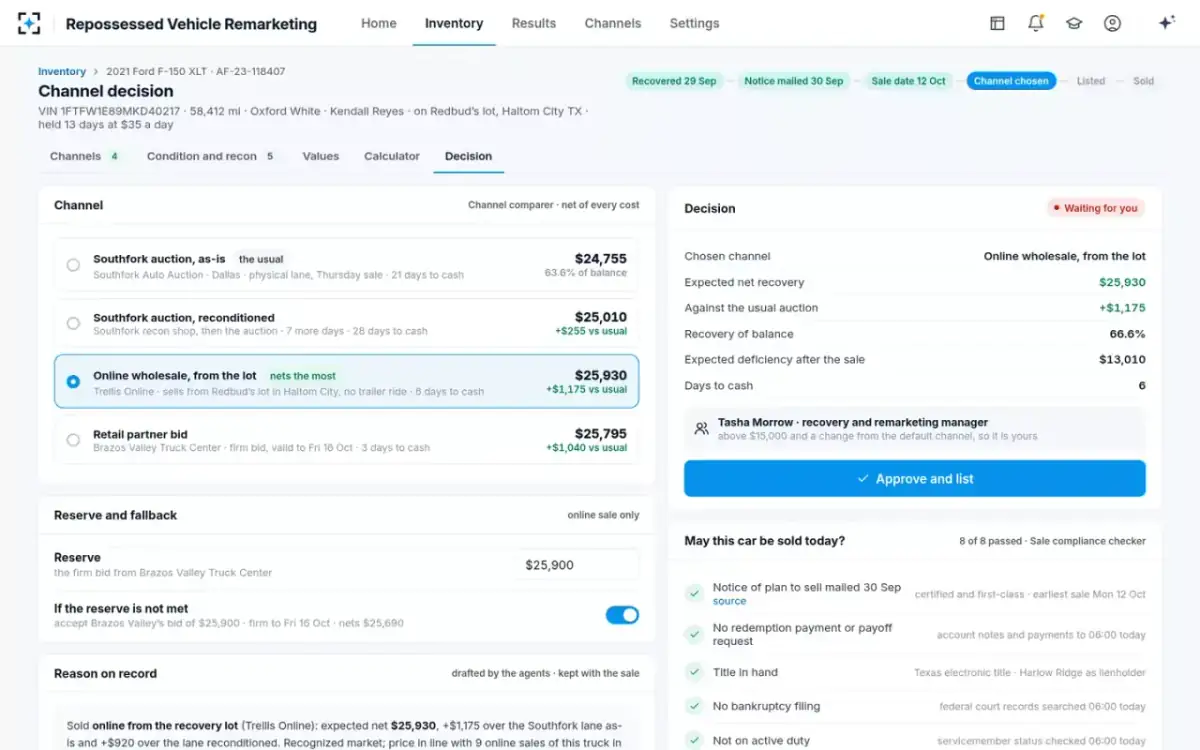
On the sample truck the four terms land at $38,940 owed, $670 of sale costs, $26,600 of proceeds and no outstanding credits, leaving $13,010. The channel decision is visible inside those terms rather than beside them. Sold at the usual auction lane instead, the same truck would have fetched $25,600 with $845 of costs — a deficiency of $14,185, about $1,175 more. The borrower's letter and the lender's loss move together, in the same direction, by the same amount.
The expected shortfall, shown before the car is listed
What a deficiency looked like across 905,000 sales
The best public picture of the outcome comes from the Consumer Financial Protection Bureau's auto finance data pilot, which collected servicing records from nine lenders covering just over 33 million originations between 2018 and 2022 — about 14.6% of the market in that period. Of the 905,000 disposals in that dataset, "94 percent ended with a deficiency balance". A repossession sale that clears the loan is the exception, not the rule.
The size of the shortfall moved with used-car prices, and it moved a long way. Mean deficiency balances among accounts that had one fell 27% from $10,544 in November 2020 to $7,692 in September 2021 as prices rose, then rose 47% from that low to $11,340 by the end of 2022 as prices fell. The median tracked lower for most of the period and then overtook the mean, falling from $9,833 to $6,660 and recovering to $11,620 by December 2022.
Mean deficiency balance moved with the used-car market, not with lending
That is worth sitting with, because it is the strongest available argument that the channel decision matters. Nothing about underwriting changed between September 2021 and December 2022. What changed was what a repossessed car fetched, and the mean shortfall rose by nearly half. A lender cannot control the market; it can control which market it sells into, how fast, and what it spends getting there — and what a repossessed car actually fetches in each channel is measurable on its own closed sales.
The refunds that should have reduced it
Line 5 of the explanation — credits the borrower is known to be entitled to — is the line most often got wrong, and it has a specific, recurring cause. Add-on products sold at origination, such as service contracts and credit insurance, are usually paid as a lump sum financed into the loan. When the loan terminates early, the unused portion is refundable, and in a repossession "the refund amount should be applied to any deficiency balance, and the borrower receives any remaining refund amount" (CFPB Supervisory Highlights, Issue 35, Fall 2024).
Examiners found that in practice it frequently was not. In one matter, "refunds were applied an average of 84 days after the post-repossession sale of the vehicle sale, with at least one up to 423 days afterwards"; in another the delays ran from 150 to 664 days. Others miscalculated the amount by using "the date of a deficiency notice for making a pro rata calculation instead of the date of the repossession". A deficiency letter sent before the refund lands is a letter demanding a figure that is already wrong.
What changes the number before the letter is written
Five things move the deficiency, and four of them are decided before the car is sold. The channel, which sets both the price and most of the costs. The days held, because storage runs every day and because the market moves under the car while it waits. Whether reconditioning was done, which adds cost in exchange for price and is only worth it when the lift clears the spend. Whether the car was redeemed — the borrower may redeem "at any time before a secured party … has disposed of collateral or entered into a contract for its disposition" (§ 9-623(c)), by paying the full obligation and the reasonable expenses, which ends the arithmetic altogether. And then the credits, which arrive afterwards and should have been there first.
The fifth is the one nobody plans: whether the sale itself holds up. If the borrower puts the lender's compliance in issue and the lender cannot prove the sale was conducted properly, the deficiency it may collect is limited by statute and, in the usual case, collapses to nothing — which is what the commercially reasonable standard really costs.
What to check on a deficiency letter, from either side of it
- Does it show the six lines, in order?
§ 9-616(c) specifies both the items and the sequence. A letter that states only a total is not an explanation within the meaning of the section.
- Is the obligation dated within 35 days of possession?
Line 1 has to be calculated as of a date no more than 35 days before the lender took the car, so a figure rolled forward to the letter date is the wrong figure.
- Are the expenses itemised, or at least typed?
The statute allows the amounts "in the aggregate or by type", but the types have to be named. "Fees $1,200" names nothing.
- Do the proceeds match the sale?
Line 2 is the gross proceeds of the disposition; the channel’s costs belong in line 4, not netted silently against line 2.
- Have the refunds been applied?
Unearned premiums on add-on products that terminated with the loan reduce the deficiency. Check the date used for the pro rata calculation is the repossession date.
- Was a request answered within fourteen days?
A borrower may request an explanation, and the lender has fourteen days. One response in any six-month period is free; a further one may carry a charge of up to $25.
Every sale against its plan, with the explanations drafted and waiting for a person
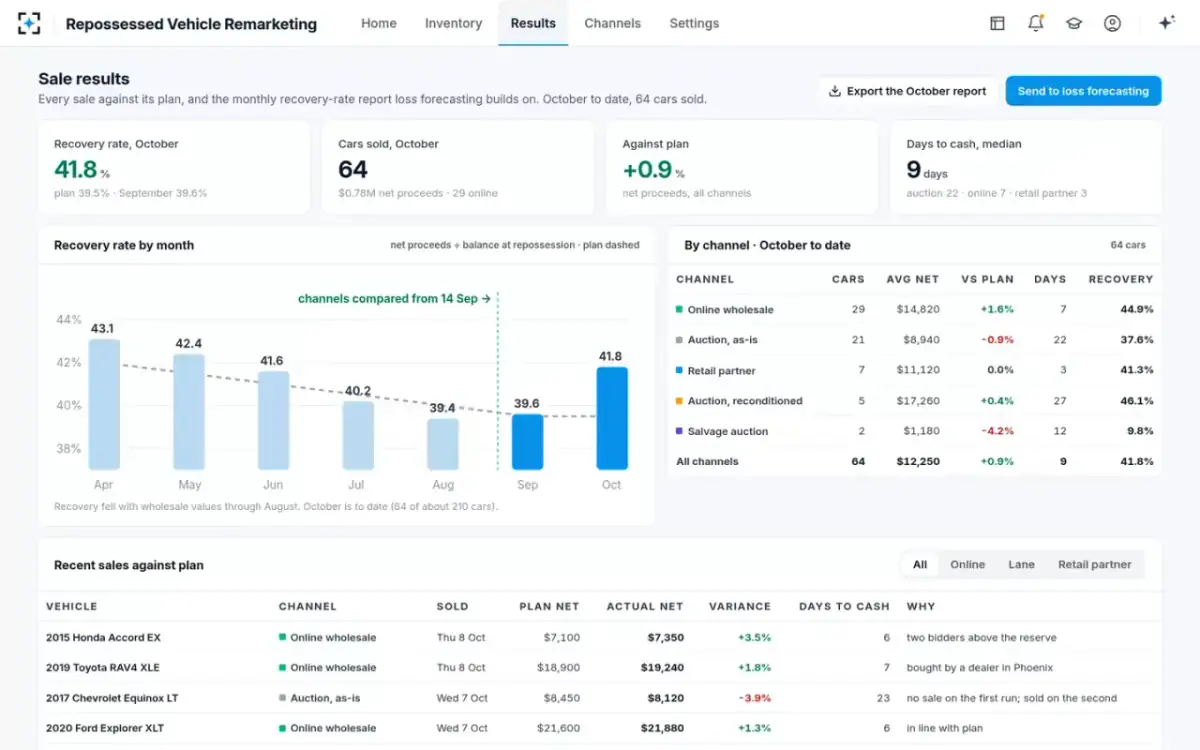
To see the shortfall worked out at the moment the channel is chosen, start from Repossessed Vehicle Remarketing.
Questions people ask
How is a deficiency balance calculated after a car is repossessed?
Take what was owed, add the reasonable costs of retaking, holding, preparing and selling the car, subtract the sale proceeds, and subtract credits such as refunds of unearned premiums on products that ended with the loan. UCC § 9-615(a) fixes the order the proceeds are applied in; § 9-616(c) fixes the six lines the written explanation must show, and the sequence they appear in.
What is the average deficiency balance on a repossessed car?
In the Consumer Financial Protection Bureau's study of 905,000 repossession sales from nine lenders, the mean deficiency among accounts that had one was $11,340 in December 2022, having fallen to $7,971 a year earlier when used-car prices were high. The median was $11,620 in December 2022. These figures are from 2018 to 2022 data and move with the used-car market rather than with lending.
Can a lender add storage and auction fees to the deficiency?
Yes, if they are reasonable and actually incurred: § 9-615(a)(1) puts "the reasonable expenses of retaking, holding, preparing for disposition, processing, and disposing" first in the waterfall. Attorney's fees are included only "to the extent provided for by agreement and not prohibited by law". A flat internal fee unrelated to what was billed, or storage charged for days after the sale, is a different matter.
How long does a lender have to send the explanation?
In a consumer-goods transaction, before or when it first makes written demand for the deficiency after the sale, and separately within fourteen days of receiving a written request from the borrower. A borrower is entitled to one free response in any six-month period in which no explanation has been sent; the lender may charge up to $25 for an additional one.
What happens if the car sells for more than the loan?
The excess is a surplus, and § 9-615(d)(1) requires the lender to account to the borrower and pay it over — after the expenses in the waterfall and after any subordinate lienholder who has demanded the proceeds in writing. Surpluses are uncommon: in the Bureau's dataset only six per cent of sales ended without a deficiency of any size, and that share shrank as used-car prices fell through 2022, reaching five per cent by the end of that year.
Can a deficiency balance be challenged?
It can, and the challenge is usually not about arithmetic but about the sale. If the borrower puts the lender's compliance with Article 9 in issue, the lender carries the burden of proving the sale was conducted in accordance with it. If it cannot, the statute presumes a complying sale would have realised the whole obligation plus expenses and fees, so the collectable deficiency falls to zero unless the lender proves a lower figure.