Banks and finance companies sell repossessed cars through wholesale channels, not to the public: the physical auction lane is still the default, but the same car can be sold online straight from the recovery lot, sold on a firm bid from a dealer the lender already works with, reconditioned first and then run through the lane, or — if it will not run or carries a salvage title — sent to a salvage sale. Which one is chosen decides a few points of recovery on every car, and those points are the loss line. Botminds' Repossessed Vehicle Remarketing prices each ready car in every channel, net of fees, transport, reconditioning and storage, so the remarketing manager sees four plans side by side before she signs one.
The lender in the examples is fictional: Harlow Ridge Auto Finance, 186 repossessed cars on four lots, as it runs through the solution on sample data. The rules quoted are the Uniform Commercial Code as adopted in almost every state; the market figures come from the federal government's own statistics, linked where they appear.
One lender's five channels, over ninety days
745
cars sold across all five channels in ninety days
97.2%
of the wholesale guide value, averaged across every channel
5days
between the fastest channel and the usual lane, on the same truck
The law starts the clock, not the auction
Nothing is sold the day the car comes off the truck. After default a secured party "may sell, lease, license, or otherwise dispose of any or all of the collateral in its present condition or following any commercially reasonable preparation or processing" (UCC § 9-610(a)) — and before it does, it "shall send … a reasonable authenticated notification of disposition" to the debtor and any secondary obligor (§ 9-611(b)). The notification has to state the method of disposition and either the time and place of a public sale or the time after which a private sale may be made.
Two things follow for the channel decision, and both are often missed. First, the borrower may redeem the car "at any time before a secured party … has disposed of collateral or entered into a contract for its disposition" (§ 9-623(c)), so the listing date is the borrower's deadline as much as the lender's. Second, the notice names a method; changing the method after the notice has gone out is not a free decision. A lender that intends to weigh channels car by car has to say so in a notice that covers what it may actually do.
Whatever the method, the money lands in the order the statute sets: "the reasonable expenses of retaking, holding, preparing for disposition, processing, and disposing" come first, then the secured obligation, then any subordinate lien (§ 9-615(a)). Every fee in the tables below is paid before a dollar touches the borrower's balance, which is why "what did it sell for" is the wrong question and what a repossessed car nets after every cost is the right one.
The four channels a repossessed car can go to
Four of the five channels below sell the car as a car. They differ in who bids, how far the car has to travel, who holds it while it waits, and how long the money takes to arrive. The figures are one lender's, measured over ninety days on its own lots; every lender's numbers differ, and that is exactly the point — the comparison only works on your own fee schedules.
Five channels, measured over ninety days on one lender's lots
| Channel | Days to cash | Sells on the first run | Price to guide | What it costs the lender |
|---|---|---|---|---|
| Auction, as-is — a physical lane | 21 | 58% | 96.4% | Seller fee $245 · transport to the lane $185 · storage at the auction $15 a day. Thursday sale; a car that does not sell runs again the next week. |
| Online wholesale — sold from the recovery lot | 6 | 71% | 98.1% | Seller fee $395 · third-party inspection $65 · no transport. Buyers bid nationally from the condition report and photos. |
| Retail partner — a dealer’s firm bid | 3 | — | 96.9% | No seller fee; the dealer collects from the lot. Bids are firm for four days and are checked against the related-buyer list before they are accepted. |
| Auction, reconditioned first | 28 | 74% | 101.2% | The lane’s costs plus the shop: windshield $410, tyre $270, bumper refinish $395, second key $235, detail $160, and seven more days of storage. |
| Salvage auction | 12 | 88% | — | Seller fee $180 · tow $140. For cars that do not run or carry a salvage title; no guide value applies. |
Read the price-to-guide column against the days column and the shape of the problem appears. The lane is the slowest of the three as-is channels and the weakest against guide, because a car that fails its first run sits a week and goes again with a history. Online is faster and dearer because the bidder pool is national rather than whoever walks the lane on a Thursday. The retail partner is the fastest and the surest, because a firm bid is a price with no auction risk in it — and the dearest to get wrong, because there is only one bidder.
Reconditioning first is a different kind of channel: it buys a higher price with cash and days. At 101.2% of guide it is the only line above the guide value, and it is still the wrong answer for most cars, for reasons set out below.
The fifth channel, when a car cannot be sold as a car
Salvage is not a worse version of the lane; it is a different market with different buyers, and it is where a car goes when the alternative is a car nobody will bid on. In the sample lender's ninety days, 34 of 745 cars went this way and sold on the first run 88% of the time — the highest first-run rate of any channel, because salvage buyers price from a parts list rather than from a condition grade. There is no price-to-guide figure because a wholesale guide value does not apply to a vehicle that will be dismantled.
The practical trap is the car that sits between the two markets: it runs, it has a clean title, and its reconditioning estimate is larger than the lift it would buy. Sending it to the lane produces a weak sale and a long wait. Sending it to salvage throws away the difference. The honest answer is usually the retail partner, where a dealer who wants that specific car for its own front line prices it on what it is worth to them rather than on what it grades.
Why most cars still go to the physical lane
Three forces hold the default in place, and only one of them is about price. The first is paperwork: transport is booked, the lane's account is open, the title flow is understood, and nobody has to explain a change. The second is time. Weighing a car means pricing it in each channel after fees, transport, reconditioning and the storage it will accrue while it waits — and a recovery desk with 186 cars and four lots has no hours for that, car by car, every morning.
The third is that the central regulator's own description of the market is the lane. The Consumer Financial Protection Bureau, reporting on 905,000 repossession disposals from nine lenders, puts it plainly: "If the disposal is done through a sale, lenders are generally required to use a commercially reasonable process, which for many lenders is through an auction" (CFPB, Repossession in Auto Finance, January 2025). That is an accurate description of practice, not a requirement; the statute allows "public or private proceedings, by one or more contracts, as a unit or in parcels, and at any time and place and on any terms" (§ 9-610(b)).
There is also an accounting reason to care, which cuts the other way. Under the federal banking agencies' retail classification policy, a closed-end retail loan 120 days past due is classified loss and charged off, but "loans with non-real estate collateral may be written down to the value of the collateral, less cost to sell, if repossession of collateral is assured and in process" (FFIEC Uniform Retail Credit Classification and Account Management Policy). The write-down a finance team books and the figure a remarketing desk should be optimising are the same figure: value less cost to sell. If the desk routes by habit and finance estimates cost-to-sell from the lane, the two agree — and both are wrong on the same cars.
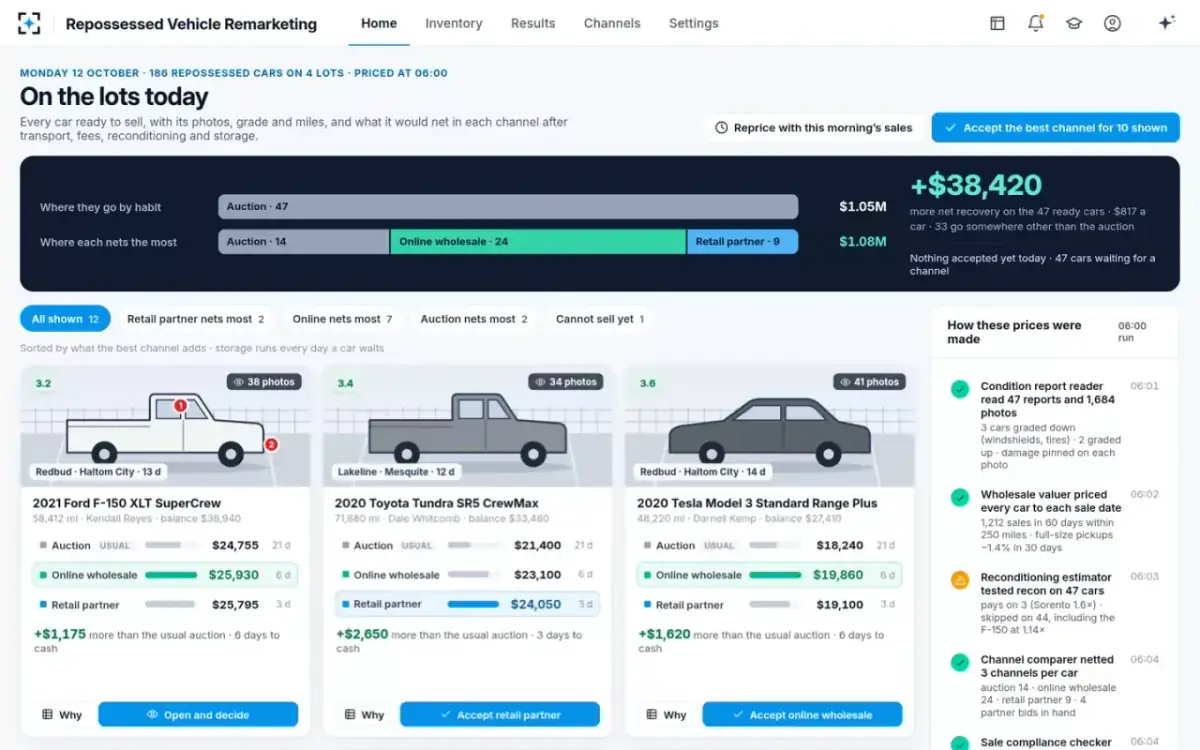
The same forty-seven cars, routed by habit and routed by net
By habit · all 47 to the lane · $1.05M
- Auction, as-is · 47 cars · 100%
By net recovery · $1.08M
- Auction · 14 · 29.8%
- Online wholesale · 24 · 51.1%
- Retail partner · 9 · 19.1%
What “net” means: the lines between the hammer price and the money a lender banks
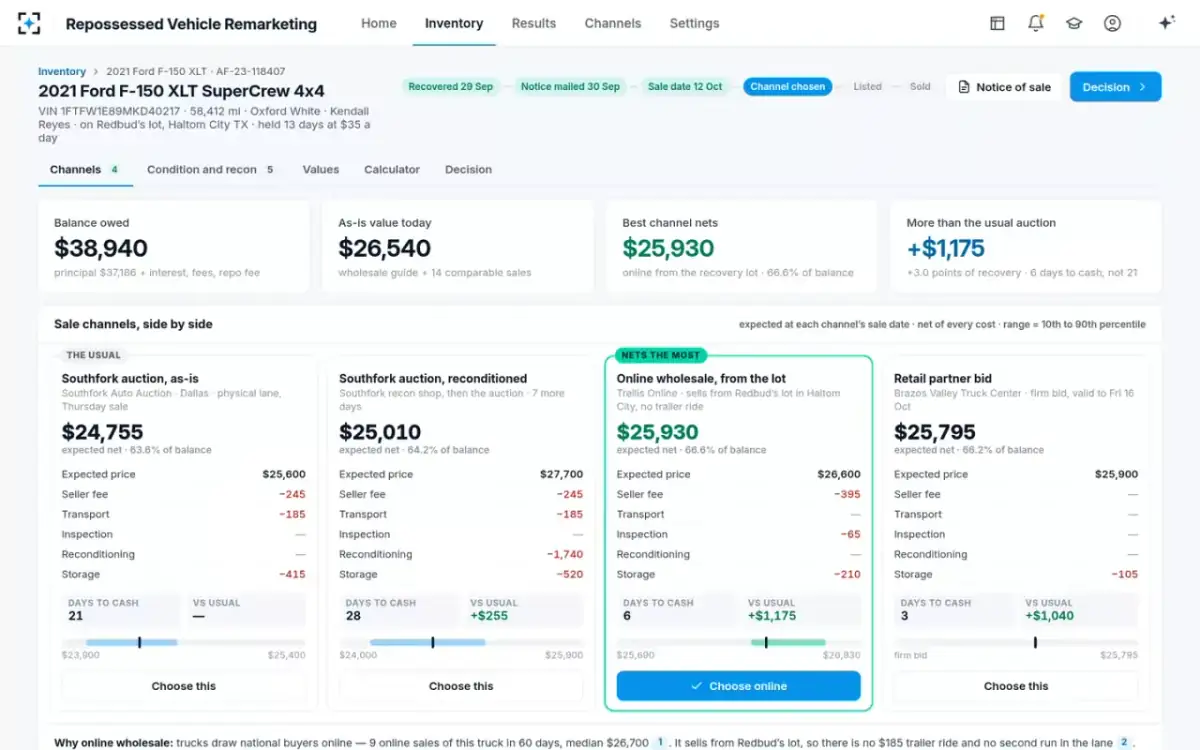
Every channel has a price and a stack. On one truck from the sample lots — a 2021 Ford F-150 XLT SuperCrew, 58,412 miles, grade 3.2 of 5, balance owed $38,940, held thirteen days at $35 a day on a recovery agent's lot — the four plans look like this. The as-is value today is $26,540; the expected price differs by channel because the sale dates differ and the bidders differ.
One truck, four plans, each net of every cost
| Plan | Expected price | Fees and costs | Net to the lender | Days to cash |
|---|---|---|---|---|
| Auction, as-is | $25,600 | Seller fee −$245 · transport −$185 · storage −$415 | $24,755 | 21 |
| Auction, reconditioned | $27,700 | Seller fee −$245 · transport −$185 · recon −$1,740 · storage −$520 | $25,010 | 28 |
| Online wholesale, from the lot | $26,600 | Seller fee −$395 · inspection −$65 · storage −$210 | $25,930 | 6 |
| Retail partner, firm bid | $25,900 | No seller fee · storage −$105 | $25,795 | 3 |
The storage line is the one that quietly decides several of these. It is not a flat charge; it runs for every day between today and the day the money arrives, and it runs at a different rate depending on who is holding the car. Twenty-one days at the lane is not twenty-one days of the same cost as six days online, and a reconditioned car pays for the shop's days on top.
The lane's expected price is also not the lane's median price. On this truck the lane median for comparable sales was $26,450, from which the solution subtracted $390 for the market trend out to a sale three weeks away and $460 for the risk that the truck does not sell on its first run — which, on this lender's own figures, happens to 42% of cars in the lane. That second deduction is the honest version of a number most comparisons leave out.
Does online really beat the lane?
On this lender's ninety days, yes, by 1.7 points of guide value and by fifteen days — but not on every car, and the exceptions are predictable. Online wholesale sells from a condition report and photographs, so it rewards vehicles whose condition can be shown and whose buyers are national: trucks, four-wheel drives, electric vehicles, anything where the nearest physical lane has thin local demand. It penalises cars whose problems are hard to photograph and easy to smell, and cars so ordinary that a local lane's volume is itself an advantage.
The sample lender's mix moved from no online sales at all to 58% of channel choices in five weeks, which is a mix change, not a market change. That is the risk in reading any single recovery figure: a rate can rise because the channels got better or because the cars got better, and the two look identical in one number. Separating them is the job of a replay of your own closed sales, not of a dashboard.
Four channels for one truck, side by side
When reconditioning first is the right channel
Reconditioning is the only channel that spends money to move the price, so it needs a test rather than a hunch. The sample lender's test is a setting: the price lift has to be at least 1.5 times the reconditioning cost plus the extra days in storage. On the F-150 the shop quoted $1,740 for five items — a fourteen-inch windshield crack, front bumper scuffs, two front tyres at 3/32 of an inch, a second key, and an interior detail — and seven more days at $15 a day, so $1,845 all in. The lift from grade 3.2 to 3.9 was worth $2,100 in the lane. That is 1.14 times, under the rule, so the truck went as-is with the damage disclosed in the condition report.
Two notes on the test that matter more than the threshold. It has to be computed per channel, because the lift is not the same everywhere: on this truck the same work was worth $2,100 in the lane and only $1,500 online, where buyers price the report rather than the walk-round. And the days have to be in the denominator. Work that pays for itself on price alone can still lose money once the car has spent a week in a shop and the market has moved under it.
How a lender chooses, car by car
The decision is six steps, and only one of them is a judgement. Reading the condition report and its photographs, pricing the reconditioning items, valuing the car against recent comparable sales, building a plan for each channel, and running the checks that say whether the car may be sold at all are all mechanical — they are slow by hand because there are forty-seven cars, not because any one of them is hard. Choosing, and carrying the reason, is not mechanical.
Six steps from a recovered car to a listed one, and the step a person keeps
Agent
Condition report readerReads the field inspection and its photographs: grade, damage, tyres, keys, warning lights, odometer and personal property.
Never: Never guesses damage it cannot see in a photo.
Agent
Reconditioning estimatorPrices each item from the shop rate card and tests whether the work pays in each channel.
Never: Never orders work.
Agent
Wholesale valuerValues the car from guide values and comparable sales, adjusted for miles, condition, region and the trend to each sale date.
Never: Never relies on one source; never uses retail asking prices.
Agent
Channel comparerBuilds a plan for every channel — price, fees, transport, inspection, recon, storage and days to cash — and ranks them on net recovery.
Never: Never ranks a channel without its fees on file; never lists a car without an approval.
Agent
Sale compliance checkerChecks the car may be sold: notice and its earliest sale date, redemption, title, bankruptcy, active duty, personal property and related buyers.
Never: Never lets a car be listed before the earliest sale date.
A person decides
Recovery and remarketing managerChooses the channel, sets the reserve and the fallback, and signs with the reason kept beside the sale.
On the sample lots the five agents take sixty-three seconds for one car and run the whole ready list before six in the morning. What the manager sees at her desk is not a recommendation with a confidence score but four priced plans, each with the sales it was priced from, and a reason already drafted. She accepts or she does not, and the reason she gives is the part that has to survive a challenge.
Every ready car, priced in three destinations before the desk opens
What the choice has to leave behind
A channel decision is only finished when it can be explained later. The borrower who receives a shortfall letter may ask how the figure was reached, and the explanation has to carry the proceeds, the expenses and the arithmetic between them — line by line, in the order the statute sets. If the sale itself is ever challenged, the lender carries the burden of showing that every aspect of it was commercially reasonable, and the price alone will not do that.
Five questions to ask of any sale channel before a car goes to it
- Whose fee schedule is this, and when was it last checked?
A comparison built on stale fees ranks the wrong channel. The sample lender re-checks each schedule quarterly and dates the check on the screen.
- Who holds the car, and at what daily rate, until the money arrives?
Storage is not a flat charge. The rate changes when the car moves to a lane, a shop or a dealer’s lot, and it runs until funds land, not until the sale.
- What happens if it does not sell on the first run?
A second run costs another week of storage and sells into a market that has seen the car. Price that risk into the first-run channel, not after it.
- Is the buyer related to the lender in any way?
Employees, affiliates and their dealers change the arithmetic a court will apply to a shortfall. Check the bid against a related-buyer list before accepting it, not after.
- Could the car have been redeemed this morning?
The right to redeem ends when the lender disposes of the car or contracts to dispose of it. Run redemption, bankruptcy and active-duty checks on the day of the decision, not the day of the notice.
To see the four plans, the reconditioning test and the checks on a car of your own, start from Repossessed Vehicle Remarketing.
Questions people ask
Do banks sell repossessed cars directly to the public?
Rarely. Most repossessed cars are sold into wholesale channels — a dealer-only physical auction, an online wholesale auction, or a firm bid from a dealer — because the lender wants a fast, defensible sale rather than the highest retail price. Credit unions and some smaller lenders do run retail sales of repossessed vehicles, and public auctions exist, but they are a small share of the volume.
How long does it take a bank to sell a repossessed car?
It depends on the channel and on the notice period before it. On the sample lender's figures, a dealer's firm bid pays in three days, an online wholesale sale in six, a physical lane in twenty-one, and a reconditioned car in twenty-eight. Before any of that, a notification of disposition has to go out and its stated sale date has to pass, and the borrower may redeem the car up to the moment it is sold or contracted for sale.
Can a lender sell the repossessed car to a dealer it knows?
Yes, and a firm bid from a known dealer is often the fastest and surest channel. The limit is relatedness: if the buyer is the lender, a person related to the lender or a secondary obligor, and the price is significantly below what an arm's-length sale would have brought, the shortfall is recalculated on what that sale would have fetched. Checking each bid against a related-buyer list before accepting it is the practical answer.
What happens to a repossessed car nobody bids on?
It runs again, usually a week later, and costs another week of storage. If it has run several times without a bid, or it does not run, or the title is branded, it goes to a salvage sale, where buyers price it as parts rather than as a car. On the sample lender's lots, 34 of 745 cars in ninety days ended there, and they sold on the first run 88% of the time.
Who decides which channel a repossessed car goes to?
At most lenders, nobody decides car by car — the default channel decides, because weighing each car by hand takes hours a recovery desk does not have. Where the decision is made explicitly, it sits with a recovery and remarketing manager, usually with a specialist able to approve the default channel below a size limit and anything larger or any change of channel going to the manager.