Repossessed car storage fees are the daily charge for keeping a recovered vehicle somewhere while it waits to be sold — on the recovery agent's lot, in an auction's compound, or at a reconditioning shop. They are a real, invoiced cost, they are usually passed to the borrower out of the sale proceeds, and on a typical car they are the smallest of the three things a day of delay costs. The other two — the market moving under the car, and the loan balance still sitting on the books — are larger, and neither one ever arrives as an invoice. That asymmetry is why days to cash is the number a recovery operation manages last. Repossessed Vehicle Remarketing prices all three on every car, every morning.
The worked figures below come from a fictional sample lender, Harlow Ridge Auto Finance, and a fictional sample vehicle on its lots. They are sample data, not a customer's measured result. Where we have done arithmetic on them, or drawn an estimate from a published series, we say so on the line.
$4,658/day
storage running across 186 repossessed cars on four lots
$25/car
a day on average — but $35 on one lot and $15 on another
Our arithmetic: $4,658 ÷ 186 cars.
9cars
held past twenty-one days: three waiting on titles, six at the lane
38→19days
from recovery to cash when the channel is priced rather than assumed
What repossession storage fees are, and who pays them
Storage is charged by whoever is physically holding the car, by the day, from the moment it comes off the recovery truck until the moment it leaves. It is not one arrangement: a car can pass through three custodians on its way to a sale, and each of them bills at its own rate.
Who pays depends on the stage. The lender pays the invoice, because the lender instructed the repossession. The borrower usually pays in the end, because Article 9 puts holding costs at the front of the queue when the money from the sale is applied. The proceeds go first to "the reasonable expenses of retaking, holding, preparing for disposition, processing, and disposing" (UCC § 9-615(a)(1)), and only what is left after that reduces the balance. Holding is the statute's word for storage. So a storage invoice does not merely cost the lender money; it enlarges the shortfall the borrower is afterwards asked for — the line-by-line arithmetic of that shortfall starts from exactly this clause.
The Consumer Financial Protection Bureau's study of nine auto lenders sets out the full list a consumer can be charged for: "vehicle recovery, towing fees, costs for use of a flatbed tow truck or specialized equipment to tow certain vehicles without damaging them, storage fees, fees for securing and storing personal property, attorney fees, or other fees" (CFPB, Repossession in Auto Finance, January 2025). Storage sits in the middle of that list, and it is the only item on it that grows every day nobody does anything.
Can a lender charge storage fees on a repossessed vehicle?
Yes — to the extent they are reasonable expenses of holding that the lender actually incurred on this car. Both halves of that sentence do work, and the second is where examinations find problems.
The Bureau's own note on its data is blunt about the practice: "some lenders reported that they charge a flat fee to consumers regardless of the amount agents or forwarders billed to the lender." A flat charge applied to every repossession is not an expense of holding this vehicle; it is a price. It may survive as a contract term, but it is not what § 9-615(a)(1) describes, and a lender that cannot show the invoice behind a storage line has nothing to answer a challenge with.
Two further findings from the same study are worth carrying into any fee review. Disposal fees charged after the repossession were consistent across income levels but not across credit tiers: consumers with near-prime scores were charged "a mean of $367 and a median of $339", against superprime consumers at a "mean of $300 and a median of $294, 18 percent and 13 percent lower". And "average repossession costs charged to consumers in the dataset were higher when a forwarder was used" — at a time when forwarder use among those lenders rose "from 31 percent at the beginning of the data collection in January 2018 to 66 percent at the end of the data collection in December 2022". A lender that has moved to a forwarder has, on this evidence, moved its chargeable costs up.
One thing the study does not contain is a storage figure. It names storage as chargeable and publishes nothing about its size. Nobody does. The only reliable number for what storage costs on a repossessed car is the one on the lender's own agreements with its own lots, which is the first argument for reading those agreements before believing any figure in this guide or anywhere else.
How much is storage on a repossessed car per day?
On the sample lender's lots the answer is three rates, not one, and the expensive rate is usually the one the car is sitting on right now.
Where a repossessed car sits, and what each day costs there
| Where the car is | Who holds it | Rate a day | What ends the clock |
|---|---|---|---|
| The recovery agent’s lot | Redbud Recovery, Haltom City — where the truck brought it | $35 | The car is collected, trailered, or sold from the lot |
| The auction’s compound | Southfork Auto Auction, Dallas — after a 31-mile trailer ride | $15 | The hammer falls, or it runs again next Thursday |
| The reconditioning shop | Southfork reconditioning — seven days for five items | $15 | The work is finished and the car moves to the lane |
| Averaged across the whole operation | Four lots, 186 cars | $25 | Nothing: this is the rate the lots bill in aggregate |
The spread between the rates changes what a channel is worth, and not in the direction most people assume. Selling the truck from the recovery lot online looks like the slow option until the storage is priced: six days there at $35 is $210, and the car never moves. Sending it to the lane is twenty-one days of storage costing $415 — five days on the recovery lot at $35 while the trailer is booked, then sixteen at the auction's cheaper compound at $15. The lane's rate is less than half, and the lane's bill is twice as large, because the lane's clock is three and a half times longer. Reconditioning first adds $105 more: seven days at the shop's $15.
A retail partner's firm bid is the limiting case. The dealer collects the car from the recovery lot, so there is no transport and no second custodian, and the whole storage line on the sample truck is $105 — three days at $35 — against a $25,900 bid.
The three costs of a day, only one of which is billed
Storage is the visible cost of a day, and it is the one every recovery operation already tracks, because a lot sends an invoice. Two others are larger on most cars and arrive silently.
What one more day costs on the sample truck, and which line arrives as an invoice
The middle bar is the one that surprises people, because a car on a lot feels like a car in a vault. It is not. It is an asset whose price is reset by a market the lender has no part in, every day it is held.
The second cost: the market moves while the car sits
The federal consumer price index for used cars and trucks is published monthly and is the cleanest free measure of how much the ground moves. Over the twenty-four months to September 2026 the average absolute monthly change in that series was 0.648%. Eleven of those twenty-four months moved by more than half a per cent, and five by more than one per cent (BLS series CUSR0000SETA02, via FRED). This is a retail index standing in for a noisier wholesale market, and it is used here because it is published, checkable and indifferent to anybody's commercial interest.
Put that average on the sample truck's as-is value of $26,540 and a month of waiting is worth $172, or about $5.73 over a thirty-day month. That is our arithmetic, and it carries three caveats worth stating out loud. It is an average size of move, not a prediction of direction — in a rising market, holding the car pays. It is an index for all used vehicles, where the lender holds one segment. And it understates the variance badly: January 2026 alone moved −1.84%, which on the same truck is $488 in a month, or $16 a day — nearly half the day's storage invoice, and nearly three times the average.
This is why the sample lender's channel comparison applies a market trend to each channel's expected sale date rather than to today. A plan twenty-one days out and a plan six days out are not the same car in two places; they are two different bets on where the segment will be — the step where that trend is applied, line by line.
The third cost: the balance is still on the books at 120 days
The last cost of a day is not a cash cost at all, which is exactly why it goes unmanaged. While the car waits, the loan behind it is still an asset with a classification, and the classification clock does not pause for a trailer booking.
Under the federal banking agencies' retail policy, "open- and closed-end retail loans past due 90 cumulative days from the contractual due date should be classified Substandard", and closed-end retail loans at 120 cumulative days "should be classified Loss and charged off" (FFIEC Uniform Retail Credit Classification and Account Management Policy). There is a concession for secured paper — the balance may be written down to the collateral's value "less cost to sell" where "repossession of collateral is assured and in process" — but that concession is itself an estimate of a net sale price, and every day of delay is a day that estimate has to be made again on a car worth a little more or a little less.
The funding side can be priced without guessing anybody's rate. On the sample truck's balance of $38,940, each percentage point of whatever the lender's own cost of funds happens to be is $1.07 a day. A lender funding at four points is carrying $4.28 a day on one truck; across the 186 cars on the lots it scales with the balances behind them — about $200 a day per point if every car carried the sample truck's balance. We are not supplying the rate — a treasurer has it, and it is the only input needed to finish the sum.
A day priced, on one car and on a whole lot
Add the three on the sample truck, with the lender's cost of funds set at four points for the sake of a complete figure: $35.00 of storage on the recovery lot, $5.73 of expected market move, $4.28 of funding carry — about $45 a day. The invoice is $35 of it. More than a fifth of the cost of a day never reaches a bill at all.
The same arithmetic across the operation is what makes it a management problem rather than an accounting one. The lots bill $4,658 a day. Add the market and funding terms at the sample truck's rates — about $10 a car — and a day across all 186 cars costs roughly $6,500, of which only the storage is ever invoiced. Every day taken out of the median time from recovery to cash is a day of that cost not spent on each car as it passes through, which on our arithmetic is a larger saving than a few dollars off a lot's daily rate.
Where a repossessed car’s days actually go
Before any of that can be shortened, somebody has to know where the days are. On the sample lender's own figures they are not where the habit says they are.
Two clocks on the same car: where thirty-eight days become nineteen
- Inspection and condition report3 d
- Notice period before a private sale10 d
- Deciding, booking transport, and selling25 d
- Inspection and condition report2 d
- Notice period before a private sale10 d
- Deciding and selling7 d
Two things stand out. The notice period — ten days after the notice of plan to sell is mailed, on the sample lender's Texas setting — is more than half of the shortened clock and cannot be compressed by anything an operations team does. And the phase that shrinks most is not the sale: it is the four days spent choosing a channel and booking a trailer, which fall to one when the choice is already priced before anyone sits down.
186 cars, ranked by what a better channel adds and by how long they have waited
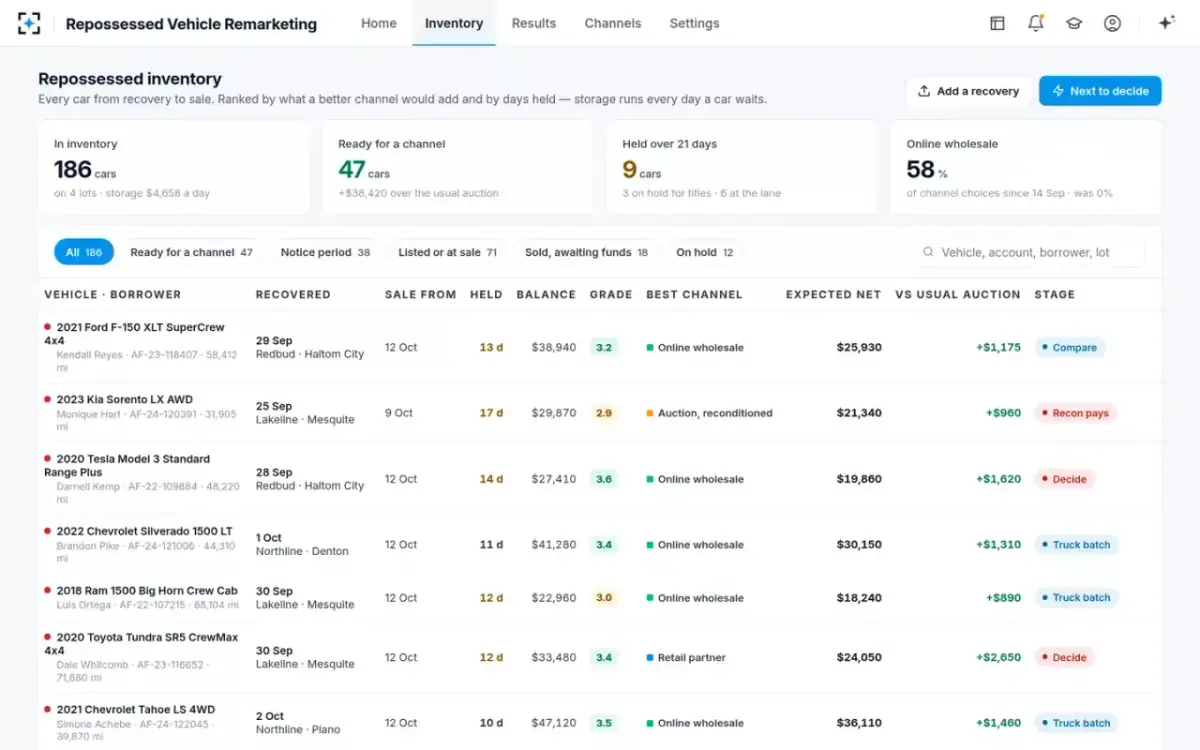
Every car is paying storage, but only a quarter of them are waiting on a decision
Where the 186 cars stand
- Ready for a channel · 47 · 25.3%
- In the notice period · 38 · 20.4%
- Listed or at sale · 71 · 38.2%
- Sold, awaiting funds · 18 · 9.7%
- On hold · 12 · 6.5%
The split matters because it sorts the bill into days somebody can shorten and days nobody can. Thirty-eight cars in the notice period are running a clock the statute set. Eighteen are sold and waiting for money to clear. The forty-seven ready for a channel are the only ones where a decision made this morning changes the cost, and they are 25% of the storage bill — about $1,180 a day.
The tail: the nine cars held past twenty-one days
Averages hide the expensive cars. Nine of the 186 have been held more than twenty-one days, and on the sample lender's figures they divide cleanly into two kinds of problem, neither of which is a storage problem.
Three are on hold for titles. No channel decision reaches them, because a car without a title in hand cannot be listed at all — it is one of the eight checks the sample lender runs before a listing is allowed. Their storage is the price of a paperwork queue somewhere else in the business, and the only cure is upstream.
Six are at the lane. They were sent there, they did not sell on the first run, and they are now waiting for next Thursday. That is the real cost of the lane's first-run sale rate of 58%: four cars in ten buy themselves another week of storage, another week of market, and another week on the books, and that cost was committed weeks earlier by a channel decision nobody priced — the four channels a repossessed car can go to, each net of every cost.
What may come out of the sale price, and what may not
Holding costs against the sale price: what the statute lets a lender take first
| Line | In the § 9-615(a)(1) queue? | What has to be true for it to stand |
|---|---|---|
| Daily storage at the recovery agent’s lot | Yes — an expense of holding | An agreement with that lot at that rate, and an invoice for those days on this car |
| Storage at the auction while the car waits for its run | Yes — an expense of holding | Separately billed, or separately identified inside the seller fee |
| Reconditioning, and the shop days it adds | Yes — preparing for disposition | The work was done, and it was reasonable to do it; a rate card is not a receipt |
| Transport from the lot to the lane | Yes — an expense of disposing | Actually incurred: a plan that keeps the car on the lot has no transport line |
| A flat repossession charge set regardless of what was billed | No — it is a price, not an expense | Nothing makes it one; the statute asks for the expenses of this disposition |
| Storage for days after the sale | No — the holding has ended | The clock stops when the car leaves, not when the money arrives |
What a lender can shorten, and what it cannot
Four of the phases on a repossessed car's clock are genuinely fixed, and treating them as targets wastes a year. The notice period is set by the lender's own state setting and the statute behind it. A title queue is somebody else's process. A sale that has to be scheduled for a weekly lane is scheduled for a weekly lane. And the days between a sale and cleared funds belong to the buyer's bank.
What is left is the part that moves, and almost all of it is one decision. On the sample lender's figures the choice of channel decides fifteen of the thirty-eight days — the four spent deciding and booking, and the eleven-day difference between a lane sale twenty-one days out and an online sale six days out. The inspection phase gives up one more day when the condition report is read as it arrives rather than when somebody opens the file.
That decision is only shortenable if it is already made when the person sits down. On the sample lots the pricing happens at 06:00: forty-seven condition reports and 1,684 photographs read, every ready car valued to each channel's own sale date, reconditioning tested on all forty-seven, and three channels netted per car — so the morning's work is approving decisions rather than assembling them.
Every day added, priced before it is spent
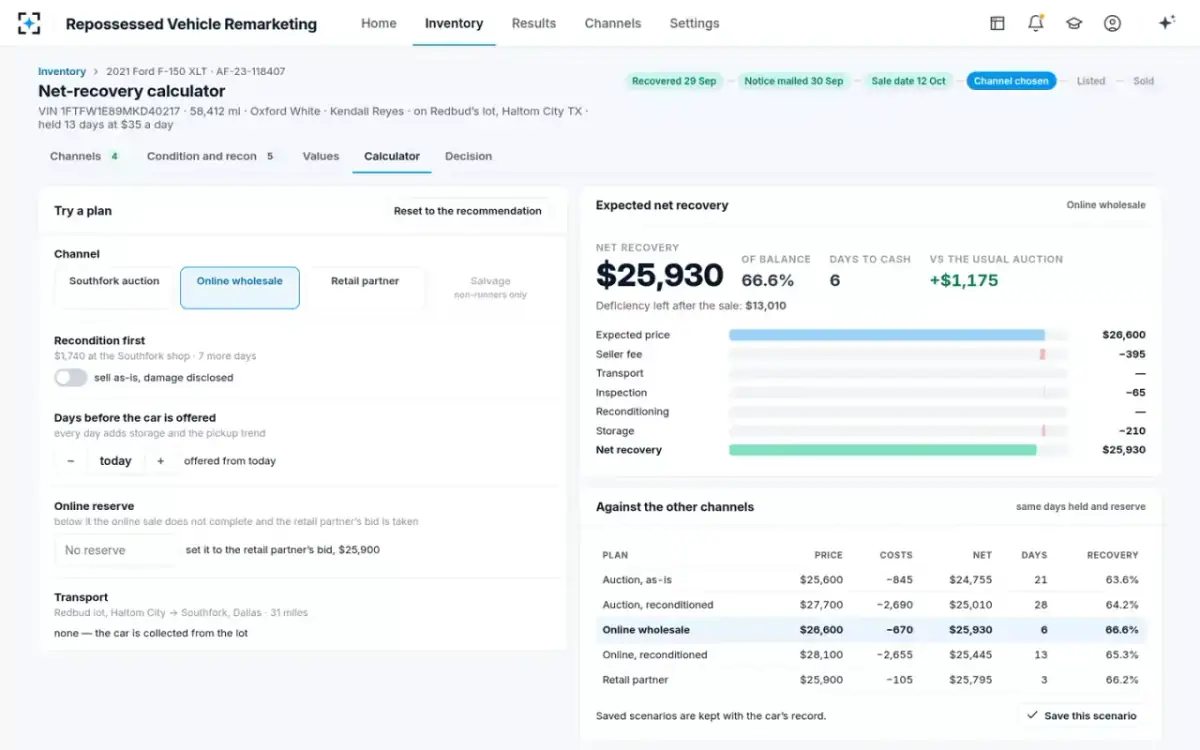
To see the day rates and the clocks on cars of your own, start from Repossessed Vehicle Remarketing.
Questions people ask
What are repossession storage fees?
A daily charge for keeping a repossessed vehicle somewhere until it is sold, billed by whoever is holding it — the recovery agent whose truck brought it in, an auction's compound, or a reconditioning shop. A single car often passes through two or three of them at different rates, so "the storage fee" on a repossessed car is usually several rates added together rather than one.
What repossession fees can be charged to the borrower?
Article 9 puts "the reasonable expenses of retaking, holding, preparing for disposition, processing, and disposing" at the front of the queue when sale proceeds are applied, together with attorney's fees where the agreement provides for them and the law allows. The CFPB's list of what consumers are charged in practice runs to vehicle recovery, towing, flatbed or specialised equipment, storage, securing and storing personal property, attorney fees and others. The test for each is that it was reasonable and actually incurred on this car.
Do storage fees come out of the sale price?
Yes, before anything reduces the loan. Section 9-615(a)(1) applies proceeds to the expenses of holding and disposing first, and only the remainder goes against the balance. That is why storage affects two different people: it reduces what the lender recovers, and it raises the shortfall the borrower is afterwards asked to pay.
How long can a lender store a repossessed car?
Article 9 sets no maximum. It constrains the sale rather than the wait — every aspect of the disposition must be commercially reasonable, and the expenses of holding must be reasonable to be chargeable. In practice the limits are commercial rather than legal: a car held long enough stops being worth its storage, and a lender that cannot explain a long hold has a weaker file if the sale is challenged.
What does a day of delay cost a lender?
Three things, of which one is billed. On the sample truck: $35 of storage on the recovery agent's lot; about $5.73 of expected market movement, from the 0.648% average absolute monthly change in the federal used-vehicle index over the two years to September 2026 applied to a $26,540 car; and $1.07 a day for each percentage point of the lender's own cost of funds on the $38,940 still owed. At four points of funding that is roughly $45 a day, of which $35 arrives as an invoice.
How do you reduce days to cash on a repossessed vehicle?
By attacking the phases that are not fixed. The notice period, the title queue and the buyer's funds clearing are outside the desk's control. The four days usually spent choosing a channel and booking transport, and the eleven-day gap between a weekly lane and an online sale from the lot, are not: on the sample lender's figures those fifteen days are the whole of the difference between thirty-eight days and nineteen. The precondition is that every ready car is already priced in every channel when the person arrives.