AI vehicle valuation, in a lender's recovery operation, means pricing a repossessed car from the evidence that already exists about it — a field inspector's condition report and photographs, the wholesale guide, recent sales of comparable vehicles, and the fee schedule of each place it could be sold — and producing not one number but one per sale channel and sale date. The useful version is auditable: every adjustment names its source, so a person can disagree with a line rather than with a verdict. In Repossessed Vehicle Remarketing the work is done by a wholesale valuer agent in about a second a car, and it carries two written limits: it never relies on one source, and it never uses retail asking prices.
The worked example is a fictional sample vehicle on a fictional lender's lot — a 2021 Ford F-150 XLT SuperCrew 4x4 at Harlow Ridge Auto Finance. Figures from the solution are sample data; the market series behind them is the federal government's, linked where it appears.
What AI vehicle valuation means here
Two quite different things get the same label. One is a price prediction: a model trained on past transactions that returns a figure for a vehicle description. The other is a priced plan: a chain of steps that starts from a published guide, narrows to this car, narrows again to a channel and a date, and ends in an expected price with a range. The first is a number. The second is an argument.
For a repossession sale the difference is not academic. A lender that cannot explain how it priced a car cannot easily explain why it sold the car where it did, and under Article 9 the method is what has to be defensible: "Every aspect of a disposition of collateral, including the method, manner, time, place, and other terms, must be commercially reasonable" (UCC § 9-610(b)). A predicted number with no visible derivation is a weak foundation for that. A chain of named adjustments is a strong one, which is why the file the lender keeps at the moment of the decision is built out of exactly these steps.
Five steps from a condition report to a price per channel, and the two that stop
Agent
Read the carThe condition report reader takes the field inspection and its photographs and produces a grade, a damage map, tyre depths, keys, warning lights, odometer and personal property.
Never: Never guesses damage it cannot see in a photo; flags a photo that does not show what the report says, for a physical inspection.
Agent
Start from the guideTake the wholesale guide value for the exact year, model, trim and drivetrain in average condition at a stated mileage.
Never: Never uses retail asking prices.
Agent
Find the comparable salesCollect sales of the same vehicle within a fixed radius and a fixed window, keeping each one’s channel, date, mileage and grade.
Never: Never relies on one source: the guide and the sales both have to agree before a value stands.
Agent
Adjust to this carApply mileage, condition, region and options against the guide’s assumptions, each with the figure it came from.
Agent
Price each channel and dateApply the segment trend out to each channel’s sale date and the channel’s own history, producing one expected price and range per channel.
A person decides
Recovery and remarketing managerReads the chain, disagrees with a line if she wants to, and chooses the channel.
Step one: the guide value, and why it is only the start
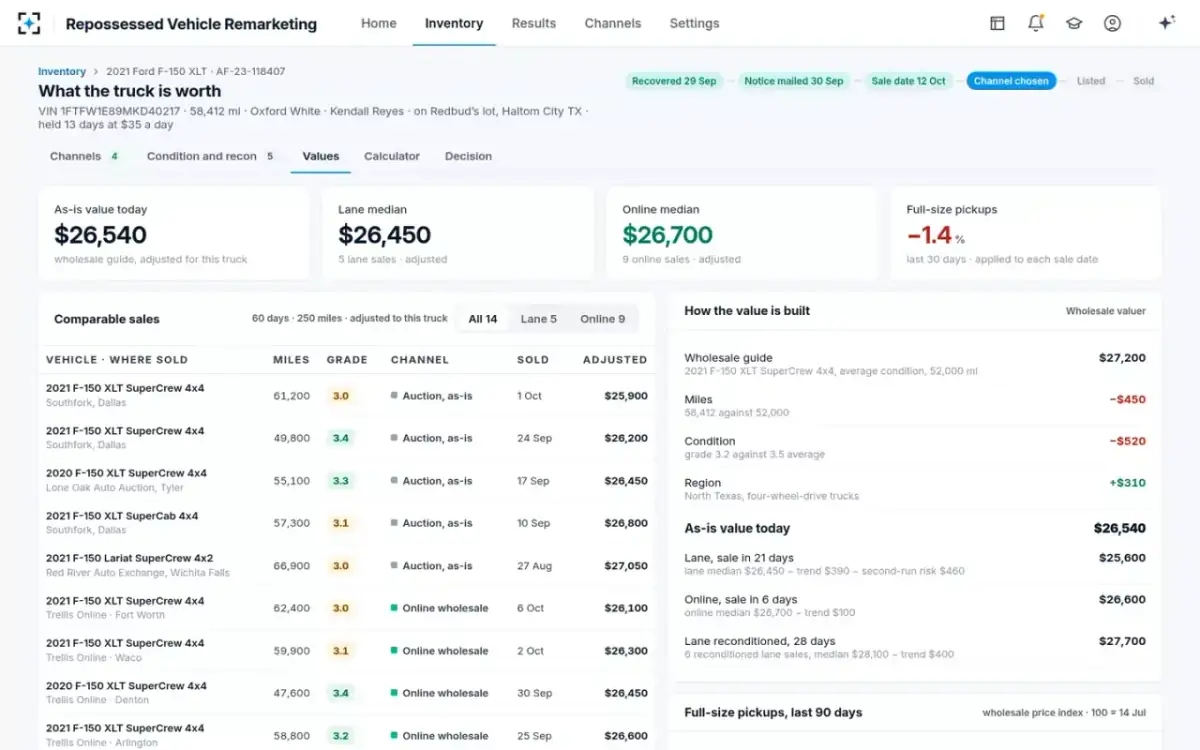
The chain starts from a wholesale guide value because it is the one number everybody in the market shares. On the sample truck it was $27,200 for a 2021 F-150 XLT SuperCrew 4x4 in average condition at 52,000 miles. That figure describes a vehicle, not this one, and every subsequent step is the work of closing the distance.
The limit attached to this step matters more than the step. A valuer that may use retail asking prices will find them everywhere — classified listings, dealer websites, marketplace pages — and they are systematically higher than wholesale, because they include a dealer's reconditioning, floorplan and margin and because an asking price is not a sale. A repossessed car is sold wholesale. Pricing it from retail asks produces a number that no channel will deliver, and a comparison between channels built on it is wrong in the same direction everywhere.
Step two: comparable sales, and the fence around them
A guide value on its own is an estimate from a national model. Actual recent sales of the same vehicle are evidence. The valuer's rule is a fence with three sides: the same vehicle, close by, recently. On the sample truck that produced fourteen comparable sales in sixty days within 250 miles — five in the physical lane with a median of $26,450, and nine online with a median of $26,700.
The fence is a judgement call with consequences in both directions. Loosen it and the sample grows but the comparables stop being comparable: a 2021 F-150 sold 800 miles away in a different climate is a different car commercially. Tighten it and the sample vanishes, and the valuer is back on the guide alone. The honest design is to state the fence, show the sales inside it, and say what happens when there are too few — which on this lender's settings means the guide carries more weight and the range widens, rather than a value being produced that looks as confident as any other.
Keeping each sale's channel is the detail that turns a median into something useful. Lane sales and online sales are two populations, not one, and averaging them hides the very difference the comparison exists to find.
Step three: four adjustments, each with its own evidence
From the guide to this truck: four adjustments, each traceable to its source
| Adjustment | What it compares | Evidence behind it | Effect |
|---|---|---|---|
| Mileage | 58,412 miles against the guide’s 52,000 | Odometer photograph from the field inspection, read and recorded | −$450 |
| Condition | Grade 3.2 of 5 against an assumed 3.5 | Five items pinned to photographs: a 14-inch windshield crack, front bumper scuffs, two front tyres at 3/32 in., one key of two, interior soiling | −$520 |
| Region | North Texas against the national average for four-wheel-drive full-size pickups | Regional sale results for the segment | +$310 |
| Options and drivetrain | XLT SuperCrew 4x4 as built | Matched to the guide’s exact trim and drivetrain rather than adjusted afterwards | In the guide value |
| As-is value today | The three adjustments, applied to the guide value | Guide $27,200 − $450 − $520 + $310 | $26,540 |
The condition line is where an automated valuation earns or loses its credibility, because it is the only adjustment that is an interpretation rather than a lookup. Two rules keep it honest on this lender's configuration. The first is that the reader never infers damage it cannot see in a photograph: a report that says "front end damage" with no photograph of the front end produces a flag, not a deduction. The second is the inverse — a photograph that contradicts the report sends the car for a physical inspection. Both rules cost speed and buy a number a person will sign.
Step four: the trend, applied to each sale date
A value is a value on a date. A car sold in six days and the same car sold in twenty-eight are sold into two different markets, and the gap is not small. The sample truck sat in a segment — full-size pickups — down 1.4% over thirty days, so the lane plan twenty-one days out carried a −$390 trend adjustment and the online plan six days out carried −$100.
That the used-vehicle market moves this much is not a modelling assumption. The federal consumer price index for used cars and trucks moved by an average of 0.65% a month in absolute terms over the two years to September 2026, and by 1.84% in January 2026 alone; it peaked at 216.876 in February 2022 and stood at 182.176 in September 2026, sixteen per cent below the peak (BLS series CUSR0000SETA02, via FRED). That is a retail index, and the wholesale market it stands in for is noisier; it is cited here because it is published, checkable and free of any vendor's interest in the answer.
Never relies on one source. Never uses retail asking prices.
The wholesale valuer’s two written limits, as configured for the sample lender
The trend step is also where a valuation stops being a price and starts being a plan, because applying it requires knowing when each channel would sell. That is a fact about the channels, not about the car, and it comes from the lender's own history: twenty-one days in the lane, six online, three on a dealer's firm bid, twenty-eight if the car is reconditioned first.
Step five: one value per channel, not one value
The output is not a number with a confidence interval. It is a small table, and the differences between its rows are the whole point.
One truck, one as-is value, three expected prices
| Plan | Built from | Expected price | Sale date |
|---|---|---|---|
| Physical auction lane, as-is | Lane median $26,450, less $390 market trend, less $460 for the risk it does not sell on its first run | $25,600 | 21 days out |
| Online wholesale, from the lot | Online median $26,700, less $100 market trend | $26,600 | 6 days out |
| Lane, reconditioned first | Six reconditioned lane sales, median $28,100, less $400 market trend | $27,700 | 28 days out |
Three things follow. A single "car value" is not actionable, because there is no single market. The reconditioned row is not a valuation of this car but of a different one, so it belongs next to the cost of creating that car rather than beside the as-is rows. And a firm bid from a dealer is evidence of a different kind — the valuer does not predict it, it checks it, which is the right division of labour.
What happens next is a separate agent's job: taking these prices, subtracting each channel's own fees, transport, inspection and storage, and ranking the results — the four channels, compared net of every cost. Keeping valuation and channel comparison apart matters, because it keeps the price from being quietly bent toward the channel somebody prefers.
The chain, open: fourteen sales, four adjustments, three prices
What the valuer may never do
Four limits do most of the work of making an automated valuation safe to act on, and three of them are refusals rather than capabilities.
A predicted number against a chain of named steps
A single predicted value: The verdict, or nothing.
A chain of named steps: Any line: the comparable set, the mileage adjustment, the grade, the trend, the sale date.
A single predicted value: The number arrives with the same confidence as any other.
A chain of named steps: The guide carries more weight, the range widens, and the page says so.
A single predicted value: Nothing; the model consumes the fields it is given.
A chain of named steps: The car is flagged for a physical inspection instead of being priced on a contradiction.
A single predicted value: Often uses them, because they are plentiful.
A chain of named steps: Refuses them: an asking price is not a sale, and a repossessed car is sold wholesale.
A single predicted value: One value.
A chain of named steps: One value per channel and sale date, each with its range.
A single predicted value: A figure, and an explanation nobody wrote.
A chain of named steps: The sales, the adjustments and the dates the price was built from.
How accurate is an AI vehicle valuation?
Nobody can answer that in the abstract, and a vendor who gives a single accuracy figure for all vehicles is telling you less than they appear to. Accuracy is a distribution, it differs by segment, and it is only meaningful against sales the model did not see. The honest test is a replay of closed sales: give the valuer only what was known on the decision date, let it price every channel that was open, and score the predicted net for the channel actually used against what the car actually netted — the method, step by step, and what it has to control for.
Three figures are worth demanding from any such test, and they are rarely all offered together. The median signed error, which shows bias — a valuer that is consistently $300 high is not accurate, it is reliably wrong. The spread, usually as a tenth-to-ninetieth percentile range, which shows how much weight a single number can bear. And the same two broken out by body style, price band and condition grade, because a valuer that is excellent on trucks and poor on small sedans averages to unremarkable and will be trusted in the wrong places.
There is also a limit on what accuracy buys. The statute is explicit that a better price available elsewhere "is not of itself sufficient" to make a sale commercially unreasonable (§ 9-627(a)), and the converse holds commercially: an exact price on a car sold into the wrong channel three weeks late is a precise answer to the wrong question. The valuation is an input to a decision, and the decision is where the money is.
What a person still has to look at
The valuer produces evidence; it does not produce judgement, and on the sample lender's configuration it never chooses a channel, never orders reconditioning and never lists a car. Four things come back to a person every time. The condition grade, when a photograph and a report disagree. The comparable set, when it is thin or when the sales inside it scatter. The reserve, which is a decision about how much downside the lender will accept rather than a prediction. And the channel, which is the one that moves the money.
Eight questions to put to any vehicle-valuation agent before you rely on it
- Show me the comparable sales behind this value.
Each one with its channel, date, mileage, grade and distance. If they cannot be listed, the value is a prediction wearing the clothes of evidence.
- What is the fence — radius, window, vehicle match?
Ask for the rule, not an example. Then ask what happens when the fence returns three sales instead of fourteen.
- Does it use asking prices anywhere?
Listings are plentiful and systematically high. A wholesale value built partly on retail asks is biased in one direction on every car.
- Where does the condition grade come from?
A grade read from photographs can be checked against them. A grade keyed by a clerk cannot, and it moves the value more than mileage does.
- Is the market trend applied to the sale date or to today?
A car sold in twenty-eight days is sold into a different market than one sold in six. If the trend is not applied per channel, the slowest channel is flattered.
- Does it produce one value or one per channel?
One value cannot support a channel decision, because the whole question is how the price differs between them.
- What does it refuse to do?
Ask for the written limits. An agent with no refusals has no boundary, and the boundary is what makes the output safe to sign.
- Can it be replayed on our own closed sales?
Not a demonstration on their data: our quarter, our fee schedules, scored against what the cars actually netted.
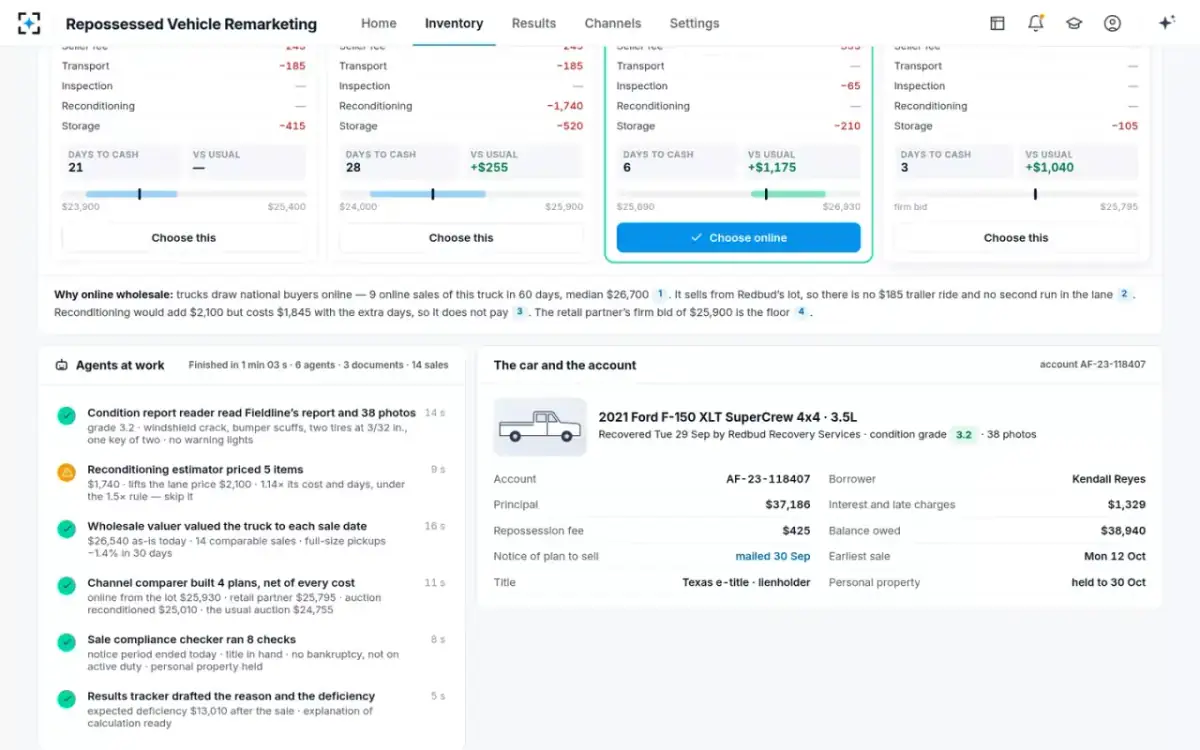
Six agents on one car, sixty-three seconds, each step named
Scale is the reason any of this is automated rather than done by hand. The Consumer Financial Protection Bureau's study of nine lenders found repossession assignments running at 0.75% of open accounts in December 2022, up 22.5% on three years earlier (CFPB, Repossession in Auto Finance, January 2025). A desk with a few hundred cars on its lots cannot price each of them in four channels every morning by hand — not because any one car is hard, but because there are too many.
To see the chain opened on a car of your own, start from Repossessed Vehicle Remarketing.
Questions people ask
How does AI value a used car?
In a lender's recovery operation, by chaining five steps: read the condition report and its photographs, start from the wholesale guide value for that exact year, model, trim and drivetrain, gather recent comparable sales inside a stated radius and window, adjust for mileage, condition, region and options, then apply the segment's market trend out to each channel's sale date. The output is one expected price per channel, each with the sales it rests on.
Can an AI read a vehicle condition report?
Yes, and the photographs with it: a grade, a damage map, tyre depths, keys, warning lights, odometer and personal property. The important part is the limits. On this configuration the reader never infers damage it cannot see in a photograph, and a photograph that contradicts the written report sends the car for a physical inspection rather than producing a quiet deduction.
What data does an AI vehicle valuation use?
A wholesale guide value for the exact specification, recent sales of comparable vehicles with their channel, date, mileage and grade, the condition report and photographs for this car, a segment price trend, and each channel's own history of days to sale and price against guide. What it should not use is retail asking prices, which are not sales and are systematically above the wholesale market a repossessed car is sold into.
Is an automated vehicle valuation reliable enough to sell on?
That is a question to answer with a replay, not with a claim. Give the valuer only what was known on each decision date for a trailing quarter of closed sales, let it price every channel, and score its predicted net for the channel used against the actual net. Ask for the median signed error, the spread, and both broken out by body style and price band. A single accuracy percentage for all vehicles tells you almost nothing.
Can AI decide where to sell a repossessed car?
It can rank the channels; on this configuration it does not choose. The valuer prices each channel, a separate agent subtracts each channel's fees, transport, inspection and storage and ranks the results, and a person approves. The specialist can approve the default channel up to a size limit, and any change of channel, or any larger car, goes to the remarketing manager, who signs with the reason kept beside the sale.
Why keep valuation and channel comparison as separate steps?
Because combining them lets the price drift toward the preferred answer. A valuer that knows which channel is being argued for can, without anybody intending it, produce prices that support the argument. Keeping the steps separate means the prices are built from sales and adjustments only, and the comparison is built from fee schedules only, so a disagreement about one does not quietly move the other.