How long after a repossession can you get your car back? For as long as the lender still has it to give back. The Uniform Commercial Code, which governs these sales in every state, does not set a redemption period in days: it ends the right at the moment the lender disposes of the car or enters into a contract to dispose of it. In practice that means the deadline is whatever date the lender lists the vehicle for — a date set inside the lender's own operation, which the borrower usually learns only from a single letter. This guide explains the window from both sides: what a borrower has to do inside it, and what a lender running Repossessed Vehicle Remarketing has to check before it closes.
This is a plain-language explanation of a federal-model statute and two federal sources, not legal advice. State law adds terms in every state, and the worked example uses a fictional sample lender's vehicle. Anyone facing a repossession should take the statute's language to a lawyer or a non-profit counsellor who knows their state.
The short answer, and why it is not a number of days
Almost every article about this question gives a number: thirty days, ten days, twenty-one days. None of them is the rule. The rule is an event, and the statute names three of them.
A redemption may occur at any time before a secured party: (1) has collected collateral under Section 9-607; (2) has disposed of collateral or entered into a contract for its disposition under Section 9-610; or (3) has accepted collateral in full or partial satisfaction of the obligation it secures under Section 9-622.
UCC § 9-623(c), Right to redeem collateral
Read it backwards and it is simpler than it looks. The window opens when the car is taken. It closes when the lender sells it, when the lender signs a contract to sell it, or when the lender decides to keep it in satisfaction of the debt. Until one of those happens, the right is alive — on day two and on day ninety alike.
Two consequences follow, and they point in opposite directions. The window can be much longer than thirty days: a car stuck waiting for a title, or held through a slow lane cycle, can sit redeemable for weeks longer than anybody expects. And it can be much shorter: a lender that agrees a dealer's firm bid has entered into a contract for the car's disposition, and the right ends then — before any money changes hands and before the car has physically moved.
Redemption and reinstatement are different rights
This is the single most expensive confusion in the subject, because the two cost wildly different amounts and only one of them exists everywhere.
Three different things people mean by getting the car back
| Redeem | Reinstate | Cure before repossession | |
|---|---|---|---|
| What it does | Ends the lender’s security interest in the car and returns it | Puts the loan back on its original terms and returns the car | Stops the repossession from happening at all |
| What you pay | The whole obligation secured by the car, plus the lender’s reasonable expenses and attorney’s fees | Typically the past-due amount plus the lender’s repossession expenses | Typically the past-due amount, inside a stated period |
| Where it comes from | UCC § 9-623 — the uniform text, in force in every state | State law or the contract; Article 9 does not create it | State law; Article 9 does not create it |
| When it is available | Until the lender disposes of the car, contracts to dispose of it, or accepts it in satisfaction | Only where a state or the agreement provides it, and usually inside a tight window | Before the car is taken, not after |
| What ends it | A sale, or a signed contract for the sale | The window in the state law or the agreement | The repossession itself |
The practical difference is the size of the cheque. Redeeming a car on a $38,940 balance means finding $38,940 plus expenses. Reinstating the same loan, where a state or the contract allows it, might mean finding three missed payments and a tow bill. A borrower who assumes reinstatement exists and discovers only redemption does is often a borrower who has lost a week to the wrong plan.
It is also an area where the published data is thinner than it looks. The Consumer Financial Protection Bureau's study of nine lenders counted redemptions and said so explicitly: "the orders asked lenders to identify accounts in which the vehicle was redeemed, and as such the dataset does not specifically measure reinstatement" (CFPB, Repossession in Auto Finance, January 2025). Reinstatement is common enough that the Bureau noted it and rare enough in its data that it could not be separated out.
How much do I have to pay to get my repossessed car back?
To redeem, the statute requires a tender of two things: "fulfillment of all obligations secured by the collateral; and (2) the reasonable expenses and attorney's fees described in Section 9-615(a)(1)" (§ 9-623(b)). That second clause is where the number grows past the loan balance.
The expenses in § 9-615(a)(1) are "the reasonable expenses of retaking, holding, preparing for disposition, processing, and disposing". On a repossessed car that is the tow, the daily storage on whichever lot is holding it, any reconditioning already done, and the transport if it has already been moved — and only the attorney's fees the agreement provides for and the law allows. The number therefore rises every day the car sits, which is the practical reason redemption figures are quoted good until a stated date and not as a standing amount.
The Bureau's data gives a sense of the fee layer. Disposal fees charged to consumers ran to "a mean of $367 and a median of $339" in the near-prime tier and a "mean of $300 and a median of $294" in superprime — and "average repossession costs charged to consumers in the dataset were higher when a forwarder was used". On the storage side there is no published figure at all, which is why the day rates and what they add up to are worth asking for line by line rather than accepting as a total.
One demand is always reasonable and rarely made: ask for the redemption figure in writing, itemised, with the date it is good until. The statute obliges a lender to publish a telephone number "from which the amount that must be paid to the secured party to redeem the collateral under Section 9-623 is available" (§ 9-614(1)(C)). It does not stop anyone from asking for the breakdown behind it.
What ends the window, exactly
Three events, and the middle one catches people out. A completed sale ends it, obviously. Acceptance of the car in full or partial satisfaction of the debt ends it, because there is then nothing left to redeem against. And a contract for the car's disposition ends it, even if the car is still standing on the recovery lot and no money has moved.
On the sample lender's figures that third route is live every week. A retail partner's bid is firm for four days; the moment the lender accepts one, the car is contracted. An online wholesale listing that completes above the reserve is a sale. A car consigned to a physical lane is not yet contracted when it is trailered, but it is when the hammer falls.
One car, two clocks: the notice period is not the redemption window
- Recovered; notice prepared1 d
- Notice period — no private sale allowed12 d
- Channel chosen, car listed3 d
- Open — redeem at any time, by paying the whole amount owed plus expensesuntil the sale
Notice the shape. The notice period — the ten or more days a private sale has to wait after the notice is mailed — is the part most people take for the deadline, and it is not. It is a floor under the sale, not a ceiling on redemption. On this truck the right to redeem outlived the notice period by three more days.
The notice that tells you the window exists
Almost everything a borrower needs is on one letter, and the statute writes the letter. For a consumer-goods transaction, § 9-614(3) sets out a form that "when completed, provides sufficient information". Lenders may phrase their own — "a particular phrasing of the notification is not required" — but the safe-harbour form is what most of them send, and knowing its lines is the fastest way to read any version of it.
The statutory notice, line by line, and what each line is telling you
NOTICE OF OUR PLAN TO SELL PROPERTY
The heading the statute itself writes. If a letter about a repossessed car does not say something like this, it is not this notice.
We have your [describe collateral], because you broke promises in our agreement.
Identifies the car. Check the description: the whole letter is about this vehicle and this account.
We will sell [describe collateral] at private sale sometime after [date].
The date. Nothing can be sold privately before it — and that date, not a rule of thumb, is the first thing a lender has to prove it respected.
You can get the property back at any time before we sell it by paying us the full amount you owe (not just the past due payments), including our expenses.
The redemption right in the statute’s own plain words: before we sell it, and the full amount — not the arrears.
To learn the exact amount you must pay, call us at [telephone number].
A lender must give a number where the redemption figure can be obtained. Ask for it in writing with a date it is good until.
If you want us to explain to you in writing how we have figured the amount that you owe us, you may call us at [telephone number].
The written explanation of any shortfall after the sale. One in any six-month period is free.
Timing is separate from content, and it is where the uniform text is least generous to consumers. Section 9-612(a) says only that "whether a notification is sent within a reasonable time is a question of fact". The familiar ten-day rule is in § 9-612(b) and is expressly limited to "a transaction other than a consumer transaction" (§ 9-612). On a consumer car loan there is no safe harbour: the lender is working to a standard a court will apply afterwards, which is one reason a careful operation sets a fixed internal period and keeps proof of posting — what a defensible file holds, line by line.
Which states have a right to cure before repossession?
Several do, and this guide will not list them, for a reason worth stating. A cure right is a creature of state statute; the periods, the triggers and the number of times it can be used differ, and they are amended. A table assembled from secondary summaries is exactly the kind of thing that is wrong in two rows by the time anyone relies on it.
What is portable is the shape of the question. Cure, where it exists, runs before the car is taken: the lender must send a notice of default and wait while the borrower brings the account current. It is therefore gone by the time anyone is reading about repossession, and it is not the same as either redemption or reinstatement. The Federal Trade Commission's summary of the variation is a fair one: "in some states, your lender has to let you know what will happen" — for example, where a public auction is used, "your state's laws might require the lender to tell you when and where the auction will happen" (FTC, Vehicle Repossession).
The reliable way to answer it for one state is to read that state's own statute on the legislature's website, or to ask a lawyer or a non-profit counsellor in the state. A lender's own setting is not the answer either: the sample lender in this guide runs a notice period of ten days after mailing because that is how its policy is configured for Texas, and a configuration is a business rule, not a statement of law.
How often a repossessed car is actually redeemed
More often than most people assume, and almost always fast. In the Bureau's dataset, "thirty-four percent of repossessions completed in December 2021 were redeemed, an increase from 25 percent in December 2019", before falling back to 30 percent by November 2022. Before 2020 the share sat in a narrow band "between 22 percent and 29 percent of all completed repossessions". And the timing is stark: "over 95 percent of redemptions in our dataset occurred within the first 30 days of repossession completion".
Two readings of that are worth holding together. For a borrower, the first month is when redemption actually happens — not because the right expires then, but because the money either appears quickly or does not appear at all. For a lender, roughly a third of recovered cars never reach a sale, which means a third of the preparation is done on cars that will go home. That is an argument for a cheap preparation step, not for a slow one.
The same study puts the recovery phase itself at "15.9 days for consumers with superprime credit scores to 23.1 days for consumers with subprime credit scores" between assignment and completion, with "about 96 percent of repossession completions" happening inside three months of assignment. The clock in this guide starts at the end of that one.
Can I get my personal property out of a repossessed car?
Yes, and it is separate from the car. The Federal Trade Commission puts the general position this way: "your lender can't keep or sell personal property found inside your repossessed vehicle at least until a certain amount of time has passed, which will depend on your state's laws".
Three practical points follow. Ask immediately and in writing, because the protection is time-limited and the period is a state question. Expect to be charged: the Bureau's list of chargeable costs includes "fees for securing and storing personal property" as its own line, separate from vehicle storage. And do not treat retrieving belongings as a step towards getting the car back — the two are unrelated rights, and the redemption clock keeps running while the boot is being emptied.
On the lender's side this is one of the checks that has to pass before a car may be listed at all, for the obvious reason that a car sold with somebody's tools in the back has created a second problem on top of the first.
What the lender has to check on the morning of the sale
The borrower's window and the lender's listing are the same event seen from two sides, which is why a well-run desk re-runs its checks on the day the channel is chosen rather than relying on a file assembled a week earlier.
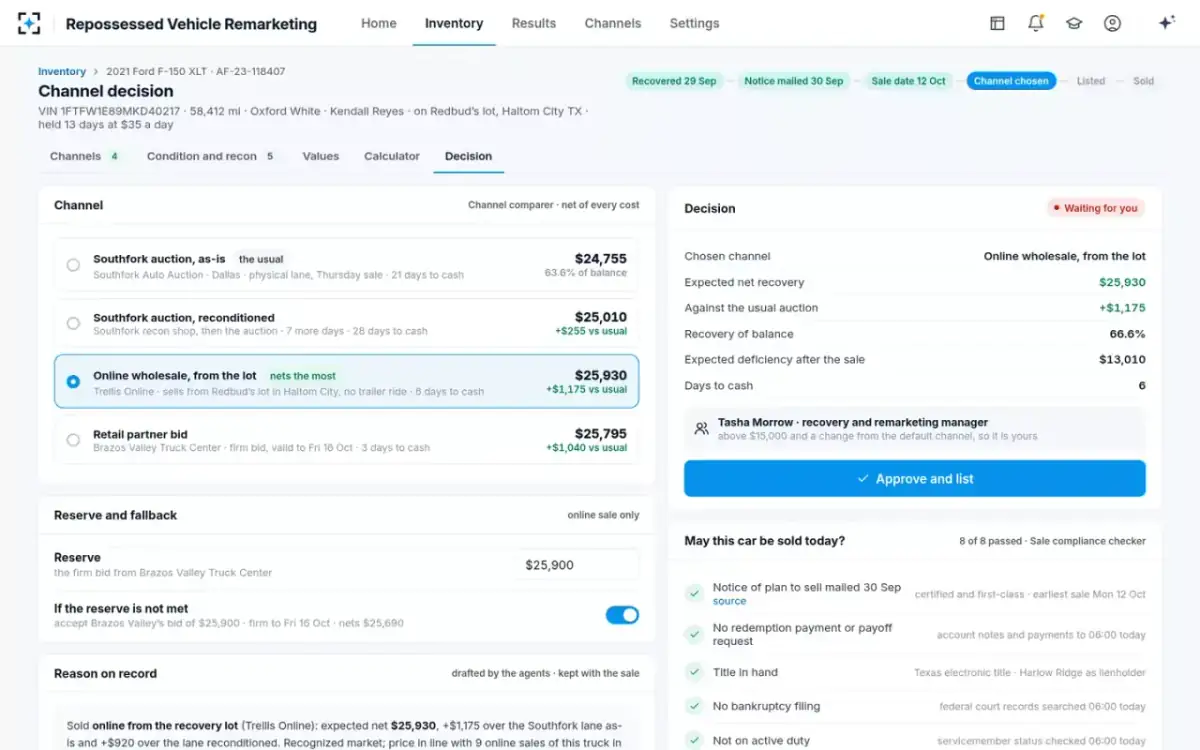
Eight checks before a repossessed car may be listed, and what each one is really testing
- The notice of plan to sell was sent, and there is proof
On the sample truck: mailed 30 September, certified and first-class. Proof of posting is what answers the question a borrower will ask first.
- The earliest sale date in that notice has passed
Monday 12 October here. This is a date the lender set and published; selling before it is the failure that needs no argument to prove.
- No redemption payment or payoff request has arrived
Checked against account notes and payments as at 06:00 on the day of the decision — not as at the date the file was opened.
- The title is in hand
An electronic title with the lender recorded as lienholder counts. Without it the car cannot be listed, however good the price is.
- No bankruptcy filing
Searched against federal court records the same morning. A filing stops the sale regardless of everything else on this list.
- The borrower is not on active duty
Servicemember status checked the same morning, because protections attach to the person and can begin after the loan did.
- Personal property is held, not sold with the car
Separately stored and recorded, so the belongings question cannot be answered by pointing at the sale.
- The buyer is not related to the lender
Employees, affiliates and their dealers blocked outright, and every firm bid tested against that list before it is accepted.
Eight checks, re-run on the morning the channel is chosen
If the car is already sold
Then the right to redeem is gone, and a different set of questions opens. The lender must apply the proceeds in the statutory order, and the borrower is entitled to an explanation of how any shortfall was calculated — how that number is built, line by line. One written explanation in any six-month period is free.
The price the car fetched is not, on its own, the test of whether the sale was proper; the method is. But the method has to be defensible, and the file behind it is what a borrower's lawyer will ask for. Three things are worth requesting in writing: the notice as sent and proof of its posting, where and when the car was sold, and an itemised statement of every expense deducted before the balance was reduced.
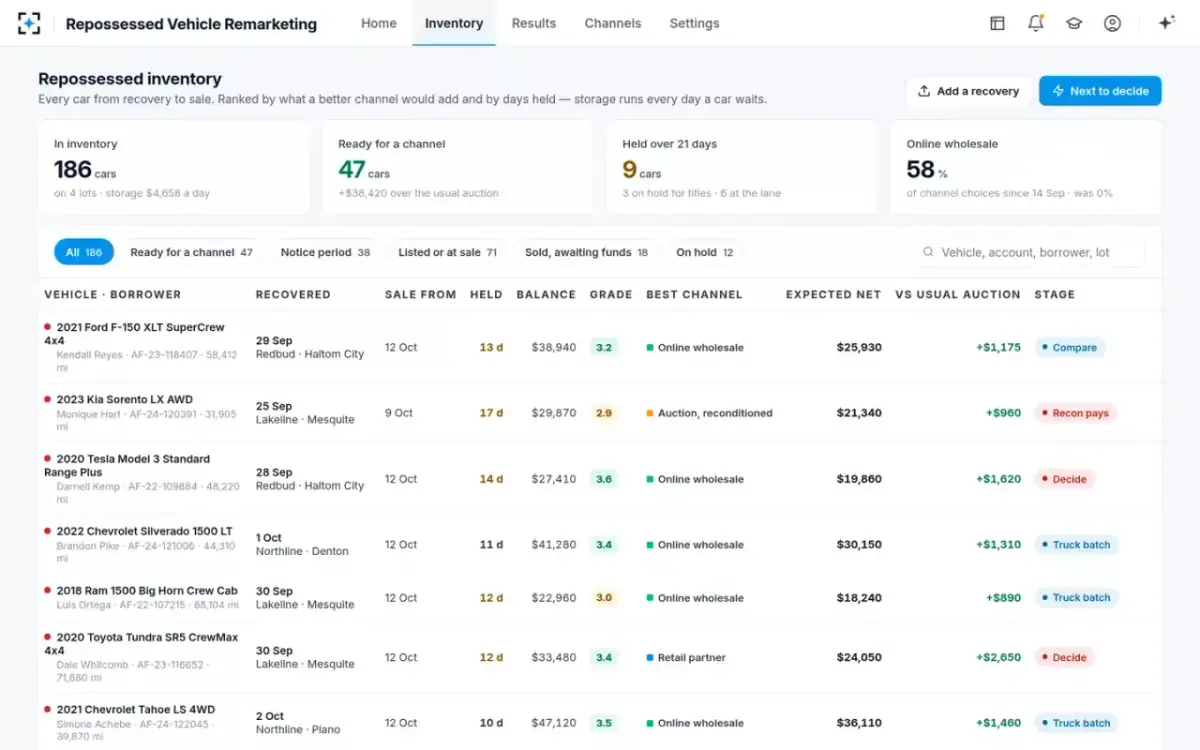
Cars that will not be sold at all are a smaller category than people expect. Around a third of completed repossessions in the Bureau's data went home, and on the sample lender's lots twelve of 186 cars are on hold on any given morning — some for titles, some for exactly the reasons on the checklist above.
Thirty-eight of 186 cars are inside their notice period this morning
To see the clocks and the checks on a lender's own cars, start from Repossessed Vehicle Remarketing.
Questions people ask
How long after repossession can I get my car back?
Until the lender sells it or signs a contract to sell it. The Uniform Commercial Code sets no number of days: § 9-623(c) ends the right to redeem when the lender has collected the collateral, disposed of it or contracted to dispose of it, or accepted it in satisfaction of the debt. That makes the real deadline the lender's own listing or bid-acceptance date, which is why the date on the notice of plan to sell is the single most important thing on the letter.
How do I get my car back after repossession?
Ask the lender, at the number the notice is required to give, for the exact amount to redeem, itemised and with a date it is good until. Ask separately whether your state or your contract allows reinstatement, which usually costs far less. Do both in writing and do them in the first week: in the CFPB's data, over 95 percent of redemptions happened within thirty days of the repossession being completed.
What is the redemption period after a car is repossessed?
There isn't one, in the sense of a fixed period. Articles and advertisements that quote thirty or ten days are describing either a particular state's reinstatement or cure right, or a lender's own practice. Under the uniform text the right lasts as long as the lender still holds the car unsold and uncontracted — which can be shorter than ten days if a firm bid is accepted quickly, or longer than a month if the car is waiting on a title.
What is the difference between redeeming and reinstating a car loan?
Redeeming ends the loan: you pay everything secured by the car plus the lender's reasonable expenses and allowable attorney's fees, and the car is yours. Reinstating resumes the loan: where a state or the agreement allows it, you pay the past-due amount plus the repossession expenses and the original terms continue. Redemption exists everywhere because Article 9 creates it; reinstatement does not, and has to be found in state law or the contract.
When does the right to redeem end?
At the first of three events: the lender disposes of the car, enters into a contract for its disposition, or accepts the car in full or partial satisfaction of the debt. The middle one is the trap — accepting a dealer's firm bid is a contract for disposition, so the window can close while the car is still standing on the recovery lot and no money has moved.
Does paying the past-due amount always get the car back?
No. Paying the arrears is reinstatement, and Article 9 does not create that right — the statutory notice says so in its own words: you can get the property back by paying "the full amount you owe (not just the past due payments), including our expenses". Where a state or the agreement does allow reinstatement, the arrears plus the repossession costs may be enough. Ask the lender which of the two it is offering, and get the answer in writing before sending money.