A vehicle remarketing manager decides where a lender's repossessed cars are sold, and signs for that decision. The work sits between collections, which hands over the car, and finance, which carries the loss: an inspection and a condition report arrive, a notice of plan to sell goes out, and when the notice period ends somebody has to say whether this car goes to a physical auction lane, to an online wholesale sale from the recovery lot, to a dealer holding a firm bid, through a reconditioning shop first, or to salvage. A few points of recovery on each car add up to the loss line. In Repossessed Vehicle Remarketing that decision is prepared by six agents before the desk opens and approved by a person, and this guide walks the four seats it passes through.
The desk described here is a fictional sample lender's, Harlow Ridge Auto Finance, with 186 repossessed cars on four lots. The people, the lots and the vehicles are characters and sample data, not a customer's operation.
What does a vehicle remarketing manager do?
Three things, in descending order of how much of the week they take and ascending order of what they are worth.
The first is logistics: knowing where every car is, which lot is holding it, what it is costing a day, whether the title has arrived, whether the notice went out and when the earliest lawful sale date is. On a book of a few hundred cars this is most of the job as it is usually practised, and none of it decides anything — what a day of waiting actually costs is a separate argument the logistics rarely get round to making.
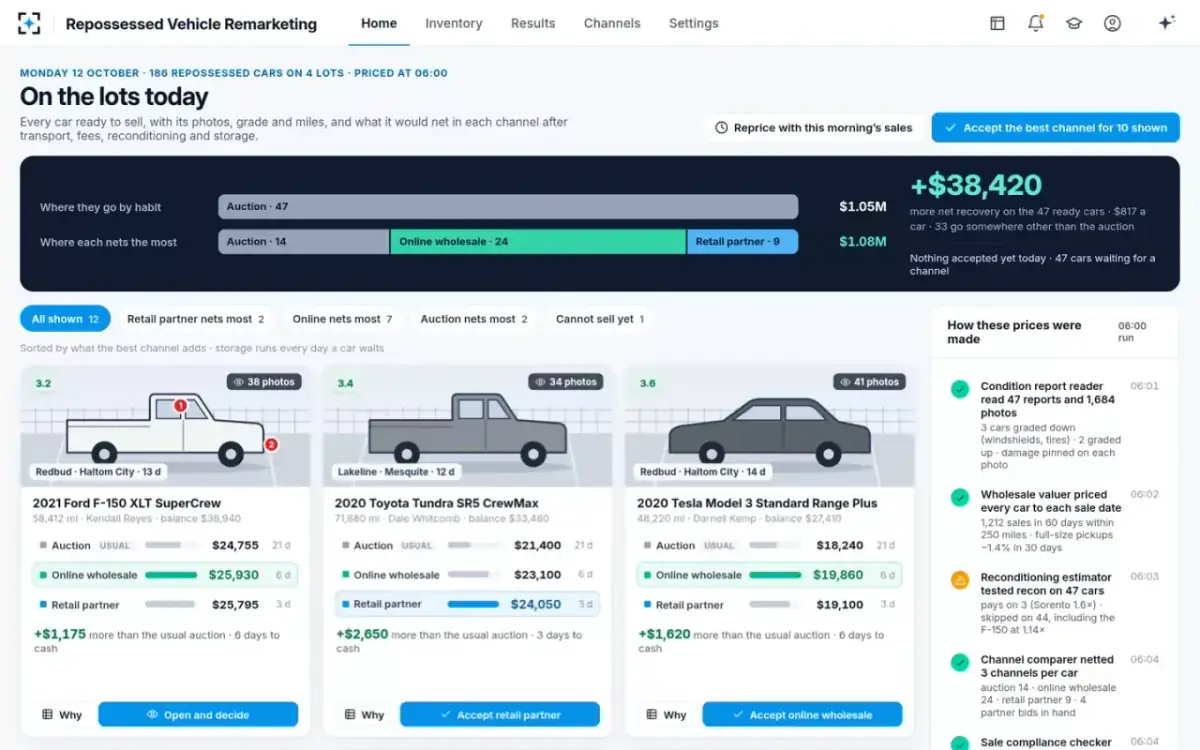
The second is the channel decision, car by car. This is the one that moves money: on one morning's forty-seven ready cars at the sample lender, sending each to the channel that nets most rather than to the habitual auction was worth $38,420, or $817 a car. It is also the one that is skipped, because weighing four channels on one car means pricing the car, then pricing each channel's fees, transport, inspection, reconditioning and storage to its own sale date, and nobody has forty-seven of those in them before lunch.
The third is defensibility. Article 9 requires that "every aspect of a disposition of collateral, including the method, manner, time, place, and other terms, must be commercially reasonable" (UCC § 9-610(b)). The manager is the person whose signature says the method was chosen rather than inherited, and the file behind that signature is what answers a challenge two years later.
The four seats around one repossessed car
Four seats around one repossessed car, and what each one keeps
Today
"Every car goes to Southfork because every car went to Southfork." The week goes on lots, trailers, titles and chasing the auction for last Thursday’s results.
With agents
Opens the morning with every ready car already priced in three channels, accepts the best on most of them, and spends the time saved on the cars where the answer is close.
Still theirs: The decision, and the signature on it
Today
"I spend my day on the phone with lots, not on what the car is worth." Prepares, lists and books transport in the order the files arrive.
With agents
Works a list ranked by what a better channel would add and by days held, and approves the default channel himself up to $15,000 of expected net.
Still theirs: The preparation, the listing, and the relationships with the lots
Today
"A point of recovery is a line in my loss forecast. I need it by channel." Rebuilds the month from spreadsheets and auction statements.
With agents
Receives every sale against the plan it was given before the sale, with recovery by channel and by month and the variance already explained.
Still theirs: The forecast, and the judgement about what the month means
Today
"If a borrower sues over the sale, show me the file." Learns what was decided after it was decided.
With agents
Sets the default channel, the reconditioning rule, the reserve rule, the notice period and the approval limits once, with every change versioned.
Still theirs: The policy, and who is allowed to sign what
The division is worth looking at closely, because it is not the one most job advertisements describe. Two of the four seats never choose a channel. The analyst measures the choices and the VP writes the rules they are made under; between them they decide almost everything about how the desk behaves, and neither of them touches a car. Of the two seats that do choose, one is limited by size and by whether the choice is the usual one. That leaves a single person, on most books, who can send a car somewhere new.
A Monday on the lots, hour by hour
The reason the channel decision is skipped is arithmetic, not laziness. Here is what preparing it for one morning's cars involves, timed on the sample lender's lots.
Five minutes before the desk opens: forty-seven cars, priced in three channels each
06:00
The run starts
Every car that finished its notice period overnight joins the forty-seven already ready for a channel.
06:01
Every condition report read
47 reports and 1,684 photographs. Three cars graded down for windshields and tyres, two graded up, each item pinned to the photograph that shows it.
06:02
Every car valued to each sale date
1,212 comparable sales inside sixty days and 250 miles. Full-size pickups down 1.4% over thirty days, applied forward to each channel’s own date.
06:03
Reconditioning tested on all forty-seven
It pays on three — a 2023 Sorento at 1.6× its cost. It is skipped on forty-four, including the F-150 at 1.14×, under the lender’s 1.5× rule.
06:04
Three channels netted per car
Auction for 14, online wholesale for 24, a retail partner for 9, with four firm dealer bids already in hand.
06:05
The sale checks run
Notice, redemption, title, bankruptcy, active duty, personal property and related buyers — so nothing on the list is a car that may not be sold today.
Done by hand, that is not a five-minute job; it is the week. A single car needs its condition report read against its photographs, a wholesale guide value, a set of comparable sales, four adjustments, a market trend applied to three or four different sale dates, a reconditioning quote tested against a rule, and each channel's fee schedule subtracted. Forty-seven of those is why the default channel exists: a default is what a desk reaches for when the comparison costs more than the gap it would find.
The morning the manager actually meets: every ready car, already priced
Who approves the sale of a repossessed car?
On a well-run desk, two different people, divided by two questions rather than one: how large is the car, and is the choice the usual one. The sample lender's settings put it like this.
Who may sign what, and the second test most limits forget
| The decision | Specialist | Remarketing manager | Why the line sits here |
|---|---|---|---|
| The default channel, expected net up to $15,000 | Signs | Not needed | The usual answer on a small car is the one the comparison already agrees with |
| The default channel, expected net above $15,000 | Refers | Signs | Size alone is enough to want a second pair of eyes on the reserve |
| Any change of channel, at any size | Refers | Signs | A change is the decision this desk exists to make, and it is the one a borrower may later question |
| Reconditioning before a sale | Refers | Signs | It commits cash and days before any sale exists; the estimator prices it and never orders it |
| A bid from a buyer related to the lender | Blocked | Blocked | Employees, affiliates and their dealers are refused outright, before anyone can approve |
| Changing the default channel, the rules or the limits themselves | No | No | That is the VP’s, and every change is versioned |
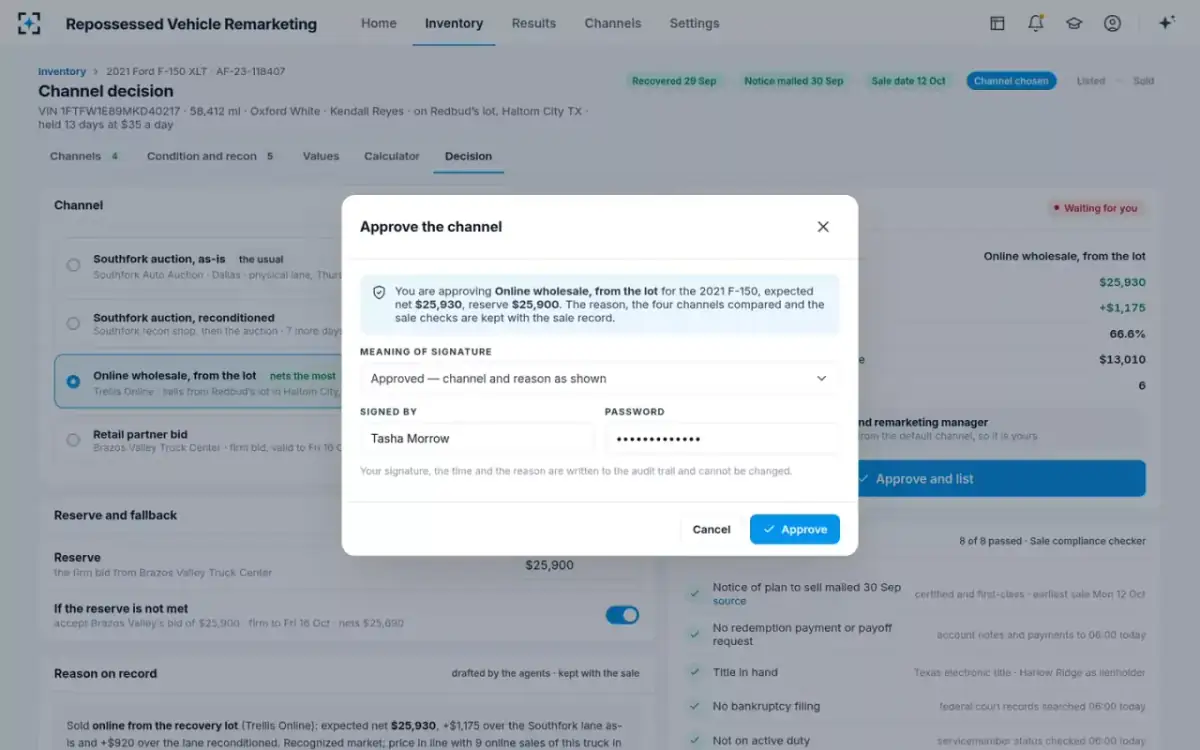
That second test is the one most approval schemes miss. A limit expressed only in dollars supervises the wrong thing: a $9,000 car moved from the lane to a dealer's firm bid is a channel change on a small car, and it is exactly the decision that should be visible — not because it is suspicious, but because it is the decision worth reviewing when the month is read back. The sample lender's scheme supervises novelty as well as size, which is why the F-150 at $25,930 needed the manager on both counts.
What the specialist owns that the manager does not
The specialist is not a junior manager. The seat owns preparation and execution: the relationship with each recovery agent's lot, the condition of each car as it arrives, the listing itself, the transport booking, and the chase when a title has not come through. These are the things that decide whether a decision can be acted on at all, and they are unglamorous in exactly the way operations work always is.
What changes for the seat is not its scope but its order. Working a queue in the order files arrive means the oldest problem gets attention when it surfaces; working a list ranked by what a better channel would add, and by days already held, means the cars at the top are the ones where a morning's work is worth most. On the sample lots that ranking puts the F-150 first — thirteen days held, $1,175 of gain available — rather than tenth.
What the loss forecasting analyst needs from the desk
One thing, and it is not a report. The analyst needs each sale compared with a plan that existed before the sale, because that is the only comparison that says anything about the decision rather than about the market. A recovery rate on its own moves with used-car prices, which the desk does not control; a sale against the net it was expected to produce is a measurement of the channel call — the series to build, split by channel and read against plan.
What the analyst gets on the sample lender's figures is the month to date as sixty-four sales, each matched to its plan with the variance explained in a phrase a person can argue with: "two bidders above the reserve", "no sale on the first run; sold on the second", "bought by a dealer in Phoenix". A variance with a reason is a fact about the operation. A variance without one is noise that will be averaged away by the next month.
What the VP sets once and rarely touches again
The fourth seat writes the rules the other three work inside, and the list is shorter than it sounds: the default channel, the test for whether reconditioning pays, the reserve rule, how far back the market trend is read, the notice period for the state, the specialist's approval limit, who signs above it, and whether related buyers are blocked. Eight settings. On the sample lender they are set to a $15,000 limit, a 1.5× reconditioning test, a reserve at the best firm dealer bid or else 97% of as-is value, a thirty-day trend window, ten days after mailing for the notice, and related buyers blocked outright.
The reason this seat matters more than its hours is that a setting applies to every car, and a decision applies to one. A default channel chosen in 2019 and never revisited will have sent several thousand cars somewhere by now, and it was never a decision anybody made with evidence in front of them — which is the whole of the argument for versioning the settings and reading the recovery rate back against them.
What a remarketing manager earns, and why no published figure fits
There is no honest single answer, and the honest reason is worth more than a made-up number. The U.S. Department of Labor's occupational system has no code for a vehicle remarketing manager. The nearest published occupation is Bill and Account Collectors, 43-3011.00, whose listed tasks include notifying customers of delinquent accounts and ordering "merchandise repossession" when collection attempts fail — adjacent work, not this work. For that occupation O*NET reports 2025 median wages of $22.61 an hour and $47,030 a year, employment of 160,200, projected growth of "Decline (−1% or lower)" to 2035, and 11,200 projected openings (O*NET OnLine, 43-3011.00).
Read that as a floor and a direction, not as a salary. The collector occupation describes the stage before repossession, is paid accordingly, and is forecast to shrink. A remarketing manager carries a different combination — the channel decision, an approval authority, and a signature on a disposition that has to be defensible — and in practice is hired against asset-disposition and operations management benchmarks rather than against a collections wage. Anyone quoting a precise national figure for this title is quoting something that has not been measured.
What skills does a vehicle remarketing manager need?
What to test for when hiring for the remarketing desk
- Can they read a condition report against its photographs?
Grade, damage map, tyre depths, keys and odometer. The grade moves a value more than mileage does, and it is the one line that is an interpretation rather than a lookup.
- Do they think in net, not in price?
Ask what a $26,600 online sale and a $25,600 lane sale are worth. The right answer asks for both fee schedules, the transport, the inspection and the days of storage before it answers at all.
- Do they know what ends the borrower’s right to redeem?
Not a number of days: the moment the lender disposes of the car or contracts to dispose of it. A desk that gets this wrong lists a car it may not sell.
- Can they defend a channel choice in writing?
Two sentences naming the comparison and the evidence. If the only reason available is "that is where we send them", there is no file.
- Do they ask what the fee schedule says, or what the auction says?
Fee schedules change. A desk running on last year’s numbers is making confident comparisons out of stale arithmetic.
- Will they hold a car rather than sell it badly?
And can they say what the hold costs per day — storage, market movement and carry — rather than treating a delay as free.
- Do they treat the specialist’s relationships as an asset?
The lots, the lanes and the dealers are where speed comes from. A manager who optimises the spreadsheet and loses the lot has gone backwards.
What changes when the pricing is already done, and what stays human
The clearest way to see the shift is the mix. The same forty-seven cars, on the same morning, with the same information available to anyone who had time to assemble it.
One morning, forty-seven cars: the default against the comparison
Where they go by habit
- Auction · 47 · 100%
Where each nets the most
- Auction · 14 · 29.8%
- Online wholesale · 24 · 51.1%
- Retail partner · 9 · 19.1%
Fourteen of the forty-seven stay where habit would have sent them. That is the number worth dwelling on, because it is what separates a comparison from a campaign. The desk is not being told to abandon the auction; it is being told which fourteen cars the auction suits, and that is a sentence a manager can defend.
What does not move is the signature. The agents read, value, test, compare and check; they never choose a channel, never order reconditioning, never list a car and never send a letter to a borrower. The manager picks the channel, sets the reserve and signs with the meaning of her signature recorded alongside it — and the reason the agents drafted while comparing is kept with the sale, so the explanation and the decision are one act rather than two.
The one thing the desk cannot delegate
One structural change outside the desk is worth watching while all this is read. Among the nine lenders in the Consumer Financial Protection Bureau's study, the use of third-party repossession forwarders rose "from 31 percent at the beginning of the data collection in January 2018 to 66 percent at the end of the data collection in December 2022", peaking "at 69 percent in October 2022" (CFPB, Repossession in Auto Finance, January 2025). The Bureau's concern is operational: inserting an intermediary "adds an additional layer of communication that must be managed effectively", and a borrower's last-minute payment now has to travel lender to forwarder to agent before anybody stops a truck. For the remarketing desk the consequence is quieter — the relationships with the lots, which used to be the specialist's own, increasingly belong to somebody else's vendor manager.
To see the four seats working on cars of your own, start from Repossessed Vehicle Remarketing.
Questions people ask
What is remarketing in auto finance?
Turning a repossessed or returned vehicle back into cash: inspecting it, valuing it, deciding where to sell it, preparing and listing it, and accounting for what it fetched against the balance owed. It begins where collections ends and finishes where loss forecasting begins, and the part that distinguishes it from a sale is the choice of channel — the same car is worth measurably different amounts at a physical lane, in an online wholesale sale, on a dealer's firm bid or after reconditioning.
Who decides where a repossessed car is sold?
The remarketing manager, within rules a VP sets. On the sample lender's configuration a specialist may approve the default channel up to $15,000 of expected net; above that, and for any change of channel at any size, the manager signs. Agents prepare the comparison and the reason, but no agent selects a channel or lists a car.
What does a remarketing specialist do?
Prepares and executes. The seat owns the lots and the recovery agents, the condition of each car as it arrives, transport bookings, the listing itself and the chase when a title has not arrived — plus approval of the default channel up to the lender's limit. It is the seat that decides whether a decision can actually be acted on this week.
How much does a remarketing manager earn?
No federal occupational code covers the title, so no published median exists for it. The nearest coded occupation, Bill and Account Collectors (43-3011.00), reports 2025 median wages of $22.61 an hour and $47,030 a year with employment projected to decline to 2035 — but that occupation describes the stage before repossession and is paid for different work. Treat it as a floor and benchmark the role against asset-disposition and operations management instead.
How big is a remarketing team?
Smaller than the car count suggests. The sample lender runs 186 cars on four lots with four named seats, only two of which choose a channel. Headcount tends to scale with the preparation — reading condition reports, pricing cars, assembling channel comparisons, chasing titles — rather than with the decisions, which is why the preparation is the part worth automating first.
Does a remarketing manager need to know the UCC?
Enough of Article 9 to know what the signature means. Four points carry most of the weight: every aspect of a disposition must be commercially reasonable; the price obtained is not itself the test; notice of the plan to sell has to go out before the sale and has its own timing; and the borrower's right to redeem ends when the lender disposes of the car or contracts to do so, not after a fixed number of days. The detail belongs to counsel; the consequences land on the desk.