A commercially reasonable sale of a repossessed vehicle is one whose method can be defended: the way it was offered, to whom, when, where and on what terms. It is not a sale that reached a particular price. The statute says so twice over — once by listing the aspects that must be reasonable, and once by stating that a higher price obtainable somewhere else "is not of itself sufficient" to make the sale unreasonable. The consequence of failing the test is not a fine; it is arithmetic, because a lender that cannot prove its method loses most or all of the shortfall it was trying to collect. Botminds' Repossessed Vehicle Remarketing is built around that fact: it compares every channel, runs the sale checks and keeps the reason with the sale, as the decision is taken rather than after a letter arrives.
"Every aspect of a disposition of collateral, including the method, manner, time, place, and other terms, must be commercially reasonable."
Uniform Commercial Code § 9-610(b)
The examples come from a fictional sample lender, Harlow Ridge Auto Finance, as it runs through the solution. The law quoted is the uniform text of Article 9; your state's version controls, and a handful of states vary it.
What “commercially reasonable” actually means
Article 9 gives a secured party broad freedom and one binding condition. The freedom: after default it may "sell, lease, license, or otherwise dispose of any or all of the collateral in its present condition or following any commercially reasonable preparation or processing", and may do so "by public or private proceedings, by one or more contracts, as a unit or in parcels, and at any time and place and on any terms" (§ 9-610(a)–(b)). The condition: every one of those choices has to be commercially reasonable.
Read as a working test, that is five questions about one sale. Was this the right method for this vehicle — a dealer-only lane, an online wholesale sale, a private bid? Was the manner ordinary for that method, with the car properly described and photographed? Was the time sensible, given that the car loses value while it waits? Was the place one where buyers for this kind of vehicle actually bid? Were the other terms — a reserve, a warranty disclaimer, who pays transport — the terms a dealer in that market would use?
Each of those is answerable in advance and almost unanswerable afterwards. A lender that compared four channels on Monday can say why it chose one; a lender that routed the car by habit can only say that habit is what it always does. Habit is not a defence the statute recognises, which is why the choice between an auction lane, an online sale and a dealer's bid is a compliance question as much as a pricing one.
The price is not the test — § 9-627(a) says so
The single most quoted sentence in this area exists precisely because borrowers argue from price. "The fact that a greater amount could have been obtained by a collection, enforcement, disposition, or acceptance at a different time or in a different method from that selected by the secured party is not of itself sufficient to preclude the secured party from establishing that the … disposition … was made in a commercially reasonable manner" (§ 9-627(a)).
Two readings of that sentence are both correct and are usually confused. The first: a low price does not by itself lose the case. The second, less comfortable: "not of itself sufficient" is not the same as "irrelevant". A price far below the range for that vehicle is evidence that something about the method was wrong, and it invites the question the lender then has to answer. The defensible position is not a good price; it is a method that explains the price — the comparable sales the car was priced from, the channels weighed, and the reason the chosen one was chosen.
Three safe harbours, and why only one of them fits a car
The statute offers routes that are commercially reasonable as a matter of law. A disposition qualifies if it is made "(1) in the usual manner on any recognized market; (2) at the price current in any recognized market at the time of the disposition; or (3) otherwise in conformity with reasonable commercial practices among dealers in the type of property that was the subject of the disposition" (§ 9-627(b)). A fourth route exists through approval "in a judicial proceeding", by "a bona fide creditors' committee", or by an assignee for creditors — and the statute adds that such approval "need not be obtained, and lack of approval does not mean that the … disposition … is not commercially reasonable".
The three statutory safe harbours, read against the five places a repossessed car can be sold
| Safe harbour | What it needs | Does it fit a used vehicle? |
|---|---|---|
| § 9-627(b)(1) — the usual manner on a recognized market | A market with standardised units and continuous quoted prices, such as a commodity exchange. | No. A used vehicle is not fungible: two trucks of the same year and model differ by condition, mileage, options and region, so there is no continuously quoted price for the unit being sold. |
| § 9-627(b)(2) — the price current in a recognized market | The same market, plus a price quoted for that unit at that moment. | No, for the same reason. A wholesale guide value is a published estimate for a described vehicle, not a current price for this one. |
| § 9-627(b)(3) — reasonable commercial practices among dealers | Evidence of what dealers in used vehicles actually do when selling this kind of vehicle. | Yes — and it is the route almost every auto lender is actually on. It is also the only one that rewards keeping evidence, because the lender has to show what the practice is. |
The practical consequence is that the third route is the only one most auto lenders can stand on, and it is a route that asks for proof. "Reasonable commercial practices among dealers" is a factual question. A lender that can show the fee schedules of each channel it considered, the comparable sales it priced the car against, and the reason it preferred one has evidence of the practice. A lender that can show a sale invoice has an outcome.
What the standard asks, and what a file has to show for each question
What § 9-610(b) asks: Was selling it this way — public lane, online wholesale, private bid — reasonable for this vehicle?
What the file has to show: The channels considered, each priced net of its own fees, transport, preparation and storage, and the reason this one was preferred for this car.
What § 9-610(b) asks: Was the car offered the way a dealer would offer it?
What the file has to show: The condition report and its photographs, the grade, the damage disclosed, and the description the buyers actually saw.
What § 9-610(b) asks: Was it sold without unreasonable delay, and after the notice period?
What the file has to show: The date the notification was sent, the earliest sale date it stated, the date the car was listed, and the days it waited with the reason for each.
What § 9-610(b) asks: Was it offered where buyers for this vehicle bid?
What the file has to show: Comparable sales of the same model in that channel, with dates and prices, and the channel’s own history for that segment.
What § 9-610(b) asks: Were the reserve, the disclaimers and the costs ordinary?
What the file has to show: The reserve and where it came from, any fallback bid, the warranty disclaimer, and who paid transport and preparation.
What § 9-610(b) asks: Was the buyer at arm’s length from the lender?
What the file has to show: The check of the bid against employees, affiliates and their dealers, run before the bid was accepted.
Notice is separate from reasonableness, and it fails first
Most disputes never reach the question of method, because the notification failed first. A secured party disposing of collateral "shall send to the persons specified in subsection (c) a reasonable authenticated notification of disposition" (§ 9-611(b)), and the contents are specified: the notification must describe the debtor, the secured party and the collateral, state the method of intended disposition, state that the debtor is entitled to an accounting, and state "the time and place of a public disposition or the time after which any other disposition is to be made" (§ 9-613(1)).
In a consumer-goods transaction — which is what a car financed for personal use is — more is required. The notification must also carry "a description of any liability for a deficiency of the person to which the notification is sent", "a telephone number from which the amount that must be paid to the secured party to redeem the collateral under Section 9-623 is available", and a number or address for further information (§ 9-614(1)). The statute then supplies a safe-harbour form, headed Notice of Our Plan to Sell Property, whose plainness is the point: "We have your [describe collateral], because you broke promises in our agreement."
Timing is where lenders most often assume a rule that is not there. Article 9 does give a bright line — a notification sent "10 days or more before the earliest time of disposition set forth in the notification is sent within a reasonable time" — but only "In a transaction other than a consumer transaction" (§ 9-612(b)). For the consumer car loan that produces most repossessions, the governing sentence is the one before it: "whether a notification is sent within a reasonable time is a question of fact" (§ 9-612(a)). Many lenders set ten days as policy, and that is sensible; it is a setting, not a statutory period, and a guide that calls it the law is wrong.
What happens when a lender cannot prove it: the rebuttable presumption
Here is the arithmetic that makes all of this worth doing. If a borrower puts compliance in issue, "the secured party has the burden of establishing that the collection, enforcement, disposition, or acceptance was conducted in accordance with this part" (§ 9-626(a)(2)). If it cannot, the shortfall it may collect is "limited to an amount by which the sum of the secured obligation, expenses, and attorney's fees exceeds the greater of: (A) the proceeds …; or (B) the amount of proceeds that would have been realized had the noncomplying secured party proceeded in accordance with" the article — and, critically, that hypothetical amount "is equal to the sum of the secured obligation, expenses, and attorney's fees unless the secured party proves that the amount is less than that sum" (§ 9-626(a)(3)–(4)).
Read the last clause slowly. The presumed sale proceeds are everything the lender was owed. Unless the lender proves otherwise, the shortfall is therefore zero.
The presumption, worked on one truck
Balance, expenses and fees owed
Provable$38,940
Not provable$38,940
Proceeds actually realised
Provable$25,930
Not provable$25,930
Proceeds a complying sale is presumed to have realised
Provable—
Not provable$38,940
Shortfall the lender may collect
Provable$13,010
Not provable$0
That is the whole commercial case for keeping a file. The difference between the two columns is not a penalty and not a reputational cost; it is thirteen thousand dollars on one truck, created by whether the lender can show what it did. Across a book of several hundred sales a year it is the largest single number in the recovery operation, and it is decided by record-keeping at the moment of the decision.
Selling to yourself, your staff or your affiliate
A secured party may buy the collateral "at a public disposition", but "at a private disposition only if the collateral is of a kind that is customarily sold on a recognized market or the subject of widely distributed standard price quotations" (§ 9-610(c)). As the table above sets out, a used vehicle is neither, so a lender cannot simply buy a repossessed car out of its own private sale.
The rule extends past the lender itself. Where the buyer is the secured party, "a person related to" it, or a secondary obligor, and the price "is significantly below the range of proceeds that a complying disposition to a person other than" those parties "would have brought", the surplus or shortfall is recalculated on what that arm's-length sale would have produced (§ 9-615(f)). In a market where a lender's fastest channel is a firm bid from a dealer it works with every week, that is a live risk, not a theoretical one. The sample lender's answer is mechanical: employees, affiliates and their dealers are blocked as buyers, and every retail partner bid is checked against that list before it is accepted.
The cars that may not be listed at all
Commercial reasonableness assumes the lender is entitled to sell. Several conditions suspend that entitlement, and each of them is a different system's problem — which is why they are the checks most often missed.
The borrower may redeem "at any time before a secured party … has disposed of collateral or entered into a contract for its disposition" (§ 9-623(c)), by tendering the full obligation plus the reasonable expenses of retaking and holding. A bankruptcy petition stays collection activity from the moment it is filed. A servicemember on active duty has protections that a repossession file will not surface on its own. The title has to be in hand before a buyer can be given one. Personal property in the car belongs to the borrower. And the earliest sale date stated in the notification has to have passed.
Eight checks before a repossessed car may be listed, and why each one is separate
- Notification of disposition sent, and its earliest sale date passed
The date in the letter governs, not the date of the letter. Send date, method and the stated earliest sale date all belong in the file.
- No redemption payment or payoff request outstanding
The right to redeem survives until disposal or a contract for disposal, so this is a same-morning check, not a check made when the notice went out.
- Title in hand
A buyer who cannot be given a title is a sale that unwinds, and a car that waits in storage while the paperwork is chased.
- No bankruptcy filing
The automatic stay starts at filing, before anyone tells the lender. Search on the morning of the decision.
- Not on active duty
Servicemember protections do not appear in a servicing system; the status has to be checked against the authoritative source on the day.
- Personal property secured and recorded
The contents of the car are the borrower’s. Withholding them against a fee has been found to be an unfair practice.
- Buyer not related to the lender
§ 9-615(f) recalculates the shortfall on an arm’s-length price when the buyer is the lender, a related person or a secondary obligor.
- The channel chosen, with its reason and the figures behind it
The last check is the one that answers § 9-610(b): why this method, this place and these terms, for this car.
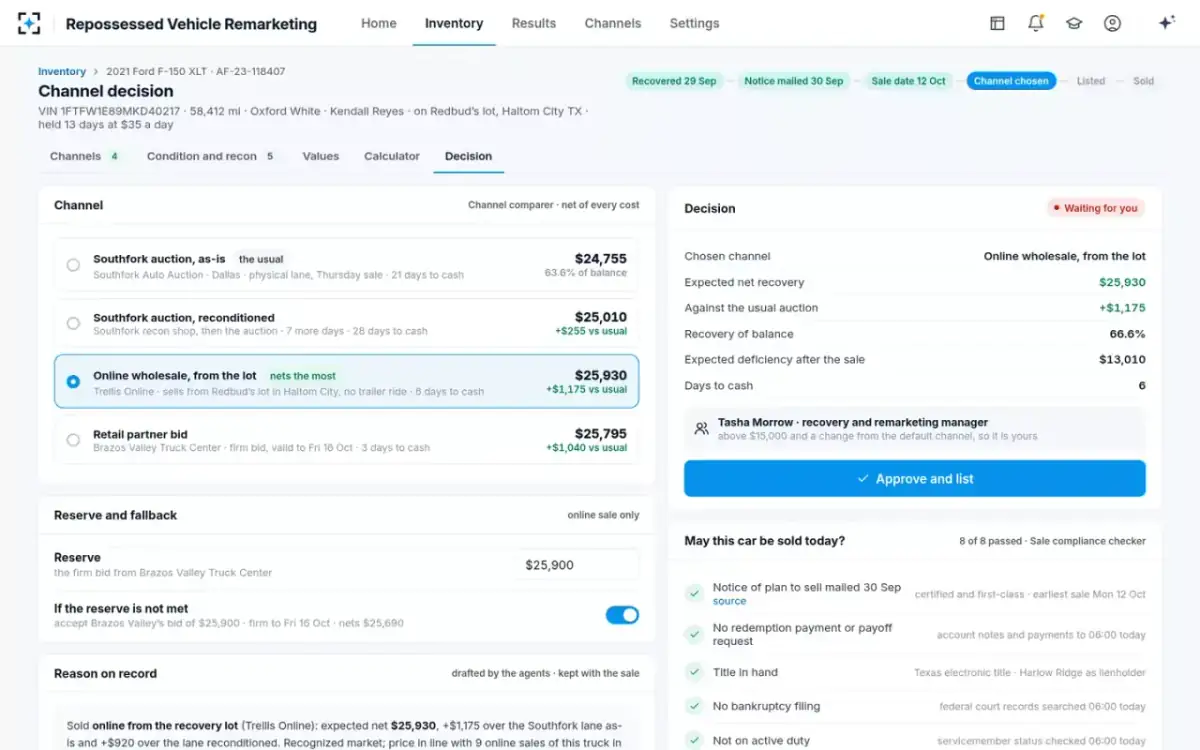
Eight checks and the reason, on the screen where the channel is chosen
Federal guidance moved in 2025; Article 9 did not
Auto servicers spent 2022 to 2024 reading federal expectations about repossession. On 12 May 2025 the Consumer Financial Protection Bureau withdrew a long list of guidance documents, item 20 of which was "Bulletin 2022-04: Mitigating Harm from Repossession of Automobiles", stating that "the Bureau does not intend to prioritize the enforcement of such guidance against parties that do not conform to the guidance during the pendency of any withdrawal" (Federal Register, 12 May 2025).
Nothing in that notice touched Article 9. The duty in § 9-610(b), the notification rules in §§ 9-611 to 9-614, the recalculation in § 9-615(f) and the shortfall limit in § 9-626 are state law, and they are enforced by borrowers in court rather than by a federal examiner. A lender that built its repossession controls to satisfy a federal bulletin and relaxed them in 2025 has relaxed controls that were never the binding constraint. The binding constraint is the one in the frame above.
It is also worth knowing the scale of what is being defended. The Bureau's own study of 905,000 repossession disposals found that "94 percent ended with a deficiency balance" (CFPB, Repossession in Auto Finance, January 2025). Almost every repossession sale a lender runs ends in a claim against the borrower — which means almost every one of them is a claim that can be contested, and the explanation that accompanies it is the first document anybody reads.
What a defensible file holds, line by line
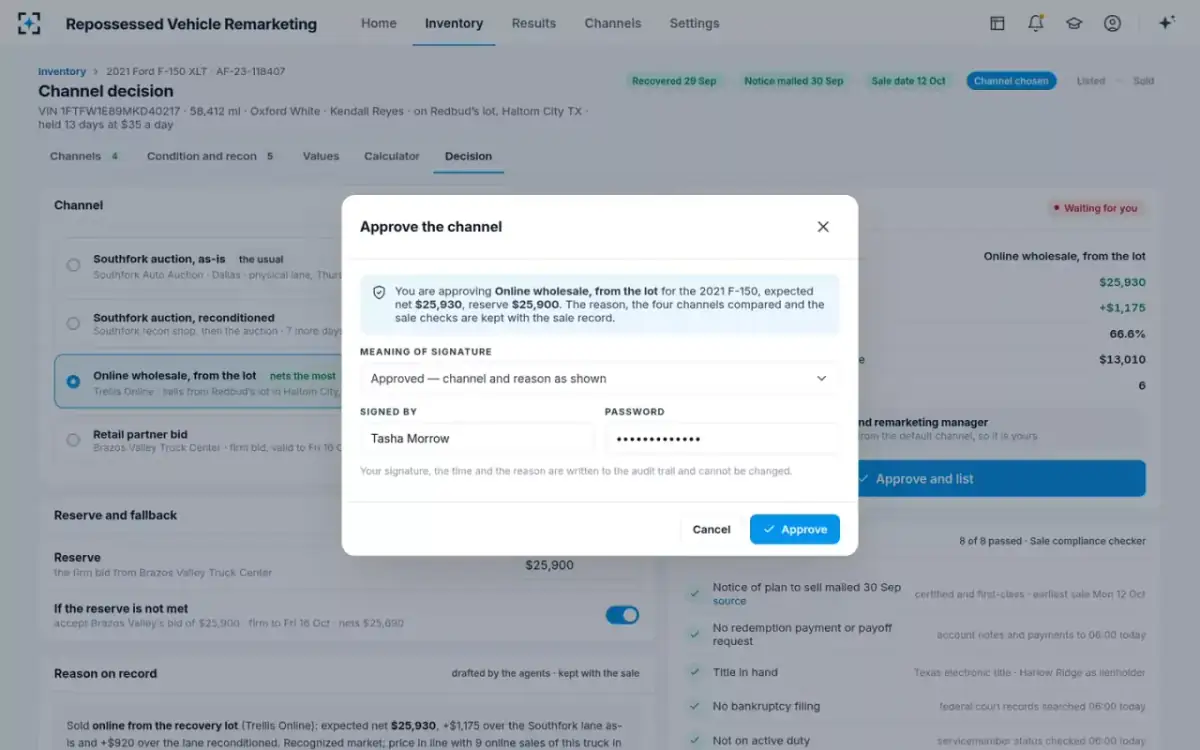
The sample lender keeps nine things with every sale, and the discipline is that all nine exist before the car is listed rather than after a complaint. The channels compared, each priced net of its own costs. The comparable sales each price rested on, with dates, mileage, grades and where they sold. The condition report, its photographs and the damage disclosed. The reconditioning estimate and the test that said whether the work paid. The reason the chosen channel was chosen, in words. The reserve, where it came from, and the fallback if it is not met. The eight checks and when each was run. The approval, with the approver's name, the time and the meaning of the signature. And afterwards, the sale result against the plan, with the variance explained.
None of that is exotic. All of it exists somewhere today — in an auction portal, a valuation subscription, a servicing note, a spreadsheet and somebody's memory. What a defensible file adds is that the nine pieces are assembled in one place, at the moment the decision is made, by the act of making it. That is also what makes the valuation behind the price worth inspecting: a number nobody can explain is not evidence of anything.
The approval, with the meaning of the signature kept
To see the channels, the checks and the reason assembled on a car of your own, start from Repossessed Vehicle Remarketing.
Questions people ask
Is an auction sale automatically commercially reasonable?
No. Selling through a dealer-only auction is ordinary practice and is good evidence under § 9-627(b)(3), but it is not a safe harbour on its own, because a used vehicle is not sold on a "recognized market" in the statutory sense. What makes an auction sale defensible is the surrounding method: that the car was described and photographed properly, offered where buyers for that vehicle bid, sold without unreasonable delay, and that the lender can say why that lane rather than another channel.
Does a low sale price make a sale commercially unreasonable?
Not by itself. § 9-627(a) says a greater amount obtainable at a different time or by a different method "is not of itself sufficient" to defeat commercial reasonableness. But a price well outside the range for that vehicle is evidence that something in the method was wrong, and it shifts attention to how the sale was run. The answer to a low price is the comparable sales and the channel comparison, not an assertion that price does not matter.
What happens if a lender never sends the notice before selling?
Compliance is then in issue, and the burden is the lender's under § 9-626(a)(2). If it cannot prove compliance, § 9-626(a)(4) presumes a complying sale would have realised the whole obligation plus expenses and fees, so the shortfall collapses to nothing unless the lender proves a lower figure. In a consumer transaction the limit may be stricter still: § 9-626(b) leaves the rule to the court, which “may continue to apply established approaches” rather than the formula above.
Can a lender keep the car instead of selling it?
Article 9 allows acceptance of collateral in full or partial satisfaction of the obligation, on its own conditions and with its own notices. It is a different route with different consequences: accepting the car in full satisfaction discharges the obligation, so there is no shortfall to collect. In consumer-goods transactions the statute restricts partial satisfaction, and a lender that has taken possession and then does not sell within a set period may have to dispose of the car.
How long does a lender have to wait before selling a repossessed car?
Long enough for the notification's stated earliest sale date to pass, and no longer than is reasonable after that. The ten-day figure many lenders use comes from § 9-612(b), which applies to transactions other than consumer transactions; for a consumer car loan, § 9-612(a) makes the reasonable time "a question of fact". Delay cuts the other way too: a car losing value in storage is an argument that the time was not reasonable.
Does a reserve price affect commercial reasonableness?
A reserve is one of the "other terms" § 9-610(b) covers, so it has to be reasonable like everything else. A reserve set at a real alternative — a dealer's firm bid the lender can actually accept if the reserve is not met — is easy to defend, because the floor is a price somebody has committed to. A reserve set at a round percentage of a guide value, with nothing behind it, is a number the lender will be asked to explain.