UCC 9-623 gives a debtor, a secondary obligor or another lienholder the right to redeem repossessed collateral by tendering "fulfillment of all obligations secured by the collateral" and the lender's reasonable expenses, at any time before the secured party has collected it, "disposed of collateral or entered into a contract for its disposition", or accepted it in satisfaction of the debt (UCC § 9-623). For an auto lender that means the right to redeem ends when the lender sells the car or signs to sell it, not after a set number of days, so every listing date is a legal decision as well as a remarketing one. The work is hard because the facts that decide it change daily: a payoff request can arrive the evening before a sale, a borrower can file for bankruptcy that morning, and a car can sit on a recovery agent's lot under a notice whose earliest sale date has not passed. Botminds' Repossessed Vehicle Remarketing re-runs its sale checks, redemption among them, on the morning a channel is chosen, and holds the car if any fails.
The vehicles, balances and lots in the examples are fictional sample data from the solution; the statute and research are real and linked where they appear.
How often repossessed cars go home, in the CFPB's data
22–29%
of completed repossessions were redeemed, January 2018 to March 2020
34%
redeemed among repossessions completed in December 2021
95%+
of redemptions happened within 30 days of repossession
When does the right to redeem end under UCC 9-623?
At the first of three events, none of which is a date on a calendar. The statute says redemption "may occur at any time before a secured party: (1) has collected collateral under Section 9-607; (2) has disposed of collateral or entered into a contract for its disposition under Section 9-610; or (3) has accepted collateral in full or partial satisfaction of the obligation it secures under Section 9-622". For a repossessed car sold at auction, online or to a dealer, the second event governs: the sale, or the signed contract to sell.
To redeem collateral, a person shall tender: (1) fulfillment of all obligations secured by the collateral; and (2) the reasonable expenses and attorney's fees described in Section 9-615(a)(1).
UCC § 9-623(b)
Two consequences follow for operations. The window is as long as the lender's own process: a car held 40 days is redeemable for 40 days, and the right does not lapse because a notice period expired. And the moment that ends it can be earlier than the auction gavel; accepting a dealer's firm bid can be "a contract for its disposition", so the redemption check belongs before the bid is accepted, not after.
Can a consumer waive the right to redeem?
No, not in a consumer-goods transaction. UCC 9-624(c) allows a debtor or secondary obligor to waive the right to redeem only by an agreement "entered into and authenticated after default", and opens that with "Except in a consumer-goods transaction" (UCC § 9-624). A clause in a retail installment contract, or a form a borrower signs at the recovery agent's lot, does not remove the right on a personal car loan.
Commercial vehicle loans differ: a business borrower may waive after default by authenticated agreement. A lender with a mixed book, personal autos and fleet or work trucks, needs the transaction type on each account so the redemption rule applied is the one that governs it.
Redemption, reinstatement and cure: three rights, three sources
Only redemption comes from Article 9, and it is the expensive one for the borrower. Reinstatement, paying the past-due amount and expenses to restore the loan, comes from state statutes or the contract where it exists. A right to cure before repossession is a state-law notice requirement in some states. Staff who answer borrower calls must know which exists for the account, because the figures differ by an order of magnitude.
Three ways a borrower may get a repossessed car back
| Right | Source | What the borrower pays | When it ends |
|---|---|---|---|
| Redemption | UCC § 9-623, in every state | All obligations secured, plus reasonable expenses and permitted attorney's fees | When the lender disposes of the car or contracts to |
| Reinstatement | State law or the contract; Article 9 does not create it | Past-due amounts and expenses, and the loan continues | As the statute or contract sets |
| Cure before repossession | State law where it exists | The default amount, after a notice of default | Before the car is taken |
On the sample F-150 with a $38,940 balance, redemption means $38,940 plus expenses; reinstatement, where available, might mean three missed payments and the tow. A borrower told the wrong figure on the first call may lose a week to the wrong plan, and a lender that cannot quote both correctly by state has a complaints problem before it has a remarketing one.
What does a borrower have to pay to redeem?
The whole secured obligation and the expenses in § 9-615(a)(1): "the reasonable expenses of retaking, holding, preparing for disposition, processing, and disposing", and attorney's fees where the agreement provides for them and the law allows. The amount therefore rises each day the car is stored, which is why a redemption figure should be quoted with a good-until date and an itemisation.
The CFPB's data gives one layer of it. Disposal fees charged to consumers ran to "a mean of $367 and a median of $339" for near-prime borrowers and "a mean of $300 and a median of $294" for superprime, and "average repossession costs charged to consumers in the dataset were higher when a forwarder was used". Storage is the other layer, and at the sample lender the 186 cars across four lots cost $4,658 a day. What each day of holding adds, and who bears it, is in repossessed vehicle carrying cost.
The notice must tell the borrower where to get the figure. In a consumer-goods transaction, § 9-614(1)(C) requires the notification of disposition to give "a telephone number from which the amount that must be paid to the secured party to redeem the collateral under Section 9-623 is available" (UCC § 9-614). The person who answers that number needs today's figure, not the one from the day the car was recovered.
How the notice period and the redemption window differ
The notice period limits when the lender may sell; the redemption window runs until it does. Timing of the notice is "a question of fact" in a consumer transaction: the 10-day safe harbor in § 9-612(b) is expressly for "a transaction other than a consumer transaction" (UCC § 9-612). A lender therefore sets its own consumer notice period, publishes an earliest sale date in each notice, and must not sell before it. Throughout that period and after it, until the sale, the borrower can redeem.
One sample truck, two clocks: the notice period is not the redemption window
- Recovered; notice prepared1 d
- Notice period: no sale allowed12 d
- Channel chosen, car listed3 d
- Open: redeem by paying the whole amount owed plus expensesuntil the sale
The overlap is where errors happen. A car listed on the morning its notice period ends, from a file last checked a week earlier, can be sold after a payoff request arrived the previous afternoon. The rules on a sale's manner, method and price are a separate test, covered in the commercially reasonable sale of a repossessed vehicle.
What a lender should check before it sells or signs to sell
Everything that could still stop the sale, as of the morning of the decision. Redemption is one check among several, and each depends on facts that move: payments and payoff requests, bankruptcy filings, a borrower's military status, title, and the borrower's personal property in the car.
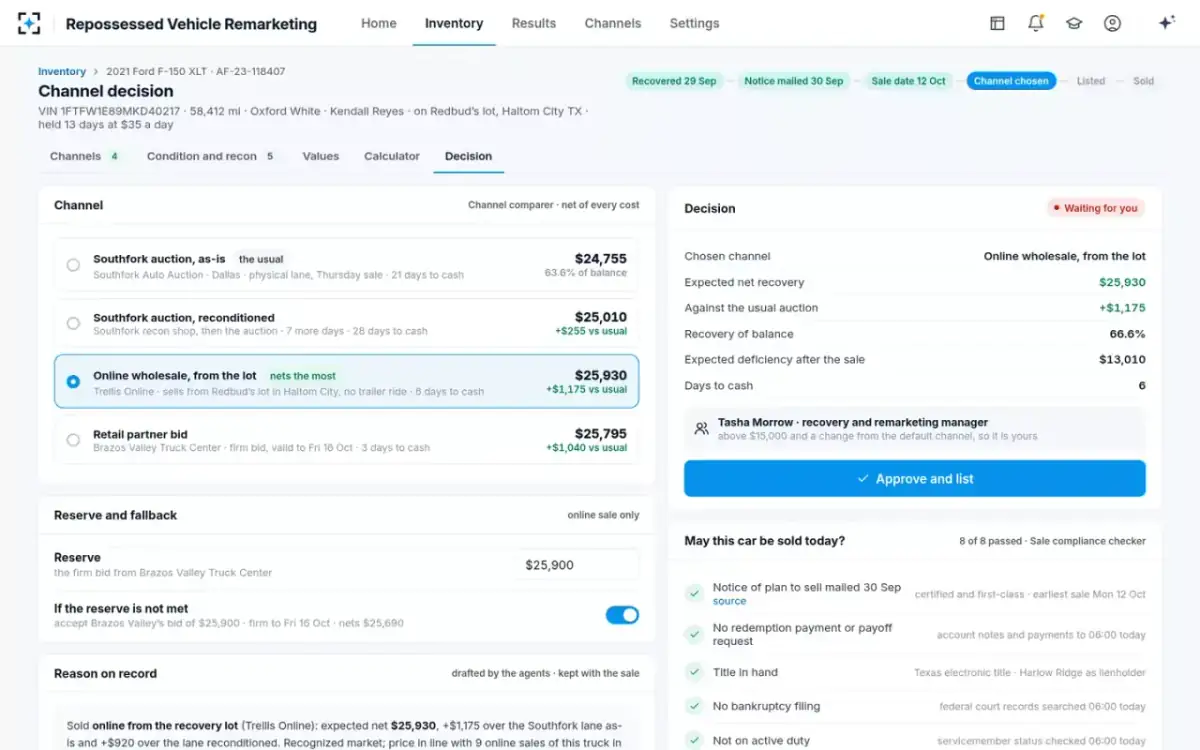
Eight sale checks, re-run on the morning the channel is chosen
- Notice of plan to sell sent, with proof
On the sample truck: mailed 30 September, certified and first-class.
- The notice's earliest sale date has passed
Monday 12 October here; selling before it is the failure that needs no argument to prove.
- No redemption payment or payoff request
Checked against payments and account notes as at 06:00 on the day of the decision.
- Title in hand
Three of the sample lender's cars are on hold for titles.
- No bankruptcy filing
Federal court records searched that morning; a filing stays the sale.
- Borrower not on active military duty
Servicemember protections can bar the repossession or the sale.
- Personal property held for return
Belongings in the car are a separate obligation with its own state rules.
- Sale channel and reserve approved
Above $15,000, or off the default channel, the remarketing manager signs with the reason.
Eight checks passed in Repossessed Vehicle Remarketing before the channel is approved
How redemption changes the remarketing plan
A car that may be redeemed should not be reconditioned or moved on the lender's assumption that it will be sold. The CFPB found "over 95 percent of redemptions in our dataset occurred within the first 30 days of repossession completion", so the first month is when spending on a car is most likely to be spent on a car that goes home. Costs the lender incurs preparing a car can be part of the redemption amount if reasonable, but a $1,740 reconditioning job on a truck the borrower then redeems turns a remarketing decision into a dispute over what was reasonable.
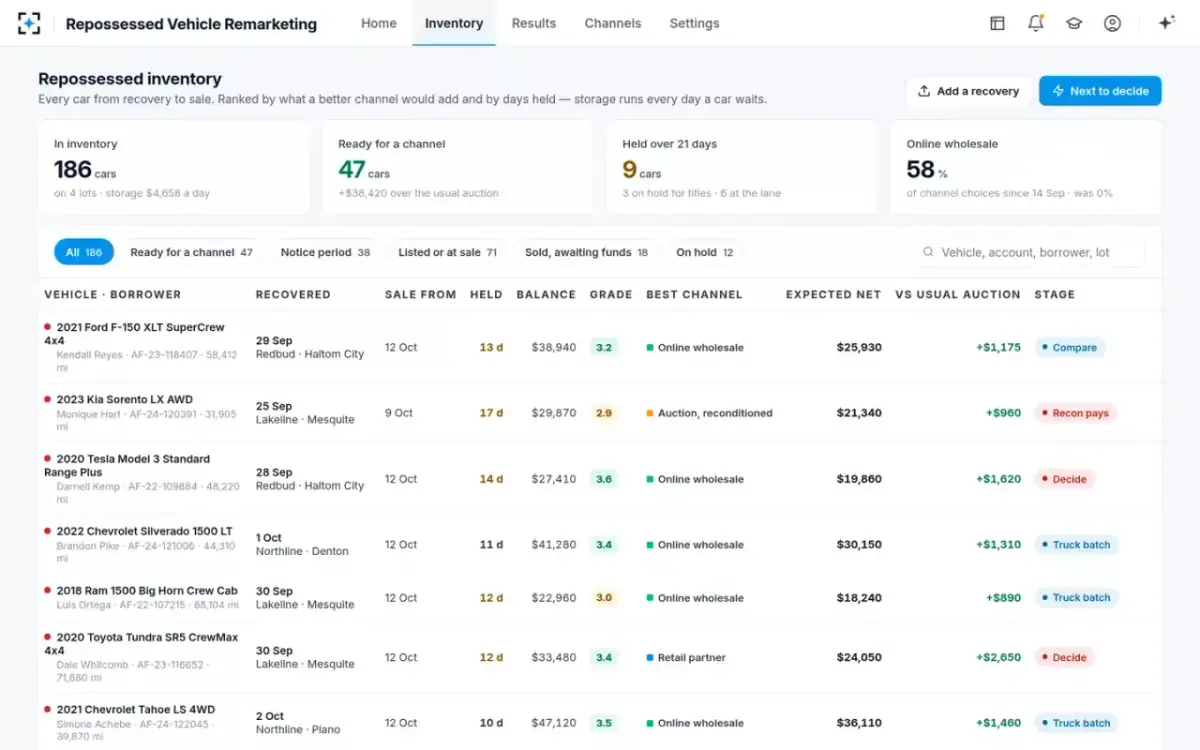
At the sample lender, 38 of 186 cars are inside their notice period on a given morning, 47 are ready for a channel, and 12 are on hold. The inventory shows each car's own sale-from date from its notice, so no car can be listed before it and the remarketing manager sees which cars are most likely still to be redeemed. Reconditioning on the F-150 did not pay anyway: it would have lifted the lane price from $25,600 to $27,700, only 1.14 times its cost plus the extra storage, under the lender's 1.5 times rule.
Thirty-eight of 186 cars inside their notice period this morning
After the sale: when redemption is gone
Once the car is sold or under contract, the right to redeem ends and the lender's duties move to the proceeds. Section 9-615 sets the order in which proceeds are applied, and a consumer borrower is entitled to an explanation of any deficiency or surplus; how that figure is built line by line is in the deficiency balance after repossession. On the sample F-150 the expected deficiency after an online sale was $13,010, at 66.6% recovery of the balance.
The redemption check is also evidence for that later conversation. A borrower who disputes a deficiency often starts by asking whether they were given the chance to redeem; a file that shows the notice, its earliest sale date, the redemption figure available by telephone and a redemption check on the morning of sale answers the question before it becomes a complaint.
Where Repossessed Vehicle Remarketing fits
The solution's agents read each recovered car's condition report and photos, value it to each possible sale date, compare channels net of every cost, and run the lender's sale checks, redemption, notice, title, bankruptcy, active duty and personal property, before a channel is chosen and again on the morning it is. A car that fails a check is held with the reason. The remarketing manager approves the channel and reserve with the meaning of the signature recorded, and the reason and the checks stay with the sale.
It does not set the lender's notice period or decide what state law requires; those are settings the lender's legal and recovery leaders own. What it changes is that no car is sold or contracted from a stale file. To see the sale checks on your own inventory, start from Repossessed Vehicle Remarketing.
Questions people ask
How long does a borrower have to redeem a repossessed car?
Under UCC 9-623, until the lender disposes of the car, contracts to dispose of it, or accepts it in satisfaction of the debt. There is no fixed number of days; state law may add notice or reinstatement rules.
What must a borrower tender to redeem?
Fulfilment of all obligations secured by the car and the lender's reasonable expenses of retaking, holding, preparing and disposing of it, plus attorney's fees where the agreement and law allow. On an accelerated loan that is the full balance, not the missed payments.
Can a lender sell before the notice's earliest sale date?
It should not: the notification of disposition states when the car may be sold, and selling earlier defeats it. In a consumer transaction the UCC gives no fixed safe-harbor period; whether notice was sent within a reasonable time is a question of fact.
Does a contract with a dealer end the right to redeem?
Entering into a contract for disposition ends it under § 9-623(c)(2), so accepting a firm bid can be the moment the right ends. The redemption check belongs before the bid is accepted.
Can a retail installment contract waive redemption?
Not in a consumer-goods transaction: UCC 9-624(c) excludes consumer-goods transactions from waiver. Outside them, waiver requires an agreement made and authenticated after default.
How common is redemption?
In the CFPB's data, between 22% and 29% of completed repossessions were redeemed before 2020, peaking at 34% in December 2021, and over 95% of redemptions occurred within 30 days of repossession.