Vacancy and credit loss is the deduction a lender makes from a property's potential rent for space that will be empty and for rent that will be billed but never collected. In underwriting it is set as the greater of what the property is actually losing and a floor: Fannie Mae's multifamily rule makes vacancy, concessions and bad debt together at least 5% of gross potential rent, HUD's market-rate multifamily program caps underwritten economic occupancy at 93%, and banks set their own floors by property type. It is hard to get right because the percentage means different things under different methods, the borrower's figure is usually the lowest one available, and recent collections can say more than any floor. Botminds' Rent Roll & Operating Statement Analysis applies the bank's own vacancy rule on every spread, after first removing tenants the leases and deposits do not support, and shows the line's reason next to its number.
The office and retail figures come from a fictional sample deal, Wexley Crossing in Columbus, Ohio, as it runs through the solution. The multifamily examples are our own illustrative arithmetic.
The numbers that set a vacancy allowance
5%
of gross potential rent: Fannie Mae's floor for vacancy, concessions and bad debt together
93%
HUD's ceiling on underwritten economic occupancy for market-rate multifamily
2%
decline in recent collections that forces Fannie Mae lenders to cut income further
3% → 5%
the sample borrower's vacancy against the sample bank's floor
What is vacancy and credit loss?
Vacancy and credit loss, also written as vacancy and collection loss or general vacancy and credit loss, is the single line in an underwriting that converts potential rent into the rent a property can actually be expected to collect. It sits between gross potential rent and effective gross income, and in most lenders' spreads it is the largest judgement on the income side.
It bundles three losses. Physical vacancy is space with no tenant. Concessions are rent given away to sign a tenant, such as free months. Credit loss, or bad debt, is rent owed by a tenant who is there but does not pay. Fannie Mae lists all three as separate deductions and then tests them together against one floor, which is the cleanest way to think about the line.
Vacancy vs credit loss: two different losses on one line
Vacancy is income lost because no one is in the space; credit loss is income lost because someone is in the space and not paying. They behave differently, and a spread that lumps them without looking at either can miss the second entirely.
Vacancy and credit loss behave differently, and are found in different documents
Vacancy: Rent on space with no tenant, plus rent given away in concessions.
Credit loss: Rent billed to a tenant in the space that is never collected.
Vacancy: Vacant rows on the rent roll; the occupancy figure.
Credit loss: Aged receivables; deposits that stop; the tenant's own estoppel.
Vacancy: Physical occupancy counts occupied space.
Credit loss: Economic occupancy counts rent collected against potential rent, so it captures credit loss too.
Vacancy: Rarely: an empty suite is visible on any inspection.
Credit loss: Easily: a tenant marked "current" on the roll can be months behind.
The sample deal shows why the distinction matters. Wexley Crossing's rent roll marks Maple & Main Kitchen as current. Its estoppel says rent is paid through 30 June, and no deposit has arrived since. That is credit loss dressed as occupancy, and no vacancy percentage applied to the roll would find it. The fix is to underwrite the suite as vacant, which removes its $95,200 before the allowance is applied, not to raise the allowance and hope it covers the hole.
What vacancy rate do lenders use? The floors in public rules
Lenders use the greater of the property's actual or market vacancy and a policy floor. The public rulebooks that write a floor down are multifamily ones: 5% under Fannie Mae, in effect 7% under HUD's market-rate program. For office, retail and industrial, the bank regulators' guidance sets no number; each bank sets its own floor by property type in its credit policy.
Minimum vacancy allowances, from public rules and one sample bank
HUD's text sets both tests at once: "Projects must have an average physical occupancy rate of at least 85%. For market rate properties, the maximum underwritten economic occupancy rate is 93%," and the project must show "a pattern of stable physical occupancy … for a period of six months prior to submission" (HUD MAP Guide, §7.8.9). A 93% ceiling means at least 7% of potential income is deducted however full the building is.
How to calculate vacancy and credit loss: the Fannie Mae method
To calculate vacancy and credit loss the Fannie Mae way, start from gross potential rent, which includes market rent for vacant units, deduct actual physical vacancy, concessions and bad debt, and then raise the total if needed so it is at least the larger of two tests. The rule sits in a footnote: adjust vacancy "such that the total of Items 4, 5, and 6 equals the greater of • the difference between the trailing 3-month net rental collections (annualized) and GPR, or • 5% of GPR" (Fannie Mae Multifamily Guide, §203.01).
Take an illustrative 120-unit property with average market rent of $1,500 a month. Gross potential rent is $2,160,000. Four units are empty ($72,000 a year), concessions run $10,000 and bad debt $8,000: $90,000 in total, 4.2%. The 5% floor is $108,000. But the last three months' collections, annualised, came to $2,040,000, a shortfall of $120,000 against potential rent, or 5.6%. The greater of the two tests wins, so the underwritten allowance is $120,000.
Then comes the trend test. If net rental income for the trailing three months has fallen more than 2% against either the trailing six or twelve months, the lender "must adjust the NRI downward to an amount that is 2% less than the lowest NRI for the trailing 1-month, 3-month, 6-month, or 12-month period." A floor protects against optimism about the future; this rule protects against a history that is already turning.
The bank method: a floor on verified in-place income
Many banks underwriting office and retail property work differently. They start from in-place rent, the rent of tenants actually there under leases, leave vacant suites out of income altogether, and then deduct a percentage for future turnover and credit loss. Under that method the floor is not covering today's empty space; it is covering tomorrow's.
The sample bank's standard reads "the greater of actual or this floor, on in-place income," with the floor at 5.0% for anchored mixed use. At Wexley Crossing the borrower applied 3% to income of $2,629,200 that still included the three tenants the documents did not support: $78,876. The T-12 shows only $4,100 of actual credit loss. The bank first removed the unproven rent and the one-time items, leaving gross potential income of $2,376,100, then applied 5%: $118,805. The vacancy line alone cost $39,929 of NOI; the verification before it cost $205,100.
The two methods produce percentages that look alike and mean different things. A 5% floor on Fannie Mae's gross potential rent, which includes vacant units at market, has to absorb existing vacancy before it covers anything else. A 5% floor on verified in-place income sits on top of existing vacancy, which has already been removed. Comparing "5%" across the two, or across banks that use different bases, compares nothing.
Vacancy and credit loss worked three ways
| Multifamily, Fannie Mae method | Multifamily, HUD market-rate | Office and retail, sample bank | |
|---|---|---|---|
| Base | Gross potential rent incl. vacant units at market: $2,160,000 | Gross potential income: $2,160,000 | Verified in-place income, vacant suites excluded: $2,376,100 |
| Actual loss | Vacancy, concessions, bad debt: $90,000 (4.2%) | The same: $90,000 (4.2%) | T-12 credit loss: $4,100 |
| Tests | 5% of GPR: $108,000; collections shortfall: $120,000 | 93% economic occupancy cap: at least 7% | Greater of actual or 5.0% floor |
| Allowance underwritten | $120,000 (5.6%) | $151,200 (7.0%) | $118,805 (5.0%) |
| Effective gross before other income | $2,040,000 | $2,008,800 | $2,257,295 incl. reimbursements and other income |
How to measure credit loss: read the receivables, not the bad-debt line
Credit loss is best measured from the aged receivables and the deposits, not from the operating statement's bad-debt line, because a manager writes rent off long after a tenant stops paying. A T-12 can show almost no credit loss while a tenant is three months behind.
The sample deal is a clear case. Wexley Crossing's T-12 shows vacancy and credit loss of $4,100 for the year, about 0.2% of gross income. Over the same months Maple & Main Kitchen paid nothing after June and owed $23,800 by September, and Lantern Nail Spa, on the rent roll from March, had paid nothing since. Neither shows as a loss on the statement because neither has been written off. A credit loss taken from the T-12 line is taken from the manager's write-off policy, not from the tenants.
One workable rule, ours rather than any regulator's, is to start from the receivables: treat balances over 60 days as at risk unless the tenant has an agreed plan, take balances over 90 days out of income and test the suite as vacant, then check the deposits of every tenant the receivables show as current. Fannie Mae's collections test reaches the same place by another road: it compares gross potential rent with actual net rental collections over the last three months, which captures unpaid rent whether or not anyone has written it off.
Why the vacancy factor should reflect the market, not the building
A building that is full today will not stay full for the life of the loan, so the vacancy factor is a forecast, not an observation. The OCC's definition makes that explicit: the vacancy factor "may be higher or lower than actual and represents an estimate of the vacancy the property is expected to experience throughout its existence. The selection of a vacancy factor should consider vacancies in comparable properties in the same market" (OCC Comptroller's Handbook, Commercial Real Estate Lending, glossary).
The market has been moving the wrong way for borrowers. The FDIC's 2026 Risk Review reports that vacancy rates rose again in 2025 across the major property types, more slowly than the year before, and that "net operating income growth continued to slow, reflecting elevated vacancy rates, higher property operating costs, and tepid rent growth" (FDIC, 2026 Risk Review). A floor written into policy years ago, in a tighter market, can sit well below what comparable buildings are losing now.
A fully leased single-tenant building is the hardest case. Its actual vacancy is zero until the day it is 100%, so a percentage allowance is a poor model of its risk; the real question is whether the tenant renews before the loan matures. Lenders still apply a factor, and then look separately at the lease term against maturity, which is where tenant rollover risk takes over.
What two points of vacancy are worth in loan dollars
Each point of vacancy on the sample building is worth about $23,000 of net cash flow and about $225,000 of loan. That is the arithmetic that makes the vacancy line worth arguing about, and the reason a relationship manager hears about it.
At the bank's 5% floor, net cash flow is $1,293,503 and the loan sizes to $12,850,000 at 1.25x coverage. At 7%, net cash flow falls to $1,247,882 and the loan to $12,400,000. The difference is smaller than the gross arithmetic suggests because the management fee, charged on effective gross income, falls with it.
Rent Roll & Operating Statement Analysis: loan sizing with a vacancy sensitivity
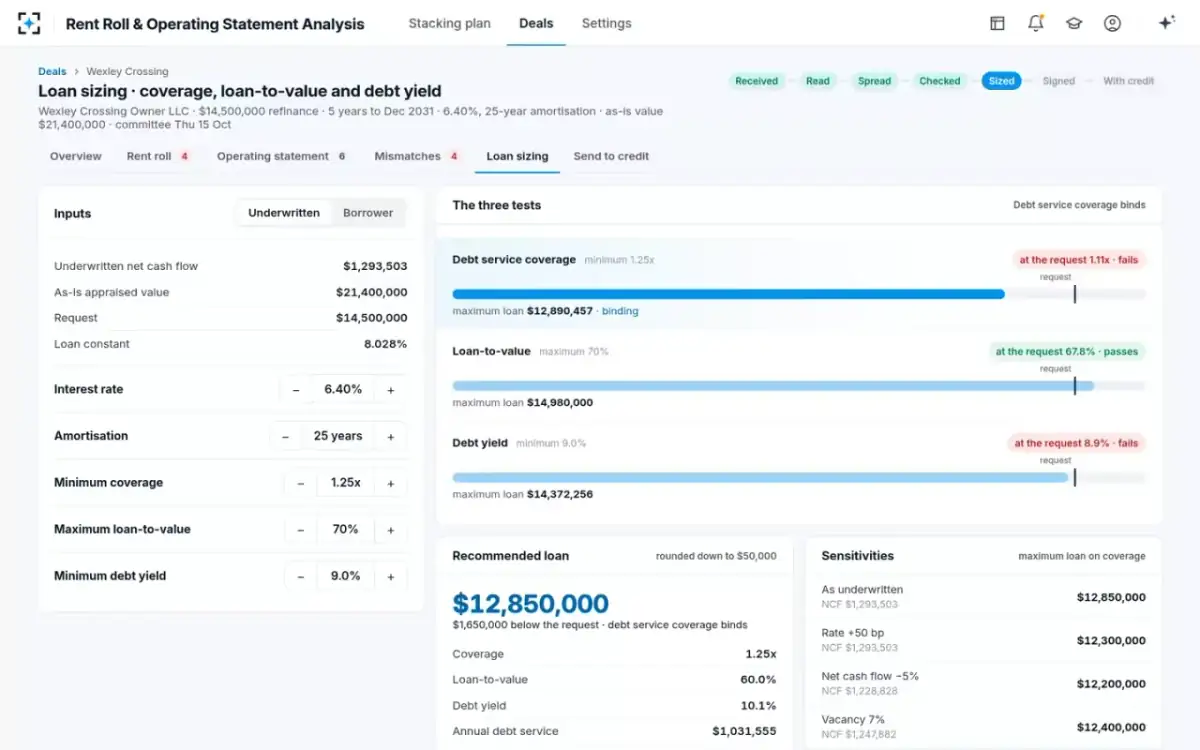
The vacancy floor as a setting in Rent Roll & Operating Statement Analysis
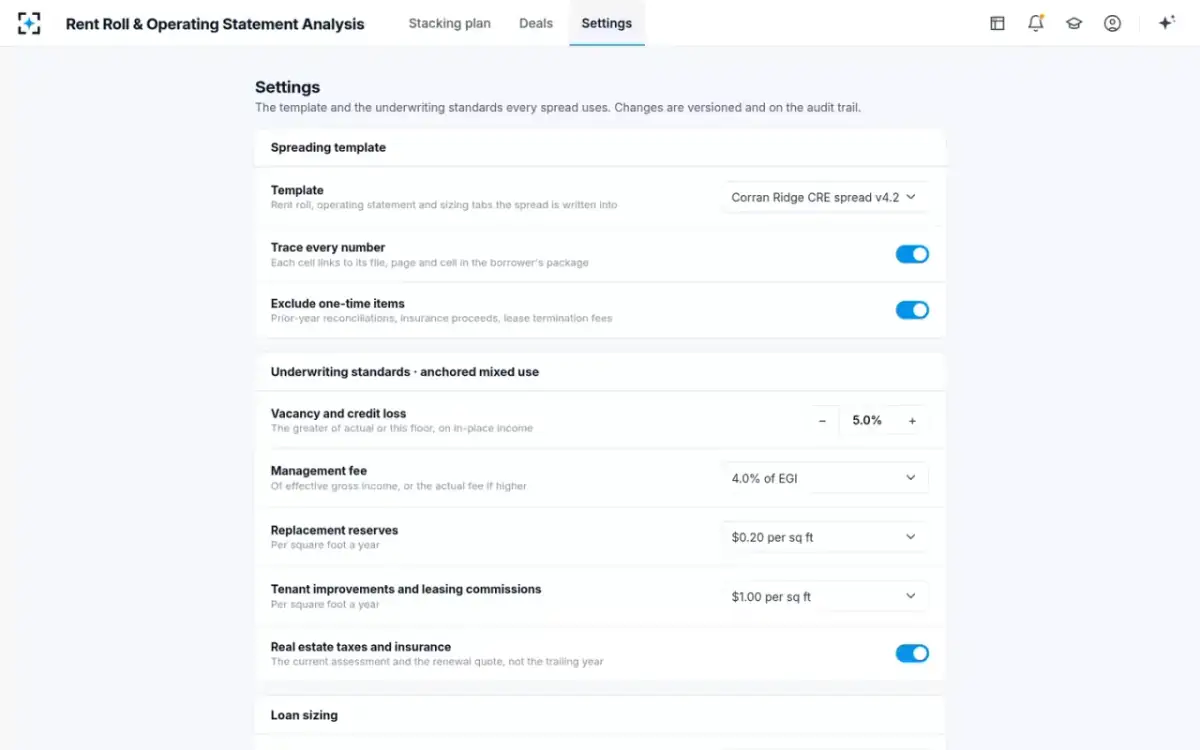
The vacancy line is where the borrower's operating statement and the bank's standards meet; what underwritten NOI means places it in the full chain from rent to coverage. To see the bank's own floors applied to a package, start from Rent Roll & Operating Statement Analysis.
Questions people ask
What is general vacancy and credit loss?
General vacancy and credit loss is the combined allowance for empty space and uncollected rent applied to a whole property, as opposed to vacancy on a specific suite. Appraisers and underwriters use it to move from potential gross income to effective gross income. It is usually expressed as a percentage of potential income, with the base stated.
Is vacancy and credit loss applied to gross potential rent or to in-place rent?
Either, depending on the lender's method, and the answer changes what the percentage means. Fannie Mae applies its 5% test to gross potential rent including vacant units at market; many banks apply a floor to verified in-place rent with vacant suites already excluded. Always state the base next to the percentage.
Do concessions count as vacancy?
Under Fannie Mae's multifamily table, yes for the purpose of the floor: physical vacancy, concessions and bad debt are three separate lines, and their total must meet the greater of 5% of gross potential rent or the recent collections shortfall. In a bank's office spread, free rent still running into the loan term is usually deducted from the tenant's rent instead.
What is economic occupancy?
Economic occupancy is rent actually collected as a share of gross potential rent, so it falls with vacancy, concessions and unpaid rent alike. Physical occupancy only counts occupied space. HUD's MAP Guide uses both: at least 85% average physical occupancy, and no more than 93% underwritten economic occupancy for market-rate properties.
Do lenders apply vacancy to a fully leased building?
Yes. Underwriting assumes the vacancy a property is expected to experience over its life, not on the day of the loan, and the OCC says the factor should consider vacancies in comparable properties. For a single-tenant building the lender also tests what happens if that tenant leaves before maturity.