To read a rent roll the way a lender does, go column by column and ask of each one which document proves it: the suite and area against the lease, the dates against the lease and every amendment in date order, the rent against the amendment in force and the bank deposits, and the status against what the tenant itself confirms. A rent roll is the landlord's schedule of tenants on a given date, and for an income-producing commercial real estate loan it is where the income the loan will be sized on begins. Reading it is hard because the party asking for the money prepares it, it usually arrives as a property-management export with summary rows and header bands, and nothing on it is evidence by itself. Botminds' Rent Roll & Operating Statement Analysis exists to do that reading on every suite: it writes the roll into the bank's template and marks each suite against its lease, its tenant estoppel and three months of deposits.
The worked examples come from a fictional sample deal as it runs through the solution: Wexley Crossing, a seven-floor office and retail building of 112,500 square feet in Columbus, Ohio, seeking a $14,500,000 refinance. Its rent roll, dated 30 September 2026, lists 21 suites.
One rent roll, read against its evidence
93.9%
occupancy the rent roll states, counting every listed tenant
89.6%
occupancy by area that is actually paying rent
4of 18
leased suites where the roll and the documents disagree
$205,100
of stated base rent the documents do not support, 10.3% of the total
What is a rent roll in commercial real estate?
A rent roll in commercial real estate is a schedule, as of one date, of every rentable space in a property: who occupies it, how large it is, when the lease started and ends, the rent in force, what the tenant reimburses, and any options. In multifamily it runs unit by unit and is short on terms; in office, retail and industrial it runs suite by suite and carries the lease economics that decide the loan.
Lenders use it twice. At underwriting it is the base for gross potential rent and occupancy, the first lines of the income the loan is sized on. After closing it becomes a monitoring document, collected annually, quarterly or monthly depending on the property, and read for change. In both uses the rent roll is a summary someone else wrote, so the lender's job is to test it, not to type it.
The OCC's examination procedures for commercial real estate say what that test covers. File readers are told to "review current rent rolls and leases and assess the quality and mix of tenants," to "note any significant volume of leases scheduled to expire," and to "analyze the potential effect on future debt-service coverage from tenant turnover" (OCC Comptroller's Handbook, Commercial Real Estate Lending, examination procedures). An examiner reads the rent roll with the leases beside it. A lender's analyst should too.
What columns are on a rent roll, and what proves each one
A commercial rent roll usually carries eight kinds of column: suite, tenant and use, area, lease start and end, rent, recoveries, options, and payment status. Each one is a claim, and each claim has a document that proves or disproves it. The figure annotates one row from the sample roll, the suite where the rent turned out to be wrong.
One row of a rent roll, annotated: every column is a claim
Suite
201
Ties the row to a space in the lease and on the plan. A suite missing from the plan, or listed twice, is the first thing to catch.
Tenant · use
Pulse Athletic Club · fitness
The legal tenant named in the lease, not a trade name. Use tells you how the space re-lets if the tenant leaves.
Area
9,800 sq ft
Rentable area from the lease. It drives rent per foot, occupancy and every per-foot reserve.
Start · end
Mar 2022 · Feb 2032
From the lease and every amendment, in date order. The end date decides rollover; one typed year moves a tenant past the loan.
Rent
$24.00 / sq ft · $235,200
The rent in force today. An amendment, a free-rent period or a step can make the lease rate the wrong number.
Recoveries
$4,410 a month
What the tenant reimburses for taxes, insurance and common area costs. The lease, not a label, says which.
Options
—
A blank still needs the lease read. A termination right inside the loan term is income that can walk; a renewal at a set rent can be a ceiling.
Billed
$24,010 a month
What the landlord bills. Only receivables and bank deposits show what arrives: here, $17,885 a month.
Read that way, the rent roll becomes a list of questions. Is suite 201 in the lease at 9,800 square feet? Does the lease, as amended, still say $24.00? Has the tenant paid $24,010 a month, the figure the roll bills? On this suite the third question settles the second: three deposits of $17,885 arrived, the amendment rate, and the roll was simply never updated.
Rent roll columns mapped to the document that proves them
| Column | What the rent roll claims | What proves it | What commonly goes wrong |
|---|---|---|---|
| Suite and area | The space exists and is this size | The lease premises clause; the floor plan | Suites listed twice; area from an old measurement |
| Tenant | This party is bound to pay | The signed lease and any assignment | A trade name with no lease behind it |
| Start and end | The term runs to this date | The lease and every amendment, read in date order | An extension never signed; a year typed wrong |
| Base rent | This rent is in force today | The lease as amended; the bank deposits | An amendment cut the rent; free rent not shown |
| Recoveries | The tenant reimburses these costs | The lease expense clauses; reconciliation statements | A "triple net" label the lease does not support |
| Options | These rights exist, or none do | The lease; the tenant estoppel | An early termination right left off the roll |
| Status | The tenant is current | Aged receivables; deposits; the estoppel | A tenant marked current that has not paid for months |
Read the top of the rent roll first: the date, the totals and the rows that are not tenants
Before reading any tenant, read the header and the footer. The as-of date tells you how stale the roll is against the operating statement and the deposits you will compare it with. The totals tell you how the landlord counts occupancy. And the rows that are not tenants, the summary lines, header bands and subtotals a property-management export inserts, are where a hand re-key most often double-counts.
The sample export carries four summary rows and two header bands among its 21 suites. Typed into a template line by line, a subtotal row reads as one more tenant. The solution drops each one and reports how many, so the analyst can see the count tie back to 21 suites and 112,500 square feet.
Then check the arithmetic the roll does for you. Total base rent should equal the sum of the rows; occupancy should equal leased area over rentable area. On the sample roll both tie, which is the point: a rent roll can be internally consistent and still wrong, because consistency only shows that the landlord added up its own claims correctly.
Area and occupancy: leased is not the same as paying
Occupancy on a rent roll usually means leased area over rentable area. A lender wants a narrower number: area whose tenant is paying under a lease the bank has seen. The difference is the first sign of how much of the stated income is at risk.
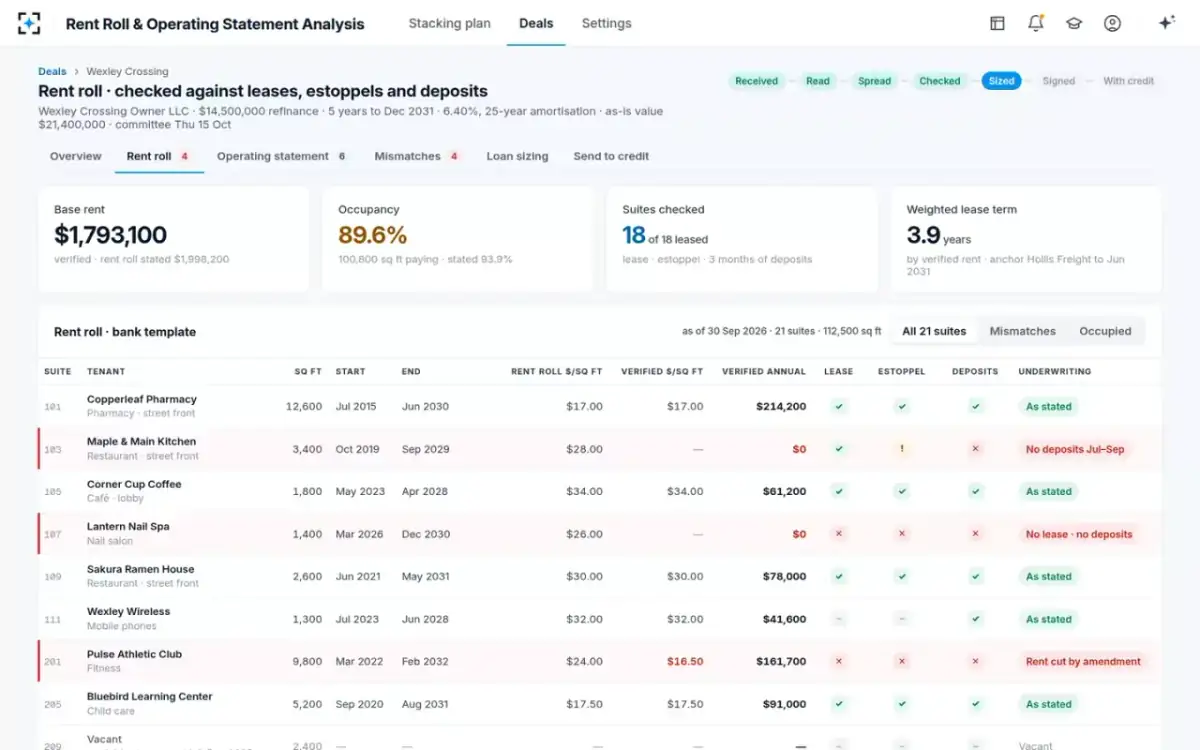
At Wexley Crossing the roll states 93.9% occupancy. Two tenants on it are not paying: Maple & Main Kitchen, 3,400 square feet, marked current, whose estoppel says rent is paid only through 30 June, with nothing deposited from July to September; and Lantern Nail Spa, 1,400 square feet, with no lease in the package, no estoppel and no deposits since March. Take out those 4,800 square feet and paying occupancy is 100,800 of 112,500, or 89.6%.
The same logic changes how the vacancy allowance should be read. A 5% allowance applied to rent that is already overstated by phantom tenants protects against nothing; applied to verified in-place rent it does its job. How lenders set the vacancy and credit loss number works through the methods in detail.
Dates: the lease end column decides the loan's rollover
The end-date column is the one most often read too quickly, and it is the one that decides rollover. Each date should come from the lease and every amendment, read in order, because an extension or early termination usually lives in an amendment the roll was never updated for.
The sample roll lists Northpoint Family Dental through 2031. Its lease ends in March 2027. The rent on the roll is right, so a rent check passes; only a date check catches it, and it moves a tenant from comfortably past the loan's December 2031 maturity to five months after the credit committee meets. One wrong digit turns a stable tenant into a condition on the loan.
From the dates comes the most useful single summary of a rent roll: weighted average lease term, the remaining term of each lease weighted by its share of rent (or area). Weighted by verified rent, the sample building's is 3.9 years, against a five-year loan. That gap is why the lender then plots expiries by year; reading the lease-expiry cliff shows what the plot reveals at this building.
Read rent by tenant, not by suite: one tenant pays 30% of it
Rent: the rate in force today, not the rate in the lease
The rent column should show the rent the tenant is obliged to pay today, and the original lease rate is often not it. Free-rent periods, scheduled steps and amendments that cut or defer rent all change the number in force, and a roll exported from a system set up at signing will not know about a concession agreed later.
Suite 201 is the example. The roll bills Pulse Athletic Club at $24.00 a square foot, $235,200 a year. Amendment 2, section 3, reads: "Commencing April 1, 2026 and continuing for eighteen (18) months, Annual Base Rent shall be $16.50 per rentable square foot ($161,700.00 per annum)." The deposits match the amendment. The underwritten rent is $161,700, and the step back to $24.00 in October 2027 is not counted, because a lender sizes on what is in force, not on a promise that resumes after the cut.
Two checks catch most rent errors. Divide annual rent by area for every row and look for rates that sit far from their neighbours or from what similar space commands. Then compare the monthly rent the roll bills with what arrived in the bank, tenant by tenant. The first finds typing errors; the second finds stale terms.
Why a "triple net" label on a rent roll is not an answer
The recovery column usually carries a short label: gross, modified gross, NNN. The label does not settle who pays which costs, and the OCC says so in its own glossary: net lease terms "lack universally agreed-upon definitions," so "the lease itself should always be analyzed to determine the expenses a landlord or tenant is responsible for rather than relying on these terms. This determination is critical to developing an accurate estimate of cash flow and NOI for the property" (OCC, Commercial Real Estate Lending, glossary).
In practice that means reading the expense clauses: which costs are recoverable, whether there is a base year or an expense stop, whether management fees and capital items are excluded, and whether recoveries are capped. A tenant labelled NNN whose lease caps common area charges leaves the landlord paying the overrun, and that overrun belongs in the bank's expenses, not the tenant's.
Status: "current" is the landlord's word, not the tenant's payment
A status column marked "current" is the landlord's statement about its own receivables. Lenders confirm it three ways: an aged receivables report showing balances at 30, 60 and 90 days; the tenant's estoppel, which states the date through which rent is paid; and the bank deposits, matched to tenants by payer and amount.
The sample roll marks Maple & Main Kitchen current at $95,200 a year. Its estoppel says rent is paid through 30 June 2026; the receivables show $23,800 past due; the deposits show nothing from July to September. Three documents agree with one another and disagree with the roll, so the suite is underwritten as vacant. The opposite trap matters too: a $12,000 transfer from the sponsor's management company that matches no tenant is not rent, however conveniently it arrives.
Rent Roll & Operating Statement Analysis: the rent roll in the bank's template, every suite checked
What to look for in a rent roll: ten checks before you trust it
The checks below are the ones that most often change the income a loan is sized on. None needs software; all of them need the leases, the estoppels and the deposits beside the roll.
Ten things to check on any commercial rent roll
- The as-of date matches the deposits and operating statement you will compare
A roll three months older than the bank statements cannot be reconciled to them.
- Suite count and area tie to the building
Drop summary rows and subtotals; look for suites listed twice.
- Every rent-paying row has a signed lease in the package
A tenant with no lease is a claim, not income.
- Rent per square foot is plausible row by row
Outliers are usually typing errors or stale terms.
- Amendments are read in date order
Rent cuts, deferrals and extensions live in amendments.
- Billed rent matches deposits for each tenant
Three months is enough to show a pattern.
- Status agrees with receivables and the estoppel
"Current" must mean paid, through a stated date.
- Recovery terms come from the lease, not the label
Caps, base years and exclusions change the expense line.
- Options and termination rights are listed
A right to leave inside the loan term is rollover risk.
- Expiries are plotted against the loan maturity
Rent ending before maturity is the refinance problem.
How do examiners review a rent roll?
Examiners review a rent roll as part of the file review for each income-producing loan: they compare it with the leases, judge the quality and mix of tenants, note leases due to expire, and ask what tenant turnover would do to future debt-service coverage. The procedure quoted earlier is the OCC's; the point for a lender is that the examiner starts where the analyst should have started, with the leases beside the roll.
That has a practical consequence for the credit file. If the analyst's spread shows a rent the lease does not support, the examiner finds it in the same file the analyst had. The safest spread is one where every rent can be opened to its lease clause and its deposits, which is what the rent roll tab in the solution does: each verified figure links to the file, page and passage it came from.
Rent Roll & Operating Statement Analysis draws the building from its rent roll
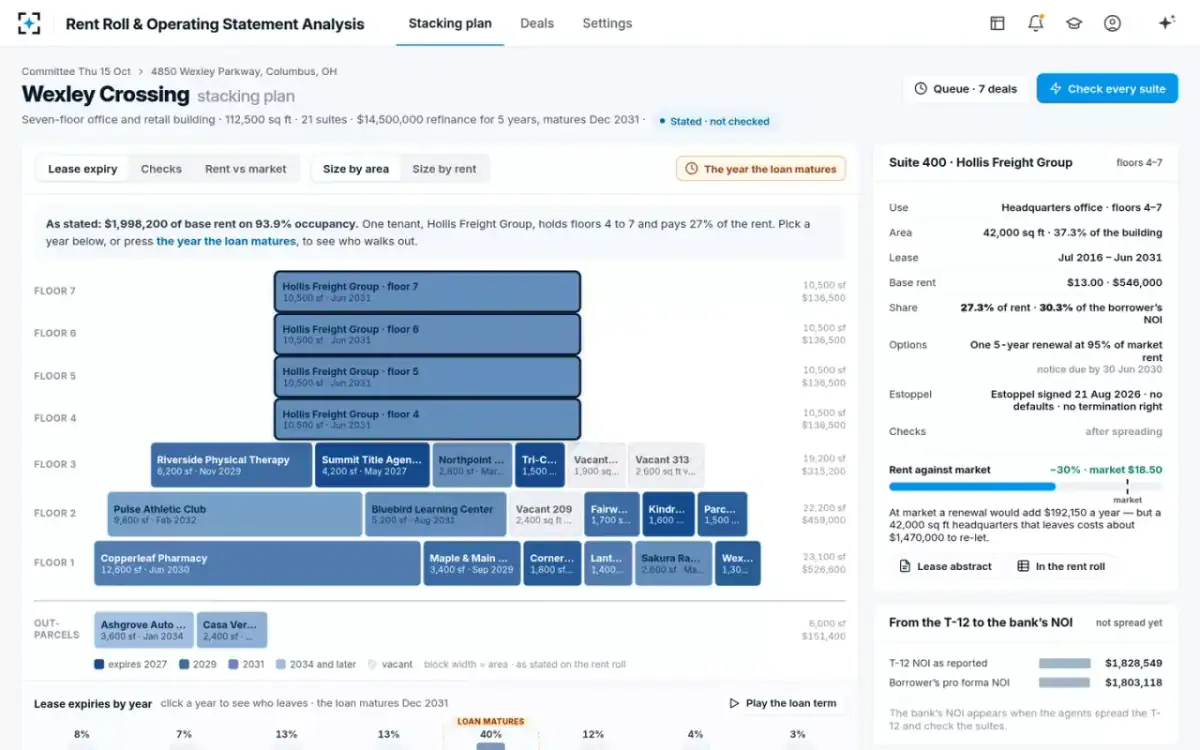
The rent roll is only half of what the borrower sends. The operating statement says what the property actually collected and spent, and the two rarely agree; what a rent roll and a T-12 each tell a lender covers how to reconcile them. To see the reading done across a whole package, start from Rent Roll & Operating Statement Analysis.
Questions people ask
What does a commercial rent roll example look like?
A typical commercial rent roll is a table with one row per suite: suite number, tenant, use, rentable square feet, lease start and end, base rent per square foot and per year, recovery type, options and payment status, with totals for area, rent and occupancy at the foot. The sample roll on this page has 21 suites over seven floors and two outparcels, dated 30 September 2026.
What should be on a rent roll?
At minimum: every rentable space including vacant ones, the tenant's legal name, area, lease dates, current rent, recovery terms, security deposit, options and arrears. A roll that omits vacant suites overstates occupancy by leaving the denominator short, and one that omits options hides termination rights.
What does weighted average lease term mean?
Weighted average lease term is the average remaining lease term of a property's tenants, weighted by each tenant's share of rent or area. Weighted by rent, it shows how many years of today's income are contracted. The sample building's is 3.9 years against a five-year loan, a signal to look at which leases end before maturity.
Is a rent roll the same as a lease abstract?
No. A lease abstract summarises one lease in detail, clause by clause; a rent roll summarises every lease in one line each, as of a date. Lenders use abstracts to check the rent roll, not to replace it, and the check that matters is whether the two agree.
Who prepares a rent roll for a commercial loan?
The borrower or its property manager, usually as an export from the property-management system, sometimes certified by the borrower as true and complete. Because it comes from the party seeking the loan, lenders test it against the leases, the tenants' estoppels and bank deposits rather than accepting it as stated.