Rent roll certification is the borrower's signed statement, usually by an officer of the borrowing entity or its property manager, that a rent roll is true, correct and complete as of its date. Lenders ask for it because it makes the borrower answerable for the schedule the loan is sized on, and some programmes require it outright: HUD's multifamily insurance programme wants an updated, certified rent roll dated no more than 30 days before the loan is endorsed. But a certification is a promise by the party asking for money, not a check, and on its way to a credit decision a rent roll passes several other seats, the tenant, the appraiser, the inspector, the lender's analyst and reviewer, each of which certifies something narrower than it seems. Botminds' Rent Roll & Operating Statement Analysis was built for the lender's seat: its agents test every suite against its lease, estoppel and deposits, so that when the analyst signs the spread, the signature says what was proven.
Lender-side examples come from a fictional sample deal run through the solution: Wexley Crossing, a 21-suite office and retail building in Columbus, Ohio, refinancing with the fictional Corran Ridge Bank.
What a certified rent roll did not stop in one federal case
24
multifamily mortgage loans in a Hartford fraud scheme built on false rent rolls and leases
~$50M
of loans; the victims included several lenders, Fannie Mae, Freddie Mac and HUD
100%
occupancy one rent roll claimed for a building where not a single tenant lived
62months
prison sentence for the property manager who ran the scheme
What is a certified rent roll?
A certified rent roll is a rent roll that carries a signed statement from the borrower, its manager or both that the schedule is accurate and complete as of a stated date. The certification usually sits at the foot of the roll or on a cover page, names the property and the date, and is signed by someone with authority to bind the borrower.
It does two jobs. It fixes a version: the lender knows exactly which schedule the borrower stands behind, so a later roll that differs has to be explained. And it allocates responsibility: if the roll is false, the borrower made a written representation the lender relied on. What it does not do is prove anything about the tenants. Every figure on a certified rent roll still comes from the landlord's own system, and the certificate adds a signature, not a source.
Who certifies a rent roll? Every seat, and what each signature proves
Five or six people sign something about the same rent roll before a loan closes, and each signature covers a different, narrower claim. The danger is in assuming the next seat checked what this one did not.
Every seat that signs off on a rent roll, and the limit of each signature
| Seat | What they sign | What it can prove | What it cannot prove |
|---|---|---|---|
| Borrower or sponsor | Certification that the roll is true and complete | Which version the borrower stands behind | That any rent on it is real |
| Property manager | The export, sometimes a certification | What the manager's system holds | That the system was updated for every amendment and default |
| Tenant | An estoppel certificate to the lender | Its own lease terms, rent paid-through date, defaults and rights | Anything about other tenants; and only if the tenant itself signs |
| Appraiser | The appraisal, with occupancy verified at inspection | That occupancy looked as stated on the day | Rent levels or payment, unless separately tested |
| Inspector | An inspection report | That spaces are occupied and maintained | Who the occupants are and what they pay |
| Lender's analyst | The spread | Whatever the analyst actually tested | Anything the analyst did not test |
| Senior underwriter and credit officer | Review and approval | That the analysis is reasonable | Evidence the file does not contain |
Read down the right-hand column and the gap appears. Nobody in the chain is required by their own role to prove that the rent on each line is in force and being paid, except the lender's analyst, and only to the extent the analyst actually checks. That is why the meaning of the analyst's signature is the subject of the rest of this page.
How recent must a certified rent roll be?
Recent enough to show the building as it is when the loan closes, and lenders set the window in days, not months. HUD's MAP Guide is the clearest public example: "The Borrower must submit an updated, certified rent roll detailing the occupancy level at the project. The rent roll must be dated no more than 30 days prior to endorsement" (HUD MAP Guide, §7.8.9).
The same section explains why. A project must show stable occupancy for six months before the application and keep it "through to the date of Initial/Final Endorsement," and "continued occupancy consistent with the underwriting conclusions must be documented with an updated rent roll no more than 30 days prior to closing." A certified rent roll here is a bring-down: proof that nothing material changed between underwriting and closing. Bank lenders commonly ask for the same thing as a closing condition; the sample deal asks for a certified rent roll showing Pulse Athletic Club at its amended rent.
Rent roll certification language: what the wording should cover
Certification language varies by lender and is a matter for the lender's counsel, but useful wording does more than say "true and correct." It should make the borrower state the things a lender cannot easily see for itself, so that an omission is a misstatement rather than a silence.
Points a rent roll certification can usefully cover
- The property, the as-of date and that the roll lists all rentable space, including vacant space
- That each rent shown is the rent in force, reflecting every amendment, concession and abatement
- That no tenant is in default, has stopped paying or has given notice, except as listed
- That no free rent, rent credit or side agreement exists that the roll does not show
- That security deposits, prepaid rent and arrears are stated as held
- That no tenant has a termination right or option not shown
- That the signer has authority to bind the borrower and knows the lender will rely on it
How do lenders verify a rent roll?
Lenders verify a rent roll by testing it against sources the borrower does not control, or controls less: the leases, the tenants' estoppels, bank deposits, and someone physically seeing the space. The OCC expects the last of these to continue after closing: "Periodic property inspections should be performed to verify that the property is being adequately maintained and that tenants and vacancies have been accurately reported in the rent roll" (OCC Comptroller's Handbook, Commercial Real Estate Lending).
HUD gives the appraiser the same job at origination: the appraiser must "confirm the project occupancy level, and verify the owner's rent roll during the inspection," and when the roll checks out, the occupancy "based on the owner's rent roll must be entered" on the appraisal form (HUD MAP Guide, Chapter 7). An inspection is good evidence that space is occupied. It is weak evidence of who occupies it, on what terms and whether they pay, which the next section shows.
Can a borrower fake a rent roll? The Hartford case
Yes, and a federal prosecution shows how far a fake can travel. Between 2016 and 2021, a property manager in Hartford, Connecticut, "provided false rent rolls and falsified leases to the victim financial institutions and their appraisers, which either overstated the number of renters by listing fictitious renters or others not actually living there, or falsely inflated the amount of rent paid by occupants," according to the U.S. Attorney's Office (U.S. Department of Justice, District of Connecticut, 2024).
Every seat in the table above was passed. Inspectors were deceived "into believing that unoccupied apartments were occupied by staging the apartments with furniture" and by employees told to say they lived there. One rent roll claimed a building was 100% occupied "when, in fact, not a single tenant resided there." When the lender's agent asked for proof of payment, it received pictures of money orders and checks for the fake tenants, bought by the scheme's own people. The financials, bank statements and invoices were doctored too. The scheme covered 24 loans totalling nearly $50 million, and the false information led Fannie Mae and Freddie Mac to buy the resulting loans and HUD to issue a mortgage insurance commitment.
Why every signature passed, and what would have caught it
Each check in Hartford tested the thing the fraud was built to survive. A staged apartment passes an inspection. A fabricated lease passes a lease audit, because the lease agrees with the roll it was written for. A money order bought by the landlord passes a request for proof of payment, because the proof was chosen by the party under test.
What is much harder to fake is a pattern of deposits, over months, from payers who are the named tenants, landing in the property's own operating account, consistent with every other source. That is why the deposit test in a rent roll reconciliation matches by payer as well as amount, and why an unmatched deposit is never treated as rent, however well it fits. It is also why a single source is never enough: in a rent roll that is honest but stale, deposits find the problem; in one that is fabricated, the disagreement between deposits, estoppels and leases is the finding. Reconciling a rent roll to the leases sets out the checks suite by suite.
What the analyst's signature should mean
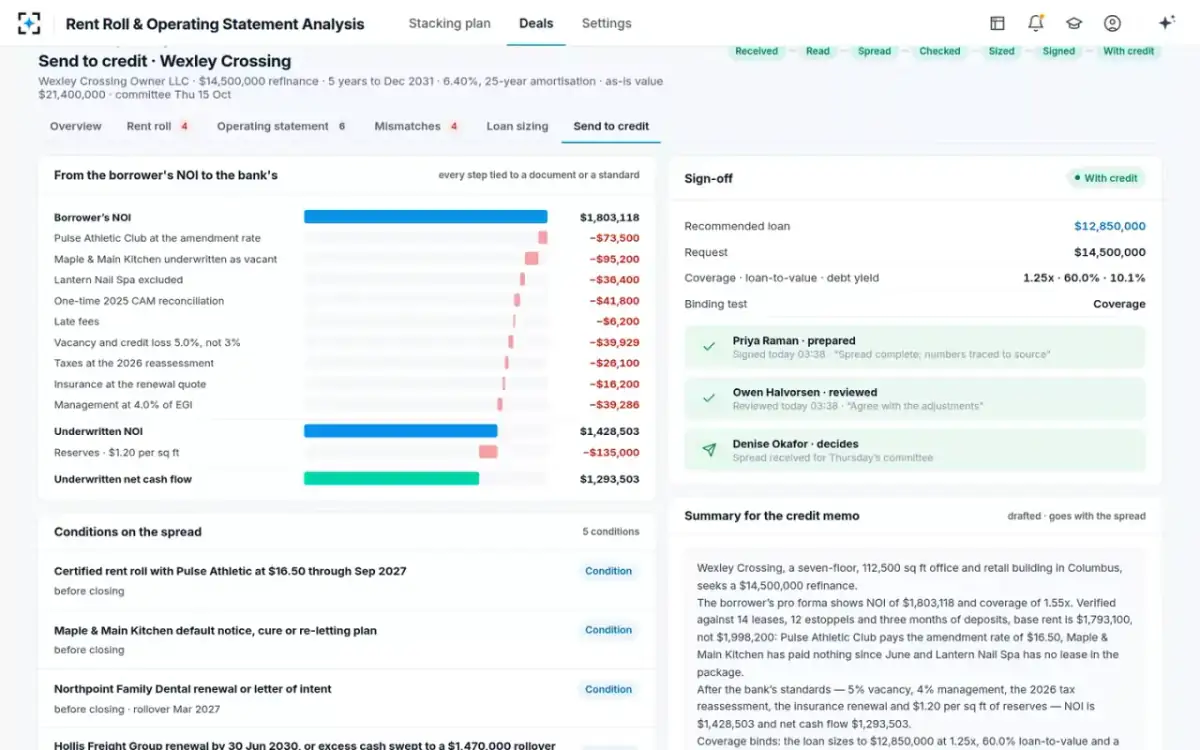
The analyst's signature on a spread should say what was tested, not just that the work is finished. In Rent Roll & Operating Statement Analysis the analyst signs with a password and a stated meaning, "Prepared — spread complete, numbers traced to source," and the senior underwriter's review carries its own: "Agree with the adjustments." The credit officer then decides with both in hand.
The sign-off chain on the sample spread: agents test, people sign
Agent
Package readerSorts and reads all 37 files in the borrower's package and dates each one.
Never: Drops a file it cannot read
Agent
Lease and estoppel checkerCompares each suite's lease, amendments and estoppel with the rent roll.
Never: Overrides a signed estoppel
Agent
Deposit matcherMatches three months of deposits to tenants by payer and amount.
Never: Counts an unmatched deposit as rent
A person decides
Credit analyst, prepares and signsWorks the four mismatches, accepts or changes each adjustment, signs: "numbers traced to source".
A person decides
Senior underwriter, reviewsOpens any line to its source and signs the review: "Agree with the adjustments".
A person decides
Regional credit officer, decidesApproves, declines or conditions the loan at committee.
A signature with a meaning changes what review is. A reviewer who sees "numbers traced to source" can test the claim by opening any number, and an examiner can do the same later. A signature that only says "prepared" invites the reviewer to redo the work or to trust it, and neither is review.
Rent Roll & Operating Statement Analysis: signed, reviewed and on its way to credit
Certification after closing: the annual rent roll
After closing, certified rent rolls arrive on the schedule the loan agreement sets, usually annually, and each one should be read against the last. The useful questions are what changed: who left, who arrived, which rents moved, which expiries were extended or brought forward, and whether the changes match the deposits.
The OCC treats collection itself as something to manage: "Receipt and analysis should be tracked so management can evaluate the effectiveness of the bank's monitoring program," and when borrowers do not respond, banks with sound processes show that "the bank's efforts to collect this information remain continuous and diligent" (OCC, Commercial Real Estate Lending). A certified rent roll that sits unread in a monitoring queue is collected but not analysed, which the guidance treats as a gap of its own.
The sample bank runs annual reviews through the same spreading as new loans. In its queue, one multi-tenant office's annual review shows coverage down from 1.38x to 1.09x and is marked for covenant watch; the certified roll that produced the number was tested the same way as the one at origination.
Where agents fit, and where they stop
Agents fit where the work is reading and comparing: dozens of leases, every amendment in order, months of bank statements, line by line. They stop where the work is a judgement or a signature. In the solution they never change one of the bank's standards, never override a signed estoppel, never recommend a loan above policy, and never sign; they recommend, and the analyst signs.
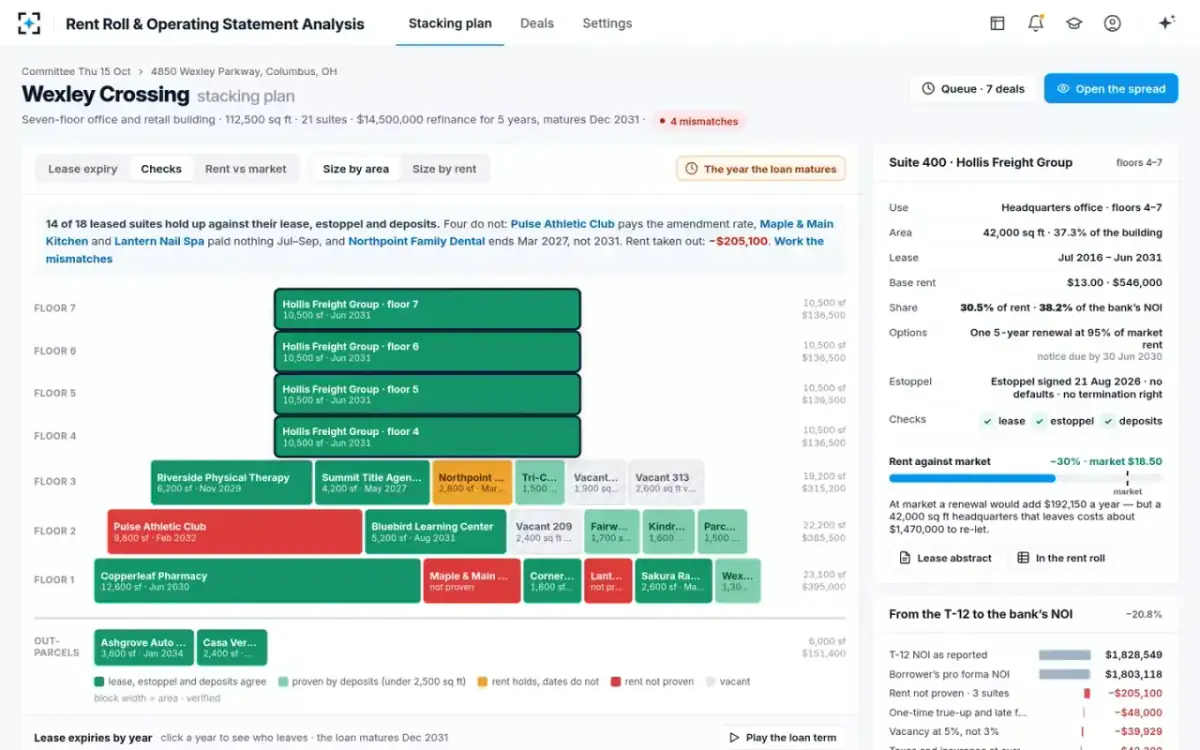
That division also answers the certification question from the lender's side. The borrower certifies its rent roll; the tenant certifies its own lease; the lender's analyst certifies that each rent in the spread was tested against those and against the money. At Wexley Crossing that test found four suites where the borrower's certified-to-be-true schedule and the evidence disagreed, worth $205,100 of rent.
What the analyst can certify in Rent Roll & Operating Statement Analysis: 14 of 18 suites proven
Certification is one stage of the work; the rent roll due diligence checklist covers the documents to collect before it, and Rent Roll & Operating Statement Analysis shows the whole chain on one deal.
Questions people ask
Who signs a certified rent roll?
Usually an officer or authorised signatory of the borrowing entity, and sometimes the property manager as well. The signer should have authority to bind the borrower, because the certification is a representation the lender relies on when it sizes and closes the loan.
What is the difference between a certified rent roll and an estoppel certificate?
A certified rent roll is the landlord's statement about all its tenants; an estoppel certificate is one tenant's statement about its own lease, given to the lender, confirming rent, term, the date through which rent is paid, defaults and rights. The estoppel is independent evidence; the certified roll is not.
Does the appraiser verify the rent roll?
In part. HUD's MAP Guide requires the appraiser to verify the owner's rent roll during the inspection and enter actual occupancy, and commercial appraisals rely on the rent roll for the income approach. An appraiser confirms occupancy and market reasonableness, not each tenant's payments.
Is rent roll verification the same as certification?
No. Certification is the borrower vouching for its own schedule; verification is the lender testing it against leases, estoppels, deposits and inspection. A rent roll can be certified and unverified, which is the position a lender is in if it relies on the signature alone.
How often do lenders ask for a certified rent roll after closing?
As often as the loan agreement requires, typically annually, and quarterly or monthly for properties in lease-up or with many tenants and frequent expirations. The OCC's guidance ties the frequency to the property's stability and expects what is collected to be analysed promptly, not filed.