Tenant rollover risk, also called lease rollover risk, is the risk that leases expiring before or around a loan's maturity are not renewed or re-let on time, so the property's cash flow falls just when the loan must be refinanced or repaid. Lenders read it from the rent roll by plotting verified rent by expiry year against the maturity date and asking what coverage would be if the leases ending in the riskiest year walked. The analysis is simple to describe and easy to get wrong: the dates on a rent roll are often stale, one tenant can occupy several suites, and a building can look well spread until its expiries are summed by year. Botminds' Rent Roll & Operating Statement Analysis builds the expiry view from dates it has checked against each lease and amendment, lights up the leases that end in the year the loan matures, and puts the resulting conditions on the spread before credit sees it.
The example is a fictional sample deal run through the solution: Wexley Crossing, a seven-floor office and retail building in Columbus, Ohio, with a five-year, $12,850,000 loan maturing in December 2031.
One building's rollover, read from its verified rent roll
39.9%
of verified rent expires in 2031, the year the loan matures
38%
of the bank's NOI comes from one tenant whose lease ends six months before maturity
0.56x
coverage if none of the 2031 leases renew
3.9years
weighted average lease term, against a five-year loan
What is tenant rollover risk?
Tenant rollover risk is the exposure of a property's income to leases ending: the tenant may leave, renew at a lower rent, or renew only after a period of free rent and a fit-out the landlord pays for. For a lender it matters most when the leases end inside the loan term, and above all near maturity, because that is when the borrower needs the income to refinance.
Rollover is not the same as vacancy. A vacancy allowance assumes a steady background level of empty space; rollover risk is lumpy. A building can carry 5% vacancy comfortably for years and then lose 40% of its rent in one year when its leases, signed in one leasing cycle, end together. That shape is the lease-expiry cliff, and it is invisible until the rent roll is summed by year.
How to build a lease expiration schedule from a rent roll
A lease expiration schedule groups a property's rent by the year each lease ends, usually as a share of total rent and total area, with the loan's maturity marked. It takes four steps, and the first is the one most often skipped.
Verify the dates. Take each end date from the lease and every amendment in order, not from the rent roll. At Wexley Crossing the roll showed Northpoint Family Dental through 2031; its lease ends in March 2027, five months after the credit committee. Group by tenant, not by suite. Hollis Freight Group occupies floors 4 to 7 as four suites on one lease; counted as four rows it looks like four small risks rather than one large one. Use verified rent. Rent that the leases and deposits do not support should not be in the schedule at all. Mark the loan. Draw the maturity date, and the date by which the largest tenants must give notice of renewal.
The OCC's credit administration guidance names this as one of the reasons rent rolls are collected at all: the information "should be analyzed in a timely manner to assess financial performance, tenant rollover risk, and compliance with any financial or performance covenants" (OCC Comptroller's Handbook, Commercial Real Estate Lending). Properties with many tenants or frequent expirations warrant more frequent rent rolls for the same reason.
The cliff at Wexley Crossing: 39.9% of the rent in the maturity year
Plotted by year, Wexley Crossing's verified rent is reasonably spread until 2031, when three leases end together: Hollis Freight Group ($546,000, June), Sakura Ramen House ($78,000, May) and Bluebird Learning Center ($91,000, August). That is $715,000, 39.9% of verified base rent, ending in the year the loan matures.
The timing within the year matters as much as the year. Hollis's lease ends on 30 June 2031; the loan matures in December. Its renewal option must be exercised by 30 June 2030. A lender that waits for the maturity to approach will find out whether its largest tenant is staying eighteen months too late to do anything about it.
The largest lease ends six months before the loan does
- Loan term to maturity62 months
- Lease runs to the notice date44 months
- Notice given or not12 months
- No lease6 months
- Lease5 months
- Renewal unknown for the rest of the loan57 months
How examiners read rollover in a rent roll
Examiners read rollover directly from the rent roll, and it can move a loan's grade. The 2023 interagency policy statement on commercial real estate workouts includes an office loan restructured at maturity that the lender graded pass. The examiner looked at the rent roll: "A review of the rent roll, which was available to the lender at the time of the restructuring, reflects the majority of tenants have short-term leases, with three leases expected to expire within the next three months" (Policy Statement on Prudent CRE Loan Accommodations and Workouts, 88 FR 43115).
The examiner disagreed with the internal grade and classified the loan substandard … In addition, there is lease rollover risk because three of the leases are expiring soon, which could further limit cash flow.
Policy Statement on Prudent Commercial Real Estate Loan Accommodations and Workouts, 2023, office example
Two details in the example are worth a lender's attention. The rent roll "was available to the lender at the time": the information was in the file, unread. And "two of the tenants have moved to hybrid work-from-home arrangements," which is the office-specific form of rollover risk, a tenant that renews for less space or not at all. The lesson is not that rollover always means substandard; it is that an examiner will do the expiry arithmetic whether or not the bank did.
Why rollover at maturity is a refinance problem
Rollover near maturity is dangerous because a loan that reaches maturity on falling income cannot be refinanced on the terms it was made on. Most income-property loans are not fully amortising, so the balance has to be refinanced, and refinance underwriting asks for coverage the property may no longer have.
The Federal Reserve's own stress-test model builds that in. Its documentation says lenders "generally require a minimum DSCR between 1.2 and 1.5 to qualify for a loan," and for income-producing loans "that approach maturity with DSCR below 1.2 (a typical minimum underwriting threshold)" it multiplies the model's projected probability of default by four (Federal Reserve, Supervisory Stress Test Documentation: Credit Risk Models). Coverage at maturity, not at origination, is what the supervisor's model treats as the trigger.
The volume is large. The Mortgage Bankers Association counts $875 billion of commercial and multifamily mortgages, 17% of the outstanding balance, scheduled to mature in 2026, $396 billion of it serviced by depositories (MBA, February 2026). The OCC's spring 2026 risk perspective says "refinance risk merits continued attention," because loans "originated in a lower-interest environment will mature in the next several years and will need to be refinanced at prevailing rates" (OCC Semiannual Risk Perspective, Spring 2026). Each of those refinancings starts with a rent roll and its expiry schedule.
What coverage looks like if the 2031 tenants leave
The useful rollover test is not the percentage expiring but what coverage would be if it went. At Wexley Crossing, with debt service of $1,031,555 on the recommended loan, the scenarios fall quickly from comfortable to impossible.
Coverage on the recommended loan if the 2031 leases do not renew
The arithmetic is deliberately crude: it assumes no re-letting and no expense savings. That is the point. It shows what the loan depends on, and here the answer is one tenant. A 1.25x loan whose coverage drops to 0.72x when a single lease ends is a single-tenant credit wearing a multi-tenant building.
Which dates count: options, termination rights and early expiries
The expiry that matters is the earliest date a tenant can leave, which is not always the lease end on the rent roll. A termination right or a contraction option brings the effective expiry forward; a renewal option does not push it back until the tenant exercises it.
Lenders therefore read two schedules: one on contractual end dates and one on each tenant's earliest exit. The gap between them is risk the rent roll often does not show. In the sample bank's queue, an industrial refinance came in with a tenant estoppel disclosing a termination right the borrower's rent roll left out; for that tenant, the termination date is the expiry to plot.
The estoppel is the best single source for both questions, because the tenant confirms its own options and rights. Hollis Freight Group's, signed on 21 August 2026, confirms no defaults and no termination right, so June 2031 stands as its earliest exit. Its renewal option, five years at 95% of market rent, is a right and not a commitment; until notice is given by 30 June 2030, the June 2031 date is the one to underwrite.
How do lenders underwrite lease rollover?
Lenders underwrite lease rollover by sizing on the income in force, then adding structure that either secures the renewals or builds cash before they fall due. The usual tools are a reserve, a cash sweep, renewal conditions and, where the cliff is severe, a shorter or longer loan term than the borrower asked for.
Tools for a lease-expiry cliff, and how the sample deal uses them
| Tool | How it works | At the sample deal |
|---|---|---|
| Renewal condition | The largest tenants' renewals, or letters of intent, are conditions of closing or of a later date. | Hollis Freight Group's renewal by 30 June 2030; Northpoint Family Dental's renewal or letter of intent before closing |
| Cash sweep to a rollover reserve | Excess cash is held from a trigger date until a target is reached or the tenant renews. | Excess cash swept to a $1,470,000 rollover reserve if Hollis has not renewed |
| Upfront reserve | Funded at closing for leasing costs on known expiries. | Not used; the sweep builds it from cash flow instead |
| Sizing on stress | The loan is sized so coverage holds above 1.0x if a named tenant leaves. | Shown as a sensitivity, not the sizing basis |
| Term choice | Maturity set before or well after a cliff, not in its middle. | Five-year term requested; the cliff sits in its final year |
Below-market rent changes the conversation. Hollis pays $13.00 a square foot against a market rent of about $18.50, and its option renews at 95% of market. Renewing would add about $192,150 a year of rent, so the tenant has a reason to look around and the landlord a reason to want it gone if the space re-lets well. A lender should not count the uplift until a renewal is signed, and should not ignore the re-letting cost, roughly $1,470,000 for a 42,000-square-foot headquarters floor plate, if it is not.
Monitoring rollover after the loan closes
Rollover risk does not end at closing; it arrives on a schedule the lender can see from the first day. Each new rent roll, collected annually or more often for multi-tenant buildings, should be checked for renewals signed, notices missed and expiries moved, and the stress test re-run on the new numbers.
Rent Roll & Operating Statement Analysis: the queue where annual reviews show coverage falling
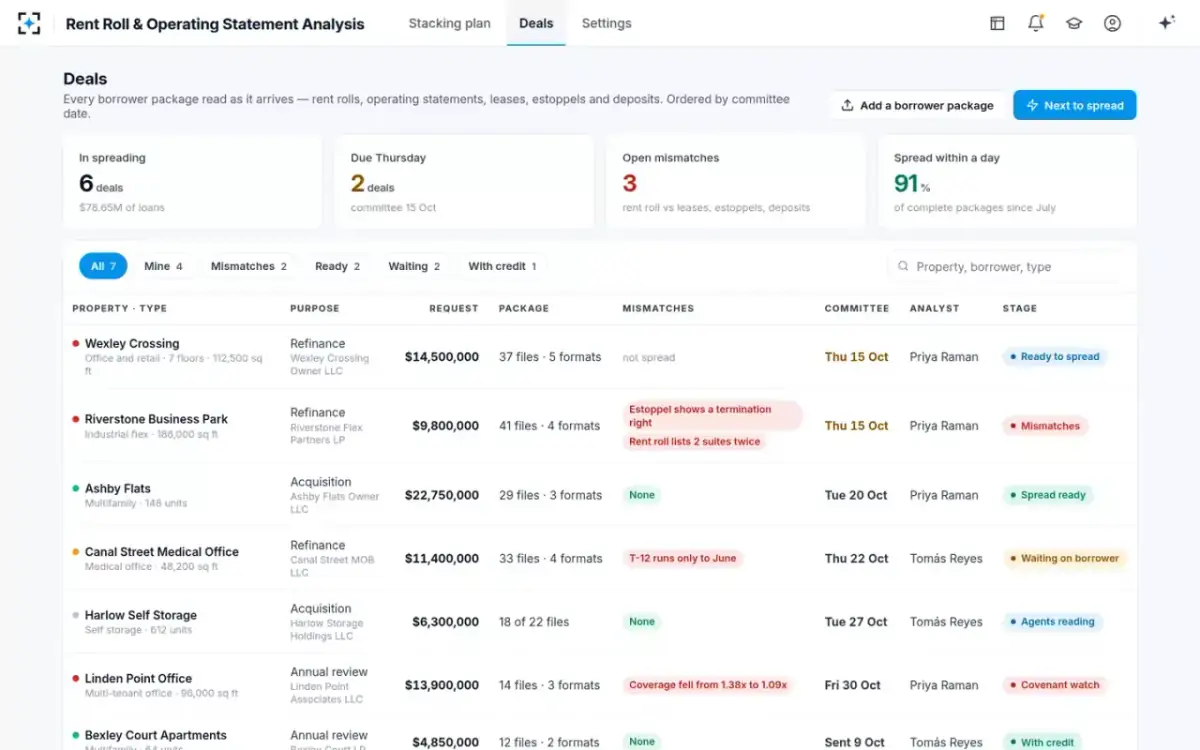
Rollover is the last of the rent roll's questions, after reading it and reconciling it; how to read a rent roll column by column starts at the first. Vacancy and rollover are often confused; vacancy and credit loss covers the steady-state allowance. To see the expiry view on your own deals, start from Rent Roll & Operating Statement Analysis.
Questions people ask
What is a lease expiration schedule?
A lease expiration schedule shows how much of a property's rent and area expires in each year, usually as a table or bar chart with the loan's maturity marked. Built from verified lease dates rather than the rent roll as stated, it shows whether expiries are spread out or bunched into one year, the cliff a lender has to plan for.
What is a rollover reserve?
A rollover reserve is cash set aside to pay for re-letting space when a lease ends: tenant improvements, leasing commissions and lost rent while the space is empty. It may be funded at closing or built through a cash sweep from a trigger date; the sample deal sweeps excess cash toward $1,470,000 if its largest tenant has not renewed by June 2030.
Does a renewal option reduce rollover risk?
Only partly. An option gives the tenant the right to stay, not an obligation; until it is exercised, the income is still at risk. Options at a fixed or capped rent can also limit the landlord's upside, and an early termination right works in the opposite direction, adding rollover risk inside the term.
What is a cash sweep on a commercial real estate loan?
A cash sweep traps the property's cash flow after debt service and operating costs in a lender-controlled account once a trigger is hit, such as a large tenant failing to renew by a set date or coverage falling below a threshold. The trapped cash funds a reserve or pays down the loan until the trigger is cured.
How far ahead of maturity should lease expiries be watched?
From origination, because the expiry schedule is known on day one. In practice the critical date is the largest tenant's renewal-notice deadline, often twelve months or more before the lease ends; at the sample deal that is 30 June 2030, eighteen months before the loan matures.