A rent roll due diligence checklist lists the documents a lender needs before it can test a rent roll rather than retype it: a current rent roll certified by the borrower, every lease with every amendment, signed tenant estoppels, the trailing twelve-month operating statement and up to three years of annual statements, an aged receivables report, recent bank statements showing rent deposits, and the tax notice and insurance quote that restate the two largest expenses. Collecting them is the slow part of commercial real estate underwriting, because the package comes from the borrower's manager, accountant and broker in different formats and at different times, and a missing amendment or estoppel is the usual reason a spread stalls. Botminds' Rent Roll & Operating Statement Analysis starts from whatever package arrives: its agents read every file in any format, say which documents are missing, and turn each gap into a request to the borrower and, where it affects income, a condition on the spread. What it cannot do is invent a document that was never sent, which is why the checklist still matters.
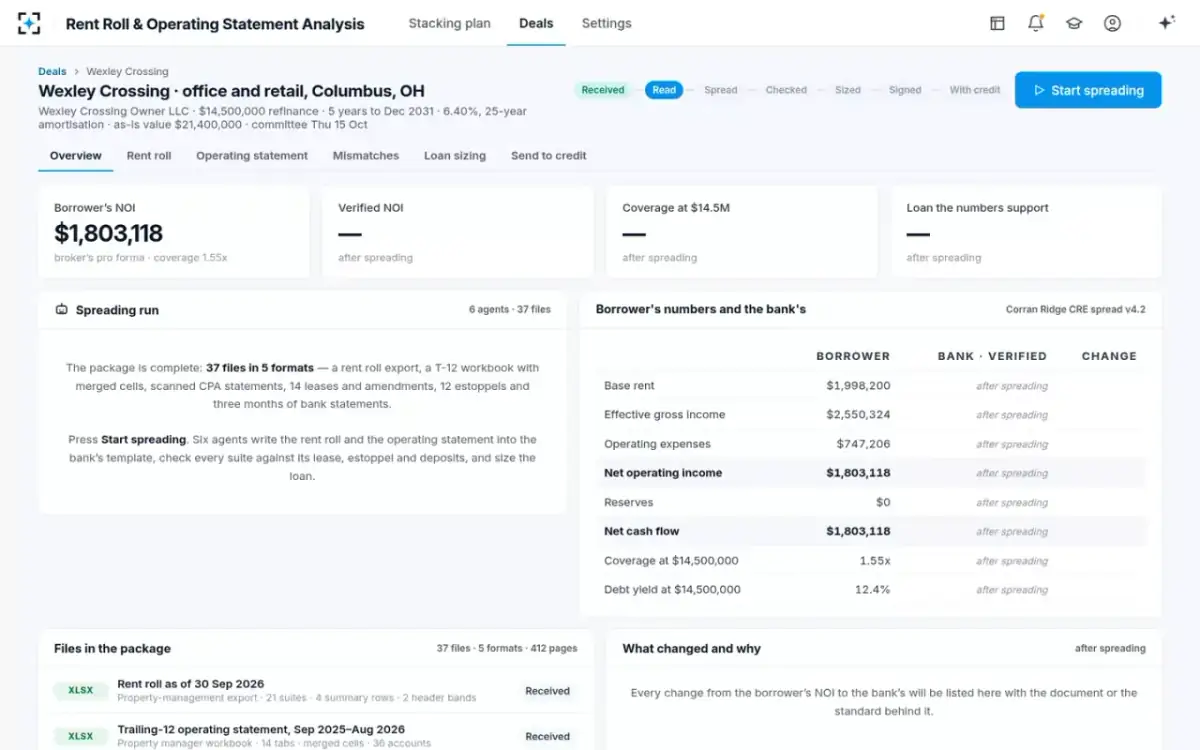
The examples follow a fictional sample deal through the solution: Wexley Crossing, a 21-suite office and retail building in Columbus, Ohio, whose package arrived as 37 files in five formats.
One complete package, as it arrives
37
files in the borrower's package
5
formats: spreadsheet exports, workbooks, scanned PDFs, signed leases, bank statements
412
pages to read before the first number is trusted
1
suite with no lease in the package at all, its rent still on the roll
What documents are needed for rent roll due diligence?
The documents needed for rent roll due diligence fall into three groups: the claims (rent roll and operating statements), the evidence (leases, estoppels, receivables and deposits) and the restatements (the documents that tell the lender what next year's expenses will be). A package with only the claims can be spread but not tested.
Rent roll due diligence checklist for an income-producing CRE loan
- Current rent roll, certified by the borrower
Every rentable space including vacant, as of a stated date; signed by someone who can bind the borrower.
- Every lease, with every amendment, side letter and assignment
Amendments in date order; a rent cut or extension usually lives there.
- Tenant estoppel certificates for tenants above the bank's size threshold
Signed by the tenant, addressed to the lender, recent.
- Trailing twelve-month operating statement, month by month
In the manager's chart of accounts, so each line can be mapped.
- Up to three years of annual operating statements
Accountant-prepared where available, to test the trend and one-time items.
- Aged receivables report at 30, 60 and 90 days
Shows who is behind, which the rent roll's status column may not.
- Three months of operating-account bank statements
Deposits matched to tenants by payer and amount.
- Recent vacancy history and leasing activity
Three months of physical and economic vacancy; leases signed and lost.
- Latest tax bill and any reassessment notice
Taxes are underwritten at what is coming, not the trailing year.
- Insurance renewal quote or current policy
Premiums are underwritten at the quote for the next policy year.
- Management agreement
Fee, term and whether the manager is affiliated with the borrower.
- Recent reconciliation statements for recoverable expenses
To separate recurring reimbursements from one-time true-ups.
What each document proves, and the rule behind asking for it
Each document on the list answers a specific question about the rent roll, and most of the questions come from a published rule or supervisory expectation. Knowing the question tells you what to do when the document is missing.
What each document proves, and where the expectation comes from
| Document | Question it answers | Where the expectation comes from |
|---|---|---|
| Certified rent roll | Which schedule does the borrower stand behind, as of when? | HUD MAP Guide: certified rent roll dated no more than 30 days before endorsement |
| Leases and amendments | Are the terms on the roll the terms in force? | HUD MAP lease audit; OCC examination procedures: review current rent rolls and leases |
| Tenant estoppels | Does the tenant agree: rent, term, paid-through date, defaults? | Market practice; no federal rule names them for bank CRE loans |
| T-12 and annual statements | What did the property actually collect and spend? | Fannie Mae §203.01: prior three years, prior full year or trailing six months |
| Aged receivables | Who is behind, and by how long? | Fannie Mae §203.01: delinquencies at day 30, 60 and 90 |
| Bank statements | Is the rent on the roll arriving? | Lender practice; the strongest single test of payment |
| Tax bill, insurance quote | What will the two largest fixed expenses be next year? | Fannie Mae §203.01, items 17(b) and 17(c) |
How many years of operating statements do lenders need?
Lenders typically ask for three years of annual operating statements plus a trailing twelve-month statement, and accept a trailing six months annualised as a minimum for the recent period. Fannie Mae's multifamily guide puts it as a list of steps: "use best efforts to obtain operating statements for the prior 3 years; obtain the prior full-year operating statement or, at a minimum, one covering the trailing 6 months (annualized); request trailing 3-month physical and economic vacancy history if not included on the operating statement provided; use best efforts to obtain a current aged receivables report, listing rent delinquencies at day 30, 60, and 90" (Fannie Mae Multifamily Selling and Servicing Guide, §203.01).
The three years are for trend and for one-time items: a line that jumps in one year and not the others is either a change in the property or something that should not be underwritten. The trailing months are for the current run rate. The receivables are for credit loss, which annual statements smooth away.
How far back each document should reach
- Three fiscal years36 months
- Trailing twelve months12 months
- Vacancy3 months
- Deposits3 months
How often lenders collect rent rolls and statements after closing
After closing, the checklist repeats on a schedule set by the property's risk. The OCC describes the range: "For a property with few tenants and long-term leases that extend beyond the loan term or stabilized multifamily properties, annual operating statements and rent rolls may be adequate. Properties that are in lease-up or nonresidential properties that have many tenants or frequent lease expirations, however, could warrant the collection of monthly, quarterly, or semiannual information" (OCC Comptroller's Handbook, Commercial Real Estate Lending).
For construction loans in lease-up the OCC goes further: "Monthly leasing reports with rent rolls should be obtained from the borrower during the lease-up period," and analysed "to compare actual lease rates and other key terms with the underwriting pro forma projections and assumptions used in the appraisal." The point of each collection is the comparison, which is why a document that arrives and is filed without being read fails the expectation as surely as one that never arrives.
What is an estoppel certificate, and which tenants should sign one?
An estoppel certificate is a short statement signed by a tenant, addressed to the lender, confirming the essential terms of its lease and its payment position: the rent, the term, the date through which rent is paid, whether either party is in default, and any options or rights. Because the tenant signs it, the tenant is held to what it says, which makes it the one piece of independent evidence in the package that speaks for the tenant rather than the landlord.
Lenders rarely require estoppels from every tenant; the cost of chasing small tenants outweighs what they prove. A size or rent threshold is typical: the sample bank requires estoppels from tenants of 2,500 square feet and above, and proves smaller suites from leases and deposits. At Wexley Crossing 12 estoppels came in. One of them, from Maple & Main Kitchen, said rent was paid through 30 June, while the rent roll marked the tenant current; with no deposits since, the suite was underwritten as vacant.
What is an aged receivables report, and why the rent roll is not enough
An aged receivables report lists, for each tenant, the amount owed and how long it has been outstanding, usually in 30, 60 and 90-day buckets. It is the landlord's own account of who is behind, and it often disagrees with the rent roll's status column, which may show a tenant as current simply because its lease is in force.
The sample deal's receivables showed $23,800 past due from Maple & Main Kitchen, the tenant the roll called current. Receivables, estoppel and deposits agreed with each other and not with the roll. A package without the receivables report would have left the estoppel as the only warning, and a package without the estoppel would have left only the deposits.
Which documents change the loan amount most
The documents that prove rent change the loan amount most; the documents that restate expenses come next; the history matters mainly for what it reveals as one-time. At the sample deal's terms, a 1.25x minimum and an 8.028% loan constant, each dollar of net cash flow supports about $10 of loan, so the order of the checklist is also an order of money.
The leases, estoppels and deposits together removed $205,100 of base rent the rent roll stated: an amended rent, a tenant that had stopped paying and a suite with no lease. That single group of documents moved the supportable loan by well over a million dollars. The T-12 detail found a $41,800 one-time reconciliation in income. The tax notice and the insurance quote added $42,300 of expense between them. The three years of statements changed nothing on their own, but they are what showed that the reconciliation income was a one-off.
That ranking suggests where to spend effort when a package is incomplete and committee is close: chase the evidence of rent first, the expense documents second and the older statements last. It also suggests why a package that is complete except for the bank statements is not nearly complete.
What agents need from the package, and what banks usually lack
Agents can read any format a borrower sends: system exports, workbooks with merged cells and many tabs, scanned statements, signed leases. What they need is the documents; what they cannot do is supply ones that are not there. A good test of any tool, ours included, is what it does when something is missing.
What the solution does with a complete package, and with a gap
When the document is there: Reads every amendment in date order and compares rent, area, dates and options with the roll.
When it is missing: Excludes the suite's rent until the lease arrives, and requests it from the borrower.
When the document is there: Compares the tenant's statement with the lease and the roll; never overrides a signed estoppel.
When it is missing: Flags the suite if it is above the bank's threshold; proves smaller suites from lease and deposits.
When the document is there: Matches deposits to tenants by payer and amount; unmatched money is never rent.
When it is missing: Cannot confirm payment; the suite stays unproven and the gap is a condition.
When the document is there: Maps every account to the bank's template and flags one-time items.
When it is missing: Spreads the latest period available and asks for the rest; a short T-12 is shown as short.
When the document is there: Restates taxes and insurance to what is coming.
When it is missing: Uses the trailing figure and says so, for the analyst to decide.
Two gaps are most common in practice. Amendments get left out of a package because the manager sends the lease file as it was at signing. And bank statements arrive from a different account from the one tenants pay into, which makes every deposit look missing. Both are quick to fix once someone asks, and slow to discover if no one reads the package until the spread is half done.
Rent Roll & Operating Statement Analysis: the package read and sorted before spreading
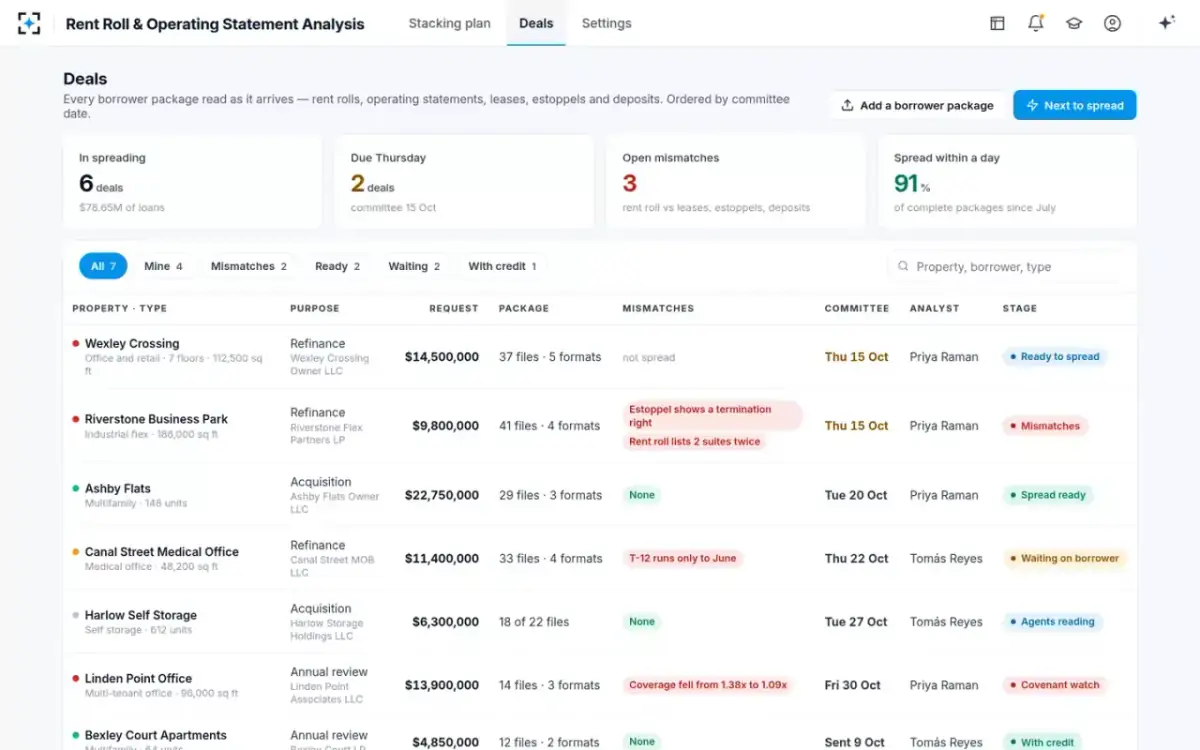
Rent Roll & Operating Statement Analysis shows which deals wait on the borrower, and why
Once the package is in, the work is the reconciliation; rent roll reconciliation covers it suite by suite, and rent roll certification covers what the borrower's signature on the roll does and does not prove. To try the checklist against your own past packages, start from Rent Roll & Operating Statement Analysis.
Questions people ask
Do lenders need the property's bank statements?
For a rent roll to be tested rather than accepted, yes. Bank statements for the account tenants pay into show whether the rent on the roll is arriving, tenant by tenant. Three months is a common window; the sample bank matches three months of deposits by payer and amount.
What if the borrower cannot get estoppels?
Treat the affected rent as less proven, not as unproven. Leases and deposits can still confirm terms and payment, but they cannot confirm what the tenant would say about defaults, offsets or rights. Lenders commonly make missing estoppels from large tenants a condition of closing.
Should tax returns be part of the package?
They can help, but they are not a substitute for operating statements. The OCC notes that tax returns may omit capital items captured in a replacement reserve and, when prepared on a cash basis, can overstate income in a year when a large expense went unpaid.
Is an insurance quote needed to underwrite a loan?
It is the best evidence of next year's premium. Fannie Mae's multifamily rules underwrite insurance at a broker's written quote for a new 12-month policy, or at 105% to 110% of the current premium when the policy has less than a year to run; the sample deal used a renewal quote that added $16,200.
What should the closing rent roll show?
The building as it is at closing, certified, with every change since underwriting visible: new leases, departures, amendments and defaults. HUD requires a certified rent roll dated no more than 30 days before endorsement; bank lenders often make an updated certified roll a closing condition, as the sample deal does.