A rent roll analysis template in Excel is a workbook with a rent roll tab, an operating statement tab and a sizing tab into which an analyst types a borrower's figures and the bank's adjustments. It costs almost nothing to build and a good deal to run, because every package has to be re-keyed into it by hand and then checked against the leases, estoppels and bank deposits by hand, and the template itself checks none of that. The cost of a spread is the analyst's hours, the reviewer's hours and the errors that pass both, not the software. Botminds' Rent Roll & Operating Statement Analysis keeps the bank's own template and standards and replaces the re-keying and the document checking with agents: they read the package in any format, write it into the template, check every suite against its lease, estoppel and deposits, and leave the analyst the mismatches and the signature.
The worked figures use a fictional sample deal run through the solution, Wexley Crossing, a 21-suite office and retail refinance of $14,500,000, and an hours estimate that is Botminds' own. No public source measures how long banks spend spreading a commercial real estate package.
Why the cost of one spread matters now
$875B
of commercial and multifamily mortgages scheduled to mature in 2026, 17% of the total
$396B
of it serviced by depositories, each refinance a fresh spread
$83,510
median annual wage of a credit analyst, May 2025
What should a rent roll analysis template include?
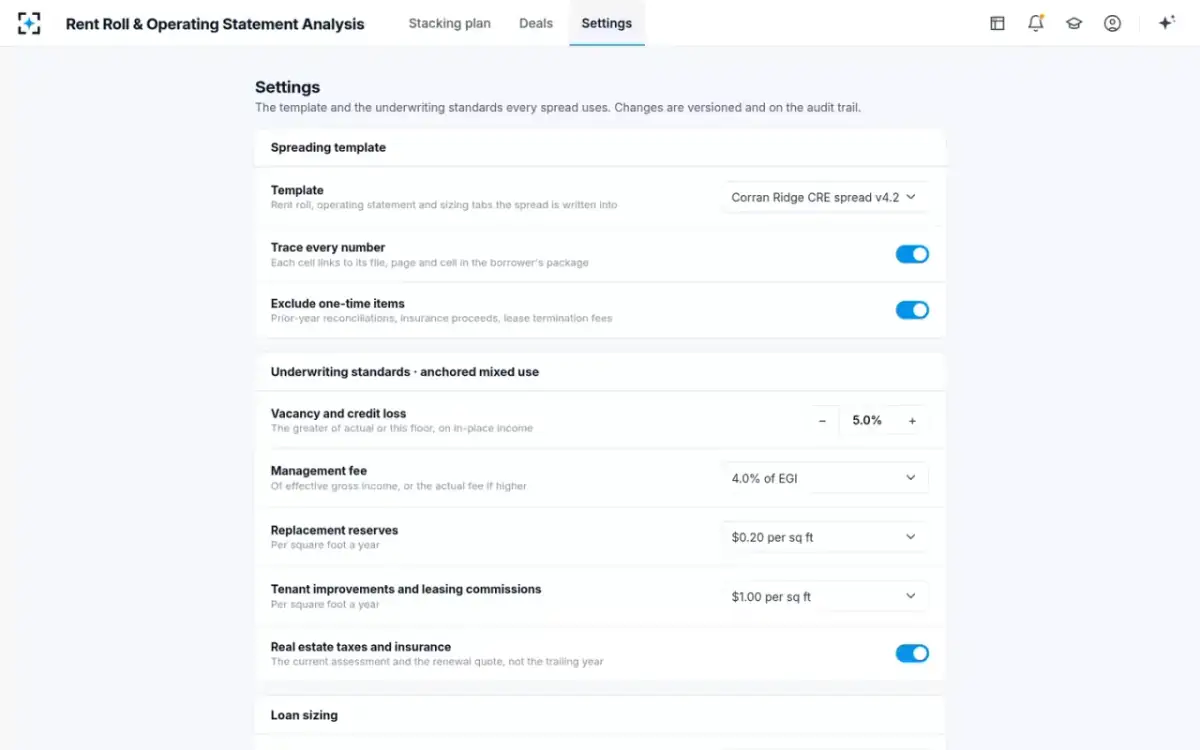
A good rent roll analysis template includes three linked tabs, a rent roll in the bank's columns, an operating statement mapped to the bank's lines and a sizing tab, and, more importantly, it encodes the bank's standards so every analyst applies the same ones. The tabs are easy; the standards are what make a template the bank's rather than a blank spreadsheet.
What a rent roll and T-12 template should hold, tab by tab
| Tab | What goes in | What the template should enforce |
|---|---|---|
| Rent roll | Suite, tenant, use, area, start and end, rent per foot and per year, recoveries, options, status | Totals tie to the building; vacant suites listed; a column for the source of each rent |
| Operating statement | Three years and the T-12, mapped from the manager's accounts to the bank's lines | Below-the-line items excluded; one-time items flagged; a reason for every adjustment |
| Standards | Vacancy floor, management fee, reserves, tax and insurance treatment, by property type | One version, owned by credit; not editable on the deal |
| Sizing | Net cash flow, value, rate, amortisation, minimum coverage, maximum LTV, minimum debt yield | Loan sized on each test; the binding test named; rounded down |
| Reconciliation | Borrower's NOI to the bank's, step by step | Every step tied to a document or a standard |
The OCC lists what a bank's commercial real estate standards should cover for each type of loan or property: "Minimum standards for borrower or project net worth, support provided by guarantees (if applicable), borrower and guarantor cash flow, and debt-service coverage ratio (DSCR)," "LTV limits by property type," "Maximum loan tenor" and "Minimum debt yield" (OCC Comptroller's Handbook, Commercial Real Estate Lending). A template that leaves those to each analyst's memory is not applying the bank's policy; it is applying each analyst's.
What does rent roll analysis cost? A formula for one spread
The cost of one rent roll and operating statement spread is the analyst's time, the reviewer's time, the cost of errors that reach the credit decision, and the cost of the deal waiting. The first two are easy to estimate; the last two are larger and usually left out.
The cost of one spread, written as a sum
Analyst time
hours × hourly cost
Sorting the package, re-keying the rent roll, spreading the statements, checking leases, estoppels and deposits, sizing.
Priced by the credit department
Review time
hours × hourly cost
The senior underwriter finding where numbers came from, and the rework that follows.
Priced by the credit department
Errors that pass
probability × loan dollars mis-sized
A stale rent or a non-paying tenant underwritten as income sizes the loan too large.
Priced by credit risk
Delay
days × deals waiting
Questions to the borrower raised late, committee dates missed, sponsors who go elsewhere.
Priced by the business line
Analyst time is the term most budgets use. At the BLS median wage for credit analysts, $83,510 a year in May 2025, an hour costs about $40 before benefits and overhead (BLS, Occupational Employment and Wage Statistics). The hourly figure matters less than the number of hours, and that is where the template and the alternatives differ.
How long does a rent roll analysis take by hand?
No public source measures it, so the figure below is an estimate, and it is ours. For one office and retail refinance package like the sample deal, Botminds estimates about 14 hours by hand from a complete package to a signed spread, and about an hour with the solution, a design target rather than a measured result. Banks should replace both with their own timings on five or ten recent packages.
Where the hours on one spread go, by hand and with agents (Botminds' estimate)
- Sort, read1.5 h
- Re-key roll1.5 h
- Spread the T-12 and statements4 h
- Check leases, estoppels, deposits4 h
- Adjust and size2 h
- Review1 h
- Total≈ 1 h
The shape matters more than the totals. Re-keying the rent roll, the step most templates and most extraction tools are sold on, is the smallest block. The two largest are spreading the operating statement, which means mapping a manager's chart of accounts line by line, and checking leases, estoppels and deposits, which a template cannot do at all.
Where the hours go: the reconciliation, not the keying
The expensive part of a spread is proving the numbers, and it is the part most likely to be cut short when a deal is due on Thursday. The OCC's expectation does not bend for deadlines: because collateral value "is largely determined by a property's NOI, it is important to analyze and understand its income-generating capacity including whether cash flow and NOI projections are reasonable and supported. Inadequately supported or questionable analysis should be challenged" (OCC, Commercial Real Estate Lending).
A template makes the keying faster and the arithmetic reliable. It does nothing for the support. An analyst who keys the sample deal's rent roll perfectly into a perfect template produces a spread that sizes the loan on $1,998,200 of base rent, $205,100 more than the leases and deposits support.
Rent Roll & Operating Statement Analysis: the rent roll written into the bank's template, with the checks a spreadsheet cannot do
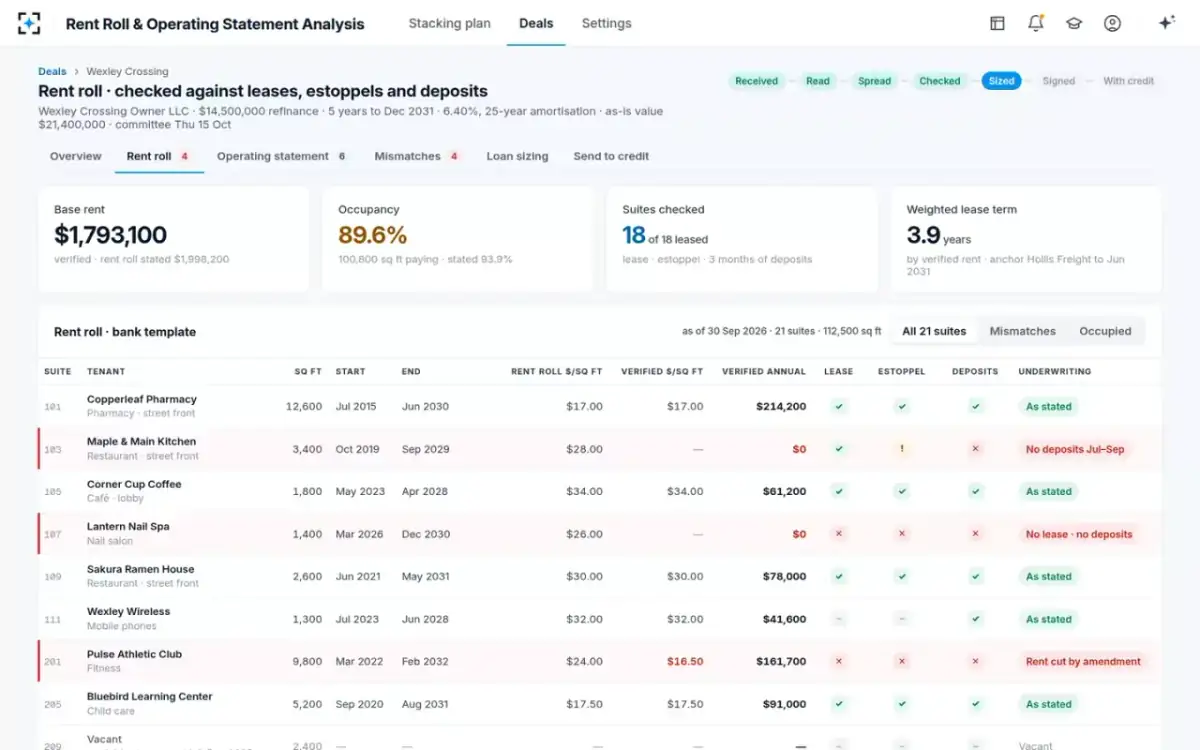
The cost of an error: $205,100 of rent, $1,650,000 of loan
Errors are the largest term in the formula and the one templates hide best. At the sample deal, the borrower's numbers give 1.55x coverage at the $14,500,000 request. The verified numbers give 1.11x, and the largest loan they support at the bank's 1.25x minimum is $12,850,000. A spread that went to committee on the borrower's rent roll would have recommended a loan $1,650,000 larger than the cash flow supports.
That is not an exotic case. The rent roll was internally consistent, the T-12 lagged the problem and the borrower certified the roll. Three ordinary events, an amendment that cut a rent, a tenant that stopped paying and a suite let without a signed lease, were enough. The only defence is checking each rent against its sources, which is the step a template leaves to whatever time is left.
Should banks outsource spreading?
Outsourcing moves the keying out of the bank and may cost less per package than an in-house analyst; it does not move the responsibility, and it usually does not include verification against leases and deposits unless the bank pays for it specifically. The bank still reviews the spread, still owns the standards and still answers to the examiner for the file.
Three ways to spread a rent roll and T-12, compared
Excel template in-house, or outsourced spreading: Re-keying into the template, by an analyst or an outside team; verification if time allows or if contracted.
Agents in-house, with the bank's template: Reading, re-keying and checking every suite against lease, estoppel and deposits; analyst time on the mismatches.
Excel template in-house, or outsourced spreading: Set by the analyst queue, or by the outsourcer's service level.
Agents in-house, with the bank's template: Minutes for the agents; the analyst's review the same day, as a design target.
Excel template in-house, or outsourced spreading: In the template, if it is locked; applied by whoever spreads.
Agents in-house, with the bank's template: Settings owned by the chief credit officer, versioned, applied on every deal.
Excel template in-house, or outsourced spreading: Whatever the spreader notes in cell comments.
Agents in-house, with the bank's template: Every number linked to its file, page and passage; every adjustment to its standard.
Excel template in-house, or outsourced spreading: In-house stays in the bank; outsourcing sends borrower files to a third party the bank must oversee.
Agents in-house, with the bank's template: Borrower files are read by software; ask any vendor, including us, where files are processed and kept.
Excel template in-house, or outsourced spreading: Low volume, simple packages, or a team with spare capacity.
Agents in-house, with the bank's template: Many packages, multi-tenant property, refinance and annual-review volume.
There is a fair case for the template. A bank spreading a handful of single-tenant deals a month, each with one lease and a short operating history, may not need anything else; the checks are few and an analyst can do them. The case changes with multi-tenant property, with volume and with the refinance wave, where the same analysts are spreading new deals, maturities and annual reviews at once.
T12 template in Excel: why the operating statement is the harder half
The operating statement takes longer than the rent roll because it arrives in the manager's chart of accounts, not the bank's. The sample deal's T-12 workbook has 14 tabs and 36 accounts; 33 map to template lines and three belong below the line, where depreciation, interest and capital items go. A T12 template in Excel gives the analyst somewhere to put the numbers, but the mapping is a judgement each time, and one-time items such as a prior-year reconciliation true-up hide inside ordinary accounts until someone reads the detail.
That is also where errors in the template's own logic creep in: a formula range that misses a new account, a line pasted as a value. The model risk guidance the agencies issued in April 2026 leaves spreadsheet arithmetic outside its definition of a model, so a template is not validated as one. Its accuracy rests on the analyst and the reviewer.
Your template and standards, as settings in Rent Roll & Operating Statement Analysis
How to run the comparison on your own numbers
The comparison is worth doing with real figures, and it takes a week. Count the packages your team spread last year: new loans, refinances and annual reviews. Time five recent spreads end to end, from complete package to signed spread, and note how long verification took and how often it was cut short. Count the changes reviewers made after the analyst signed, and the loans whose income changed after closing because a rent turned out to be wrong.
Then run three of those closed packages through any tool you are considering, including ours, and compare its questions with what your team found. The hours saved are the visible return. The errors it raises that your team missed are the real one. What to ask of rent roll AI sets out the tests, and the due diligence checklist covers the package each spread needs. To run the comparison on your own deals, start from Rent Roll & Operating Statement Analysis.
Questions people ask
Is there a free rent roll analysis template in Excel?
Many are published, and building one takes an afternoon. The template is rarely the constraint: what matters is whether it carries your bank's standards in a locked tab, ties each rent to its source and reconciles the borrower's NOI to yours step by step. A free template with none of that is a blank page with formulas.
What is CRE spreading software?
CRE spreading software turns a borrower's rent roll and operating statements into a lender's standard spread. Products range from extraction tools that read documents into a template to systems that also verify the figures against leases, estoppels and deposits and size the loan; ask which level a product works at before comparing prices.
How much does a credit analyst cost per hour?
The BLS median annual wage for credit analysts was $83,510 in May 2025, about $40 an hour over 2,080 hours, before benefits, overhead and supervision. The mean was $100,850.
Can an Excel template check a rent roll against the leases?
Not by itself. A template can check that a rent roll adds up and flag rents per foot far from their neighbours, but it cannot read a lease, an amendment or a bank statement. That comparison is done by the analyst, or by software built to read documents.
Do agents replace our Excel template?
They should not. In the solution the bank's own template is a setting, and the agents write into it, so the spread looks the same to reviewers, the credit memo and the examiner. What changes is how the numbers got there and what each one links back to.