Rent roll reconciliation means proving each line of a rent roll against independent evidence: the lease and its amendments for the terms, the tenant's estoppel for what the tenant itself confirms, and the bank deposits for what was actually paid. Where the three agree, the rent can be underwritten; where they disagree, the lender has found income that is stale, overstated or not there. It matters because the rent roll comes from the borrower, research on securitised loans finds underwritten income commonly overstated, and the most explicit public rules ask for only a sample of leases to be audited. It is hard because a full reconciliation means opening every lease, every amendment in date order and three months of bank statements for every deal. Botminds' Rent Roll & Operating Statement Analysis does that on every suite: its agents read the package, compare the sources and show each difference with both passages, and the analyst decides what is underwritten.
The suite-level examples come from a fictional sample deal run through the solution: Wexley Crossing, a 21-suite office and retail building in Columbus, Ohio, refinancing $14,500,000.
How often underwritten income runs ahead of the property
29%
of CMBS loans studied overstated projected income by at least 5%
39,522
loans pooled into CMBS from 2013 to 2019, compared with their first year of actual income
$4M
of value created by $200,000 of overstated income at a 5% capitalization rate
How do you reconcile a rent roll? Three sources, one question per suite
You reconcile a rent roll by asking, for every suite, whether the lease, the estoppel and the deposits each tell the same story as the roll. Each source catches different errors, which is why one is not enough. The lease shows what was agreed and how it has been amended. The estoppel shows what the tenant says today, including the date through which rent is paid and any defaults or rights. The deposits show what money arrived.
Four ways a rent roll goes wrong, and the source that catches each
| Mismatch | Sample suite | Lease and amendments | Estoppel | Deposits |
|---|---|---|---|---|
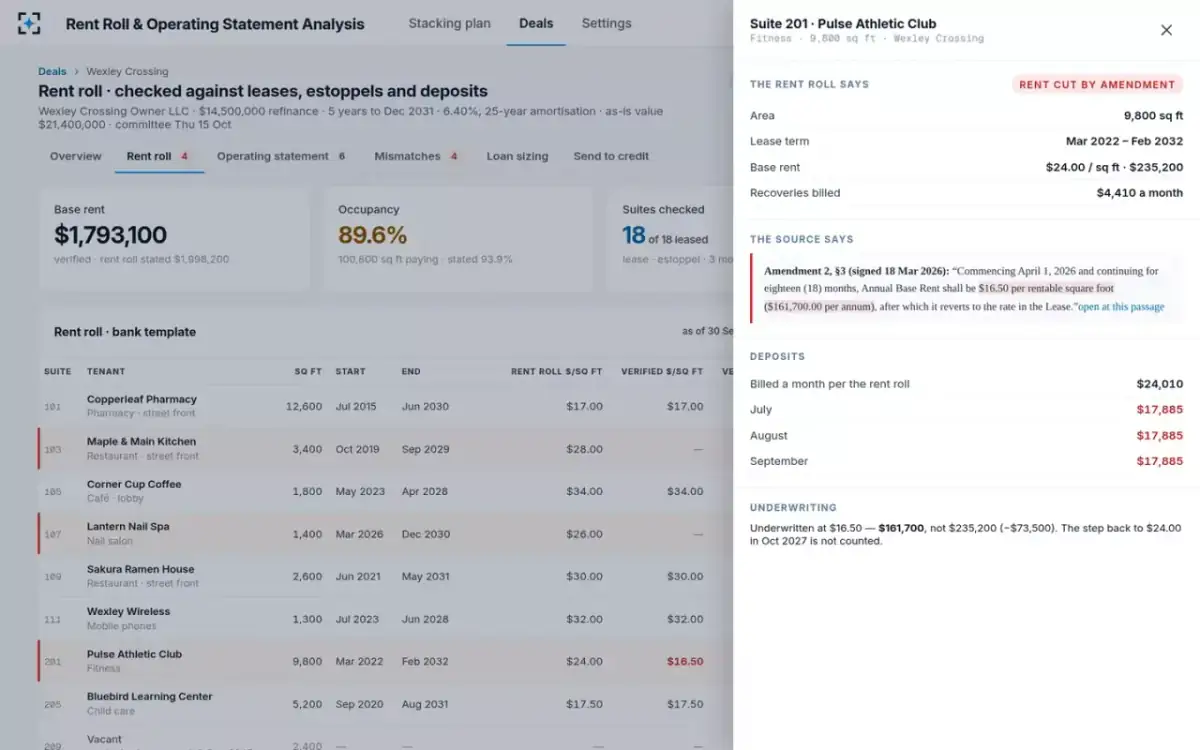
| Rent cut by a later amendment | Pulse Athletic Club: roll $24.00, amendment $16.50 | Catches it, if every amendment is read in date order | Confirms the amended rent | Confirm: $17,885 a month, the amendment rate |
| Tenant marked current, not paying | Maple & Main Kitchen: roll "current", $95,200 | Silent: the lease is valid | Catches it: paid through 30 June | Confirm: nothing July to September |
| Tenant with no lease | Lantern Nail Spa: roll $36,400 | Catches it: no lease in the package | Missing | Confirm: no deposits since March |
| Wrong lease end date | Northpoint Family Dental: roll 2031 | Catches it: ends March 2027 | Should confirm the date | Silent: the rent is right |
The table makes the point a sampling approach tends to miss. Deposits alone would have found three of the four problems and missed the date. Leases alone would have missed the tenant who stopped paying. Estoppels alone would have missed the tenant who had never signed one. The reconciliation is the combination.
Rent roll vs leases: what a lease audit checks
A lease audit compares the terms of each lease with its line on the rent roll and then with the income the lender is about to underwrite. HUD's Multifamily Accelerated Processing Guide gives the most precise public description: "The terms of the leases must be compared to the rent roll, verifying the unit number, resident name, lease commencement date, expiration date, concessions, if any, and monthly rent. The Underwriter must confirm that this data is consistent with the assumptions used in the underwriting analysis" (HUD MAP Guide, Chapter 11).
The next sentence is the standard of proof: "Any inconsistencies or conflicts between the leases, rent roll and the underwritten revenue assumptions must be fully investigated and explained." HUD also wants the work visible: the scope and results of the audit go in the underwriter's narrative, and copies of the audited leases stay in the working papers. For a commercial lender the same list extends naturally to area, recovery terms, options and amendments, the columns where office and retail rent rolls go wrong.
How many leases should a lender audit?
HUD's MAP Guide sets a sample by project size: at least one of each unit type, plus 10% of units for projects of 50 or fewer, 10 units plus 5% of units above 50 for projects up to 250, and 15 units plus 2% of units above 250, to a maximum of 50. Typically the leases audited are those of the units inspected. The share of the property audited falls steeply as it grows.
Above 100 units, HUD's lease-audit sample shrinks as a share of the property
A sample is a reasonable design for multifamily, where hundreds of similar leases carry similar rents and an error in one unit moves income by a fraction of a percent. It is a weak design for an office or retail building, where a handful of leases carry most of the rent and each is negotiated separately.
Why a sample misses the mismatch that matters in commercial property
In a commercial building, a sample can miss everything. Wexley Crossing has 18 leased suites and four of them are wrong. Audit a random two, roughly the 10% HUD's rule would give a small multifamily property, and the chance of missing all four is about 59%. The four mismatches are worth $205,100 of rent, 10.3% of what the roll states.
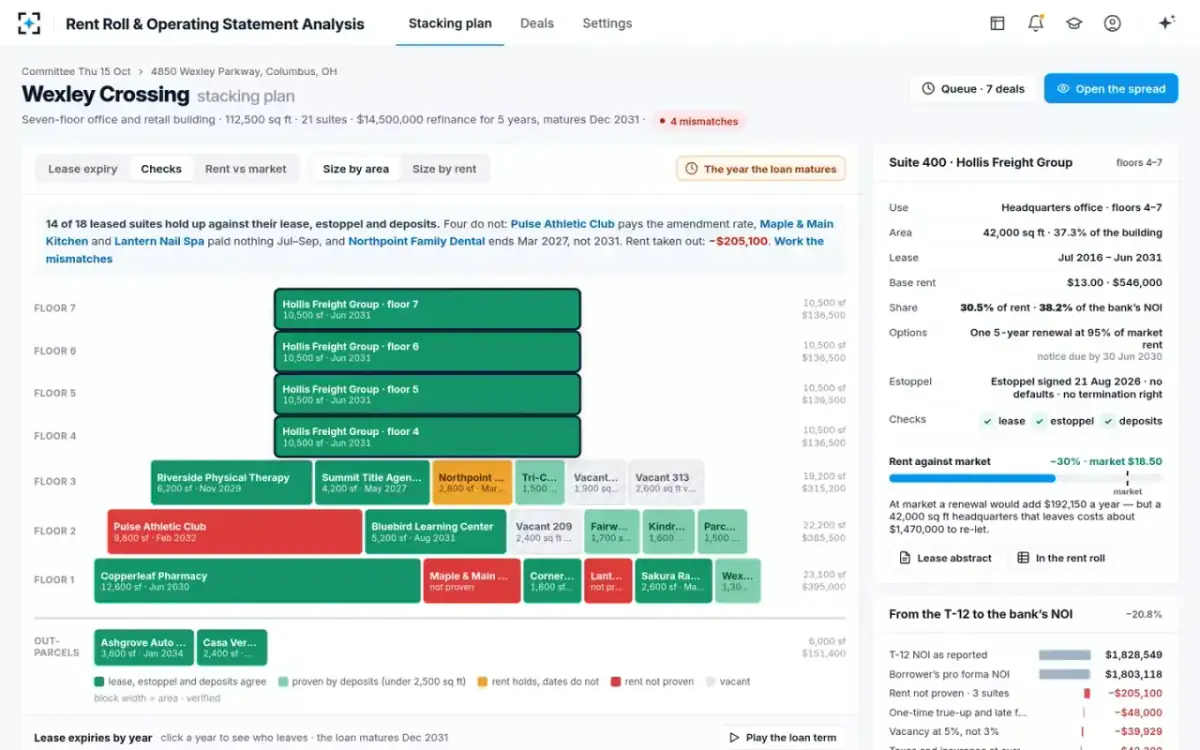
Concentration makes it worse. One tenant, Hollis Freight Group, pays 30.5% of the building's verified rent from four floors. A sample that happens to include it proves a third of the income; one that does not proves a few percent. Commercial lenders sometimes respond by auditing the largest tenants by rent, which catches concentration but by design skips the small suites where, at this building, three of the four problems sat.
Sampling the leases versus checking every suite
A sample lease audit: A share of units or the largest tenants by rent.
Every suite against lease, estoppel and deposits: All leased suites; vacant suites confirmed vacant.
A sample lease audit: That the sampled leases agree with the roll.
Every suite against lease, estoppel and deposits: That each rent underwritten is in force, confirmed and paid.
A sample lease audit: Anything outside the sample: here, up to all four mismatches.
Every suite against lease, estoppel and deposits: Errors in documents the package does not contain, which become requests to the borrower.
A sample lease audit: Hours per deal, which is why it is a sample.
Every suite against lease, estoppel and deposits: Many hours per deal by hand; minutes with agents reading the package.
A sample lease audit: Opens leases and ticks rows.
Every suite against lease, estoppel and deposits: Reviews the differences, with both passages shown, and decides.
Can deposits prove a rent roll?
Deposits prove that money arrived, not that it was rent, and not that it will keep arriving. Matched to tenants by payer and amount over three months, they are still the strongest single test of a rent roll, because a stale term or a tenant who has stopped paying shows up as a missing or different deposit.
The discipline is in what does not count. An unmatched deposit is not rent. At the sample deal a $12,000 transfer from the sponsor's property-management company landed on 30 September, the rent roll's date; it matches no tenant and stays out of income. A borrower that wants a building to look occupied can make deposits appear, which is exactly what happened in a federal mortgage fraud case covered in who certifies a rent roll, and what that proves. Matching by payer, against a named tenant with a signed lease, is what makes deposits hard to fake.
Rent Roll & Operating Statement Analysis: one suite's evidence, side by side
What are rent roll fraud red flags?
Most mismatches are not fraud: a property manager forgets to update a rent after an amendment, or carries a tenant as current out of optimism. But the same checks find both, and a handful of patterns deserve a harder look whatever their cause.
Rent roll red flags worth a second look
- Occupancy far above comparable buildings, with no lease-up history
A building that went from half empty to full in a quarter should show the leases and the deposits.
- Round-number rents, or identical rents per foot across different space
Real leases are negotiated one by one.
- Tenants on the roll with no lease, or leases signed just before the application
Recent paper is not yet proven by payment.
- Deposits from the sponsor, its affiliates or the manager
Money moving inside the borrower group is not tenant rent.
- Rent paid by money order, cash or a third party
Harder to tie to the tenant named in the lease.
- Estoppels that are missing, unsigned or returned by the landlord
An estoppel is only evidence if the tenant signs it.
- A T-12 that rises sharply in the last three months
The history should support the rent roll, not catch up with it.
- Inspection access refused to occupied units or suites
An inspector should see what the roll describes.
What if the rent roll doesn't match the leases? Underwriting each mismatch
When the rent roll does not match, underwrite what the evidence supports, write down why, and turn whatever is missing into a request or a condition. Each mismatch at the sample deal ends in one of four treatments.
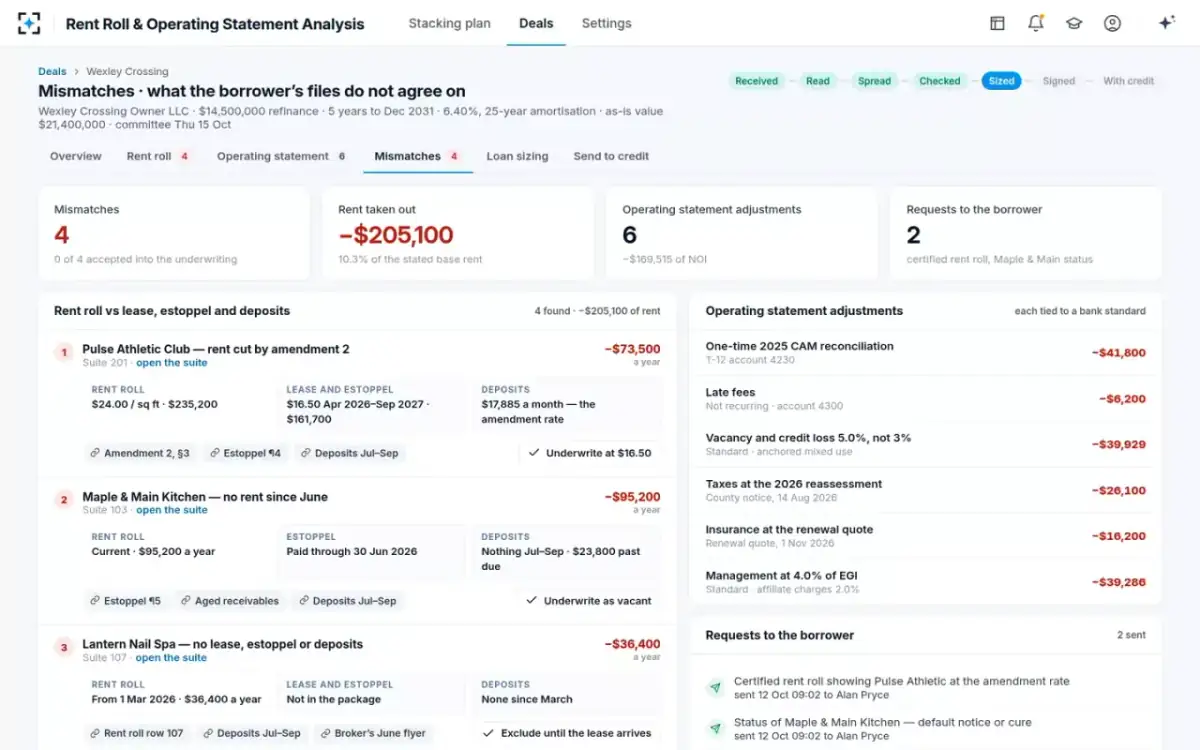
Where an amendment has changed the rent, underwrite the rent in force: Pulse Athletic Club at $161,700, with the later step back to $24.00 not counted. Where a tenant has stopped paying, underwrite the suite as vacant until it cures: Maple & Main Kitchen, $95,200 out, and a default notice, cure or re-letting plan as a condition. Where a tenant has no lease, exclude it until the lease, a signed estoppel and a first deposit arrive: Lantern Nail Spa, $36,400 out, with a request to the sponsor that, if met, lifts the supportable loan from $12,850,000 to $13,200,000. Where only a date is wrong, correct the date and test what it means: Northpoint Family Dental's March 2027 expiry becomes a condition for a renewal or letter of intent.
Rent Roll & Operating Statement Analysis shows every mismatch with its three sources
What a rent roll reconciliation should leave in the credit file
A reconciliation is only as useful as what it leaves behind for the reviewer and the examiner. For each suite that means the rent roll's line, the lease clause, the estoppel paragraph and the deposits relied on, the decision taken and who took it; for each gap, what was requested, of whom and when, and the answer when it came.
HUD asks the same of its multifamily lenders: the scope and results of the lease audit go in the underwriter's narrative, and the leases reviewed stay in the working papers, "which may be subject to audit." A bank's commercial file benefits from the same discipline, because the examiner's file review begins with the rent roll and the leases.
At the sample deal the file shows four mismatches, none of them accepted into the underwriting as stated, two requests sent to the sponsor's manager on 12 October, and five conditions on the spread. Every verified rent links to the file, page and passage it came from. The test of the file is simple: someone who never saw the deal should be able to open it and reach the same rent for every suite.
Every suite instead of a sample: what changes for the credit file
Checking every suite changes what the analyst's signature can mean. Under a sample, the analyst can certify that the leases audited agree with the roll. Under a full reconciliation, the analyst can certify that every rent in the spread is in force, confirmed and paid, or excluded with a reason, which is what an examiner reading the same leases will look for.
It also changes where time goes. The reading, matching and comparing are mechanical, and agents do them in the time a person takes to open the first lease. What is left for the analyst is judgement on the four suites that disagree, which is where the credit work was always meant to be. Reconciling the rent roll with the T-12 is the next step, and Rent Roll & Operating Statement Analysis shows both on one deal.
The building recoloured by what is proven
Questions people ask
What is a rent roll audit?
A rent roll audit is a check of the rent roll against the leases, and often the tenants and the payments, to confirm that the rents, dates and occupancy it states are real. Lenders call the lease part a lease audit; HUD's MAP Guide requires one on a sample of units, compared field by field with the rent roll.
Who performs the lease audit on a multifamily loan?
Under HUD's MAP Guide, the lender's approved underwriter, or an analyst or trainee acting under the underwriter's direction who does not report to the loan originator. The person who inspected has to be named in the underwriter's narrative, and the audited leases stay in the working papers.
Does every tenant need an estoppel for the reconciliation?
Not usually. Lenders set a size threshold, because chasing estoppels from small tenants costs more than it proves. The sample bank requires them from tenants of 2,500 square feet and above and proves smaller suites by their leases and deposits.
How many months of deposits should a lender check?
Three months is a common minimum, long enough to show a pattern and short enough to obtain. The sample bank checks three. Fannie Mae's multifamily rules also ask for three months of vacancy history and an aged receivables report at 30, 60 and 90 days.
What if a tenant's estoppel disagrees with the lease?
Investigate before underwriting either version. A signed estoppel binds the tenant to what it states, so a lower rent, a default or a right the lease does not show is a serious finding. The solution's agents never override a signed estoppel; they report the difference with both passages for the analyst to resolve.