The difference between a rent roll and a T12 is the difference between a promise and a history. The rent roll lists the rent each tenant is contracted to pay as of one date; the T-12, the trailing twelve-month operating statement, reports the income the property actually collected and the expenses it actually paid over the last year, usually month by month. A commercial real estate lender needs both, because the rent roll says what income should look like going forward and the T-12 says whether it has been arriving. The hard part is that they are prepared by different people, cover different periods, use different charts of accounts and almost never agree. Botminds' Rent Roll & Operating Statement Analysis was built for exactly that gap: it writes both into the bank's spreading template and reconciles them to the leases, the tenant estoppels and the bank deposits, so the analyst starts from the differences instead of the typing.
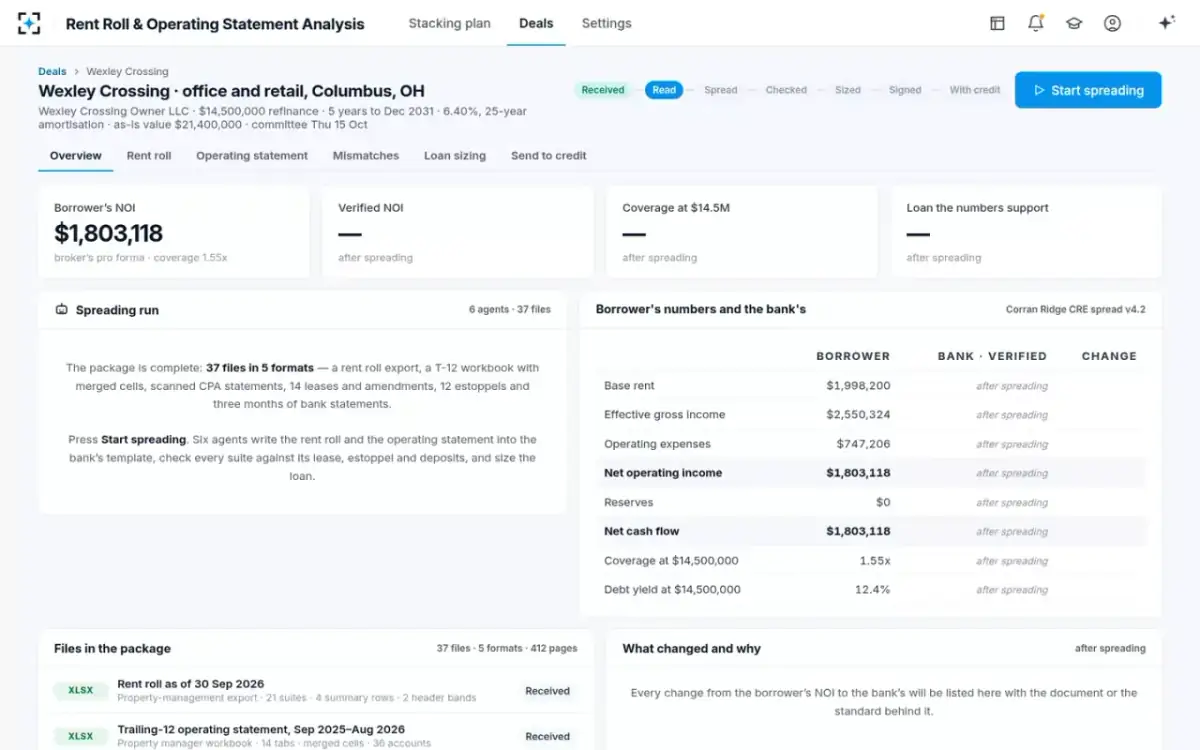
The examples follow a fictional sample deal through the solution: Wexley Crossing, a 112,500-square-foot office and retail building in Columbus, Ohio, asking for a $14,500,000 refinance. Its rent roll is dated 30 September 2026; its T-12 runs from September 2025 to August 2026.
One building, three different base rents
$1,998,200
base rent on the rent roll, as of 30 September 2026
$1,949,375
base rent the T-12 reports for September 2025 to August 2026
$1,793,100
base rent the leases, estoppels and deposits support today
What is a T12 operating statement?
A T12 operating statement is the property's income and expense statement for the most recent twelve months, laid out month by month in the property manager's own chart of accounts. It is the closest thing a lender has to the property's actual performance: rent collected, reimbursements billed, other income, and each operating expense as it was paid or accrued.
It is called trailing because it moves. A T-12 to August 2026 drops September 2025 when September 2026 closes, so a lender asks for the most recent one rather than the last calendar year. Fannie Mae's multifamily rules, the most explicit public standard on the point, ask for the prior full-year statement or at a minimum the trailing six months annualised, alongside three years of history (Fannie Mae Multifamily Selling and Servicing Guide, §203.01).
A T-12 usually arrives as a workbook built by the manager's accounting system: monthly columns, a total, dozens of accounts, often merged cells and a tab per property or per entity. The sample deal's has 14 tabs and 36 accounts. Before it can be compared with anything, each account has to be mapped to a line in the lender's template, with depreciation, interest and capital items pushed below the line.
Rent roll vs T12: what is the difference?
A rent roll answers what each tenant owes from today; a T-12 answers what the property did over the last year. One is forward-looking and contractual; the other is backward-looking and actual. Every disagreement between them is either a change that happened during the year, or an error in one of them.
The rent roll and the T-12 answer different questions
Rent roll: Who is in each suite, on what terms, paying what rent, as of one date.
T-12 operating statement: What the property collected and spent, month by month, over the last twelve months.
Rent roll: A single date. Forward-looking: contractual rent from today.
T-12 operating statement: A period. Backward-looking: income and costs already incurred.
Rent roll: Base rent in force, recoveries billed, options and arrears by tenant.
T-12 operating statement: Rent and reimbursements received or accrued, other income, credit loss.
Rent roll: None, beyond each tenant's recovery terms.
T-12 operating statement: Every operating expense: taxes, insurance, repairs, utilities, management.
Rent roll: The property manager, usually as a system export.
T-12 operating statement: The manager's accounting, sometimes reviewed by the owner's accountant.
Rent roll: Stale terms, tenants marked current who are not paying, suites with no lease.
T-12 operating statement: Cash-basis timing, one-time items in income, expenses not yet billed.
Why the rent roll and the T-12 almost never agree
They disagree because the year happened. Tenants moved in and out, rents stepped up or were cut, free-rent periods ended, someone stopped paying, the manager booked last year's common area reconciliation, and the tax bill arrived in a different month from the year before. A gap between the two is normal; an unexplained gap is the problem.
The usual reasons a rent roll and a T-12 disagree, and which one is right
| Reconciling item | What happens | Which number to underwrite |
|---|---|---|
| A rent change during the year | A step up, an amendment that cuts rent, a renewal at a new rate. The T-12 averages old and new; the roll shows only the new. | The rent in force, from the lease as amended, confirmed by deposits |
| Move-ins and move-outs | A tenant who arrived in March shows five months on the T-12 but a full year on the roll. | In-place rent for signed, paying tenants; vacant space at a vacancy allowance |
| Free rent and concessions | The roll shows contract rent; the T-12 shows little or none during the free period. | Contract rent once the concession has ended; the concession if it runs into the loan term |
| Arrears and credit loss | The roll marks a tenant current; the T-12 shows rent stopped. | Neither: the receivables and deposits decide |
| Reconciliation true-ups | Last year's common area or tax reconciliation lands in this year's income. | Exclude the one-time true-up; keep recurring reimbursements |
| Cash versus accrual timing | A tax bill paid in the wrong month makes a cash-basis T-12 look profitable. | The expense actually owed for the year, from the bill or assessment |
Worked example: why the T-12 lags the bad news
At Wexley Crossing the rent roll shows $1,998,200 of base rent and the T-12 shows $1,949,375, about $49,000 lower. That looks like a modest, explainable gap. It is actually the leading edge of a $205,100 problem.
Three things happened during the T-12's year. Pulse Athletic Club's rent was cut by an amendment from April 2026, so five months of the T-12 carry the lower rate: roughly $30,600 less than the roll. Maple & Main Kitchen stopped paying after June, so July and August are missing: roughly $15,900. Lantern Nail Spa appears on the roll from March 2026 and has paid nothing since. The first two alone account for about $46,500 of the $48,825 gap. Run the same three events forward a full year and the shortfall is $205,100.
Base rent at one building, by the document you believe
That is the general lesson. A T-12 tells you where income was on average over the last year; when something has just gone wrong it shows a fraction of it. A rent roll tells you where the landlord thinks income is today, and does not show the problem at all. Only the leases and the deposits show the run rate the loan will actually live on.
Where the $205,100 between the roll and the evidence comes from
Base rent the documents do not support
- Tenant not paying since June · 46.4%
- Rent cut by amendment · 35.8%
- No lease, no deposits · 17.8%
Which do lenders trust more, the rent roll or the T-12?
Neither, on its own. For income going forward lenders start from the rent roll, because the T-12 includes tenants who have left and misses those who have just arrived, but only after every rent on it has been tested against its lease and deposits. For expenses they start from the T-12, because the rent roll has none, and then adjust it for what is known to be coming.
The T-12 also disciplines the rent roll. If recent collections are falling, a lender should not underwrite a roll that says nothing has changed. Fannie Mae writes this into a numeric rule for multifamily, comparing trailing three-month collections with the six- and twelve-month figures; how lenders set vacancy and credit loss works the rule through. Bank lenders rarely have a rule that explicit, but the principle is the same: when the history and the promise disagree, the more cautious number is the one that has to be disproved.
Cash basis: when an operating statement overstates income
A cash-basis operating statement books income when received and expenses when paid, so it can overstate a year's profit simply because a large bill was paid in a different year. The OCC gives the standard example: a tax return for a property whose real estate taxes went unpaid in the year "would understate expenses and overstate income compared with financial statements prepared on an accrual basis. This can also be the case with operating statements that are prepared on a cash basis" (OCC Comptroller's Handbook, Commercial Real Estate Lending).
The OCC's remedy is to "compare reported expenses with expenses incurred by comparable properties, adjusted for supported variances and lease terms," because the objective is "an NOI that represents a stabilized estimate of income and expenses." In practice the check is quick: for taxes and insurance, compare the T-12 with the bill, the assessment and the policy; for repairs, compare the T-12 with the prior two years. A line far below both deserves a question before it reaches the spread.
Expenses live in the T-12, and that is where the rent roll cannot help
Every expense in a spread starts in the T-12, and the T-12 reports the past. Two of the largest lines, real estate taxes and insurance, are routinely about to change: a reassessment notice, a renewal quote. Underwriting the trailing figure for either one sizes the loan on an expense the property will no longer have.
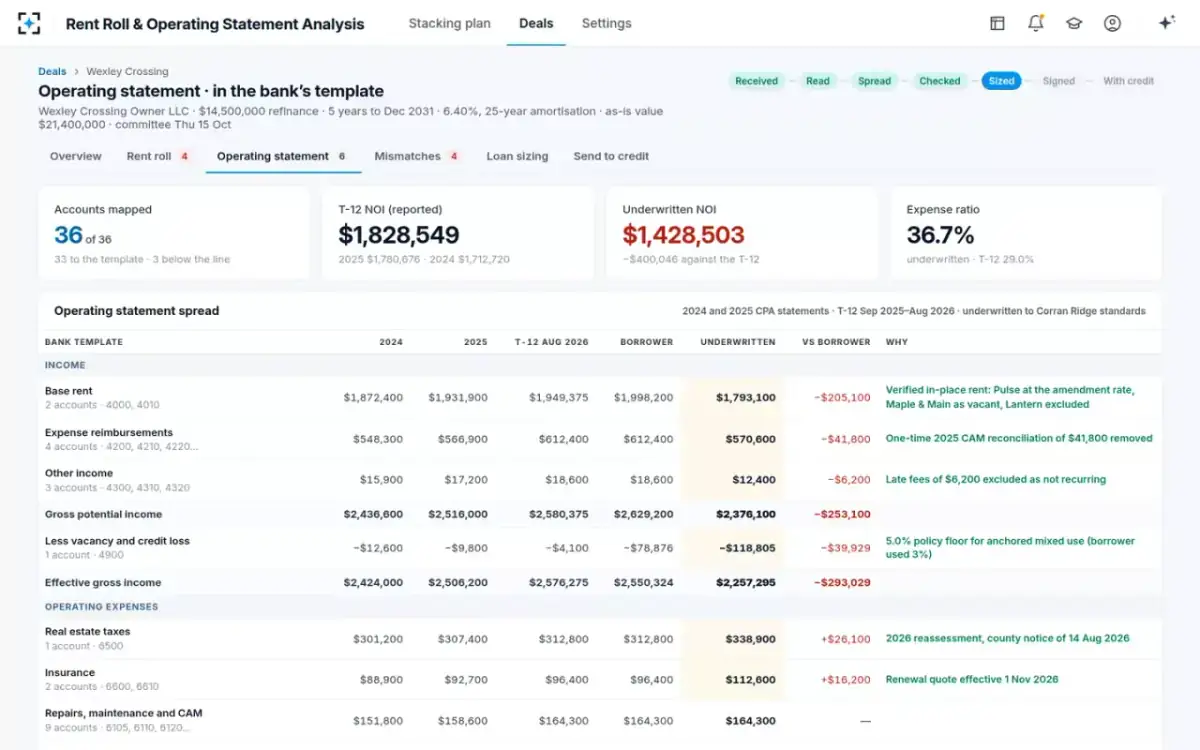
At the sample building the T-12 shows taxes of $312,800 and insurance of $96,400. The county's reassessment notice of 14 August 2026 puts taxes at $338,900, and the renewal quote effective 1 November puts insurance at $112,600. Add a management fee at the bank's standard of 4% of effective gross income and the expense ratio moves from 29.0% on the T-12 to 36.7% underwritten. None of that is visible on a rent roll; all of it changes coverage.
Rent Roll & Operating Statement Analysis: the T-12 and two years of statements in the bank's template
What if the rent roll doesn't match the T12? How to reconcile them
When the rent roll and the T-12 do not match, the lender's job is to explain every material difference and document it, not to pick one document. Fannie Mae's multifamily guide states the standard bluntly: lenders review "operating statement and rent roll updates, ensuring no inexplicable variances compared to previously provided statements," and any variance "should be investigated, reconciled, and documented" in the approval memo (Fannie Mae Multifamily Selling and Servicing Guide, §203.01). No bank regulator writes it that plainly, but an examiner reading a bank file asks the same thing.
A practical order of work follows from the reconciling items above:
First, line up the periods. Annualise the latest months of the T-12 and compare them with the rent roll's monthly billing, so a change mid-year is visible as a change rather than buried in an annual total. Second, explain rent by tenant. For each tenant, the roll's rent, the lease as amended and three months of deposits should tell one story; where they do not, the deposits usually say which document is stale. Third, pull one-time items out of income. A prior-year reconciliation true-up, an insurance recovery or a termination fee belongs in the history, not in the income the loan will rely on; the sample T-12 carries a $41,800 one-time reconciliation in reimbursements. Fourth, restate expenses to what is coming. Taxes to the assessment, insurance to the quote, management to the market or the bank's standard. Fifth, write down each difference and its reason. The reconciliation is only as good as the explanation that survives review.
The rent-by-tenant step is the one hand spreads skip, because it means opening every lease and every bank statement. It is also the step that found the whole $205,100 at Wexley Crossing; reconciling a rent roll to the leases covers it suite by suite.
Rent Roll & Operating Statement Analysis: the package as it arrives, before spreading
Once the two documents are reconciled, the result feeds one number, underwritten net operating income; what underwritten NOI means follows a rent dollar the rest of the way. To see the reconciliation run across a whole package, start from Rent Roll & Operating Statement Analysis.
Questions people ask
Is a T12 an operating statement?
Yes. A T12 is an operating statement covering the trailing twelve months, usually with a column for each month and a total. It is sometimes called a trailing-twelve or T-12 P&L; in commercial real estate it reports income and operating expenses down to net operating income, before debt service and capital items.
Is a T12 the same as a profit and loss statement?
It is a property-level profit and loss statement for a rolling year, but it stops at net operating income. Interest, depreciation, income taxes and most capital spending sit below the line, which is why a lender maps each account before using it: the sample T-12's 36 accounts mapped to 33 template lines and three below the line.
What is a T3 or T6?
A T3 or T6 is the same statement over the trailing three or six months, usually annualised. Lenders use them to see the current run rate when the twelve-month figure is out of date. Fannie Mae's multifamily rules accept a trailing six months annualised at a minimum and compare trailing three-month collections against six and twelve.
Should CAM reconciliation income be in the T-12?
The recurring reimbursements should; a true-up for a prior year should not be underwritten as ongoing income. A reconciliation of last year's common area charges booked this year is real cash but not repeatable at that size, which is why the sample spread removes a $41,800 one-time 2025 reconciliation from reimbursements.
Which is more current, the rent roll or the T-12?
The rent roll is a single date and is usually the more current document; the T-12 ends at the last month the manager closed. In the sample package the rent roll is dated 30 September and the T-12 ends in August, so a September change would show on the roll and nowhere in the history.