Rent roll AI is software that reads a borrower's rent roll, operating statements, leases and bank statements and turns them into a lender's spread. The useful kind does more than extract: it compares the sources with one another and, whenever they disagree, asks a person instead of averaging, guessing or quietly picking one. That distinction matters because the hard part of commercial real estate spreading was never typing. It is knowing that suite 201's rent was cut by an amendment, that a tenant marked current has not paid since June, that a deposit from the sponsor is not rent, and being able to show where each answer came from. Botminds' Rent Roll & Operating Statement Analysis is built that way: six agents read the package, write it into the bank's template and check every suite against its lease, estoppel and deposits; every difference becomes a question for the analyst or the borrower, and the analyst signs.
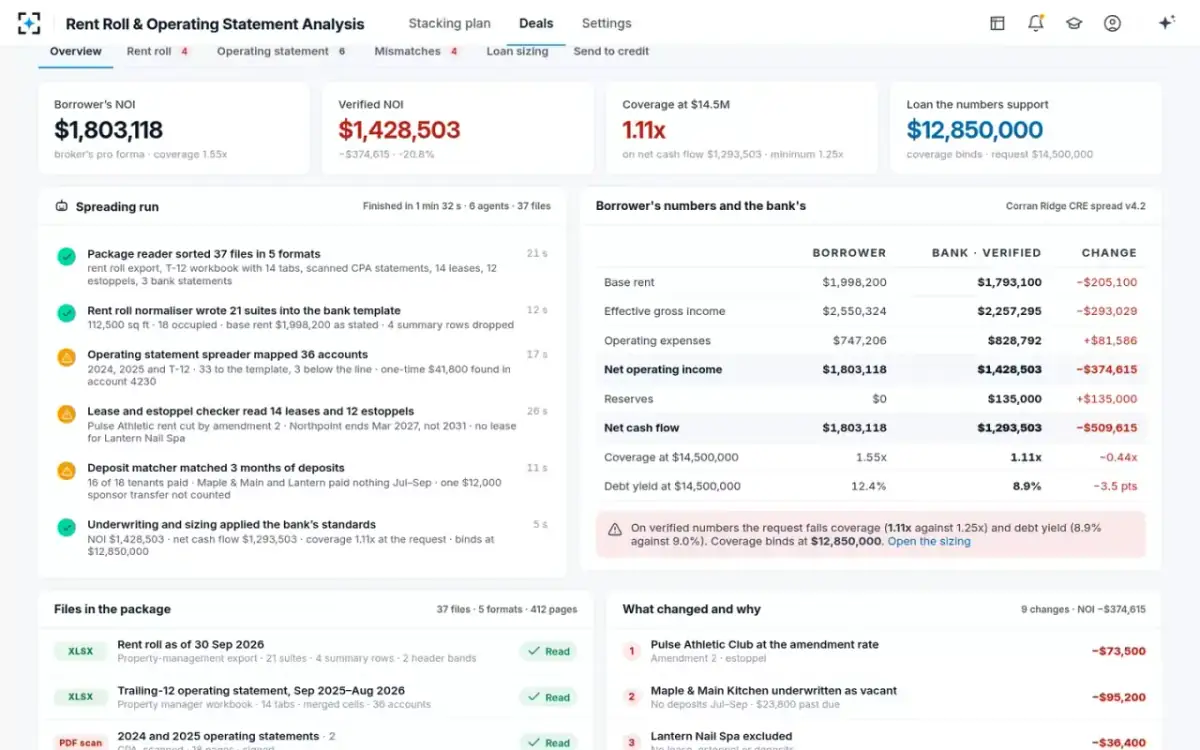
The examples come from a fictional sample deal run through the solution: Wexley Crossing, a 21-suite office and retail building in Columbus, Ohio, with a $14,500,000 refinance request.
One package, read by six agents, with four questions left for people
92s
to read 37 files in five formats and produce the spread
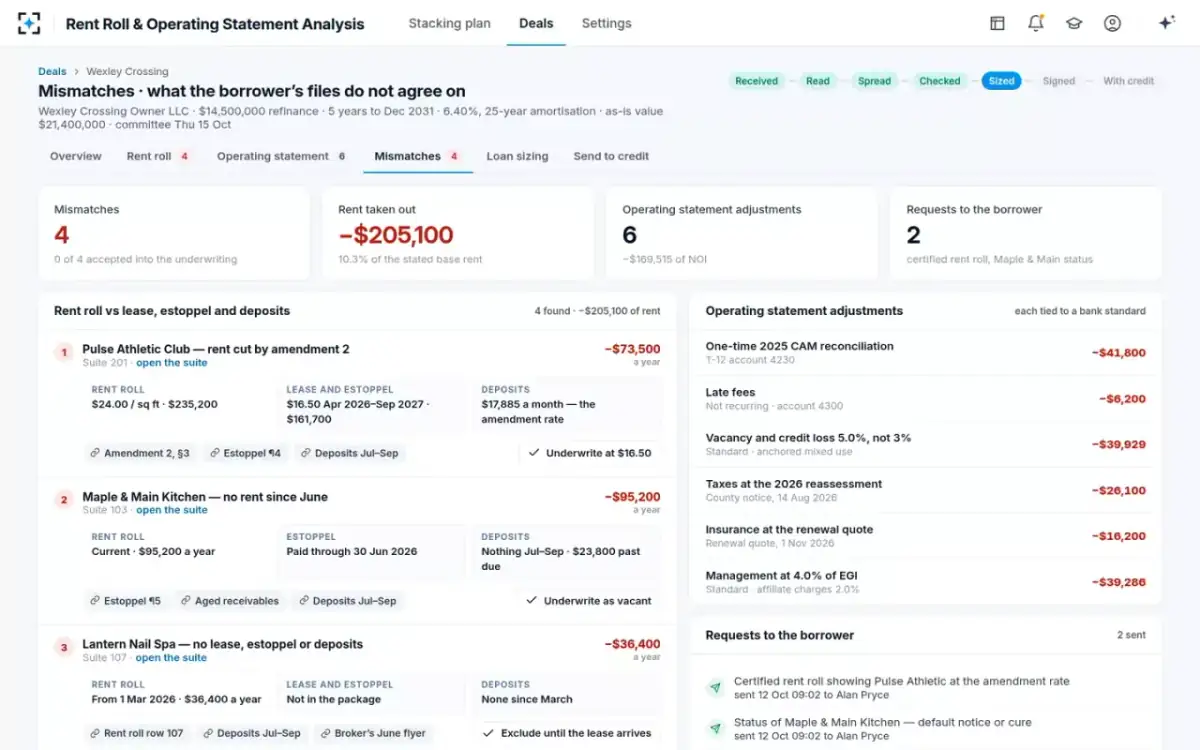
4
mismatches between the rent roll and its leases, estoppels and deposits
2
requests sent to the borrower, each a condition until answered
100%
of leased suites checked on every deal: the design target
Can AI analyze a rent roll?
Yes, for the parts that are reading and comparing, which is most of the effort; not for the parts that are judgement, which are most of the value. An AI system can read a scanned rent roll, map a manager's 36 accounts to a bank's template, find the amendment that changed a rent and match three months of deposits to tenants. It should not decide whether a tenant behind on rent will cure, whether a vacancy floor is right for this market, or whether the loan should be made.
The useful line falls between finding and deciding. At the sample deal the agents found that Maple & Main Kitchen's estoppel says rent is paid through 30 June and that no deposit has arrived since. They recommended underwriting the suite as vacant. Whether to do that, or to wait for a cure, or to make a default notice a condition, was the analyst's call, and the spread shows who made it.
OCR rent roll vs rent roll analysis: three levels of tool
"Rent roll AI" covers three quite different products, and a buyer should know which one is on offer. Extraction turns a document into data. Normalisation puts the data in the lender's own template. Verification tests the data against independent sources. Most of the risk, and most of the time saved, is in the third.
Three levels of rent roll automation, and what each leaves for the analyst
| Level | What it does | What the analyst still does | What it cannot catch |
|---|---|---|---|
| Extraction (OCR) | Reads a PDF or scan into rows and columns | Fixes misreads, removes summary rows, re-keys into the template, checks everything | Anything the document itself gets wrong |
| Normalisation | Writes each suite and account into the bank's template, drops subtotals, maps the chart of accounts | Checks the mapping, then opens every lease and statement to test the numbers | A stale rent, a tenant not paying, a missing lease |
| Verification | Compares each suite with its lease, amendments, estoppel and deposits, and each adjustment with a standard | Answers the questions the disagreements raise, and signs | Documents the package does not contain, which become requests |
Why rent roll AI should ask, not guess
Rent roll AI should ask because every number in an underwriting needs a reason a reviewer can check, and a guess has none. Fannie Mae's multifamily rules make the standard explicit for its lenders: if adjustments were made to any reviewed historical operating statement, the lender must "document and reconcile each individually adjusted line item; and provide supporting detail in the Transaction Approval Memo" (Fannie Mae Multifamily Selling and Servicing Guide, §203.01). A bank examiner reading a commercial spread looks for the same trail.
A system that resolves a disagreement by picking the more plausible number produces a spread that looks finished and cannot be defended. A system that asks produces a short list of open questions, each with both sources shown, and a spread in which every answer is attached to the person who gave it. The second is slower by the minutes it takes to answer; it is faster by every hour a reviewer would otherwise spend redoing the work.
What the agents ask, who answers, and what happens until they do
| When the sources disagree | What the agent asks | Who answers | Until answered |
|---|---|---|---|
| Rent on the roll differs from the lease as amended | Which rent is in force? Both passages and the deposits shown | Credit analyst | The amended rent the deposits support is recommended |
| A tenant shows no deposits for three months | Is the tenant paying, in default or gone? | Analyst, then the borrower | Recommended as vacant |
| A tenant on the roll has no lease in the package | Send the lease, a signed estoppel and the first deposit | Borrower, by request | Excluded from income |
| A deposit matches no tenant | What is this payment? | Analyst | Not counted as rent |
| A lease date differs from the roll | Which date is right, and what does it mean for rollover? | Analyst | The lease date is used; a condition is drafted |
| A file cannot be read | Resend this file, or confirm it is not needed | Borrower or analyst | Reported as unread, never dropped |
Who answers each question
A question is only useful if it reaches the person who can answer it. On a commercial spread that is usually the analyst, sometimes the borrower's property manager, and occasionally the senior underwriter or the chief credit officer when the answer changes a standard rather than a figure.
The people the agents' questions go to, and what changes for each
Today
Re-keys the rent roll and statements, then opens leases and bank statements if there is time.
With agents
Starts from a spread with every suite checked and answers the four questions that came out of it.
Still theirs: Every judgement on a mismatch, and the signature
Today
Gets a list of follow-up questions days into underwriting, by email.
With agents
Gets specific requests on the first day: this lease, this estoppel, this deposit.
Still theirs: Responsibility for the documents and the certified rent roll
Today
Asks "where did this number come from?" and waits.
With agents
Opens any line to its source passage and each adjustment to its standard.
Still theirs: The review, and the right to send it back
Today
Hopes the same standards were applied on every deal.
With agents
Owns the standards as versioned settings every spread uses.
Still theirs: Every change to a standard
How accurate is AI rent roll extraction?
There is no public, independent benchmark for rent roll extraction on bank commercial real estate packages, so any accuracy figure a vendor quotes is its own. The only reliable answer is a test on your own closed files, measured in a way that matches the risk.
Three measures matter, and they give very different numbers. Field accuracy counts correct cells, and is flattered by the hundreds of easy ones. Suite accuracy counts suites where every field is right, which is closer to how errors affect a loan. Dollar-weighted accuracy counts rent correctly underwritten, which is what sizes the loan; at the sample deal, three suites out of 21 carried $205,100 of rent the documents did not support, 10.3% of the total, and a fourth carried a wrong lease date. A tool can be 99% accurate on fields and miss all of it, because the rent roll it read so faithfully was wrong.
A fair test therefore includes at least one package with a known amendment, a known non-paying tenant and a known missing lease, and scores the tool on whether it raises each one as a question, not only on whether it transcribes the roll correctly.
Is AI rent roll analysis allowed by bank regulators?
Nothing in current federal guidance prohibits it, and the supervisors' framing points to how it should be used: with people accountable for decisions. The OCC's spring 2026 risk perspective describes banks taking "a measured approach to the adoption of generative AI (genAI) and agentic AI, with usage generally limited to specific use cases with guardrails and human-in-the-loop accountability to manage risk" (OCC Semiannual Risk Perspective, Spring 2026).
The model risk guidance the agencies reissued in April 2026 matters in two ways. The spreading arithmetic itself is not a model: the term "excludes simple arithmetic calculations, such as those found within spreadsheets, as well as deterministic rule-based processes" (OCC Bulletin 2026-13). And the guidance says generative and agentic AI models are novel and outside its scope, with a request for information planned. Until that arrives, a bank's own controls carry the weight: every value traced to a source, standards applied as rules a person approved, and a person who signs.
What rent roll AI should never do
Rent roll AI should never fill a missing value with a guess, treat an unmatched deposit as rent, override what a tenant signed, change a bank's standard, recommend a loan above policy or sign the spread. Each of those is a decision that belongs to a person and needs a name attached to it.
Six agents, each with a limit written down, and the person who signs
Agent
Package readerSorts every file, reads exports, workbooks and scans, and dates each one.
Never: Drops an unreadable file without saying so
Agent
Rent roll normaliserWrites every suite into the bank's template and drops summary rows, saying how many.
Never: Fills a missing value with a guess
Agent
Operating statement spreaderMaps the manager's accounts to the template for each year and the T-12; flags one-time items.
Never: Reclassifies a line without showing the mapping
Agent
Lease and estoppel checkerReads each lease and every amendment in date order, then the estoppel, against the roll.
Never: Overrides a signed estoppel
Agent
Deposit matcherMatches three months of deposits to tenants by payer and amount.
Never: Counts an unmatched deposit as rent
Agent
Underwriting and sizingApplies the bank's standards, computes NOI and net cash flow, sizes the loan, drafts conditions.
Never: Changes a standard or recommends above policy
A person decides
Credit analystAnswers the questions, accepts or changes each recommendation, and signs the spread.
Rent Roll & Operating Statement Analysis: the spreading run, step by step
How to evaluate rent roll AI before you buy
Evaluate rent roll AI on your own closed packages, scoring it on what it raises, not only on what it reads. The checklist below is what we would ask of any tool, including ours.
Ten tests for rent roll AI on your own files
- Run it on three closed packages whose problems you already know
Include an amendment, a non-paying tenant and a missing lease.
- Score questions raised, not just fields extracted
Did it find each known problem and show both sources?
- Open five numbers at random and follow them to the source passage
File, page and clause, or it is not traced.
- Remove a lease from a package and see what happens to that suite's rent
It should be excluded and requested, not kept.
- Add a deposit from the sponsor and see whether it is counted
It should not be.
- Check that it writes into your template, not a vendor format
The spread has to match your credit memo and policy.
- Check that your standards are settings, versioned, with an approver
Vacancy floors, reserves, management, sizing minimums.
- Feed it a scanned statement and a workbook with merged cells
These are the formats packages actually arrive in.
- See who signs, and what the signature says
An agent should never sign.
- Time it from complete package to signed spread, including the questions
Speed that skips the questions is not the comparison.
Where rent roll AI fits, and where it does not
It fits where packages are many, varied and document-heavy: a commercial real estate desk spreading new loans, refinances and annual reviews from borrower files, with a template and credit policy it applies on every deal. It fits less well where there is nothing to read: a single-tenant net-lease loan with one lease and no operating statement gains little from suite-level checks.
It does not replace an appraisal review, a property inspection or a site visit, and it does not make a credit decision. It also cannot verify a document the borrower never sent; what it can do is say so on the first day rather than the last. And it is only as good as the bank's standards it applies, which is why those belong to the chief credit officer, not to the software.
Rent Roll & Operating Statement Analysis turns questions into requests to the borrower
The cost case for agents against a spreadsheet template is set out in rent roll analysis in Excel or with agents, and the checks the agents run are those of a full rent roll reconciliation. To see the questions raised on a package of your own, start from Rent Roll & Operating Statement Analysis.
Questions people ask
What is the best AI for rent roll analysis?
The one that finds what your analysts would have found and shows its sources, tested on your own closed files. Look for verification against leases, estoppels and deposits, not just extraction, for your own template and standards, and for a clear rule that people sign. A tool that scores well on clean rent rolls but raises no questions on messy ones is the wrong one.
Can AI read a scanned rent roll?
Yes. Current document AI reads scanned PDFs, photographed pages and spreadsheets with merged cells. What it reads still has to be checked: a scanned roll can be read perfectly and still be wrong about the tenants, which is why reading is the first step, not the last.
Is lease abstraction AI the same as rent roll AI?
No. Lease abstraction summarises each lease's terms, usually for a landlord's portfolio. Rent roll analysis for a lender uses those terms to test a borrower's rent roll and operating statement and to size a loan. The lease reading is shared; the purpose and the output differ.
Does rent roll AI replace the credit analyst?
No. It replaces the re-keying and much of the document checking, which moves the analyst's time to the mismatches and the credit judgement. The analyst still answers the questions, accepts or changes each adjustment, and signs the spread; the senior underwriter reviews and the credit officer decides.
Does rent roll AI need our template and credit policy?
It should. A spread in a vendor's format has to be re-keyed into the bank's, and standards the tool decides for itself are standards no one at the bank approved. In the solution the template and every standard are settings, versioned and changed only on the chief credit officer's approval.