Underwritten NOI means the net operating income a lender is prepared to size a loan on: the property's income with its proven leases in force and a normal vacancy allowed for, less the operating expenses it will actually bear, including some that are imputed whether or not the owner pays them in cash. It is usually lower than the NOI the borrower presents, because the borrower shows the property at its best and the lender underwrites the property that has to carry the debt for years. Getting from one to the other is the core of commercial real estate credit work, and it is slow because every step needs a document: the lease for the rent, the deposits for the payment, the assessment for the taxes, the quote for the insurance. Botminds' Rent Roll & Operating Statement Analysis builds that bridge on every deal, writing the borrower's rent roll and operating statements into the bank's template and attaching a reason and a source to each adjustment.
The figures follow a fictional sample deal through the solution: Wexley Crossing, a 112,500-square-foot office and retail building in Columbus, Ohio, refinancing $14,500,000 over five years at 6.40% on a 25-year amortisation.
The borrower's NOI and the bank's, on one building
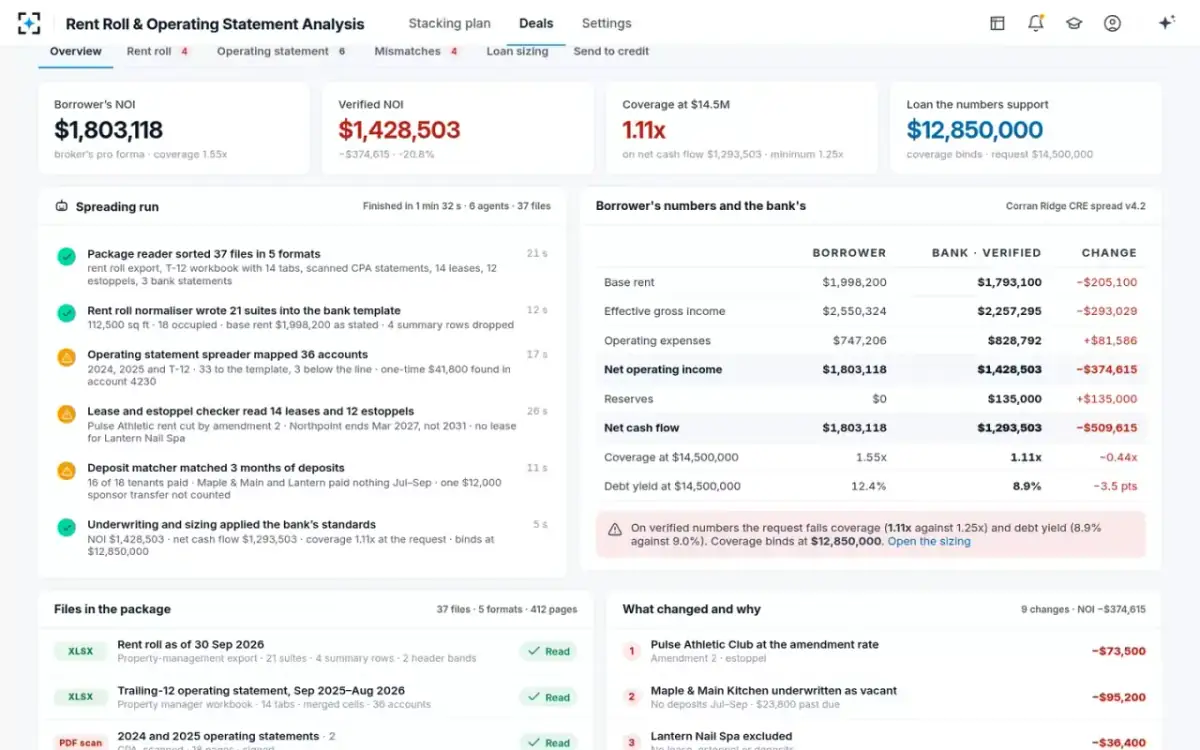
$1,803,118
NOI on the broker's pro forma, coverage 1.55x
$1,428,503
underwritten NOI, 20.8% lower
$1,293,503
underwritten net cash flow, after reserves
1.11x
coverage at the requested loan, against a 1.25x minimum
What does underwritten NOI mean?
Underwritten NOI is a lender's stabilized estimate of a property's annual income less its operating expenses, built from documents the lender has tested rather than taken from the borrower. "Underwritten" means the lender has made its own adjustments, applied its own standards and is prepared to defend each one; "NOI" means income after operating costs but before debt service, capital items, depreciation and income taxes.
Three adjustments recur. Income is cut to what is in force and proven, then reduced by a vacancy and credit loss allowance. One-time items come out. Expenses are restated to what the property will pay next year, not what it paid last year, and include items like a management fee even when the owner manages the building itself. Below NOI, a reserve for replacing capital items turns it into net cash flow, the figure coverage is usually tested on.
Follow one rent dollar: from contract rent to coverage
The clearest way to see what underwriting does is to follow income line by line from the rent roll to the coverage ratio. Fannie Mae's multifamily guide sets out the chain in a fixed table that every Delegated Underwriting and Servicing lender must use, and it is the most explicit public version of what bank lenders do less formally.
Underwritten NOI and net cash flow, line by line, as the most explicit public rulebook sets it out
| Step | What happens to the rent dollar | The rule |
|---|---|---|
| Gross potential rent | Rents in place for occupied units, plus market rent for vacant ones, from a current rent roll, times twelve | Fannie Mae §203.01, item 1 |
| Less vacancy, concessions and bad debt | Together at least 5% of gross potential rent, or the shortfall in recent collections if larger | Fannie Mae §203.01, items 4–6 |
| Plus other income | Only income that is stable, common in the market and supported by prior years; one-time items excluded | Fannie Mae §203.01, item 7 |
| Equals effective gross income | The income the property can be expected to collect | Fannie Mae §203.01 |
| Less operating expenses | Line by line, stabilized; management at the greatest of 3% of income, the actual fee or the market fee; taxes and insurance at what is coming | Fannie Mae §203.01, items 17–19 |
| Equals underwritten NOI | Income after operating costs, before reserves and debt service | Fannie Mae §203.01 |
| Less replacement reserve | At least $200 per unit a year, whether or not the escrow is funded | Fannie Mae §203.01, item 20 |
| Equals underwritten net cash flow | The figure coverage is tested on | Fannie Mae §203.02 |
At the sample building, each dollar of gross potential income the bank accepts ends up split four ways. Five cents is set aside for vacancy and credit loss, about 35 cents goes to operating expenses, almost 6 cents to reserves for capital items and leasing costs, and 54 cents is left as net cash flow to pay the loan.
Where each dollar of underwritten gross income goes
Wexley Crossing, underwritten
- Net cash flow · 54.4%
- Operating expenses · 34.9%
- Reserves · 5.7%
- Vacancy · 5%
Underwritten NOI vs actual NOI: why the two differ on purpose
Actual NOI is what the property earned; underwritten NOI is what the lender expects it to earn on a stabilized basis, and the two are meant to differ. The OCC's commercial real estate booklet puts it directly: "Unlike cash-flow analysis, the NOI analysis may assume market vacancy rates that are above or below actual vacancy rates, and expenses that may not represent an actual or immediate cash expense, such as management fees and reserves for capital replacements" (OCC Comptroller's Handbook, Commercial Real Estate Lending).
The same passage adds a warning that matters after closing: "Debt-service coverage calculations for covenant compliance may differ from the DSCR used for underwriting and risk-rating analysis." A coverage covenant measured on actual results, with no management fee for a self-managed owner and no reserve, will read higher than the ratio the loan was approved on. The loan agreement should define which NOI the covenant uses, or the bank will be monitoring a number it never underwrote.
Four NOIs a lender meets, and what each is for
What it is: The sponsor's or broker's projection, often at full occupancy and current billing.
What a lender uses it for: A starting point and a claim to test; never the sizing figure.
What it is: What the T-12 and annual statements report, as booked.
What a lender uses it for: Evidence of performance and of expense levels; adjusted for one-time items and timing.
What it is: The lender's stabilized estimate, after verification and its own standards.
What a lender uses it for: Sizing, risk rating and the credit decision.
What it is: Whatever the loan agreement defines, tested on actual results.
What a lender uses it for: Monitoring after closing; it can read higher than underwritten NOI.
What is stabilized NOI, and why lenders underwrite it?
Stabilized NOI is net operating income at normal, ongoing occupancy and expense levels, without the distortions of a lease-up, a renovation, a one-time recovery or an unusual expense. Lenders underwrite it because a loan has to be repaid from the property's ordinary year, not its best one or its worst.
The OCC calls developing "an NOI that represents a stabilized estimate of income and expenses" an important objective of underwriting. Fannie Mae adds a test of realism: lenders should "consider if the Property can achieve the Underwritten NCF within 12 months after the Mortgage Loan Origination Date," and its expense line is "stabilized operating expenses," with "non-recurring, extraordinary expenses" left out (Fannie Mae, §203.01). An NOI the property cannot reach within a year is a pro forma, not an underwriting.
Income cuts: what a lender takes out before NOI
Before NOI, a lender removes income that is not in force, not proven or not repeatable. At the sample building that is four kinds of cut, three from the rent roll and one from the operating statement.
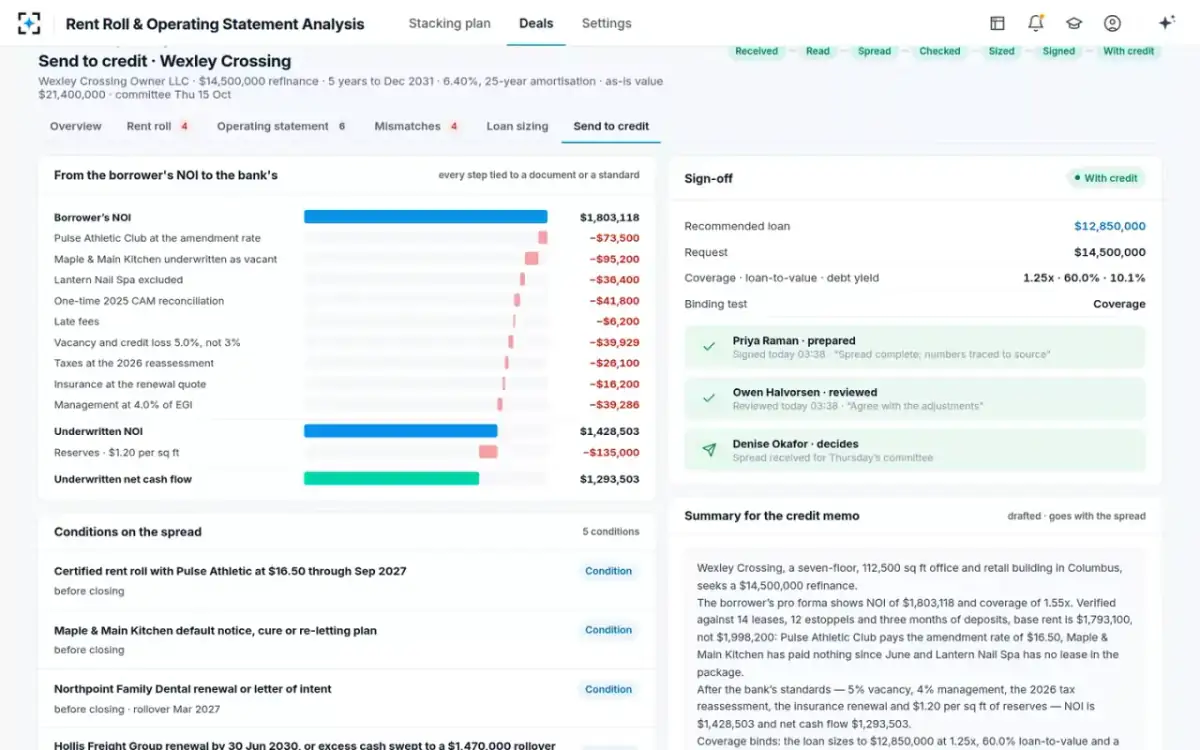
From the rent roll: Pulse Athletic Club at the rent its amendment set, $73,500 less than billed; Maple & Main Kitchen underwritten as vacant after three months without a deposit, $95,200; and Lantern Nail Spa, with no lease in the package, excluded until one arrives, $36,400. From the operating statement: a one-time 2025 common area reconciliation of $41,800 sitting in reimbursements.
Fannie Mae's other-income rule is the template for the last kind: income must "be stable; be common in the market; exclude one-time extraordinary non-recurring items; and be supported by prior years," and a list of items "must not be included," among them straight-line lease income, insurance proceeds, interest income and security deposits. For mixed-use multifamily, commercial income is cut by 10% and capped at 20% of effective gross income. One divergence is worth knowing: Fannie counts late fees as other income, while many bank standards, including the sample bank's, exclude them as not recurring. At Wexley Crossing that is $6,200, and the spread names the bank's standard as the reason, not a rule it does not have.
Expense restatements: taxes, insurance and management at what is coming
On the expense side underwriting means replacing last year's figure with next year's wherever next year's is knowable. Taxes, insurance and management are the three lines where the difference is largest and the evidence easiest to find.
For taxes, Fannie Mae requires the greatest of the next full-year bill or the prior year's taxes increased by 3%, and expected increases from a reassessment within twelve months or one triggered by the sale. For insurance, the broker's written quote for a new policy, or 105% to 110% of the current premium when the policy has under a year to run. For management, the greatest of 3% of effective gross income, the actual fee or the appraiser's market fee. The sample bank's own standards follow the same logic: taxes at the 2026 reassessment (+$26,100), insurance at the renewal quote (+$16,200) and management at 4.0% of effective gross income or the actual fee if higher (+$39,286 against the affiliate's 2.0%).
Underwritten net cash flow: the reserve that is imputed, funded or not
Underwritten net cash flow is underwritten NOI less a reserve for replacing capital items, and in office and retail also for tenant improvements and leasing commissions. The reserve is charged whether or not the owner actually funds one, because roofs, systems and re-leasing will cost money during the loan whether or not anyone saves for them.
The OCC's glossary is explicit: operating expenses "do include a reserve for replacing capital items (replacement reserve). The replacement reserve is imputed for underwriting purposes irrespective of whether it is actually funded." Fannie Mae sets the multifamily floor: "a minimum annual amount of $200 per unit," and "Replacement Reserve expense must be included whether the escrow is funded or not." The borrower's pro forma at Wexley Crossing carried no reserve at all. The sample bank charges $0.20 a square foot for replacements and $1.00 for tenant improvements and leasing commissions, $135,000 a year on 112,500 square feet.
From underwritten NOI to DSCR and debt yield
Underwritten NOI, or net cash flow after reserves, is what coverage and debt yield are measured on. The OCC defines both: the DSCR is "calculated by dividing the NOI by the annual debt service requirements," and debt yield is "the ratio of NOI to debt," a measure "independent of the interest rate, amortization period, and capitalization rate." Which numerator a bank uses, NOI or net cash flow, is a policy choice; the sample bank tests both on net cash flow.
At the requested $14,500,000, annual debt service at 6.40% on a 25-year amortisation is about $1,164,000. On the borrower's $1,803,118 that is 1.55x. On the bank's $1,293,503 it is 1.11x, below the 1.25x minimum, and debt yield is 8.9% against a 9.0% minimum. Coverage binds: the largest loan the net cash flow supports at 1.25x is $12,890,457, rounded down to $12,850,000.
From the borrower's NOI to the bank's net cash flow, every step
The largest cuts are not the standards. Three tenants whose rent the documents did not support account for $205,100, more than half of the $374,615 difference. That is why underwritten NOI is a verification exercise before it is an arithmetic one, and why the reconciliation of the rent roll to the leases comes first.
Rent Roll & Operating Statement Analysis: the bridge from the borrower's NOI to the bank's, sent to credit
Rent Roll & Operating Statement Analysis: the borrower's numbers against the bank's
Vacancy is the one standard that moves the most money on most properties, and the method matters as much as the percentage; vacancy and credit loss, worked three ways goes through it. To see the bridge built on a package of your own, start from Rent Roll & Operating Statement Analysis.
Questions people ask
Is underwritten NOI the same as stabilized NOI?
Usually, but not always. Stabilized NOI describes the property at normal occupancy and expenses; underwritten NOI is the lender's chosen figure, which may be stabilized, in-place or a stressed version of either. For a stabilized income property they normally coincide; for a lease-up they can be far apart, and the lender has to say which one the loan is sized on.
What is a replacement reserve per unit?
An annual allowance for replacing capital items such as roofs, boilers and parking surfaces, expressed per apartment unit in multifamily or per square foot in commercial property. Fannie Mae's multifamily minimum is $200 per unit a year, charged whether or not the escrow is funded; the sample office and retail bank charges $0.20 a square foot plus $1.00 for leasing costs.
Why is underwritten NOI lower than the borrower's NOI?
Because the lender removes rent that is not in force or not proven, takes out one-time income, applies a vacancy allowance, restates taxes and insurance to what is coming and charges a market management fee. On the sample deal those steps took the borrower's $1,803,118 to $1,428,503, 20.8% lower, and more than half of the gap was rent the leases and deposits did not support.
Does underwritten NOI include debt service?
No. NOI is measured before interest and principal, so the same property has the same NOI whatever loan it carries. Debt service is divided into NOI or net cash flow to get the debt service coverage ratio, and the loan amount into it to get debt yield.
Does a lender use the appraiser's NOI?
A lender compares its own underwritten NOI with the appraiser's, but does not simply adopt it. The appraisal's income approach capitalises an NOI into a value; the lender's NOI sizes the loan. A large gap between the two is a question for both the appraisal review and the spread.