A transfer of marketing authorization moves a registration from one holder to another, and it is a separate legal act in every market the product is sold in. Closing the acquisition does not do it. Each authorization needs its own filing, its own documents and its own waiting period, and until the regulator acts the former holder is still the holder — still the name on the label, still the recipient of the agency's letters, still responsible for pharmacovigilance. Botminds' Regulatory Due Diligence turns the registration inventory it built during the review into the transfer plan, with each market's route, clock and documents scheduled from the close date.
The plan on this page comes from a fictional sample deal: Northwind acquiring Orvelle Pharmaceuticals, 14 registrations across seven markets, close set for December 1, 2026. The companies and day numbers are demonstration data.
One acquisition's transfer plan, generated from the inventory
13
registrations move; Japan is held by a licensee and does not
1,842
archive sequences to migrate — three missing, asked of the seller
6
commitments that carry over and need a named owner
Day 118
when the last transfer lands, counting from close as Day 0
What a transfer actually changes, and what it does not
The authorization is the asset, and what moves with it is the whole legal position: the name on the approval, the duty to report adverse events, the obligation to answer the agency's questions, and every promise the former holder made to get the approval. In the United States the new owner's letter must carry its commitment to the agreements, promises and conditions the former owner made in the application — which is why the diligence checklist treats the commitment inventory as a transfer document, not a background schedule.
What does not change is the product. A transfer is not a variation: the formulation, the manufacturing sites, the specification and the indication stay where they were. Anything a buyer wants to change is a separate filing, on its own timetable, after the transfer. Teams that bundle the two — new holder and new packaging site in one submission — put the registration's clock behind the slowest element in it.
A transfer of marketing authorization: what moves, and what stays where it is
Moves with the authorization: Post-marketing requirements, commitments and any conditions attached to the approval pass to the new holder.
Stays, or needs its own filing: Their content. A new holder inherits the study and its deadline, not a chance to renegotiate it.
Moves with the authorization: The complete, up-to-date file, including supplements and the records the holder must keep.
Stays, or needs its own filing: Any gap in it, which becomes the buyer's problem on signing.
Moves with the authorization: Nothing changes by virtue of the transfer.
Stays, or needs its own filing: A new site, specification or label is a separate variation, filed after the transfer, on its own clock.
Moves with the authorization: The duty to collect and report, from the effective date.
Stays, or needs its own filing: The system behind it — safety database, qualified person, literature screening — which the buyer must have ready before, not after.
Moves with the authorization: Nothing, where a licensee holds the registration in its own name.
Stays, or needs its own filing: The licence agreement, which decides what control the buyer has. In the sample deal this is the Japan position.
How do you transfer a marketing authorisation?
In every route the shape is the same and only the mechanism differs: the outgoing holder tells the regulator it is giving up the registration, the incoming holder says it is taking it on and can carry the obligations, the regulator records or approves the change, and a date is fixed from which the new holder is the holder. What varies is whether the regulator records or must agree, how long it takes, and how much proof the incoming holder must produce.
Four routes, four clocks: the main markets in the sample deal
| Route | What is filed | The clock | When it takes effect |
|---|---|---|---|
| United States, NDA or ANDA — 21 CFR 314.72 | A letter from the former owner transferring all rights; from the new owner, an application form plus a letter giving its commitment to the former owner's agreements, the effective date, and whether it holds a complete copy of the application. | No published review period: an administrative change recorded by FDA, not an approval. | The date the new owner states as effective. |
| United States, biologics licence — CBER SOPP 8403 | Product correspondence from both parties; FDA then issues two letters, one licensing the new applicant, one revoking the product under the old licence. | No published period; CBER coordinates the revocation so that it takes place at the same time the licence issues to the new applicant. | A single date: the two letters are dated so the issuance and the revocation take effect on the same day. |
| European Union, centralised — Regulation (EC) No 2141/96 | An application to the Agency with the Annex documents, including proof the complete file has been handed over. | The Agency gives its opinion within 30 days of receiving the application; a Commission decision follows. | A date set by the Agency by mutual agreement with both parties. |
| United Kingdom — MHRA change of ownership | A change-of-ownership application for each authorization moved. | Up to 42 days to process, with a 10-working-day limit on answering any validation correction request. | When the MHRA completes the change. |
The United States: letters from both owners, and what each must say
For an application approved under an NDA or an ANDA the rule is short and the practice is mechanical. "An applicant may transfer ownership of its application. At the time of transfer the new and former owners are required to submit information to the Food and Drug Administration as follows" — the former owner files a letter giving up all rights, and the new owner files an application form together with a letter carrying three things.
The first is the commitment to the agreements, promises and conditions the former owner made. The second is the date the change of ownership takes effect — the parties choose it; nobody waits for FDA. The third catches people out: "either a statement that the new owner has a complete copy of the approved application, including supplements and records that are required to be kept under § 314.81, or a request for a copy of the application from FDA's files". A buyer that cannot truthfully make the first statement is asking FDA for the file, under a fee schedule, and that is a discovery best made in diligence rather than in the week after close.
One further duty starts on the effective date: "the new owner shall advise FDA about any change in the conditions in the approved application under § 314.70, except the new owner may advise FDA in the next annual report about a change in the drug product's label or labeling to change the product's brand or the name of its manufacturer, packer, or distributor." The label change that announces the new owner is an annual-report item; everything else runs through the ordinary supplement rules.
A biologics licence is different: two letters, one effective date
A biologics licence does not transfer under the drug-application ownership rule in 21 CFR 314.72. The route is set out in CBER's standard operating procedure on licences, which states that "changes to a U.S. License that are required due to changes to the applicant's or the product's ownership will be handled as administrative actions through product correspondence".
The mechanism is a pair of letters, not a handover: "two regulatory letters will need to be sent – a licensing letter to the new applicant that will be assuming responsibility for the product(s) transferred, and a revocation letter to the original applicant revoking the product(s) under their existing license".
The dating is what makes the plan work. "The letters to the new applicant and original applicant will be dated so that the new license issuance and old license revocation is effective on the same date." There is no window in which the product is licensed to both parties, and none in which it is licensed to neither — which is why the two parties' submissions are best prepared together rather than filed whenever each party is ready.
The European Union: an application, a 30-day opinion, an agreed date
A centrally authorised medicine moves under a regulation written for the purpose, and here the regulator does more than record the change: it forms an opinion. The clock is explicit.
The Agency shall submit, within 30 days following receipt of an application within the meaning of Article 3 (2), an opinion concerning this application to the holder of the marketing authorization, to the person to whom the transfer shall be granted and to the Commission.
Commission Regulation (EC) No 2141/96, Article 4
The grounds for refusing are narrow — reassuring for a planner, a trap for anyone who files carelessly. The opinion "can only be unfavourable if the documents submitted in support of the application are incomplete or if it appears that the person to whom the transfer shall be granted is not established within the Community". The two ways to lose 30 days are an incomplete annex and an acquiring entity not established in the Union; both are avoidable at signing and neither is fixable quickly afterwards.
The effective date is negotiated rather than imposed: "the date on which the transfer actually takes place shall be set by the Agency by mutual agreement with the holder of the marketing authorization and the person to whom the transfer is to be granted". That lets an integration office align the European date with the artwork and supply changes that follow it, rather than landing in the middle of them.
What documents are needed to transfer a marketing authorisation?
Each route has its own list, and across all of them the same two items are the ones that hold plans up: the proof that the incoming holder has the file, and the proof that the incoming holder can carry a holder's duties. The European annex states both plainly.
The documents a transfer needs, and the two that plans most often forget
- The outgoing holder's letter or application
In the United States, a letter stating that all rights have been transferred; elsewhere, the outgoing holder's part of the transfer application.
- The incoming holder's letter, with the effective date
The commitment to the former holder's agreements, promises and conditions, and the date the change takes effect.
- Proof that the file has been handed over
The European annex asks for "a document certifying that the complete and up-to-date file concerning the medicinal product or a copy of this file has been made available to or has been transferred to the person to whom the transfer is to be granted". The United States asks the equivalent question as a statement or a request for FDA's copy.
- Proof that the incoming holder can be a holder
The annex requires the incoming holder to "provide documents showing his capacity to perform all the responsibilities required of a marketing authorisation holder under Community pharmaceutical legislation" — establishment, pharmacovigilance, qualified person, batch release.
- Current product information
The approved labelling as it stands, so the regulator moves the authorization as approved rather than as the parties remember it.
- Fees, where the route charges them
The United Kingdom charges a fee, and the MHRA says the full fee is charged even on an application it cancels for a late reply.
- Evidence of the corporate change itself
Where the route asks for it, the instrument that effected the sale, showing the outgoing holder had the rights it gives up.
The United Kingdom and other national routes
The United Kingdom runs its own change-of-ownership procedure, with a published processing period and an unusually sharp penalty for slow replies. The MHRA states that "the application can take up to 42 days to process during which we may contact you with a Validation Correction Request (VCR) for information", and then: "if you don't respond within 10 working days we will cancel your application and you will be charged the full fee."
Ten working days is easy to lose after a close, when the people who prepared the file have moved to the next market and nobody owns the inbox the correction request lands in. The answer is unglamorous: a named owner per market, with a deputy, from Day 0 — which is what the sample deal's Day 1 checklist is for.
Canada, Switzerland and Australia each have their own procedure and documentary expectations, and belong in a plan as separate lanes with separate owners rather than as one "rest of world" workstream. One market does not move at all: the Japanese approval is held by a licensee in its own name, so the buyer acquires a contract rather than a registration.
The transfer plan, generated from the inventory and waiting for one approval
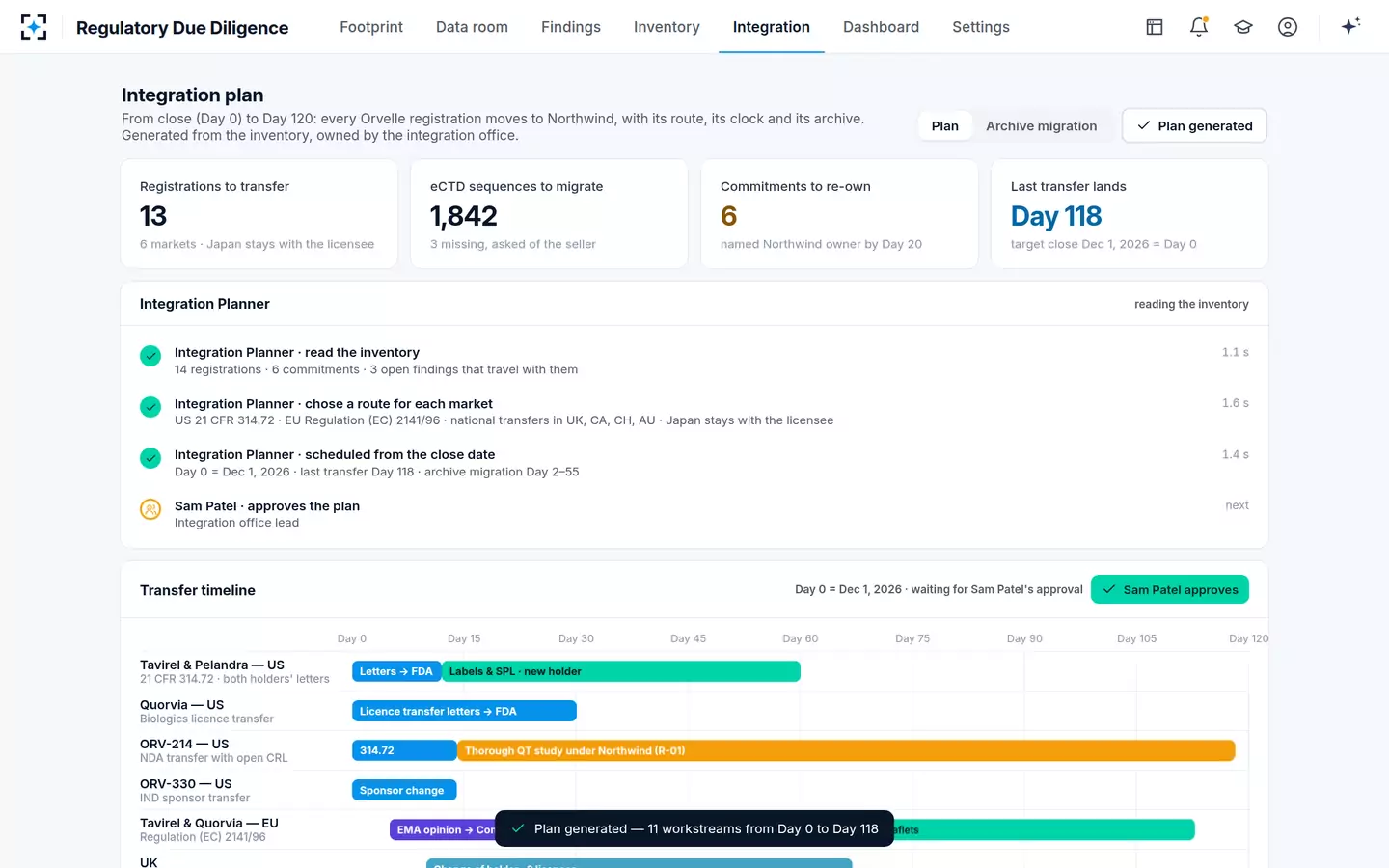
The same close date, six different clocks
- Letters to FDA12 d
- Labelling, new holder30 d
- Coordinated licence letters27 d
- Agency opinion30 d
- Decision, agreed date30 d
- Leaflets and artwork30 d
- Filed from Day 15wait
- MHRA processing42 d
- Canada, Switzerland, Australiato Day 90
- Study required by the decision letter118 d
The archive nobody budgets for: eCTD sequences and the complete up-to-date file
Behind every registration sits its lifecycle: the original application and every sequence filed since. The buyer needs all of it, because the next submission in that market builds on the last one, and because both the American and the European routes ask the incoming holder to state that it has the complete file.
In the sample deal that is 1,842 sequences to migrate, and three cannot be found. Three out of 1,842 is a rounding error until you notice which product they belong to and that the gap sits in the middle of its lifecycle. It was raised during the review and went to the seller as a question, which is the right time for it; found after close, it is a reconstruction project against somebody else's filing calendar.
Two rules follow. Ask for the archive index early, not the archive: a list of sequences with their numbers and dates is small, quick to produce and immediately checkable for gaps. And migrate before the effective date, because the first regulatory question the new holder gets will be answered out of that archive.
Building the plan backwards from the close date
Every clock on this page is knowable at signing. That is the argument for building the transfer plan during diligence rather than after it: the inventory exists, the routes are published, and the only unknown is the close date, which the plan treats as Day 0 and shifts when it moves.
The sequence: list every registration with its market, holder and whether it moves; pick the route from the market and the application type; attach the documents that route needs and name who produces each; lay the clocks out from Day 0 and find the longest; give every market an owner and a deputy before Day 1. In the sample deal the last transfer lands on Day 118 and the archive migration starts in the first week, not the third month.
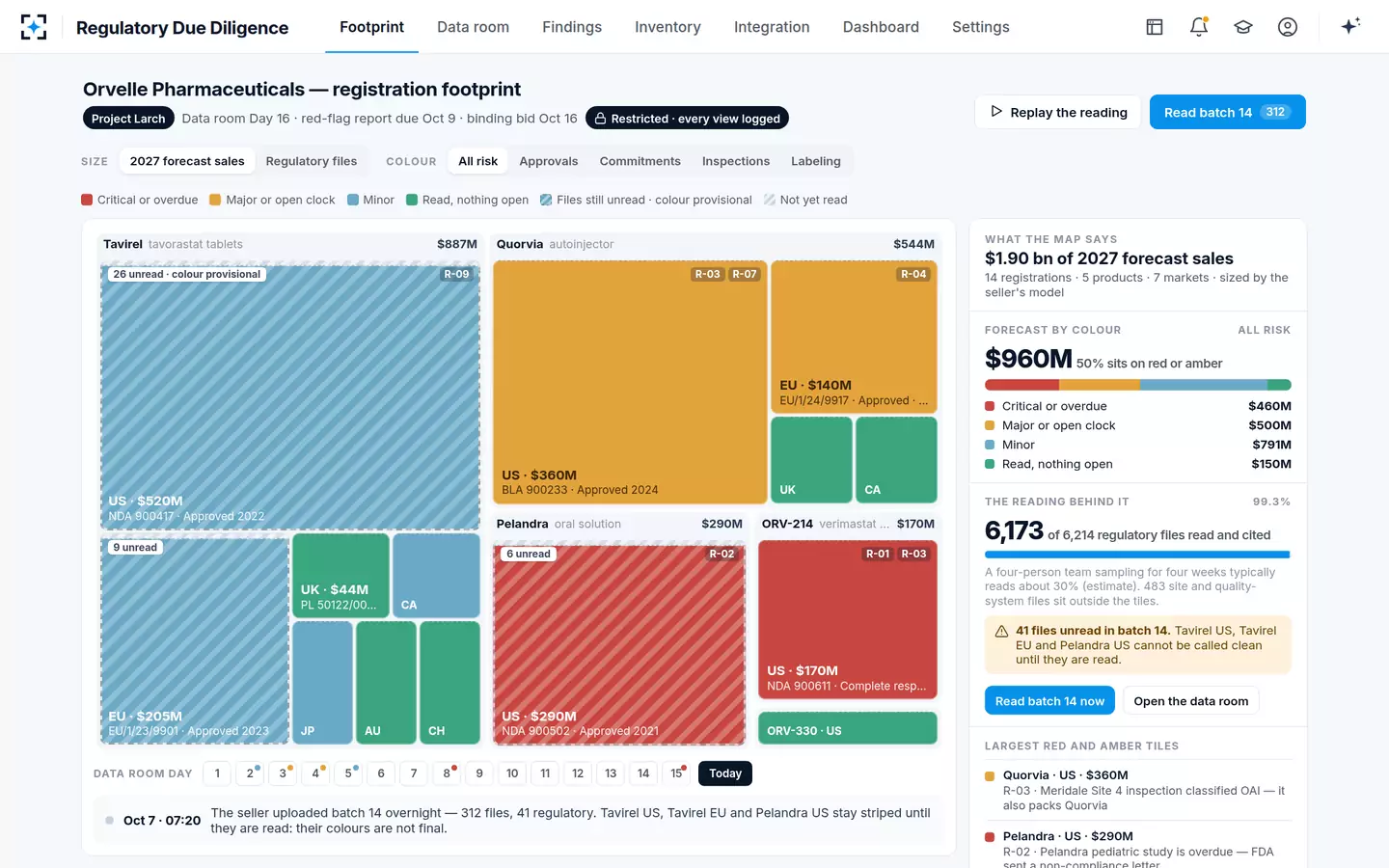
The inventory the plan is built from, product by product and market by market
One discipline belongs in the plan rather than its footnotes: nothing is filed with any regulator, and no system of the buyer's is updated, before the deal closes. Preparing the filings is work the parties may do; filing them is not. Protections for a registration still carrying an open finding sit in the red-flag report, and one whose manufacturing site is under an open classification travels with that problem attached — the subject of reading a target's inspection record.
Questions people ask
How long does a marketing authorisation transfer take?
It depends on the market. The European Medicines Agency gives its opinion within 30 days of a complete application, after which a Commission decision and an agreed effective date follow. The MHRA says a change of ownership can take up to 42 days. The United States routes publish no review period, because the change is recorded rather than approved. Plan for the slowest market.
How do you transfer an NDA to a new owner?
Under 21 CFR 314.72: the former owner files a letter stating that all rights to the application have been transferred, and the new owner files an application form plus a letter containing its commitment to the former owner's agreements, promises and conditions, the date the change in ownership is effective, and either a statement that it holds a complete copy of the approved application or a request for a copy from FDA's files.
How is a biologics license transferred?
Not under the drug-application ownership rule in 21 CFR 314.72. CBER handles ownership change as an administrative action through product correspondence and issues two letters — a licensing letter to the new applicant and a revocation letter to the original applicant — dated so that the issuance and the revocation take effect on the same day.
Does the new holder inherit the post-marketing commitments?
Yes. In the United States the new owner's letter must carry its commitment to the agreements, promises and conditions the former owner made in the application, and the other routes take the same position in their own words. A study that is behind schedule stays behind schedule; the holder's name is the only thing that changes.
Can the EMA refuse a transfer?
Only on two grounds. The regulation says the Agency's opinion can only be unfavourable if the documents submitted in support of the application are incomplete, or if the person to whom the transfer is to be granted is not established within the Community. Both are checkable before filing, which makes an unfavourable opinion an avoidable loss of a month rather than a commercial risk.
What happens to the eCTD archive after a transfer?
It comes with the registration, and both the American and the European routes ask the incoming holder to confirm it has the complete, up-to-date file. Get the archive index during diligence, check it for gaps, raise missing sequences as a question to the seller, and migrate before the effective date.